AI vs Machine Learning: The Distinction That Prevents Badly Scoped Projects From Draining Budget

Key Highlights:
- Teams write RFPs and internal specs asking for “AI” when the actual requirement is a narrower ML model, which produces vendor quotes and timelines that do not match the real problem.
- Treating AI vs ML as a scoping decision, not a definitions exercise, means naming the specific data, decision, and accuracy bar a system needs before any vendor conversation starts.
- Getting the distinction right at scoping keeps a project anchored to a buildable first release instead of an open-ended “AI initiative” that stalls once the real requirements surface mid-build.
- Sigma resolves the AI vs ML question during discovery on every engagement, matching the technical approach to the actual business decision before a statement of work is written.
Introduction:
A vendor proposal comes back asking for six figures and twelve weeks to build “an AI system” that turns out, once you read the technical appendix, to be a single classification model trained on eighteen months of support tickets. Or the reverse happens: an internal team scopes a project as “just ML” and only discovers mid-build that the business actually needs a reasoning layer, a decision policy, and an orchestration system that no single model can provide. Both mistakes trace back to the same root cause, treating AI vs ML as a vocabulary problem instead of a scoping problem. For a CTO or VP of Product deciding what to fund, build, or put out for bid, the distinction is not academic. Getting it wrong delays time-to-value, erodes efficiency gains, and creates a competitive disadvantage against peers who scoped correctly from the start.
Turn the Right AI Scope Into Faster Time-to-Value
Align the technology, data, and architecture to the business decision before development starts. Explore Sigma’s Artificial Intelligence Development Services,
Why AI vs ML Turns Into an Expensive Guessing Game in Scoping Documents
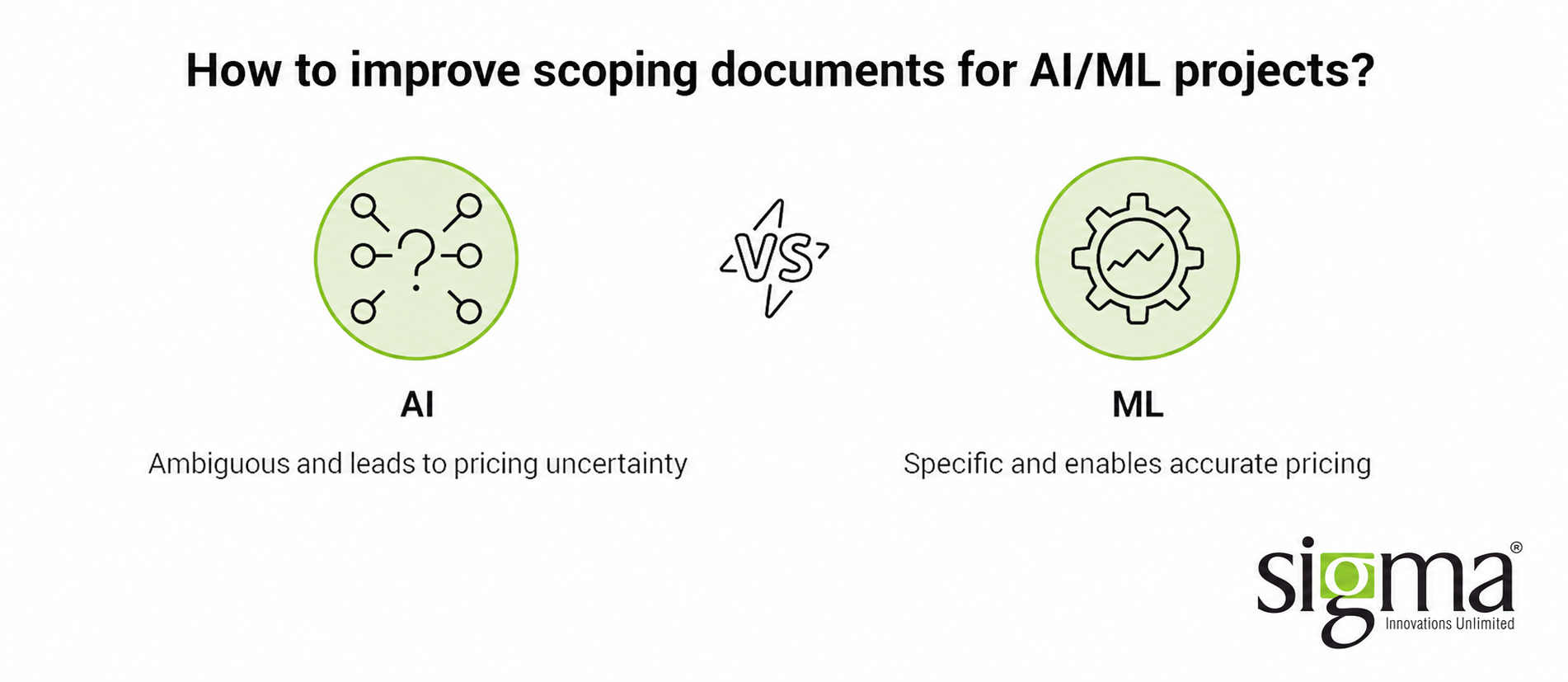
Most scoping documents use “AI” as a catch-all because it sounds ambitious and nobody wants to write a spec that undersells the project. The problem is that “AI” describes a goal, not a build. It covers everything from a rules engine dressed up with a chatbot interface to a genuinely novel reasoning system, and a vendor reading an RFP that only says “AI-powered” has no way to know which one you mean. That ambiguity gets priced in both directions. A vendor unsure whether you need a trained model or a decision tree will often quote high to cover scope-creep risk, or quote low and then negotiate change orders once the real requirement surfaces mid-engagement.
The confusion is not really about definitions. Most technical leaders can recite that machine learning is a subset of artificial intelligence in under a sentence. The failure happens at the translation step, turning that definition into a concrete statement of what the system needs to do and what “working” looks like on day one. A scoping document that says “we need AI to reduce support ticket resolution time” gives a vendor nothing to price against.
What “AI” Actually Means vs What “ML” Actually Means, for a Buyer
Textbook definitions do not help a budget conversation, so it is worth restating the distinction in terms that map to a scope of work. Artificial intelligence is the broader category: any system designed to perform a task that would normally require human judgment, reasoning, or perception. That includes machine learning, but also rule-based expert systems, symbolic logic, and increasingly, large language models used for reasoning and generation rather than prediction. Machine learning is the specific technique of training a model on historical data so it can make predictions or classifications on new data without being explicitly programmed for every case.
| Scoping Dimension | Artificial Intelligence (broad) | Machine Learning (specific) |
| What it typically means in a spec | A system goal or capability, e.g. “automate this decision” | A trained model producing a specific prediction or classification |
| Data requirement to scope for | Varies widely; some approaches need little historical data | Requires a defined, sufficiently large historical dataset |
| Typical vendor deliverable | An application, workflow, or agent built on one or more underlying techniques | A model, a training pipeline, and a validation report |
| Risk of under-specifying | Vendor builds the wrong type of system for the actual decision | Project stalls when the data needed to train the model does not exist |
| Right RFP language | Describe the business decision and desired outcome | Describe the input data, the prediction needed, and the accuracy bar |
The practical test is simple. If you can point to historical, labeled data that captures the pattern you want the system to learn, you likely have an ML problem and should scope for a training pipeline and a validation plan. If the task instead requires reasoning over unstructured information or generating content, you are more likely looking at a broader AI application, and the scoping conversation should center on guardrails and evaluation criteria rather than training data volume.
Not Sure Where AI Fits?
Find the right AI starting point in 10 days. Start an AI Discovery Sprint
How the Distinction Changes What Goes Into an RFP or Internal Spec
Once the AI vs ML distinction is settled, the scoping document changes in specific, checkable ways. An ML-scoped RFP should name the training data source, its volume and label quality, the prediction target, and the accuracy threshold that counts as success, plus what happens when the model is uncertain, since every trained model has a confidence floor below which a human needs to review the output. An AI-scoped RFP involving reasoning or generation should instead specify the decision boundaries the system must respect, the guardrails against fabricated output, and how a human reviewer stays in the loop during the early release.
This also changes how a buyer should read a vendor’s pitch. A proposal that promises broad “AI transformation” without naming the specific prediction, decision, or generation task it will deliver is a signal to ask harder questions, not a reason to be impressed. The strongest vendor responses name the exact technique and are specific about what will and will not work in the first release.
Ready to Turn AI Into a Roadmap?
Prioritize use cases, architecture, and investment. Start an AI Clarity Sprint
Where Scoping Goes Wrong: Over-Specifying and Under-Specifying
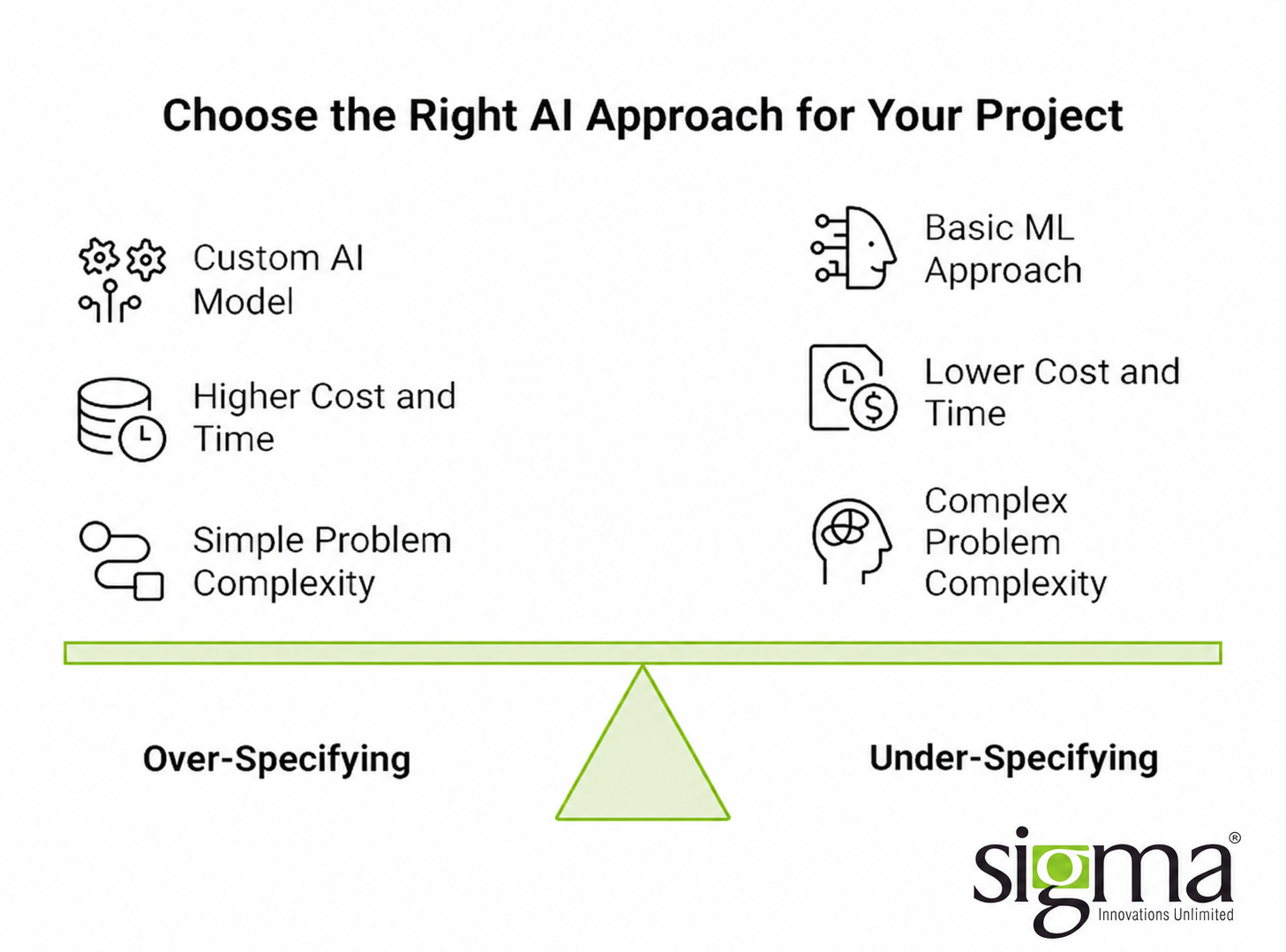
Over-specifying happens when a team demands a fully custom trained model for a problem that a simpler rules engine or an off-the-shelf language model application would solve faster and cheaper, usually from treating “AI” as inherently more impressive than a simpler approach. Under-specifying happens in the opposite direction: a team scopes a project as “basic ML” when the actual requirement- understanding open-ended customer language, reasoning across multiple data sources, generating varied output- needs a broader application architecture that a single trained model cannot provide on its own.
A useful discipline is to write the scoping document around the decision, not the technology. Name the decision a human currently makes, the data available to inform it, and the acceptable error tolerance, then let the AI vs ML classification follow from those answers rather than precede them. This keeps the conversation with any vendor or internal team anchored to a buildable outcome instead of a technology preference. The same discipline applies when evaluating whether AI tooling should touch your own engineering workflow, not just a customer-facing product.
Writing the Statement of Work Only After the Technique Question Is Settled
Every AI or ML engagement carries the same underlying risk: a mismatch between what gets proposed and what the business decision actually requires. Sigma’s engineering principle is that scoping happens before technique selection, not after. A discovery phase maps the specific decision or workflow being automated, audits what data actually exists to support it, and only then recommends whether the right build is a trained ML model, a rules-based system, an LLM-based application, or a combination, rather than defaulting to whichever approach a sales conversation implied. This shows up directly in delivery.
Sigma Infosolutions Resolves the AI vs ML Scoping Question Before Writing a Statement of Work
On a separate engagement, a specialty finance company holding thousands of unstructured customer memos needed pattern recognition applied to language that no rules engine could parse reliably. Sigma built a phased Azure OpenAI framework that reached a 100 percent accuracy match against tested customer behavior categories, proof that scoping the right technique to the right decision, rather than defaulting to the biggest possible build, is what makes an AI vs ML choice pay off in production.
Both engagements solved a different kind of problem with a different kind of technology. The case management automation used rule-based automation to route and prioritize support tickets; the memo analysis platform used a language model to interpret unstructured text at scale. Treating both as interchangeable AI would have misapplied either one, which is exactly the scoping distinction a team needs to make before writing a statement of work.
For enterprise and mid-market technology leaders evaluating AI or machine learning investment, the trade-off in over-specifying the technique before scoping the decision is a statement of work that arrives padded against ambiguity rather than matched to the real problem. Vendors quote against what is written, not against what was actually needed, which means a poorly scoped RFP produces either a budget overage or a solution that technically delivers the specified requirement but does not solve the actual business problem it was meant to address. The constraint is time: a proper scoping discipline requires a discovery phase before the RFP is written, which adds two to four weeks to the pre-project timeline.
Sigma runs an AI and machine learning scoping engagement before recommending a technique or writing a statement of work, mapping the specific decision being automated and auditing the data that actually exists to support it. If your organization is evaluating an AI or ML investment and wants to arrive at a properly scoped project rather than a vendor quote built on ambiguity, speak with Sigma’s AI and data practice to scope the discovery engagement.
Conclusion:
The AI vs ML distinction matters most at the moment a project gets scoped, not in a glossary. Artificial intelligence describes the broader goal of automating a decision that currently requires human judgment. Machine learning describes one specific technique for reaching that goal, training a model on historical data to predict or classify new cases. A scoping document that conflates the two invites vendor quotes built on guesswork, either padded to cover ambiguity or too narrow to match the real requirement. The fix is not a better definition; it is a scoping discipline that names the decision, the available data, and the accuracy bar before selecting a technique. Over-specifying a custom-trained model for a problem a simpler system would solve wastes budget and timeline. Under-specifying a broad reasoning task as basic ML stalls a project once the real complexity surfaces. Both failure modes are avoidable when the scoping document is written around the business decision rather than around whichever term sounds most ambitious. A well-scoped RFP lets any vendor, including one evaluating the work internally, quote accurately because the ambiguity has already been resolved. Technical leaders who treat this as a scoping step rather than a vocabulary lesson consistently end up with projects that ship on the timeline they were budgeted for. The distinction between AI vs ML is a tool for buying and building correctly, not a topic to master for its own sake.
Ready to Scope Your AI Project?
Align the right technology, data, and architecture before development begins. Talk to Sigma
Frequently Asked Questions
What is the actual difference between AI and ML when I’m writing a project scope?
Artificial intelligence is the broad goal of automating a task that normally needs human judgment. Machine learning is one specific technique for reaching that goal, training a model on historical data to predict new cases. In a scope document, AI describes the outcome you want, while ML describes a concrete deliverable: a model, a training pipeline, and a validation report.
How do I know if my project needs ML specifically, rather than a broader AI application?
Check whether you have historical, labeled data capturing the pattern you want the system to learn. If that data exists in sufficient volume, you likely have an ML problem suited to a trained model. If the task instead requires reasoning over unstructured information or generating varied output, you need a broader AI application, often built on a large language model.
What happens if I write an RFP that just says “AI-powered” without specifying further?
Vendors reading an ambiguous RFP cannot price it accurately, so they either pad the quote to cover scope-creep risk or underbid and renegotiate once the real requirement surfaces mid-build. Naming the specific decision, data source, and accuracy bar upfront removes that guesswork and produces quotes that reflect the actual work involved.
Is it possible to over-specify an AI project and waste budget?
Yes. Demanding a fully custom-trained model for a problem a simpler rules engine or existing language model application would solve faster is a common and costly mistake. It usually happens when a team treats “AI” as inherently more impressive than the simplest approach that actually meets the accuracy and decision requirements at hand.
How does Sigma approach the AI vs ML decision during a new engagement?
Sigma runs a discovery phase before recommending a technique, mapping the specific decision being automated and auditing what data actually exists to support it. That sequence, scoping the decision first and selecting the technique second, is what keeps the resulting statement of work matched to the real business problem rather than a generic AI pitch.