eCommerce Platform Switch: The Real Signals That Justify the Cost Versus Just Growing Pains

Key Highlights:
- Retailers risk costly, premature eCommerce migrations when they mistake fixable performance, checkout, or integration issues for platform limitations.
- Delaying a necessary switch allows structural gaps in catalog complexity, scalability, and B2B functionality to compound as the business grows.
- A structured platform assessment distinguishes operational friction from genuine architectural constraints, guiding decisions on targeted fixes versus migration.
- Sigma Infosolutions brings eCommerce engineering expertise to assess platform limitations, resolve operational issues, and plan migrations when the current platform can no longer support business needs.
Introduction
Retailers experiencing friction with their current eCommerce platform face a genuinely difficult diagnostic question: is this friction a normal, solvable operational issue, or a genuine sign the platform has structurally outgrown the business and a migration is now genuinely warranted. Confusing these two categories is costly in both directions, a retailer that migrates prematurely in response to solvable friction incurs a significant, unnecessary cost and disruption, while a retailer that dismisses a genuine structural limitation as ordinary friction continues absorbing the compounding cost of operating on a platform that can no longer support the business well or its customers. For a CTO or Head of eCommerce at a growth-stage brand, this diagnostic question directly determines whether the next engineering cycle goes toward a platform migration or toward scaling features on the current stack. Getting it right is one of the highest-leverage calls a technical leader makes in a platform’s lifecycle. Distinguishing real signals to switch eCommerce platforms from normal growing pains requires looking specifically at whether the friction is structural, tied to the platform’s fundamental architecture and capability ceiling, or operational, solvable through configuration changes, process improvements, or targeted development work within the existing platform and current team structure, without a larger, riskier commitment of budget, time, and sustained team attention.
Identifying Real Signals to Switch eCommerce Platforms vs. Operational Friction
Operational friction, a checkout flow that could be streamlined, a slow-loading page that needs optimization, an integration that needs better configuration, is almost always solvable within the current platform through focused development work, and treating it as a reason to migrate wastes significant budget on a problem the current platform never actually caused. Structural friction is different in kind: it is the platform’s fundamental architecture reaching a genuine ceiling, a catalog complexity the platform cannot represent without extensive custom workarounds, a transaction volume the platform cannot reliably handle, or B2B requirements the platform has no credible path to support natively at scale.
Reading the Catalog Complexity Ceiling Signal
A genuine catalog complexity signal appears when representing the business’s actual product structure, pricing rules, or B2B requirements within the current platform increasingly requires custom development that grows more fragile and expensive with each new addition, rather than becoming easier as the team gains platform experience. This is distinct from a single complex feature request that a competent, experienced development team can implement reasonably within the existing platform; the signal is a pattern of increasingly difficult, expensive customization across multiple areas of the catalog, suggesting the platform’s underlying data model no longer matches the business’s actual structure or growth trajectory.
Reading the Performance and Scale Ceiling Signal
A genuine performance ceiling signal appears when the platform cannot reliably handle current or near-term traffic and transaction volume despite reasonable optimization effort, technical infrastructure investment, and experienced development attention, rather than reflecting a specific, fixable performance issue in one part of the site. A retailer whose performance problems resolve meaningfully after a focused optimization engagement was experiencing operational friction, not a structural signal; a retailer whose performance problems persist despite genuinely thorough optimization work is looking at a real architectural ceiling the current platform cannot be optimized past. The distinction matters because the fix for each is entirely different: one is a development project within the existing platform, the other is a much larger decision about the platform itself.
Comparing Structural Signals to Operational Friction
| Friction Type | Operational (Solvable) | Structural (Migration Signal) |
|---|---|---|
| Root Cause | Configuration, process, or code issue | Platform architecture ceiling |
| Resolution Path | Targeted development or process fix | Requires a different platform |
| Pattern Over Time | Improves with focused effort | Persists or worsens despite effort |
| Cost of Ignoring | Ongoing inefficiency | Compounding structural limitation |
Reading the Team Capacity and Cost Signal
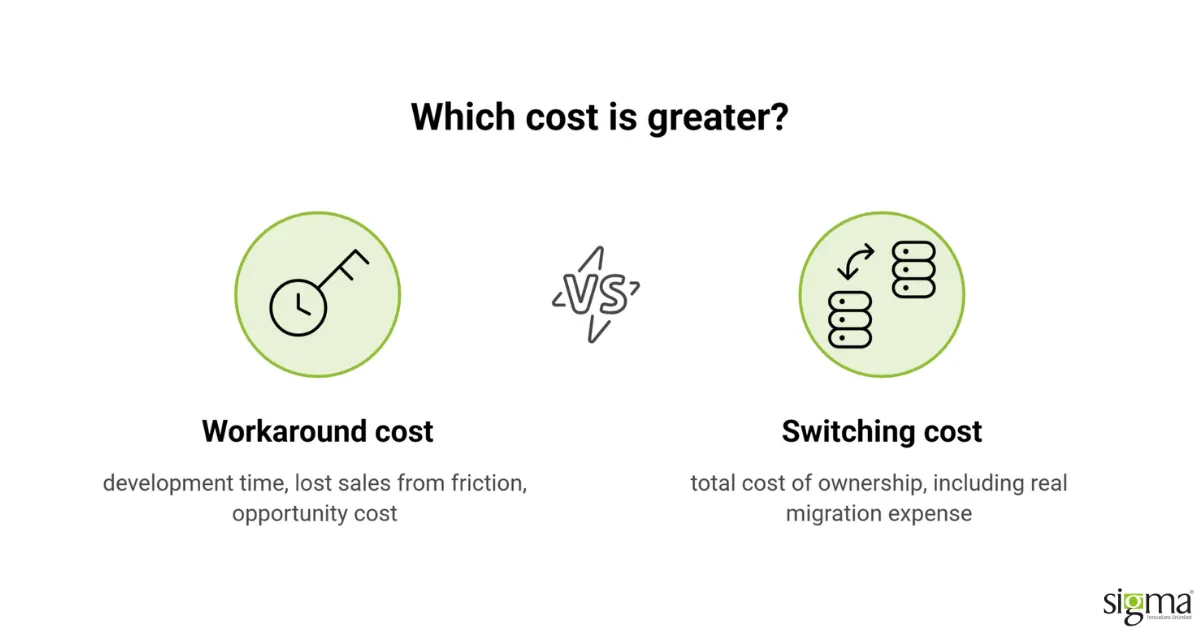
A genuine cost signal appears when the ongoing cost of maintaining and working around the current platform’s limitations, measured honestly across development time, lost sales from friction, and real opportunity cost, has grown to exceed what a genuine total cost of ownership comparison shows a better-fitting platform would cost, including migration expense. This calculation requires the same rigor as an initial platform selection decision, since an emotional sense that the current platform is frustrating is not the same as a rigorous cost comparison showing that switching would genuinely be cheaper over a realistic ownership horizon and growth curve.
That diagnostic distinction, correctly identifying whether friction is solvable within the current platform or genuinely structural, is exactly the discipline that prevents both a premature migration and an overdue one.
The Platform Friction Diagnostic Sigma Runs Before Any Migration Decision
Sigma Infosolutions helps retailers diagnose whether platform friction reflects a genuine structural limitation or a solvable operational issue, before recommending either a targeted fix within the current platform or a full migration to a genuinely better-fitting alternative platform. That diagnostic work has saved clients from unnecessary migrations where the actual issue was solvable configuration or process friction, and has confirmed genuine structural signals where the current platform truly could not support the business’s continued growth and expansion plans.
Retailers that go through this diagnostic process before deciding consistently avoid the considerable cost of an unnecessary migration while still catching genuine structural signals before they become an urgent, forced decision made under significant pressure.
Planning the Migration Once a Genuine Signal Is Confirmed
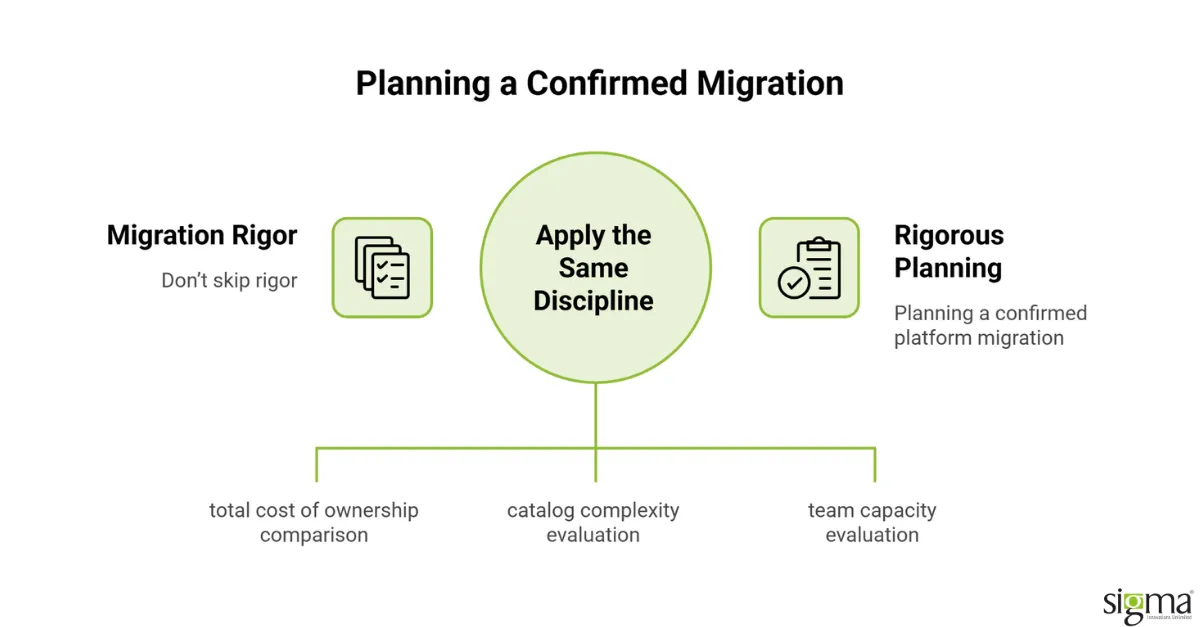
Once a genuine structural signal is confirmed, the migration itself deserves the same careful planning as any major platform transition, including a realistic total cost of ownership comparison across the platforms genuinely being considered, and a clear-eyed evaluation of catalog complexity and team capacity against each option, rather than treating the migration decision as urgent enough to skip the same disciplined evaluation that should have informed the original platform choice. Rushing this step because the signal finally feels undeniable often trades one platform mismatch for another, simply in the opposite direction, which defeats the entire purpose of having waited for a genuine structural signal in the first place.
Wrapping up:
Real signals to switch eCommerce platforms are structural, a genuine ceiling in the platform’s architecture, catalog data model, performance capacity, or B2B functionality, not the normal operational friction every growing retailer experiences at some point along the way. Operational friction, checkout flow issues, slow pages, poorly configured integrations, is almost always solvable within the current platform through focused development work, and treating it as a migration trigger wastes significant budget on a problem the platform did not actually cause. A genuine catalog complexity signal shows up as a pattern of increasingly expensive, fragile customization across multiple areas, not a single difficult feature request that a competent team can reasonably implement. A genuine performance ceiling signal persists despite thorough optimization effort and infrastructure investment, distinguishing it clearly from a specific, fixable performance issue in one part of the site. The cost signal requires a rigorous total cost of ownership comparison, not an emotional sense of frustration, weighing ongoing workaround costs honestly against what a genuinely better-fitting platform would cost including the real expense of migration. Retailers that go through a careful diagnostic process before deciding consistently avoid both an unnecessary, costly migration and a genuinely overdue one that keeps getting postponed under uncertainty. Once a genuine structural signal is confirmed, the migration itself deserves the same disciplined evaluation that should inform any major platform decision, not an urgency-driven shortcut around that same rigor. Getting this diagnostic distinction right protects a retailer from both directions of error, wasted migration spend chasing solvable friction, and prolonged operation on a platform that has genuinely outgrown the business’s real needs. The discipline that matters most here is honest diagnosis before action, treating platform friction as a question to investigate carefully rather than a feeling to react to immediately under pressure. Once a migration is genuinely warranted, the same structured platform evaluation that should guide any major commerce decision applies just as much to a forced transition as it does to a first-time platform choice. Retailers who internalize this distinction carry it forward into every future platform decision, not just the one currently in front of them.
Make Smarter eCommerce Technology Decisions
Resolve platform challenges, extend capabilities, and plan for growth with the right engineering approach.
Frequently Asked Questions
How can a retailer tell if platform friction is operational or structural?
Structural friction persists or worsens despite genuinely thorough optimization and development effort, while operational friction typically resolves meaningfully after a focused fix. A pattern of increasingly expensive, fragile customization across multiple catalog areas is a stronger structural signal than a single difficult feature request from one department.
Is slow page performance always a signal to switch platforms entirely?
Not usually. Most performance issues are solvable through optimization, infrastructure investment, and focused development work within the current platform. A genuine performance ceiling signal only appears when these efforts fail to resolve the issue despite reasonable, sustained investment and effort over a meaningful period of time.
How much more expensive does a platform need to become before switching makes sense?
This depends on the specific total cost of ownership comparison, but the calculation should include ongoing workaround development costs and lost sales from friction, not just the visible hosting and license costs, compared honestly against a genuine alternative’s full cost including its own real migration expense and disruption.
Can a retailer avoid this diagnostic problem entirely by choosing the right platform initially?
Largely, yes, since a platform chosen through a structured evaluation of catalog complexity, growth trajectory, and team capacity is less likely to hit a genuine structural ceiling early. Some ceiling is still possible as a business grows well beyond its original planning assumptions over time.
What is the biggest risk of migrating platforms in response to operational friction?
The biggest risk is spending significant budget and disruption on a migration that does not actually resolve the underlying issue, since operational friction rooted in configuration or process problems persists on a new platform unless the actual root cause is properly addressed and resolved first.