Magento B2B Commerce Features: Which Ones to Prioritize Before a Missed Release Costs You Revenue

Key Highlights:
- Implementing every Magento B2B feature at once can delay launch and prevent sellers from addressing the buyer needs that matter most to early revenue.
- Poor feature prioritization can increase development scope and leave sellers investing in complex workflows that their current B2B customers may not need.
- A phased Magento B2B rollout prioritizes account-based pricing, streamlined reordering, and essential approval workflows before expanding to more complex capabilities as buyer needs evolve.
- Sigma Infosolutions helps eCommerce businesses prioritize Magento B2B commerce features around actual buyer workflows, available technical resources, and long-term growth plans.
Introduction
Growth-stage sellers expanding into B2B commerce on an existing Magento store frequently approach the platform’s B2B feature set as a checklist to implement in full, company accounts, negotiated quoting, tiered pricing, requisition lists, and approval workflows, rather than as a set of options to prioritize against their specific buyer workflow and go-to-market strategy. This approach extends implementation timelines considerably and often delays revenue from B2B customers who are ready to buy well before the full feature set ships. Magento B2B commerce features deliver the most value when a seller identifies which specific friction points are actually blocking B2B buyers today and builds toward those first, treating the remaining functionality as a phased roadmap rather than a single all-or-nothing launch the team is not actually staffed or ready to support well from day one. For a Head of eCommerce or VP of Engineering at a growth-stage company, that distinction matters significantly, since a missequenced feature build delays revenue from buyers who are ready to transact well before the full platform capability ships. The goal is identifying which capabilities unblock B2B revenue now and sequencing everything else into phases validated by real buyer demand as the customer base grows.
Understanding What B2B Buyers Actually Need First
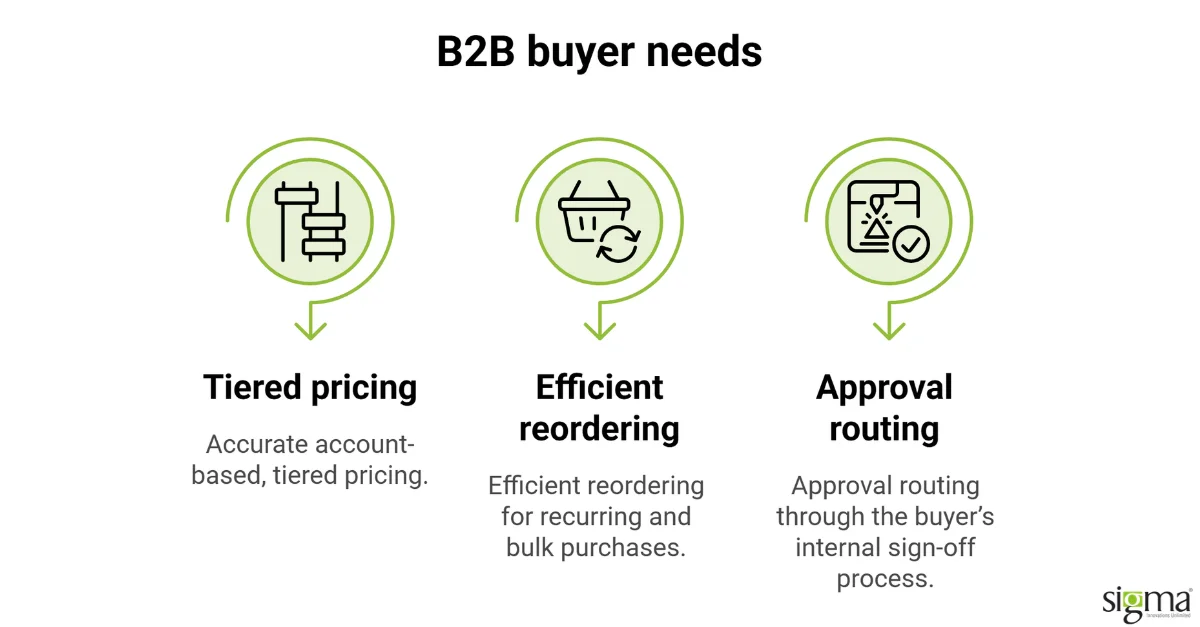
B2B buyers evaluating a new supplier’s online store typically care most about three things early in the relationship: seeing pricing that reflects their negotiated or tier-based rate rather than public list pricing, having a straightforward way to place recurring or bulk orders without re-entering the same information every time, and being able to route a purchase through their organization’s own approval process before it is finalized. These three needs, accurate account-based pricing, efficient reordering, and approval routing, tend to matter more to early B2B revenue than more sophisticated capabilities like complex quoting workflows or company-wide requisition list sharing, which become valuable later as the B2B customer base and its complexity both grow.
Why Full-Feature Launches Delay Revenue Without Adding Proportional Value
A seller that insists on shipping company accounts, negotiated quoting, tiered pricing, requisition lists, and approval workflows together before launch is effectively gating simple, high-value functionality, accurate tiered pricing, for instance, behind more complex functionality, a full negotiated quoting workflow, that most early B2B customers do not yet need. This sequencing mistake is common because the features are bundled together in Magento’s B2B feature set and easy to treat as a single implementation project, when unbundling them into a prioritized roadmap based on actual buyer need typically gets revenue-generating functionality live months earlier.
Comparing a Full-Feature Launch to a Prioritized Rollout
| Approach | Full-Feature Launch | Prioritized Rollout |
|---|---|---|
| Time to First B2B Revenue | Delayed until full build is complete | Accelerated, core features first |
| Feature Utilization | Uneven, some features unused for months | High, each phase matches real demand |
| Implementation Risk | Higher, larger single project | Lower, phased and validated |
| Team Learning Curve | Steep, all at once | Gradual, informed by real usage |
Building a Prioritization Framework for Magento B2B Commerce Features Against Actual Buyer Friction
A practical prioritization approach starts by talking directly to the sales team or the earliest B2B customers about where they currently experience friction in the ordering process, then maps that friction against Magento’s available B2B features to identify which specific capability addresses the most costly or frequent pain point. Tiered, account-based pricing typically ranks highest for sellers moving existing offline B2B relationships online, since incorrect pricing is the single fastest way to damage a B2B relationship, while requisition lists and multi-level approval workflows typically rank lower initially, since they matter most for larger buying organizations that a seller may not yet have significant volume from.
That same prioritization discipline, sequencing implementation against actual business need rather than building every available capability at once, applies directly to rolling out Magento B2B commerce features effectively.
Sequencing Requisition Lists and Approval Workflows for Later Implementation Phases
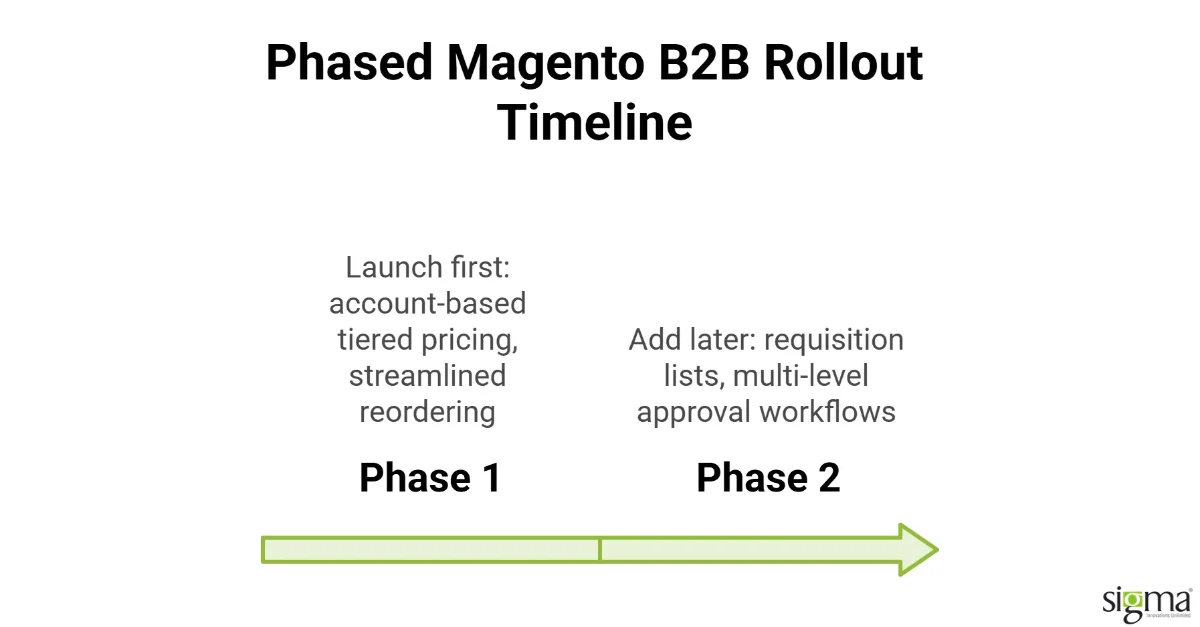
Requisition lists, letting a buying organization save and reuse common order configurations, and multi-level approval workflows, routing larger purchases through a buyer’s own internal sign-off process, are genuinely valuable capabilities but typically matter most for larger buying organizations with more complex internal purchasing structures. Sellers whose early B2B customers are smaller organizations with simpler purchasing processes can reasonably sequence these features into a later phase, prioritizing account-based pricing and streamlined reordering first, then adding requisition lists and approval routing once the buyer base grows to include organizations that genuinely need that additional structure. Waiting for this signal, rather than building the capability speculatively ahead of demand, keeps development effort aligned with buyers who will actually use the feature from launch.
The B2B Feature Gap Assessment Sigma Delivers Before Any Magento Build
Sigma Infosolutions implements Magento B2B commerce functionality for growth-stage sellers by starting with a prioritization exercise, identifying the specific friction points in a seller’s current B2B ordering process before scoping which features to build first. That approach has consistently gotten revenue-generating B2B functionality live faster than a full-feature build would, while still leaving a clear roadmap for the additional capabilities that matter as the B2B customer base grows in size and complexity.
Sellers who sequence B2B functionality this way consistently see B2B revenue start flowing months earlier than sellers who wait for a comprehensive feature set to ship in a single, larger launch across the entire store.
Also, read the blog: Why Magento / Adobe Commerce is the Ideal Platform for Omnichannel Integration
Planning for the Underlying Platform Decision Alongside the Feature Roadmap
B2B feature prioritization does not happen in isolation from the underlying platform decision, since a seller evaluating whether their current Magento version and infrastructure can support the planned B2B roadmap may also need to factor in broader platform currency and end-of-life considerations before committing significant development budget to new B2B functionality. Addressing platform currency alongside the B2B feature roadmap, rather than building extensive new functionality on a platform version already approaching its own risk threshold, avoids having to revisit the same investment again sooner than planned. This sequencing question matters more for B2B functionality specifically than for typical B2C feature work, since B2B customers tend to represent larger, less easily replaced order volume, which makes any future disruption from an unplanned emergency migration considerably more costly to the business than the same disruption would be for a purely consumer-facing storefront.
Not every B2B commerce feature delivers equal return: prioritizing all of them at once risks spreading engineering effort too thin before any single capability is fully functional. The trade-off is breadth against depth, shipping fewer features completely is usually a better investment than a wider set each left half-finished before the next release window closes.
Conclusion
Magento B2B commerce features deliver the most value when prioritized against a seller’s actual buyer workflow rather than implemented as a uniform, all-at-once bundle. B2B buyers typically care most, early in the relationship, about accurate account-based pricing, efficient reordering, and approval routing, which tend to matter more to early revenue than more sophisticated capabilities like complex quoting or requisition list sharing. A full-feature launch delays revenue-generating functionality by gating simple, high-value capabilities behind more complex ones most early B2B customers do not yet need. A practical prioritization framework starts by identifying real friction points in a seller’s current B2B ordering process, then maps that friction against available features to sequence implementation accordingly. Requisition lists and multi-level approval workflows genuinely matter, but typically rank lower in priority for sellers whose early B2B customers are smaller organizations with simpler purchasing structures. Sellers who sequence functionality this way consistently see B2B revenue start flowing months earlier than those waiting for a comprehensive feature set to ship together. B2B feature prioritization should also account for the underlying platform’s currency and end-of-life risk, since a major feature build is a natural moment to address both together rather than separately. Getting this sequencing right accelerates time to revenue while avoiding the scope creep that delays a launch by months without proportional added value in return. The right feature roadmap depends entirely on a seller’s specific buyer base and its purchasing complexity, not a generic implementation checklist applied uniformly across every account. Sellers who treat B2B functionality as a phased, prioritized rollout rather than a single comprehensive project consistently capture value faster and with considerably less implementation risk, month over month as the buyer base matures and grows more sophisticated. This same phased mindset extends naturally to the platform decisions surrounding a B2B rollout, including how a store’s underlying commerce architecture should evolve alongside its growing buyer base and order volume over time and through each stage of growth.
Frequently Asked Questions
1. Which Magento B2B feature should a seller implement first when adding B2B functionality?
Account-based, tiered pricing typically delivers the most immediate value, since incorrect pricing is one of the fastest ways to damage a new B2B relationship. Streamlined reordering for recurring purchases is usually the next highest priority for most sellers moving offline relationships online for the first time.
2. How long does implementing Magento’s full B2B feature set typically take?
A full implementation, company accounts, quoting, tiered pricing, requisition lists, and approval workflows together, commonly takes several months of dedicated development, which is why prioritizing a smaller initial feature set based on actual buyer need gets revenue-generating functionality live considerably sooner in most real-world cases.
3. Do requisition lists matter for smaller B2B buying organizations?
Less so initially, since requisition lists deliver the most value for larger organizations with complex, repeated purchasing patterns across multiple buyers and departments. Smaller organizations with simpler purchasing processes often see more immediate value from accurate pricing and streamlined reordering instead of that added structural complexity.
4. Can B2B features be added incrementally to an existing Magento B2C store without disrupting it?
Yes, and this phased approach is generally the more practical path, since it lets a seller validate each new B2B capability with real customers before committing further development budget to the next phase of the roadmap and its associated ongoing operational and support costs down the line.
5. Should a seller upgrade their Magento platform before or alongside a B2B feature build?
This depends on how close the current platform version is to its own end-of-life risk threshold. If platform currency is already a near-term concern, addressing it alongside the B2B build avoids having to revisit the same investment again shortly after the B2B rollout finally completes.