Magento Store Maintenance: Why Most Checklists Fail and How to Build One That Runs on Schedule

Key Highlights:
- Reactive Magento maintenance leaves security vulnerabilities, extension issues, and performance degradation undetected until they affect store operations.
- Without clear ownership and recurring reviews, maintenance checklists are often overlooked, while untested backups can fail when recovery is needed.
- A scheduled Magento maintenance checklist covering security, performance, extension health, and backup restoration helps teams identify issues before they escalate.
- Sigma Infosolutions provides structured Magento maintenance services with scheduled reviews, security patching, performance monitoring, and extension compatibility management to keep growing stores maintained.
Introduction
Growth-stage retailers running Magento frequently treat platform maintenance as a reactive function, applying security patches after a scan flags a vulnerability, investigating a performance issue only once a customer complaint or a bounce rate spike surfaces, and reviewing extension health only when something visibly breaks. This reactive posture is understandable given competing priorities, but it consistently costs more in the long run than a modest, recurring maintenance cadence would, since issues caught during a scheduled review are considerably cheaper and less disruptive to resolve than the same issues discovered after they have already affected customers or compliance status. A Magento store maintenance checklist run on an actual recurring schedule, not just documented and left unused, is what separates a store that stays healthy as it scales from one that accumulates quiet technical debt until something forces the issue during a peak sales period under real, mounting, and largely unavoidable pressure the team never actually wanted to face. For an IT Director or Head of eCommerce managing a growing Magento operation without a dedicated platform engineer, this gap between documented intent and actual practice is where security exposure and performance debt quietly accumulate over time. A well-structured maintenance program closes that gap by assigning clear ownership, setting a fixed cadence, and logging outcomes where the broader team can see them.
Why Maintenance Checklists Fail to Run in Practice
Most Magento maintenance checklists fail not because they are poorly designed but because nobody owns actually running them on schedule, which means a well-intentioned document gets created once and then quietly ignored as competing priorities take precedence sprint after sprint. The fix is not a more detailed checklist; it is assigning explicit ownership for running it on a fixed cadence, with the outcome logged somewhere visible, so skipped maintenance becomes an obvious gap rather than an invisible one that only surfaces once a problem has already occurred.
What Belongs in a Recurring Security Review
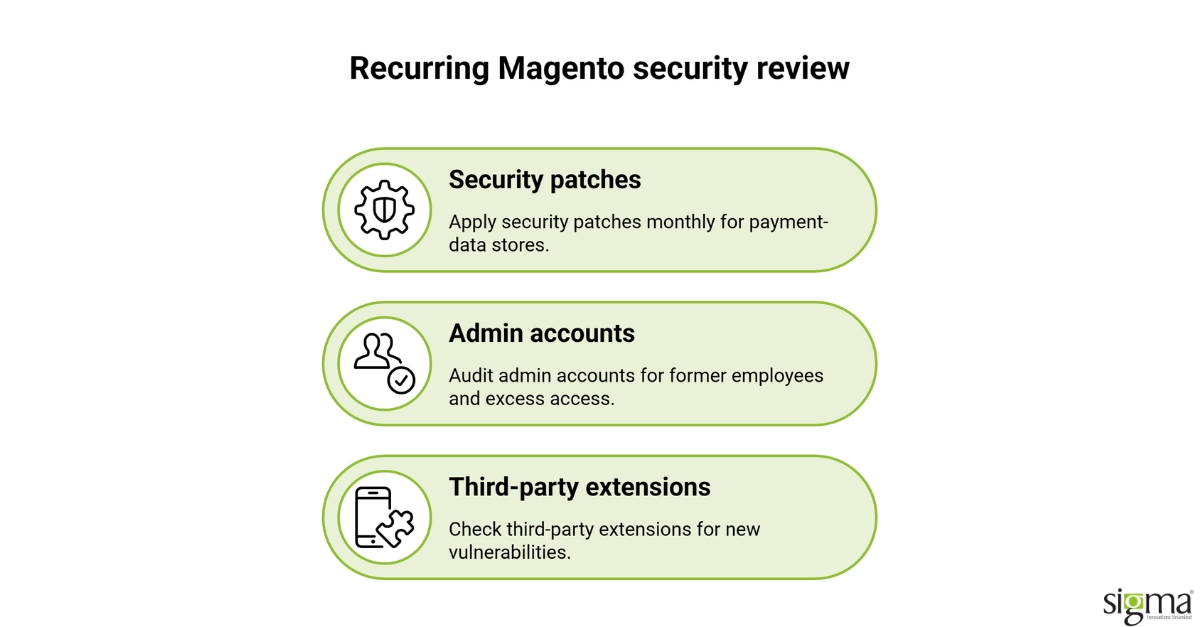
Security maintenance should include reviewing and applying available security patches, auditing admin user accounts for former employees or unnecessary access levels, and checking for any newly disclosed vulnerabilities in installed third-party extensions, since extension vulnerabilities are a common entry point that a platform-level security patch alone does not address. This review should run at minimum monthly for stores handling payment data directly, since the gap between a vulnerability’s disclosure and its exploitation in the wild continues to shrink, making a quarterly cadence increasingly risky for stores carrying meaningful PCI scope.
Comparing a Reactive Maintenance Posture to a Scheduled One
| Maintenance Area | Reactive Posture | Scheduled Recurring Review |
|---|---|---|
| Security Patching | Applied after a scan flags an issue | Applied on a fixed monthly cadence |
| Performance Monitoring | Investigated after a complaint | Benchmarked on a recurring schedule |
| Extension Health | Reviewed only when something breaks | Audited quarterly for compatibility |
| Backup Verification | Assumed working, rarely tested | Restore tested on a regular cycle |
What Belongs in a Recurring Performance Review
Performance maintenance should include benchmarking page load times against the store’s own historical baseline, not just an industry benchmark, since a gradual degradation is often more dangerous than a sudden one, quietly eroding conversion rate for months before anyone notices the trend. This review should also check database health, since accumulated log data and unoptimized indexes are a common, under-monitored source of gradual Magento performance decline that a routine review catches well before it becomes severe enough to affect the customer experience directly.
That same discipline, treating maintenance as a scheduled, recurring practice rather than a reactive response to visible problems, is the foundation a workable Magento maintenance checklist depends on.
Verifying Backups Actually Restore, Not Just That They Run
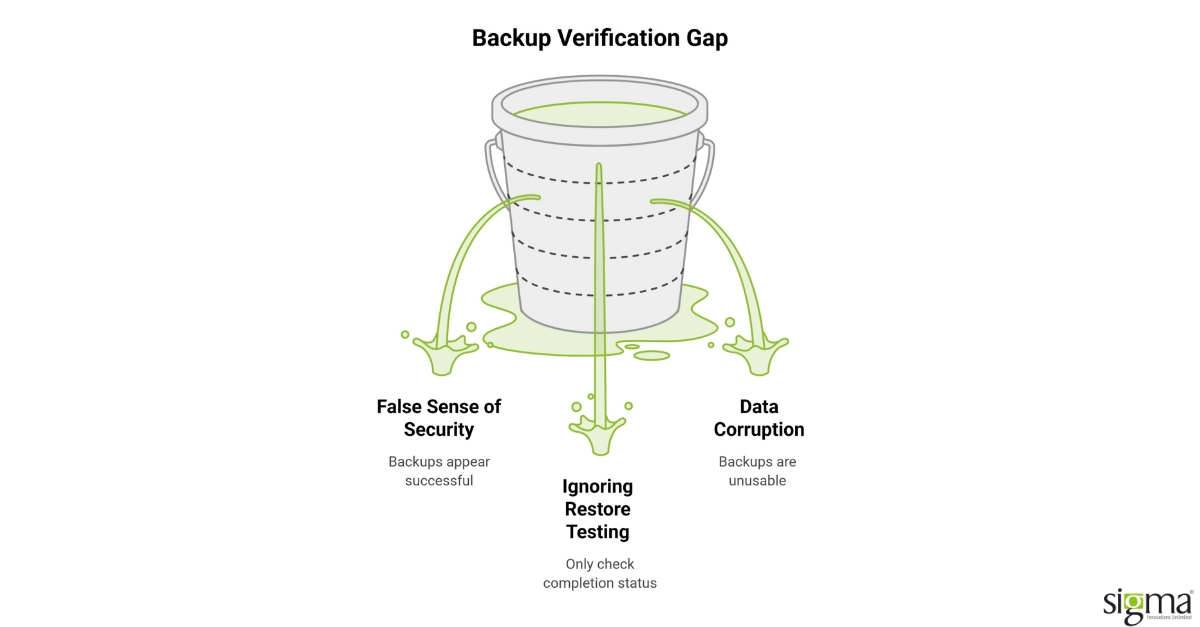
A backup that completes successfully is not the same as a backup that can actually restore a store to a working state, which is a distinction many retailers only discover the hard way, during an actual incident, when a backup that appeared healthy turns out to be corrupted or incomplete. A recurring maintenance checklist should include periodically testing an actual restore, not just confirming that the backup job completed without an error, since this is the one maintenance item where a false sense of security carries the highest cost if something goes wrong during a real incident.
The Maintenance Discipline Sigma Installs in Growth-Stage Magento Operations
Sigma Infosolutions runs recurring Magento maintenance programs for growth-stage eCommerce clients covering security patching, performance benchmarking, extension health audits, and tested backup verification, on a fixed schedule with an assigned owner and a logged outcome for each review. That structure has kept client stores meaningfully more current and secure than a reactive maintenance posture would, while giving retailers without a dedicated full-time platform engineer the same operational discipline a larger internal team would otherwise provide.
Retailers that build this discipline into their operations consistently spend less on emergency fixes and carry meaningfully less security and performance risk than retailers relying on ad hoc, reactive maintenance alone.
Scaling the Magento Store Maintenance Checklist as the Store and Team Grow
A maintenance checklist appropriate for a smaller store with a lean team will need to expand as the business grows, adding more frequent reviews as transaction volume and PCI scope increase, and incorporating checks for any new integrations or custom functionality added along the way. Retailers that revisit the checklist itself periodically, not just execute the existing one on schedule, are the ones whose maintenance program actually keeps pace with a growing store rather than gradually falling behind its increasing complexity and risk surface over time. A practical way to keep the checklist current is to review it alongside the annual budget planning cycle, using that natural planning moment to add new checks for anything the store has integrated over the past year and to retire checks that no longer apply to the current architecture and its current scale.
For retailers whose maintenance review surfaces a platform version approaching its own end-of-life risk threshold, that finding should feed directly into a broader upgrade planning process rather than being treated as a routine patching item alone.
Also, read the blog: Top 4 Magento Extensions to Boost Sales
How Sigma Infosolutions Manages Magento Store Maintenance
Sigma Infosolutions provides Magento store maintenance as a managed service that covers security patch deployment, performance monitoring, extension compatibility management, and scheduled infrastructure reviews. Sigma’s maintenance model includes defined SLAs for response time and change management processes that keep the maintenance cadence running without requiring client-side project management overhead.
A maintenance checklist that is too comprehensive has its own cost: teams skip items under time pressure, which defeats the purpose of having a checklist at all. The trade-off is thoroughness against the realistic time a team actually has each cycle, a shorter checklist that runs reliably on schedule delivers more protection than a longer one that gets abandoned after two cycles.
That is the central consideration: a checklist is only as valuable as a team’s realistic capacity to run it, and the risk of an overbuilt checklist is that it gets abandoned entirely rather than scaled back.
Conclusion
A Magento store maintenance checklist only delivers value when it actually runs on a recurring schedule, not when it exists only as a well-intentioned document that competing priorities quietly push aside sprint after sprint. Most checklists fail not from poor design but from a lack of explicit ownership, which is fixed by assigning a specific owner and logging each review’s outcome somewhere visible to the broader team. Security maintenance should include patch review, admin account auditing, and extension vulnerability checks, run at least monthly for stores handling payment data directly given how quickly disclosed vulnerabilities get exploited. Performance maintenance should benchmark against the store’s own historical baseline and review database health, since gradual degradation is often more dangerous than a sudden, more visible failure. Backup verification deserves particular attention, since a backup that completes successfully is not the same as one that can actually restore a working store during a real incident. Retailers that build this recurring discipline into their operations consistently spend less on emergency fixes and carry meaningfully less risk than those relying on reactive maintenance triggered only by visible problems. The checklist itself should scale as the store grows, adding more frequent reviews and new checks as transaction volume, PCI scope, and technical complexity all increase together. A maintenance review is often the first place an approaching platform end-of-life risk actually surfaces, which means findings should feed directly into broader upgrade planning rather than being treated as a routine, isolated patching item. Getting this operational discipline right does not require a dedicated full-time platform engineer, but it does require clear ownership and an actual recurring schedule that gets followed consistently rather than skipped under competing pressure. A store that treats maintenance as a scheduled, ongoing practice consistently stays healthier and more secure than one that waits for a problem to force the question. Building this cadence into the team’s regular operating rhythm, rather than treating it as optional extra work, is what makes the discipline durable as the business and its platform both continue to grow.
Keep Your Magento Store Secure and Fast
Frequently Asked Questions
How often should a Magento store run a full security review?
Minimum monthly for stores handling payment data directly, since the gap between a vulnerability’s public disclosure and its exploitation in the wild continues to shrink. Stores with lower PCI exposure can reasonably extend this to a quarterly cadence without meaningfully increasing their real-world exposure.
What is the most commonly skipped item on a Magento maintenance checklist?
Backup restore testing is skipped most often, since confirming a backup job completed successfully feels sufficient without actually testing whether it restores a fully working store. This is the maintenance item most likely to reveal a costly gap during a genuine incident, when it is hardest to fix.
Can a small team realistically maintain this checklist without a dedicated platform engineer?
Yes, particularly by assigning clear ownership for running the checklist on schedule and logging outcomes somewhere visible, or by partnering with a team that handles recurring Magento maintenance as a structured, ongoing service on the store’s behalf without requiring an added full-time platform engineering hire on staff.
How does extension health monitoring differ from general security patching?
Extension vulnerabilities are a distinct entry point that platform-level Magento security patches do not address, since a vulnerable third-party extension can remain exploitable even on a fully patched core Magento installation without a dedicated extension-level review process actively running in place year-round across the store.
Should maintenance frequency increase as a store’s transaction volume grows?
Yes, since higher transaction volume typically increases both PCI compliance scope and the cost of any downtime or security incident, which justifies a more frequent review cadence than a smaller, lower-volume store would reasonably need to maintain on its own throughout a typical operating year.