Enterprise eCommerce Platform Selection: A Framework That Goes Beyond the Feature Checklist

Key Highlights:
- Platform comparisons that stop at feature checklists miss the total cost of ownership question that determines long-term fit.
- Enterprise eCommerce platform selection should weigh migration cost, ongoing development overhead, and scaling headroom together, not separately.
- Getting this framework right avoids a costly mid-growth replatform that most retailers eventually face when they choose on features alone.
- Sigma has supported platform migrations where total cost of ownership, rather than a vendor comparison chart, drove the final decision.
Introduction
Retailers evaluating a new eCommerce platform typically start with a feature comparison chart, checking off checkout options, integrations, and hosting models against a shortlist of vendors, and end up choosing whichever platform’s chart looks fullest at that particular moment in the evaluation. Enterprise eCommerce platform selection decided this way tends to miss the factor that actually determines long-term fit: total cost of ownership, which includes migration cost, ongoing development and maintenance overhead, and how much custom engineering the platform will require as the business scales past its current catalog size and order volume. A platform with an impressive feature list can still be the wrong choice if its total cost of ownership curve rises faster than the business’s revenue growth over the following several years, quietly eroding margin along the way well before anyone notices the pattern in the numbers. For a CTO or IT Director at a growth-stage retailer, that means the platform evaluation has to model cost forward, not just compare what each vendor offers at the point of initial launch. A framework that weighs migration cost, ongoing fees at projected volume, and exit cost together produces a more defensible decision than one built on a feature checklist alone.
Why Feature Checklists Miss the Real Comparison
Every major platform, whether open-source or SaaS, supports the core functionality a retailer needs at launch: product catalogs, checkout, basic integrations, and content management. The differentiation that actually matters shows up later, in how much custom development each platform requires to support the specific merchandising logic, B2B pricing rules, or multi-region operations a growing business eventually needs, and in how predictable that development cost turns out to be over a multi-year horizon. A feature checklist evaluated at a single point in time cannot capture this trajectory, which is why platforms that look comparable in a vendor demo diverge significantly in actual cost once a business scales past its initial requirements.
Open-Source vs SaaS: The Real Trade-off
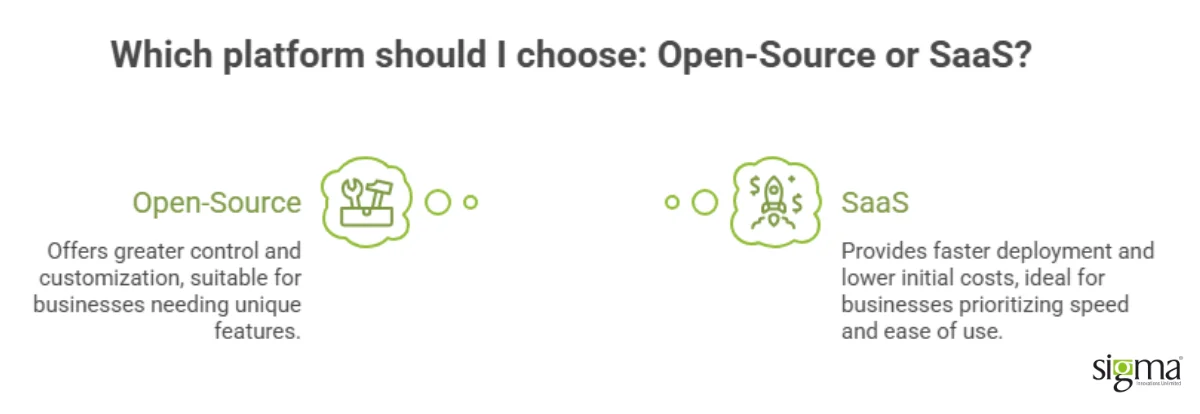
The open-source versus SaaS decision is often framed as a cost question, with SaaS platforms appearing cheaper upfront due to lower initial development investment, but this framing misses where the costs actually accumulate over time. Open-source platforms carry higher initial development cost but offer more control over customization and lower long-term licensing overhead as transaction volume grows, since SaaS platforms typically charge based on revenue or order volume, meaning the platform’s cost scales directly with the business’s own growth. The right choice depends on whether the business’s competitive advantage requires deep platform customization, which favors open-source control, or whether speed to market and reduced operational overhead matter more, which favors a managed SaaS approach.
Comparing Total Cost of Ownership Factors
| Cost Factor | Open-Source Platform | SaaS Platform |
|---|---|---|
| Initial Development Cost | Higher, more customization work | Lower, faster initial launch |
| Ongoing Platform Fees | Hosting and maintenance only | Revenue-based or volume-based fees |
| Customization Ceiling | High, limited mainly by budget | Limited by platform’s extension model |
| Migration Complexity Later | Depends on architecture chosen | Often higher, due to platform lock-in |
Why Migration Cost Deserves More Weight Than It Gets
Migration cost is frequently treated as a one-time expense to absorb during the initial platform decision, but the more important question is how expensive migrating away from the chosen platform will be if the business’s needs change significantly in three to five years’ time. Platforms with proprietary data models and limited export capabilities create switching costs that function as a form of lock-in, which is a reasonable trade-off if the platform’s roadmap aligns with the business’s growth plans, but a significant risk if it does not. Retailers who evaluate this exit cost as part of the initial decision, rather than discovering it only when they need to leave, make a materially better-informed choice from the start of the relationship rather than several years in.
That migration succeeded partly because the target platform was chosen with the retailer’s specific growth trajectory in mind, not selected purely on a feature comparison against competitors at a single point in time.
Building a Framework That Weighs the Right Enterprise eCommerce Platform Selection Factors Together
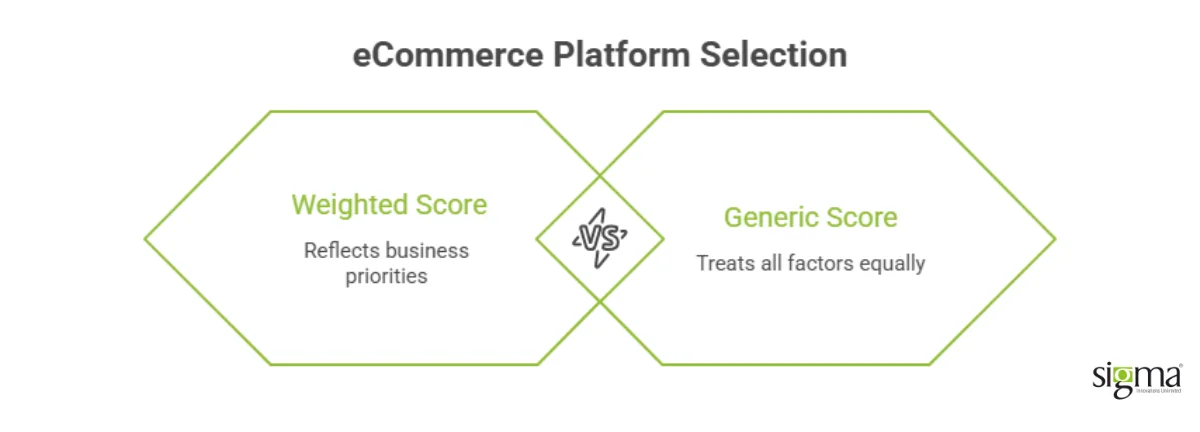
A practical enterprise eCommerce platform selection framework scores each candidate platform across four dimensions together, rather than evaluating them separately in isolation: initial development and migration cost, ongoing platform fees at projected transaction volume three years out, customization ceiling against the business’s specific merchandising needs, and exit cost if the platform relationship needs to end. Weighting these dimensions according to the business’s actual priorities, rather than treating them as equally important by default, produces a decision that reflects the business’s real constraints rather than a generic vendor comparison template built for a different kind of retailer entirely.
The TCO Model Sigma Uses Before Any Enterprise eCommerce Platform Recommendation
Sigma Infosolutions works with growth-stage and enterprise retailers evaluating platform decisions and executing the resulting migrations, bringing direct experience with the total cost of ownership trade-offs between open-source and SaaS models across Magento, Shopify, WooCommerce, and BigCommerce implementations of varying scale and complexity. That experience includes migrations where legacy platform replacement delivered measurable business outcomes, not just a technical upgrade, because the target platform was matched to the retailer’s actual growth trajectory rather than chosen on feature comparison alone.
Retailers who build this kind of framework before committing to a platform avoid the costly mid-growth replatform that many eventually face after discovering their initial choice cannot scale affordably with the business.
Applying the Framework to a Specific Shortlist
Once the four scoring dimensions are defined, the practical next step is applying them to an actual shortlist of two or three candidate platforms rather than treating the framework as an abstract exercise. This typically means requesting a detailed cost breakdown from each vendor at the business’s projected three-year order volume, not just current volume, since that is where the fee structures of different platforms tend to diverge most sharply. It also means asking each vendor directly about data export capabilities and contract terms around migrating away, since this is the exit-cost dimension vendors rarely volunteer information about unprompted. Retailers who push for this level of specificity before signing a contract consistently make better-informed decisions than those who rely on a vendor’s own comparison materials.
How Sigma Infosolutions Supports Enterprise eCommerce Platform Selection
Sigma Infosolutions supports enterprise eCommerce platform selection by running a structured evaluation against the organization’s specific technical and commercial requirements, rather than a generic feature checklist. Sigma’s evaluation process includes a total cost of ownership model, an integration complexity assessment, and a migration risk analysis so that the selection decision is grounded in the actual cost and effort of implementation, not just platform capability documentation.
If you are conducting an enterprise eCommerce platform selection and want an independent technical evaluation that goes beyond vendor demonstrations, speak with Sigma Infosolutions. Sigma’s eCommerce architecture team can run a structured assessment and provide a recommendation matched to your organization’s integration landscape and growth requirements.
Conclusion
Enterprise eCommerce platform selection should be driven by total cost of ownership across a multi-year growth trajectory, not by a feature comparison chart evaluated at a single point in time. Every major platform supports core functionality at launch, which means the real differentiation shows up later, in how much custom development each platform requires as the business scales and how predictable that development cost remains over time. The open-source versus SaaS decision is not simply about upfront cost; SaaS platforms often carry lower initial investment but scale their fees directly with business growth, while open-source platforms carry higher initial cost but more customization control. Migration cost deserves more weight in the initial decision than it typically receives, since exit cost functions as a form of lock-in that matters significantly if the platform’s roadmap does not align with future business needs. A practical selection framework scores candidate platforms across initial cost, ongoing fees at projected volume, customization ceiling, and exit cost together, rather than treating these factors as separate, disconnected questions answered in isolation from each other. Applying that framework to a real shortlist, with vendor-specific numbers rather than generic assumptions, is what turns the exercise from theoretical into decision-ready. Weighting these dimensions according to actual business priorities, rather than a generic template, produces a decision that reflects real constraints rather than a vendor’s marketing narrative. Retailers who build this kind of framework before committing avoid the costly mid-growth replatform that many eventually face after their initial choice fails to scale affordably. The right platform is the one whose total cost of ownership curve matches the business’s actual growth trajectory, not the one with the longest feature list in a vendor comparison. Applying the framework to a real shortlist, with vendor-specific cost projections at future volume, turns the exercise from theoretical into a concrete, defensible decision. Getting this evaluation right before committing a budget is considerably cheaper than discovering the mismatch three years into a platform relationship that is difficult to exit.
Frequently Asked Questions
Q: Is a SaaS eCommerce platform always cheaper than an open-source one?
Not necessarily over a multi-year horizon. SaaS platforms often have lower initial development cost but charge fees based on revenue or order volume, meaning the ongoing cost scales directly with business growth, which can exceed an open-source platform’s hosting and maintenance costs at higher volume.
Q: How should migration cost factor into an initial platform decision?
Migration cost should be evaluated both for the initial move to the new platform and for the hypothetical cost of leaving it later. Platforms with proprietary data models create switching costs that function as lock-in, which matters if the platform’s roadmap may not align with future needs.
Q: What is the biggest mistake retailers make when comparing eCommerce platforms?
Evaluating platforms on a feature checklist at a single point in time rather than projecting total cost of ownership across a multi-year growth trajectory. Platforms that look comparable in a demo can diverge significantly in actual cost once catalog size and order volume scale up.
Q: When does open-source customization control matter more than SaaS convenience?
When the business’s competitive advantage depends heavily on merchandising logic, pricing rules, or workflows a standard SaaS extension model cannot support well. If speed to market and reduced operational overhead matter more than deep customization, a managed SaaS platform is usually the better overall fit.
Q: How often should a growing retailer reevaluate its eCommerce platform choice?
There is no fixed interval, but a reevaluation makes sense whenever projected order volume or catalog complexity approaches the threshold where the current platform’s cost curve or customization ceiling was expected to become a real constraint, based on the original selection framework the business used.
