AI Governance at Scale: How to Standardize AI Usage Across Engineering and Business Teams

Key Takeaways
- While 78% of companies use AI, only 14% have a formal governance framework. Without a plan, you’re 40% more likely to face a data integrity disaster.
- Standardizing your AI isn’t about hitting the “brakes“, it’s about building a “paved road,” so your engineering and business teams can move faster without the fear of a security breach.
- From fixing “AI Sprawl” to bridging the “Capability Gap” with custom-built models, Sigma Infosolutions turns messy experimentation into a high-performance, audit-ready engine.
In today’s fast-paced world, many business leaders think they are winning the tech race just because their staff is using AI. But if you look under the hood, you’ll see a messy reality called “AI sprawl.” Right now, your marketing team is likely using unvetted ChatGPT prompts, while your developers are leaning on GitHub Copilot, and other departments are downloading “shadow tools” nobody even knows about. It feels like progress, but it’s actually a trap. There is a common myth that more tools equal more productivity. In reality, this patchwork creates a fragmented mess, huge security holes, and a return on investment that is basically zero.
Leaders feel stuck between wanting to control the risk and not wanting to kill the vibe of innovation. But here is the truth. AI governance isn’t a “no” button, but a performance system. To move past the messy experimental phase, smart companies are turning to Artificial Intelligence Development Services to build a real foundation. Whether you need AI & Data Analytics Solutions for Fintech Growth or more general BI & Analytics Development Services, the goal is the same. At Sigma Infosolutions, we see that the real winners this year aren’t the ones with the most tools, but are the ones with the best standards.
Why Most AI Governance Strategies Fail
Many executives treat an AI governance framework like a dusty handbook that sits on a shelf. This is exactly why they fail. The first big myth is that enterprise AI governance is about stopping people from using tech. In reality, a lack of rules is what actually slows you down because people are too afraid of making a mistake to innovate. Another common mistake is thinking that a written policy is enough. Static PDFs can’t keep up with how fast AI changes. You need living AI guardrails for enterprises that work in real-time, not just on paper.
We also need to stop assuming that engineering and business teams can just “self-regulate.” Without an AI compliance framework, you end up with silos where nobody talks to each other, leading to triple the work and inconsistent results. Finally, don’t fall for the trap that off-the-shelf tools are ready for the big leagues. Most basic apps lack the deep context and security that an AI software development company provides. True generative AI governance isn’t about the tool you buy, but it’s about the system you build around it.
What’s Actually Breaking Inside Enterprises (The Cost of AI Sprawl)
When everyone uses different tools, things start to break in ways you might not see at first. We call this the “sprawl cost.” Without AI tool standardization, you have no way to measure if the AI is actually helping. You also end up with massive security blind spots where sensitive data might be leaked through untracked prompts. According to recent industry projections, companies without an AI risk management plan face a 40% higher chance of data integrity failure compared to those with a cross-functional AI governance strategy. This isn’t just about tech, but it’s about the bottom line.
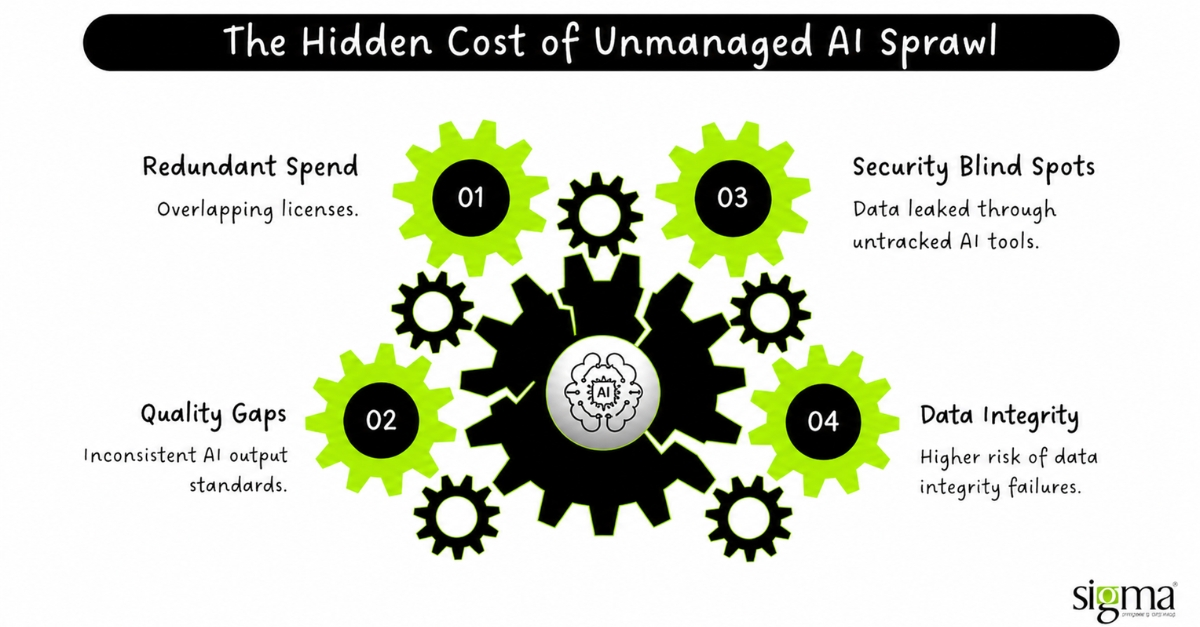
Most organizations are currently in the “Early Maturity” stage. This means they have high experimentation but zero measurable ROI. They are spending money on three different tools that all do the same thing, and they have no audit trail for how AI influenced their decisions. To fix this, you have to move away from just “using tools” and start focusing on AI lifecycle management.
- Fragmented Workflows: Teams are speaking different technical languages.
- Redundant Spend: Paying for overlapping licenses across five departments.
- Security Risks: No AI compliance and security checks on third-party bots.
- Quality Gaps: Inconsistent outputs that don’t meet brand standards.
The AI Governance Framework for the Audit-to-Automation Pipeline
To move from a messy “wild west” to a high-performance machine, you need a repeatable system. We call this the Audit-to-Automation pipeline. This AI governance framework isn’t just a list of rules, but a four-stage process that aligns your developers and your business leads. By following this path, you turn AI adoption governance from a guessing game into a science.
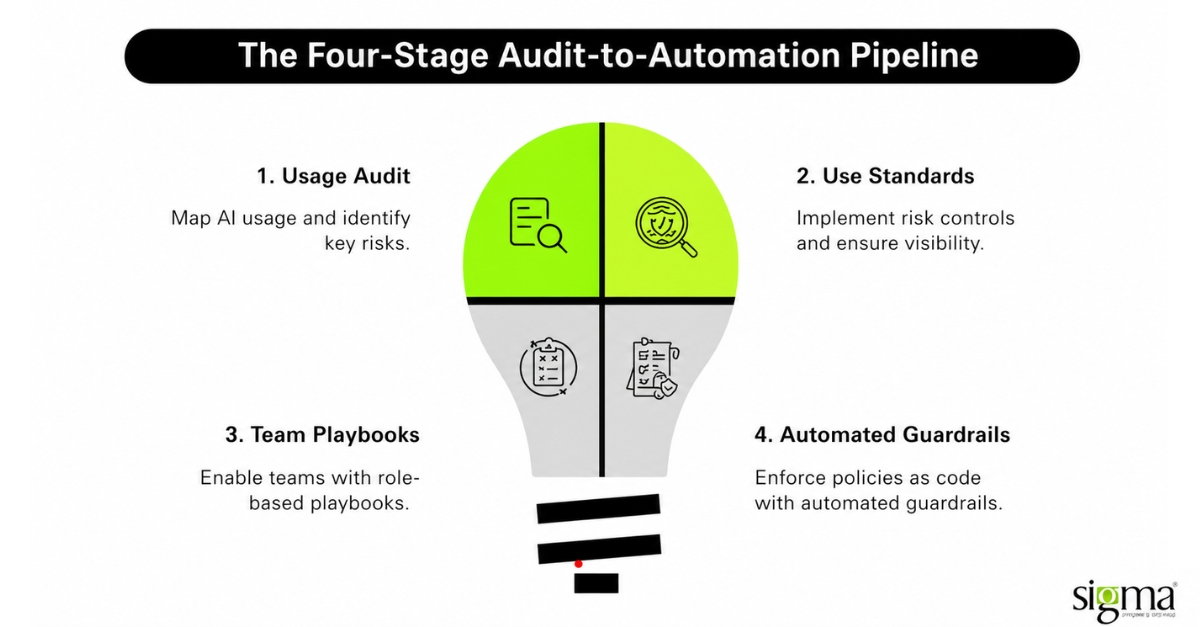
Stage 1: The Usage Audit (Discovery)
You can’t fix what you can’t see. The first step is to map out every single AI tool currently running in your company. This discovery layer identifies where data is flowing and who is using what. The goal is to create a “risk heatmap” that shows which tools are safe and which ones are leaking your secret sauce.
Stage 2: Acceptable Use Standards (Control)
Once you know what’s being used, you need to set the rules. We use a “Tiered Risk” system here. For example, using AI to summarize a public news article is “Low Risk,” but using it to analyze customer financial data is “High Risk.” This is where your AI compliance framework meets real-world action. You define exactly what is allowed, what is restricted, and what needs constant monitoring to stay in line with global laws like the EU AI Act.
Stage 3: Team Playbooks (Enablement)
Governance shouldn’t slow people down; it should show them the “right way” to go fast. We create specific playbooks for different roles. For engineers, this means standard patterns for coding assistance and debugging. For business teams, it means clear ways to use AI for research without compromising data integrity. This role-based AI tool standardization ensures everyone is playing from the same sheet of music.
Stage 4: Guardrails to Automation (Execution)
The final step is moving from a written policy to “policy-as-code.” This is where enterprise AI governance becomes truly powerful. Instead of just telling people to be safe, you build AI security guardrails directly into your software. This includes things like automated filters that catch private info before it leaves your network and CI/CD checks that scan for AI compliance and security issues automatically. By creating these “paved roads,” you make the right way the easiest way.
Finding the “Capability Gap”
As you reach the end of this pipeline, something interesting happens. You gain total control, but you also start to see where generic tools like ChatGPT or basic Copilots fall short. You’ll notice that off-the-shelf software can’t handle your specific business logic or your unique industry data. This is the “Capability Gap“, the moment when standard tools are no longer enough to give you a competitive edge.
Where Does Your Organization Stand as per Industry Benchmarking?
To understand how to win, you first have to be honest about where you are. In today’s competitive world, we see a massive divide in how companies handle AI governance. Most organizations are not as far along as they think. By looking at these three maturity levels, you can see exactly where your enterprise AI governance stands compared to your competitors.
Level 1: Experimental Stage
This is the “wild west.” Teams are using disconnected tools without any oversight. There is no AI governance framework, which means you have a high risk and very low ROI.
Level 2: Controlled Adoption
You have some basic policies in place. Maybe there’s a PDF on the company drive about using ChatGPT. There is partial AI tool standardization, but different departments still don’t talk to each other.
Level 3: Standardized & Scalable
This is the gold standard. You have a centralized AI governance model with AI security guardrails built into your systems. At this level, business outcomes are measurable and predictable.
The hard truth? Most enterprises are currently stuck in the messy middle between Level 1 and Level 2. Very few have achieved true cross-functional AI governance, which is where the real money is made.
Also, read the blog – How to Automate and Improve Business Processes with Machine Learning
The Hidden Turning Point on AI Governance & Capability Gaps
Here is a secret that most people miss. AI governance isn’t just about safety, but it’s also a diagnostic tool. Once you actually start implementing a real AI compliance framework, a new problem always pops up. You start to realize that generic, off-the-shelf AI tools are actually holding you back. They are like a “one-size-fits-all” suit that doesn’t actually fit anyone perfectly.
When you standardize your AI lifecycle management, you will likely find four major gaps:
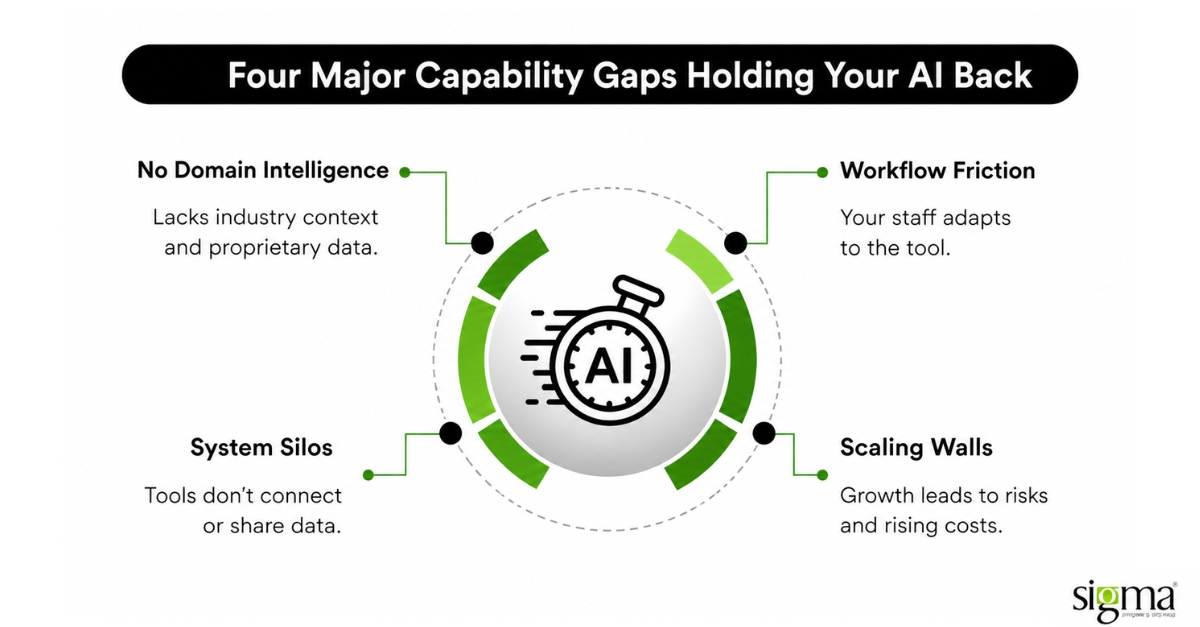
- No Domain Intelligence: The AI doesn’t know your specific industry secrets or terminology.
- System Silos: The tools don’t “talk” to your internal databases or CRM.
- Workflow Friction: You are forcing your staff to change how they work to fit the AI, rather than the other way around.
- Scaling Walls: You can’t safely grow the usage without the costs or risks spiraling out of control.
This realization is the “pivot point.” It’s the moment you realize that to truly lead, you need more than just a subscription to a basic bot. You need a partner who understands AI risk management and custom engineering.
From Standardization to Custom AI Advantage
At Sigma Infosolutions, we’ve seen that the most successful companies don’t just buy AI, they build it into their DNA. Once you have a solid AI governance strategy, you quickly realize that generic models are just the starting point. To truly win, you need to bridge the “Capability Gap” with systems that understand your specific business logic. We specialize in taking organizations from messy experimentation to high-performance optimization.
Our approach focuses on building custom AI workflows that fit your existing processes like a glove. Whether it is fine-tuning models for niche industry data or integrating AI compliance and security directly into your CRM and ERP systems, we ensure your tech is both powerful and protected. By moving beyond off-the-shelf limits, Sigma helps you create a governed, scalable ecosystem where your data remains your greatest asset.
How to Start Without Slowing Down Innovation
You don’t have to “boil the ocean” to get started. Effective enterprise AI governance works best when it is rolled out in smart, manageable steps. Start with a focused audit of one or two departments to see where the biggest risks live. From there, form a cross-functional council to set your first AI guardrails for enterprises.
Focus on standardizing just 2–3 high-impact use cases first, like coding assistance or customer support bots. Instead of adding extra work, bake your AI risk management checks directly into the tools your teams already use. This way, you keep the speed of innovation while maintaining the safety of a professional AI compliance framework.
Read our success story – Operationalizing Structured Intervention Through Tiered Student Support
Conclusion
As we navigate today, the data is clear that AI success isn’t about how many people have access to a chat box. It is about alignment, safety, and AI tool standardization. Research shows that organizations with a mature AI governance framework are 2.5 times more likely to report significant bottom-line growth from their tech investments compared to those without one.
At Sigma, our AI & ML experts believe governance is a competitive advantage, not a hurdle. When you treat AI lifecycle management as a core engineering discipline, you stop worrying about “Shadow AI” and start focusing on market leadership. The future belongs to the enterprises that turn their messy AI sprawl into a predictable, high-performance engine.
Is your organization ready to move beyond fragmented tools and risky experiments?
Ready to move beyond fragmented tools and risky AI experiments?
Frequently Asked Questions (FAQs)
1. How do we create an AI governance framework from scratch?
Start with a “Usage Audit” to map every tool currently in play. Then, categorize use cases by risk (Low, Medium, High). The goal is to move from a static PDF policy to “Policy-as-Code,” where guardrails like data filters and access controls are baked directly into your engineering workflows.
2. How can enterprises safely govern ChatGPT and LLM use?
Don’t just ban it, standardize it. Use Enterprise tiers that offer data isolation, enforce MFA, and implement “Prompt Guardrails” to redact PII (Personally Identifiable Information) before it hits the model. At Sigma, our AI & ML experts help companies build custom wrappers so your data never leaves your secure environment.
3. What is the best way to manage “AI Tool Sprawl” across teams?
Treat AI tools like managed SaaS assets. Consolidate overlapping licenses (e.g., three different writing assistants) and create an “Approved AI Catalog.” This reduces redundant spend and ensures your security team has vetted every piece of software in the building.
4. How do AI guardrails impact innovation speed?
Actually, they accelerate it. When teams have a clear “Playbook,” they don’t have to wait weeks for legal approval on every experiment. High-performing organizations use automated CI/CD checks to scan for AI compliance in real-time, allowing developers to ship faster with total confidence.