Flutter App Development Cost in 2026: Key Pricing Factors and What Businesses Should Know

Key Highlights
- Businesses that begin Flutter projects without a structured cost framework often encounter budget overruns caused by scope changes, platform-specific customizations, and post-launch remediation efforts.
- Organizations that define development budgets, feature priorities, and delivery expectations early are better positioned to launch cross-platform applications on predictable timelines.
- Sigma Infosolutions helps businesses scope Flutter app development more accurately through feature-level effort estimation, structured discovery, and milestone-driven engineering planning.
Introduction:
Businesses planning a cross-platform mobile product in 2026 are increasingly evaluating Flutter as a faster and more cost-efficient alternative to separate native iOS and Android development. While Flutter reduces development duplication through a shared codebase, the actual cost of building a production-ready application depends on far more than the framework itself. Factors such as feature complexity, backend architecture, third-party integrations, custom UI requirements, and quality assurance significantly influence the final development budget.
For many organizations, estimating Flutter app development cost becomes challenging because early-stage project requirements are often incomplete or loosely defined. A simple business application may be delivered within a controlled budget, while applications requiring real-time synchronization, advanced workflows, payment integrations, or enterprise-grade scalability can involve substantially higher engineering effort. Understanding these cost drivers before development begins helps businesses avoid scope gaps, unrealistic timelines, and unexpected budget escalations later in the project lifecycle.
This blog breaks down the major pricing factors that shape Flutter app development cost in 2026, explains how project complexity affects development timelines and budgets, and outlines what businesses should evaluate when comparing vendor estimates. It also explores the hidden costs that are frequently overlooked, including backend infrastructure, testing, and long-term maintenance planning.
Planning a Flutter application in 2026?
Why Businesses Find Flutter App Development Cost Difficult to Estimate
Planning a development budget for a Flutter project is more complex than it appears at the outset. Flutter app development cost is shaped by variables that are not always visible in high-level product descriptions, including state management architecture, platform-specific plugin requirements, and backend integration complexity. Businesses that request quotes based on vague briefs receive estimates that rarely reflect actual project needs.
The cross-platform nature of Flutter creates a perception that development is inherently cheaper than native builds. While Flutter does reduce total development hours by sharing a single codebase across iOS, Android, and web, this efficiency does not eliminate the cost factors associated with complex logic, custom UI components, or third-party service integrations. Understanding where Flutter saves cost and where it does not is essential for accurate budget planning.
Need a clearer development roadmap?
Key Cost Factors That Drive Flutter App Pricing
Feature Complexity and Custom UI Requirements
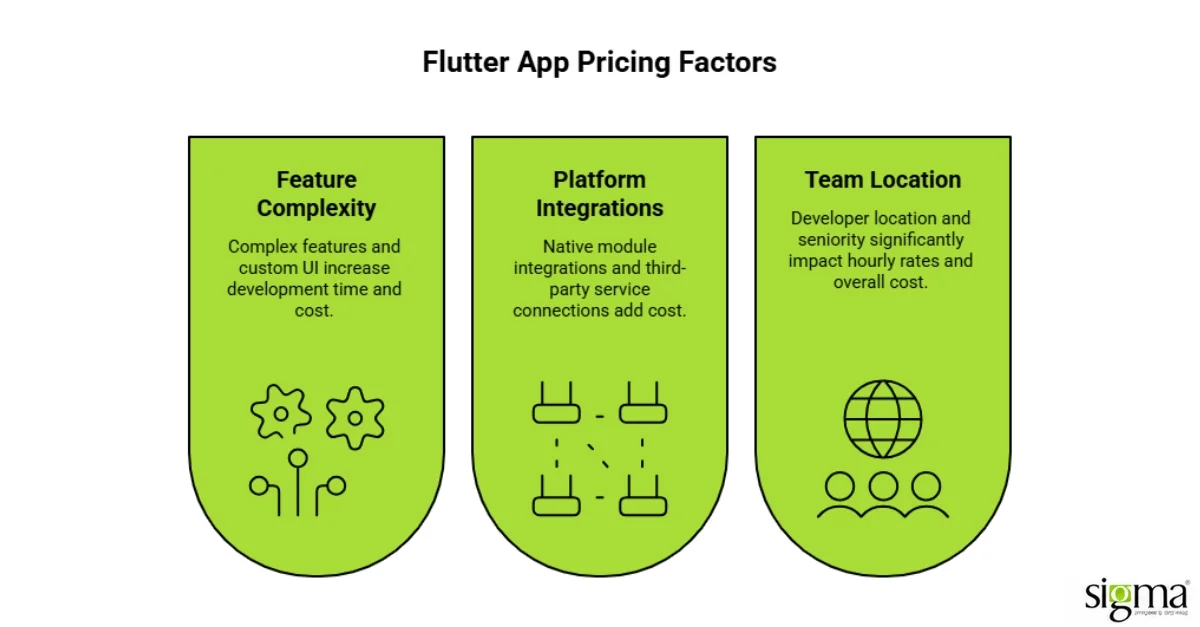
The most significant driver of Flutter app development cost is the complexity of the features the application must support. A standard business app with authentication, a dashboard, and basic CRUD operations requires far fewer development hours than a platform with real-time data sync, custom animations, or role-based access control across multiple user types. Flutter’s widget-based architecture accelerates standard UI builds but does not reduce the engineering effort required for custom visual behaviors or non-standard interactions.
Custom UI components that deviate from Flutter’s built-in widget library require additional design and development hours. Each custom component must be built, tested across screen sizes, and validated against both iOS and Android rendering engines. Businesses that require highly branded, non-standard interfaces should account for this added effort explicitly when planning their development budget.
Also, read the blog : Application Development for Business Goals: How to Align Your App Roadmap with Revenue Outcomes
Platform-Specific Integrations and Native Modules
Flutter’s cross-platform codebase covers the majority of standard app functionality, but certain device features require platform-specific native code written in Swift, Kotlin, or Java. Integrating hardware capabilities such as biometric authentication, Bluetooth connectivity, or camera controls with custom processing logic adds cost that is not reflected in standard Flutter app pricing for simpler applications.
Third-party service integrations, including payment gateways, analytics platforms, CRM systems, and push notification providers, each require API mapping and testing cycles that add measurable hours to the project timeline. The cost of these integrations scales with the number of services involved and the complexity of the data flows between them. Businesses should inventory all required third-party connections during the scoping phase to ensure these cost factors are captured in the initial estimate.
Integrating payments, CRMs, analytics, or enterprise systems?
Team Location, Seniority, and Engagement Model
Flutter developer hourly rates vary widely. Experienced engineers typically bill between $100 and $180 per hour, while other qualified developers may charge between $25 and $60 per hour. For a mid-complexity project requiring 1,200 to 1,800 hours, this difference can create a cost variance of $90,000 or more.
Seniority composition within the team also affects both cost and quality. A team weighted toward junior developers will have a lower blended rate but may require more revision cycles and closer technical oversight. Engaging a senior Flutter architect for the design and setup phases while using mid-level engineers for feature execution is a cost-efficient model that balances budget control with technical quality.
Flutter App Development Cost by Project Complexity
App Category | Estimated Hours | US-Based Team Cost | Typical Features |
| Basic App (8-15 screens) | 300-500 hours | $45,000 – $75,000 | Auth, static content, basic API |
| Mid-Complexity App (15-35 screens) | 700-1,400 hours | $90,000 – $180,000 | Payments, notifications, multi-role |
| Complex App (35-60 screens) | 1,500-3,000 hours | $180,000 – $400,000 | Real-time sync, custom UI, integrations |
| Enterprise App (60+ screens) | 3,000+ hours | $400,000+ | Analytics, workflow automation, ERP integration |
Not ready for a full-scale product launch?
Additional Cost Factors Businesses Frequently Underestimate
Backend Infrastructure and API Development
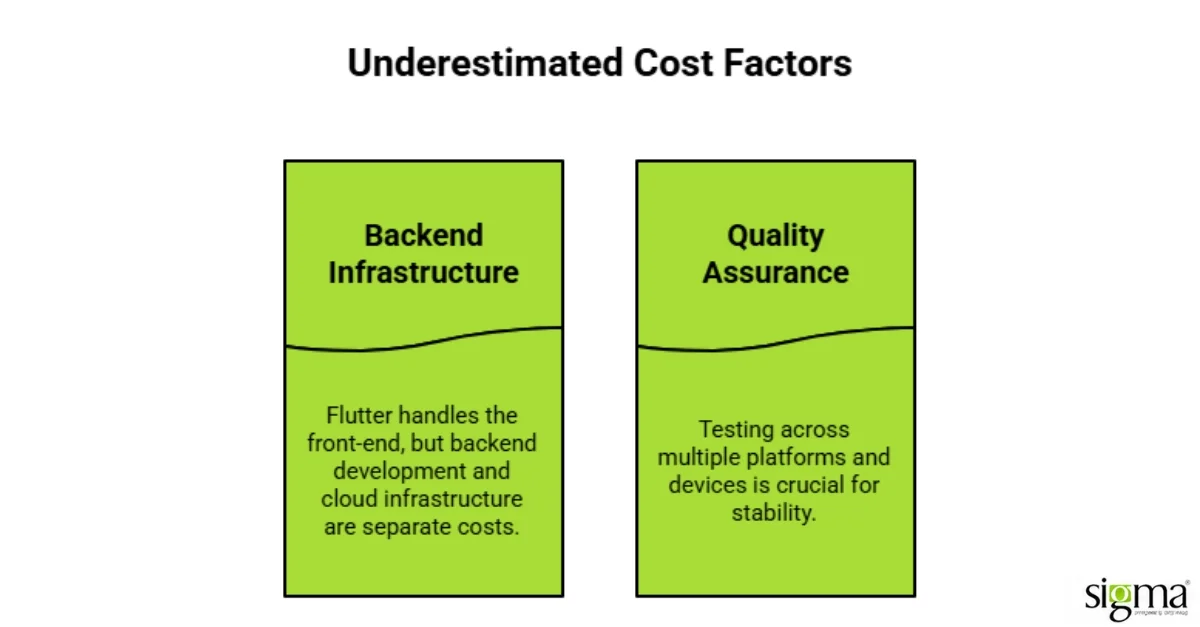
Flutter handles the front-end presentation layer, but every data-driven application requires a backend infrastructure to manage storage, authentication, business logic, and external service connections. Backend development is a separate cost line that must be included in the total app development cost calculation, and it is frequently absent from initial vendor quotes that focus only on the Flutter front-end.
Cloud infrastructure setup on platforms such as AWS or Firebase adds further cost that compounds with user volume over time. Serverless architectures reduce upfront infrastructure spend but introduce per-transaction pricing that must be modeled against projected usage. Businesses that defer backend planning until after the Flutter front-end is underway typically face architectural revisions that add both time and cost.
Building a scalable SaaS or cloud-native Flutter platform?
Quality Assurance Across Platforms and Devices
Testing a Flutter application requires validation across multiple iOS and Android device types, screen sizes, and OS versions. A mid-complexity Flutter application typically requires 150 to 300 QA hours to reach production stability. This is a non-negotiable component of the development budget, and vendors who quote minimal testing hours are either making assumptions about quality standards or planning to charge for defect remediation separately.
Automated testing frameworks reduce long-term QA costs but require upfront configuration effort. For applications with frequent feature releases, investing in automated test coverage during the initial build reduces the ongoing cost of regression testing across each update cycle.
Read our success story: US based B2C Custom Web Application for Small Business Loans
How Sigma Infosolutions Helps Businesses Plan Flutter App Development Costs More Accurately
Estimating Flutter app development cost requires more than assigning hourly rates to engineering tasks. Businesses need visibility into feature dependencies, backend complexity, infrastructure requirements, and long-term scalability considerations before development begins. Sigma Infosolutions follows a structured delivery approach that helps organizations define realistic project budgets, reduce scope ambiguity, and align development investments with business priorities from the outset.
Discovery-First Project Scoping
Sigma begins Flutter engagements with a detailed discovery and solution-mapping phase designed to convert business requirements into clearly defined engineering tasks. Instead of relying on broad estimations, the team evaluates application workflows, user roles, integration dependencies, platform-specific requirements, and scalability expectations before finalizing project scope.
This early-stage assessment helps businesses identify hidden development variables that frequently increase costs later in the lifecycle, including third-party service dependencies, custom workflow logic, and backend architecture requirements.
Feature-Level Effort Estimation
Rather than presenting generalized project pricing, Sigma provides feature-level effort breakdowns tied to individual modules and functional requirements. This approach gives stakeholders greater transparency into how development hours are distributed across UI engineering, backend services, integrations, testing, and deployment activities.
By mapping engineering effort directly to business functionality, organizations can prioritize features more effectively, phase releases strategically, and make informed trade-offs without disrupting overall delivery timelines.
Cross-Platform Engineering with Backend Alignment
Flutter reduces development duplication across platforms, but application performance and scalability still depend heavily on backend architecture and API design. Sigma’s engineering teams work across Flutter front-end development, backend API implementation, cloud infrastructure setup, and native module integration to ensure the application ecosystem functions cohesively.
The team supports integrations involving payment systems, analytics platforms, authentication services, enterprise workflows, and cloud-native infrastructure, helping businesses avoid fragmented delivery models that often create operational inefficiencies and budget overruns.
Structured Delivery and Quality Governance
Sigma follows standardized project management and quality assurance processes aligned with its ISO 9001:2015-certified delivery framework. Scope changes, feature approvals, testing cycles, and deployment milestones are documented through structured workflows that improve delivery predictability throughout the engagement.
This process-driven execution model helps reduce common project risks such as uncontrolled scope expansion, delayed testing cycles, and post-release defect accumulation, all of which can significantly increase total application development cost.
Scalable Engagement Models for Budget Flexibility
Different businesses require different delivery structures depending on project size, release timelines, and internal technical capabilities. Sigma supports flexible engagement models that allow organizations to scale engineering resources based on evolving delivery requirements.
Businesses can combine senior solution architects for platform planning with dedicated Flutter developers, QA specialists, and backend engineers for execution, creating a balanced delivery model that supports both technical quality and cost optimization.
Transparent Cost Planning for Long-Term Product Development
Flutter app development costs extend beyond the initial release phase. Ongoing maintenance, infrastructure scaling, feature enhancements, operating system updates, and testing automation all contribute to long-term product investment.
Sigma helps businesses account for these operational considerations early in the planning cycle by providing realistic effort projections, infrastructure guidance, and release planning recommendations that support sustainable product growth beyond launch.
Conclusion
Flutter continues to be one of the most practical frameworks for businesses building cross-platform digital products in 2026, particularly for organizations looking to accelerate development timelines without maintaining separate native codebases. However, Flutter app development cost is influenced by far more than the framework itself. Feature complexity, backend architecture, third-party integrations, QA requirements, infrastructure planning, and long-term scalability all contribute significantly to the final project budget.
Businesses that approach Flutter development with clearly defined requirements and structured technical planning are better positioned to avoid budget overruns, reduce delivery delays, and build applications that scale efficiently over time. Rather than evaluating vendors solely on headline pricing, organizations should focus on transparency in scope definition, feature-level effort estimation, backend planning, and post-launch support capabilities.
Sigma Infosolutions helps businesses navigate these decisions through structured discovery, scalable engineering practices, and transparent development planning tailored to each product’s requirements. From MVPs to enterprise-grade Flutter applications, the focus remains on building cost-efficient, maintainable, and scalable digital products aligned with long-term business goals.
Planning a Flutter App in 2026?
Connect with Sigma Infosolutions to discuss your app development scope, timelines, and estimated costs. Contact Us
Frequently Asked Questions
Q: What is the average Flutter app development cost for a business application in 2026?
A: A mid-complexity Flutter app with authentication, API integrations, and multi-screen navigation typically costs between $22,000 and $55,000 with a cost-efficient development team. Higher-cost development for the same scope generally ranges from $90,000 to $180,000.
Q: How does Flutter app pricing compare to native iOS and Android development?
A: Flutter reduces total app development cost by sharing a single codebase across platforms, which typically saves 30% to 40% compared to building two separate native applications. For most business use cases, the performance and user experience of Flutter apps are comparable to native builds.
Q: What cost factors most commonly cause Flutter projects to exceed their initial budget?
A: Undefined third-party integrations, platform-specific native module requirements, and insufficient QA planning are the most frequent sources of unplanned costs. A detailed scoping phase before development starts is the most effective way to prevent these overruns.
Q: How does team location affect the overall development budget for a Flutter app?
A: Developer hourly rates can vary significantly, creating a major cost difference for the same scope. Many businesses use a hybrid model combining distributed engineering teams with centralized project management to balance cost and communication quality.
Q: Does Flutter app development cost include backend development?
A: Flutter covers only the front-end presentation layer, so backend development, cloud infrastructure, and API costs must be budgeted separately. Businesses should confirm with their vendor whether backend services are included in the quoted scope or priced independently.
Q: How much should be allocated for QA within a Flutter app development budget?
A: Quality assurance typically represents 15% to 20% of total development hours for a Flutter application, covering manual testing across devices and OS versions. Applications with complex business logic or payment integrations may require a higher QA allocation to reach production stability.
Q: What is the typical timeline for a mid-complexity Flutter app project?
A: A mid-complexity Flutter application generally requires four to six months from scoping through app store submission with a dedicated development team. Projects with extensive backend development or custom integrations may require six to nine months.
Q: How should businesses evaluate Flutter app pricing from different vendors?
A: Request a feature-level effort breakdown from each vendor rather than accepting a single blended total, and confirm what is and is not included in the quoted scope. Vendors who provide only high-level estimates without specifying deliverables represent a budget risk regardless of their headline price.