AI-Powered Business Applications: Real-World Enterprise Use Cases Across Industries
Key Highlights
- Enterprises across every industry face mounting pressure to reduce operational costs, accelerate decision-making, and deliver better customer experiences, yet many organizations struggle to move beyond AI experimentation into scalable, production-ready implementation.
- AI business applications built on machine learning, natural language processing, and intelligent automation provide enterprises with the tools to transform operations, optimize decisions, and unlock new sources of competitive advantage across every business function.
- Sigma Infosolutions develops AI-powered enterprise applications that automate complex workflows, enhance operational efficiency, and deliver measurable business outcomes across industries including fintech, retail, healthcare, and manufacturing.
Introduction
Artificial intelligence has moved well beyond the proof-of-concept stage. In 2026, AI business applications are driving real, measurable outcomes in enterprises across every sector of the global economy. From automating back-office processes to personalizing customer experiences at scale, the practical value of enterprise AI is no longer theoretical. It is visible in quarterly earnings reports, operational efficiency metrics, and customer satisfaction scores.
For CIOs, innovation leaders, and enterprise executives, the challenge has shifted from evaluating whether AI is worth pursuing to determining how to implement it effectively across complex, legacy-heavy organizations. The organizations that are winning with AI are not necessarily the ones with the largest technology budgets. They are the ones that have identified the right use cases, built the right data foundations, and partnered with engineering teams that can translate AI potential into production-grade applications.
This blog explores the most impactful AI use cases across key industries, examines what makes enterprise AI implementations succeed, and explains how Sigma Infosolutions helps organizations move from AI ambition to AI execution.
Why Enterprise AI Adoption Is Accelerating in 2026
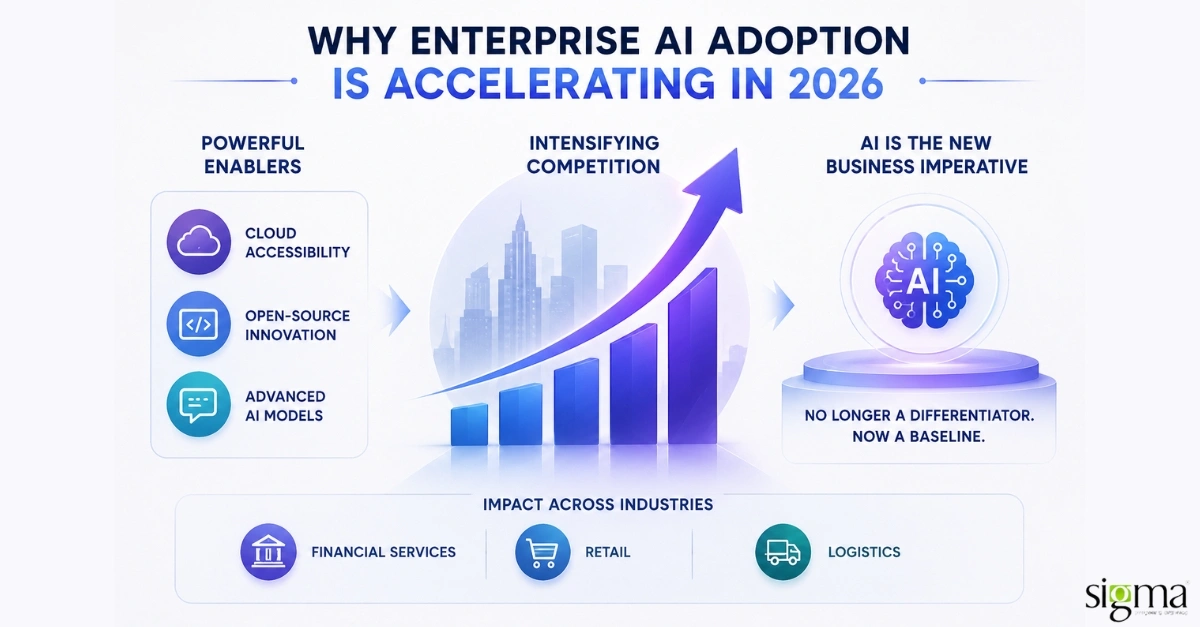
Several converging forces are driving the rapid acceleration of enterprise AI adoption in 2026. Cloud computing has made AI infrastructure accessible to organizations of every size. Open-source model frameworks have reduced the cost of building custom AI solutions. And the emergence of large language models has expanded the range of business problems that AI can address, from structured data analysis to unstructured text processing and conversational interfaces.
At the same time, competitive pressure is intensifying. In industries such as financial services, retail, and logistics, early AI adopters have already demonstrated significant advantages in cost efficiency and customer experience. Organizations that have not yet moved AI into production are beginning to feel the consequences in the form of slower operations, higher costs, and declining customer satisfaction relative to more digitally advanced competitors.
The result is a market where enterprise AI is no longer a differentiator reserved for technology-first companies. It is becoming a baseline expectation for any organization that wants to remain competitive in its industry.
Real-World AI Business Applications Across Key Industries
The most effective way to understand the value of enterprise AI is to examine how it is being applied in practice across different industries. The following use cases represent some of the highest-impact applications of AI in business operations today.
Financial Services: Intelligent Risk and Fraud Detection
In financial services, AI business applications are transforming how organizations assess risk and detect fraudulent activity. Traditional rule-based fraud detection systems generate high volumes of false positives and struggle to adapt to the evolving tactics of bad actors. Machine learning models trained on transaction history and behavioral data can identify anomalous patterns with far greater accuracy and adapt in real time as new fraud patterns emerge.
Many leading banks and lending platforms are also using AI to automate credit underwriting, reducing the time required to evaluate loan applications from days to minutes while improving the accuracy of risk assessments. AI-powered loan origination and servicing platforms are helping lenders improve operational efficiency, streamline borrower onboarding, and strengthen portfolio risk management across alternative lending and non-banking financial institutions.
Retail and E-Commerce: Personalization and Demand Forecasting
Retail is one of the industries where AI use cases have matured most rapidly. AI-powered recommendation engines analyze customer browsing behavior, purchase history, and contextual signals to deliver personalized product recommendations that increase average order value and improve conversion rates.
Beyond personalization, demand forecasting models allow retailers to optimize inventory levels across complex multi-location supply chains. A leading e-commerce retailer reduced overstock by a significant margin after implementing an AI-driven demand forecasting system that incorporated external variables such as seasonal trends, regional purchasing patterns, and promotional calendars. For retail executives managing thin margins, this level of inventory precision translates directly into improved profitability.
Also, read the blog: The Ultimate AI Playbook for Grocery Retailers in 2025
Healthcare: Clinical Decision Support and Operational Automation
Healthcare organizations are deploying AI in industries including clinical decision support, patient triage, and administrative automation. AI models trained on clinical data can assist physicians in identifying diagnostic patterns that may be difficult to detect through manual review, improving the speed and accuracy of diagnosis for complex conditions.
On the operational side, many healthcare providers are using AI-driven automation to reduce administrative overhead in areas such as appointment scheduling, billing reconciliation, and prior authorization processing. These applications free up clinical staff to focus on patient care rather than administrative tasks, improving both operational efficiency and staff satisfaction.
Manufacturing and Logistics: Predictive Maintenance and Supply Chain Optimization
In manufacturing, AI business applications are delivering significant value through predictive maintenance programs that analyze sensor data from industrial equipment to forecast failures before they occur. By scheduling maintenance based on actual equipment condition rather than fixed time intervals, manufacturers reduce unplanned downtime and extend the operational life of critical assets.
In logistics, AI models optimize routing, load planning, and warehouse operations to reduce transportation costs and improve delivery reliability. Enterprise AI implementations in this space have enabled logistics operators to handle growing order volumes without proportional increases in operational headcount, making AI a key enabler of scalable growth.
Customer Service: Conversational AI and Intelligent Routing
Across industries, AI in customer service is enabling organizations to handle higher volumes of customer interactions with greater consistency and lower cost. Conversational AI systems powered by large language models can resolve a wide range of common customer inquiries without human intervention, escalating complex or sensitive issues to the appropriate human agent with full context preserved.
Intelligent routing systems analyze the nature of incoming requests and the skills of available agents to match customers with the most qualified representative, reducing resolution times and improving first-contact resolution rates. These applications improve customer satisfaction while reducing the cost per interaction for enterprise contact centers.
Read the blog: How AI Governance Enhances Data Privacy and Security
What Makes Enterprise AI Implementations Succeed
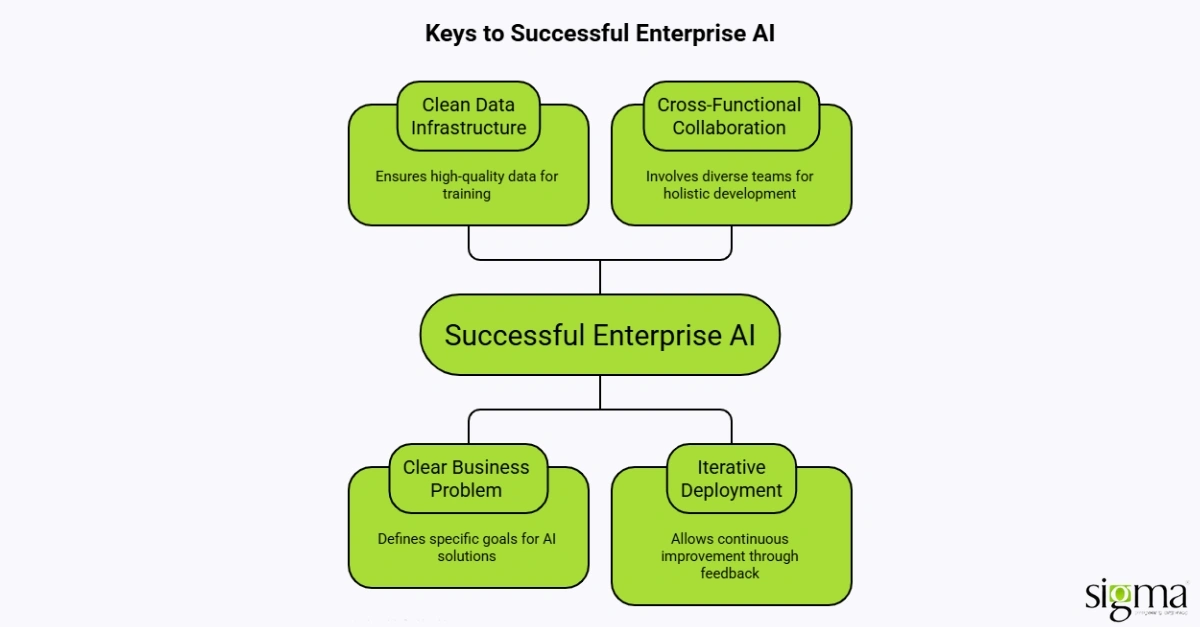
Not all AI projects deliver on their promise. Organizations that achieve lasting value from enterprise AI consistently share several characteristics that distinguish successful implementations from those that stall at the pilot stage.
Clean, Unified Data Infrastructure: AI models are only as good as the data they are trained on. Enterprises that invest in data quality, governance, and centralization before building AI applications achieve faster time to value and more reliable model performance.
Clear Business Problem Definition: The most successful AI implementations start with a specific, well-defined business problem rather than a general ambition to use AI. Defining success metrics upfront ensures that the solution is built to deliver measurable outcomes.
Cross-Functional Collaboration: Effective enterprise AI requires close collaboration between data scientists, software engineers, domain experts, and business stakeholders. Organizations that treat AI as purely a technology initiative rather than a business transformation program consistently underperform.
Iterative Deployment and Feedback Loops: Production AI systems require continuous monitoring, retraining, and refinement. Organizations that build feedback loops into their AI programs from the start are able to improve model performance over time rather than watching accuracy degrade as data patterns shift.
How Sigma Infosolutions Helps Enterprises Build AI-Powered Applications
Sigma Infosolutions brings deep engineering expertise and a proven delivery methodology to help enterprises design, build, and scale AI business applications that solve real operational challenges. With experience across fintech, retail, healthcare, and enterprise software, Sigma’s team understands how to navigate the technical and organizational complexity of AI implementation at scale.
Discovery and Use Case Prioritization
Sigma works with enterprise leadership teams to identify and prioritize AI use cases based on business impact, data readiness, and implementation feasibility. This structured discovery process ensures that AI investments are directed toward the opportunities with the highest potential return rather than the most technically interesting problems.
Solution Architecture and Model Development
Sigma’s AI engineering team designs end-to-end solution architectures that integrate machine learning models, data pipelines, and application interfaces into a cohesive, production-ready system. Models are developed using frameworks appropriate to the specific use case and are validated rigorously before deployment to ensure reliability and accuracy.
Workflow Automation and Integration
Sigma builds the integration layer that connects AI models to the enterprise systems and workflows where their outputs will be used. Whether integrating with a CRM, an ERP, a customer service platform, or a proprietary internal system, Sigma ensures that AI-generated insights reach the right people at the right time in the right format.
Quality Assurance and Responsible AI
Sigma applies rigorous quality assurance processes to every AI deployment, including bias testing, explainability evaluation, and performance benchmarking. This commitment to responsible AI ensures that enterprise applications perform consistently across diverse user populations and comply with relevant regulatory requirements.
Deployment and Ongoing Optimization
After deployment, Sigma monitors model performance, manages retraining cycles, and expands AI capabilities as the organization’s needs evolve.
Conclusion
AI business applications are no longer a future aspiration for enterprise organizations. They are a present-day competitive necessity across financial services, retail, healthcare, manufacturing, and customer service. The enterprises that are extracting the most value from AI in 2026 are those that have moved decisively from experimentation to production, supported by strong data infrastructure, clear business objectives, and experienced engineering partners.
The breadth of AI use cases available to enterprise organizations today means that virtually every major business function has an opportunity to benefit from intelligent automation, predictive analytics, or conversational AI. The challenge is not finding the right use case. It is finding the right partner to build and deploy the solution effectively.
Sigma Infosolutions is the AI engineering and implementation partner that enterprise leaders trust to turn AI potential into measurable business outcomes. With a proven track record across industries and a full-stack capability that spans data engineering, model development, and enterprise integration, Sigma delivers AI applications that work in the real world.
Looking to scale AI beyond experimentation?
Frequently Asked Questions
1. What are AI business applications?
AI business applications are software solutions powered by artificial intelligence technologies such as machine learning, natural language processing, computer vision, and intelligent automation. These applications automate workflows, analyze large datasets, improve decision-making, enhance customer experiences, and optimize operational efficiency across enterprise functions.
2. How are enterprises using AI in 2026?
Enterprises are using AI across industries for fraud detection, predictive analytics, customer service automation, personalized recommendations, supply chain optimization, healthcare workflow automation, predictive maintenance, intelligent document processing, and AI-powered decision support systems.
3. Which industries benefit the most from AI business applications?
Industries seeing significant value from AI adoption include financial services, retail and eCommerce, healthcare, manufacturing, logistics, insurance, education, and customer service operations. AI helps organizations reduce operational costs, improve efficiency, and scale decision-making capabilities.
4. What are the most common enterprise AI use cases?
Common enterprise AI use cases include:
- Fraud detection and risk assessment
- Conversational AI and virtual assistants
- Predictive maintenance
- Intelligent workflow automation
- Demand forecasting
- AI-powered underwriting
- Customer behavior analysis
- Clinical decision support
- Automated document processing
- Supply chain optimization
5. What technologies power AI business applications?
Enterprise AI applications are commonly powered by machine learning, deep learning, large language models (LLMs), natural language processing (NLP), robotic process automation (RPA), computer vision, predictive analytics, and cloud-based AI infrastructure platforms.
6. How do AI business applications improve operational efficiency?
AI applications reduce manual effort by automating repetitive tasks, accelerating decision-making, minimizing human error, improving workflow orchestration, and enabling real-time analytics. This allows organizations to increase productivity while lowering operational overhead.
7. What challenges do enterprises face during AI implementation?
Common AI implementation challenges include fragmented data infrastructure, poor data quality, unclear business objectives, integration complexity with legacy systems, scalability concerns, governance requirements, model accuracy issues, and lack of cross-functional collaboration.
8. Why is data infrastructure important for enterprise AI?
AI models depend on accurate, centralized, and well-governed data to deliver reliable outputs. Organizations with strong data infrastructure achieve faster AI deployment, better model performance, improved scalability, and more consistent business outcomes.
9. How long does it take to develop and deploy an AI-powered enterprise application?
The timeline depends on the complexity of the use case, data readiness, integration requirements, and compliance considerations. Smaller AI workflow automation projects may take a few months, while enterprise-scale AI transformation initiatives may require phased implementation over multiple quarters.
10. How does Sigma Infosolutions support enterprise AI implementation?
Sigma Infosolutions provides end-to-end Artificial Intelligence Development Services including AI strategy consulting, use case prioritization, machine learning model development, workflow automation, enterprise system integration, conversational AI development, quality assurance, and ongoing AI optimization.
11. Can Sigma Infosolutions build custom AI applications for specific industries?
Yes. Sigma Infosolutions develops custom AI-powered software solutions for industries including fintech, retail, healthcare, manufacturing, logistics, and enterprise SaaS. Solutions are designed around specific operational workflows, compliance requirements, and business goals.
12. What is the difference between AI experimentation and production-ready AI?
AI experimentation typically involves isolated pilots or proofs of concept with limited operational integration. Production-ready AI includes scalable infrastructure, enterprise-grade integrations, governance frameworks, monitoring systems, retraining pipelines, and measurable business KPIs aligned to operational workflows.
13. How does conversational AI improve customer service operations?
Conversational AI automates customer interactions through intelligent chatbots and virtual assistants capable of understanding context, resolving common issues, routing inquiries intelligently, and maintaining conversational continuity. This improves response times, reduces support costs, and enhances customer satisfaction.
14. What should enterprises consider before investing in AI applications?
Organizations should evaluate business priorities, data readiness, infrastructure maturity, integration requirements, governance policies, scalability expectations, and measurable ROI objectives before launching enterprise AI initiatives. Successful AI adoption requires alignment between technology strategy and business outcomes.