App Development Cost in 2026: What Influences Pricing and How to Estimate Your Budget
Key Highlights
- Sigma Infosolutions helps businesses scope, price, and execute app development projects with defined milestones, transparent cost structures, and delivery accountability at every phase.
- A clearly estimated app budget reduces mid-project scope changes, prevents cost overruns, and ensures the final product is built to the organization’s actual functional requirements.
- Businesses that begin app development without a structured cost estimate frequently encounter budget exhaustion before launch, forcing compromises on core features or security requirements.
- Mobile app investment continues to grow across industries, with organizations increasingly prioritizing custom builds over off-the-shelf tools to meet specific operational and customer experience demands.
Estimating the cost of app development is one of the most frequently mishandled steps in any digital product initiative. Organizations routinely begin the process with budget expectations that do not account for the full scope of design, engineering, testing, and post-launch support. The result is either a product that is underbuilt relative to business needs or a project that runs over budget before it reaches a usable state. This blog identifies the primary factors that determine app development cost in 2026 and provides a structured approach to building an estimate that holds up through execution.
What Determines App Development Cost
App development cost is shaped by a combination of factors that interact differently depending on the project type, platform, and team structure. No two projects carry identical cost profiles, which is why generalized price lists from vendors are rarely reliable without a detailed scope conversation.
Platform choice is one of the first and most consequential decisions. Building a native iOS app, a native Android app, or a cross-platform application using frameworks such as React Native or Flutter each carries different development hours, testing requirements, and long-term maintenance implications. Cross-platform development typically costs less upfront but may require additional engineering effort for platform-specific performance tuning.
Feature complexity drives the majority of hours in any engagement. An app with user authentication, real-time data sync, third-party API integrations, payment processing, and push notifications requires significantly more engineering time than a simple informational or catalog application. Each feature must be independently scoped, built, tested, and integrated, and that process compounds as feature count increases.
For businesses developing subscription-based platforms or cloud-native products, SaaS architecture decisions can significantly influence long-term development and maintenance costs.
Mobile App Pricing Benchmarks by Project Type
Understanding where a project falls within established mobile app pricing ranges helps organizations enter vendor discussions with calibrated expectations. The table below provides directional benchmarks based on app type and scope.
App Type | Typical Price Range | Primary Cost Drivers |
| Simple Informational App | $10,000 to $25,000 | Basic UI, static content, minimal backend |
| Mid-Complexity Consumer App | $25,000 to $80,000 | User accounts, API integration, push notifications |
| eCommerce Mobile App | $50,000 to $150,000 | Product catalog, payments, inventory sync, UX design |
| Enterprise Mobile Application | $100,000 to $300,000+ | Role-based access, ERP integration, compliance requirements |
| Custom SaaS or Platform App | $150,000 to $400,000+ | Multi-tenant architecture, data security, and ongoing iterations |
These ranges reflect professional development team rates in the US market. Blended delivery models that combine onshore management with offshore engineering can reduce development cost by 30 to 50 percent, provided the vendor maintains clear documentation and communication standards throughout the project.
Looking to scale beyond 100 clients? Click now and get an an effective blueprint
How to Build an Accurate App Budget
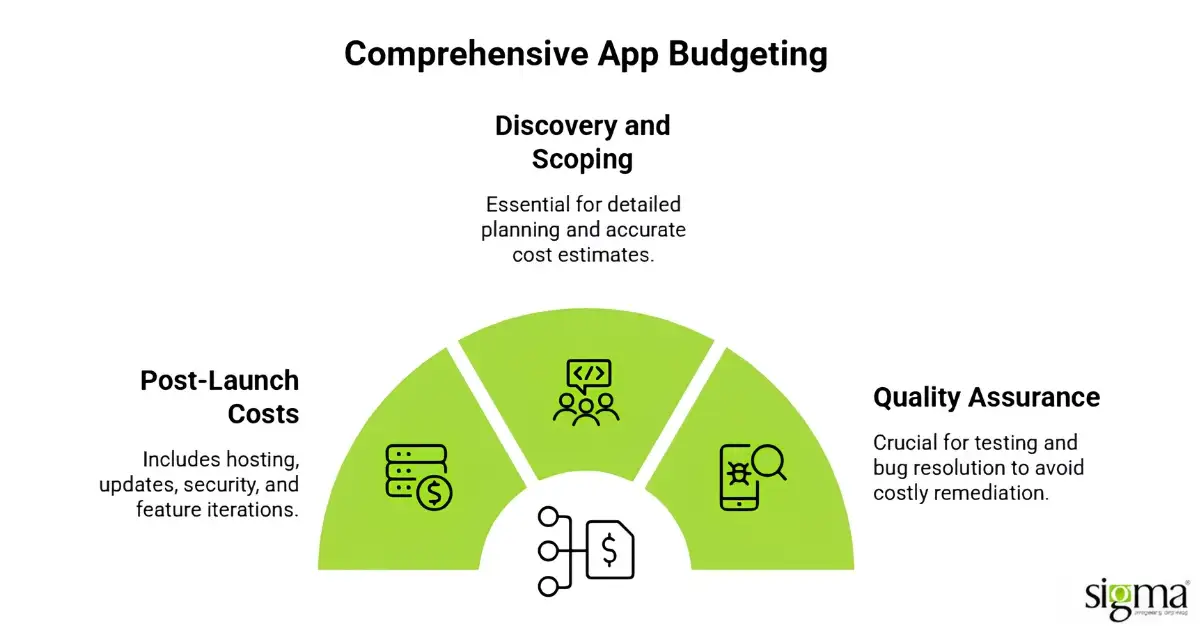
An app budget must account for more than the initial build. Organizations that plan only for the development phase routinely discover that post-launch costs, including hosting, updates, security patches, and feature iterations, add 20 to 30 percent to the total annual investment.
Discovery and scoping should be treated as a billable and necessary phase, not a free pre-sales exercise. A proper discovery engagement produces detailed wireframes, a technical architecture document and a feature-by-feature breakdown that forms the basis of an accurate development cost estimate. Skipping this phase is the single most common cause of budget overruns in app projects.
Quality assurance must be explicitly scoped in the app budget. Testing across devices, operating system versions, network conditions, and user scenarios is time-intensive and cannot be compressed without risk. An app that reaches production with unresolved bugs or performance issues incurs remediation costs that often exceed what proper QA would have cost during the build phase.
Read our success story: Automating Ticket Resolution with AI-Powered Resolvify++
Factors That Directly Influence App Development Pricing
Several variables consistently affect final app development pricing regardless of project category. Recognizing these factors early in the planning process allows organizations to make informed trade-offs before commitments are made.
Third-party integrations. Connecting an app to payment gateways, CRM platforms, analytics tools, or external data APIs each requires dedicated engineering effort. Some integrations are straightforward using existing SDKs, while others require custom middleware, and that distinction has a direct effect on overall cost.
Security and compliance requirements. Applications that handle financial data, health information, or personal user data must meet specific regulatory standards such as PCI DSS, HIPAA, or GDPR. Meeting these standards adds engineering, documentation, and third-party audit costs that must be scoped explicitly before the project begins.
UI/UX design investment. Design is frequently underbudgeted in app projects. A well-researched, user-tested interface requires discovery workshops, multiple prototype iterations, and accessibility review. Organizations that treat design as a minor line item often revisit it at high cost after the product reaches real users.
How Sigma Infosolutions Approaches App Development Engagements
How Sigma Infosolutions Approaches App Development
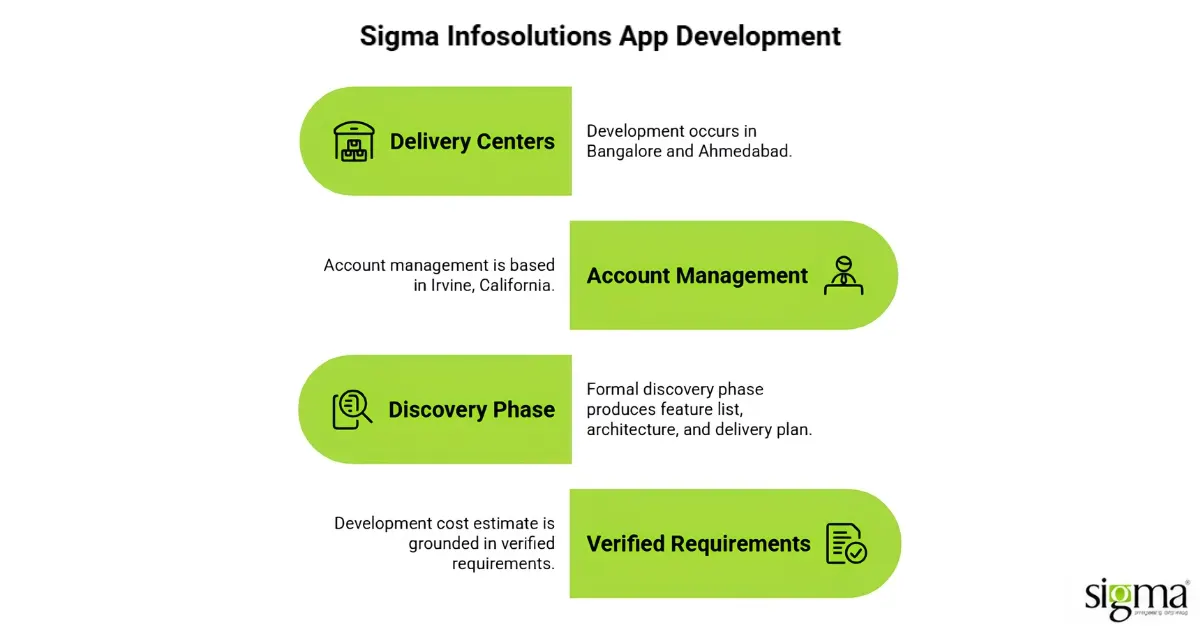
Successful app development starts long before coding begins. At Sigma Infosolutions, every engagement is built around clarity, scalability, and delivery accountability so businesses can move forward with confidence instead of uncertain budgets and shifting timelines.
Discovery Before Development
Every project begins with a structured discovery phase designed to eliminate guesswork early. The team works closely with stakeholders to define business goals, prioritize features, map user journeys, and recommend the right technical architecture before development starts.
This approach helps businesses build realistic budgets, avoid unnecessary scope expansion, and align product decisions with long-term growth plans.
Built for Scale and Reliability
From mobile apps and SaaS platforms to enterprise web applications, Sigma designs solutions with performance, security, and future scalability in mind. As an AWS Select Technology Partner, the company helps businesses build cloud-ready applications that support evolving user demand, integrations, and operational complexity.
The focus is not just on launching an app, but on building a stable digital product that can grow alongside the business.
Transparent Delivery at Every Stage
App projects often fail because of poor communication and unclear execution visibility. Sigma addresses this through milestone-based delivery, shared project tracking, regular sprint reviews, and clearly documented progress throughout the engagement lifecycle.
Clients always know what is being built, what has been completed, and what comes next, reducing surprises during development.
Quality-Driven Engineering
Sigma follows structured quality management practices aligned with ISO 9001:2015 standards to ensure consistency across planning, development, testing, and deployment. This helps businesses reduce rework, strengthen release quality, and maintain product stability after launch.
For organizations evaluating app development cost in 2026, a well-scoped engagement backed by transparent execution often becomes the difference between a delayed product and a successful launch.
Conclusion
App development cost in 2026 is influenced by far more than coding hours alone. Platform decisions, feature complexity, integrations, security requirements, design quality, and long-term scalability all shape the final investment. Businesses that approach development with a clearly defined scope and realistic app budget are far more likely to launch successfully without costly delays or compromises.
The most effective app projects begin with structured planning, transparent execution, and a development partner that understands both technology and business outcomes. By investing in proper discovery, quality engineering, and scalable architecture from the start, organizations can build applications that not only launch successfully but continue delivering value as the business grows.
Frequently Asked Questions
Q: What is the average app development cost for a mid-size business in 2026?
A mid-complexity app for a midsize business typically ranges from $40,000 to $100,000, depending on platform, feature set, and delivery model. Development cost increases when integrations, compliance requirements, or custom backend architecture are involved.
Q: How does platform choice affect mobile app pricing?
Native iOS and Android apps require separate codebases, which increases mobile app pricing compared to cross-platform frameworks like React Native or Flutter. The right choice depends on performance requirements and the target user base for the application.
Q: What should be included in an app budget beyond initial development?
An app budget should include discovery, design, development, QA, launch support, and at least 12 months of maintenance and hosting. Excluding post-launch costs produces an incomplete financial picture that leads to funding gaps after the product goes live.
Q: How does offshore development reduce development cost?
Offshore or blended delivery models reduce development cost by applying lower-cost engineering labor to execution while maintaining onshore oversight for client communication and architecture decisions. The savings typically range from 30 to 50 percent compared to fully onshore teams.
Q: What causes app projects to exceed the original budget?
Scope changes, insufficient discovery, undocumented integration requirements, and compressed QA timelines are the most common causes of budget overruns. A detailed scoping phase before development begins is the most effective way to protect the initial estimate.
Q: How long does a custom app development project typically take?
A mid-complexity custom application generally takes between 12 and 24 weeks from discovery to launch. Enterprise applications with complex integrations or compliance requirements may require 30 or more weeks of development time.
Q: How do security requirements affect app development pricing?
Compliance with standards such as PCI DSS, HIPAA, or GDPR adds engineering, documentation, and audit costs that must be scoped explicitly in the project budget. Underestimating security requirements is a common source of cost increases during the later stages of development.
Q: How should a business compare app development quotes from multiple vendors?
Compare quotes based on the specificity of the scope each vendor has defined, not the total number alone. A lower-priced quote that omits testing, integrations, or post-launch support will typically result in a higher total expenditure than a fully scoped proposal at a higher initial figure.