Generative AI Development for Business-Critical Applications
Generative AI delivers value when integrated into the products, applications, and workflows that drive business outcomes.
Sigma provides generative AI development and consulting services to integrate AI capabilities across content, code, data, media, and enterprise applications. From model selection and architecture to data integration, deployment, and optimization, we engineer GenAI applications for production.
Overview of Sigma’s Generative AI Development Services
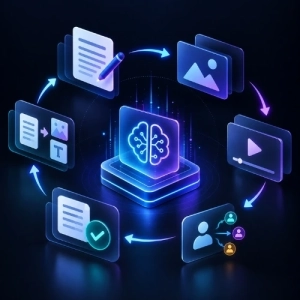
Automate Content Workflows With Generative AI Development Services
Generative AI development services cover content creation, transformation, personalization, and review workflows to increase content velocity across enterprise marketing, product, and operational environments.
Key Features
- LLM-powered content generation for marketing, product, technical, and operational content.
- AI content transformation across formats, channels, and target audiences.
- Context-aware personalization using customer, product, campaign, and business data.
- Human-in-the-loop workflows for content review, approval, and publishing.
Accelerate Software Delivery With AI Code Generation
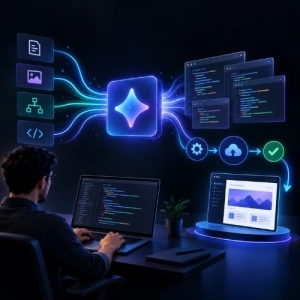
AI code generation that applies generative AI across development, testing, documentation, and legacy modernization to reduce repetitive engineering effort while maintaining enterprise software quality.
Key Features
- AI-powered code generation from requirements and developer instructions.
- Automated test generation to expand application validation and coverage.
- Legacy code transformation for refactoring, documentation, and modernization.
- AI documentation generation from source code and application context.
Generate Synthetic Data With Generative AI Services
Synthetic data generation to create realistic, controlled datasets for testing, experimentation, analytics, and AI development where production data access is limited or restricted.
Key Features
- Synthetic dataset generation for development, testing, and AI experimentation.
- Scenario-based data generation for edge cases and application validation.
- Statistical characteristic preservation for realistic testing and analytical workflows.
- Controlled data generation for repeatable testing and experimentation

Scale Personalization With Generative AI Services
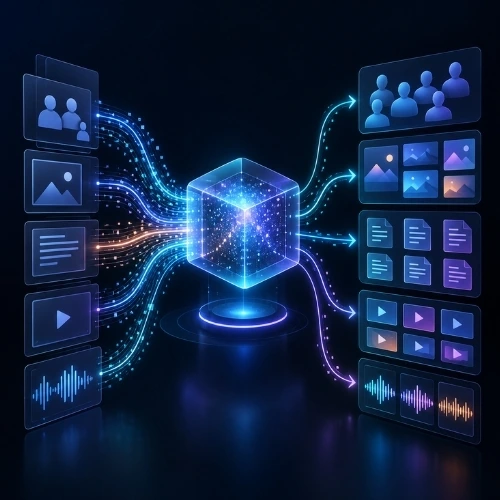
Generative AI personalization to create contextual content variations across audiences, products, campaigns, and customer journeys to support relevant digital experiences at scale.
Key Features
- Dynamic content generation across campaigns, products, and digital experiences
- Contextual generation intelligence using customer and behavioral signals
- Campaign variation generation for audience segmentation and experimentation
- AI-driven content optimization for continuous refinement of generated experiences
Generative AI Integration Services for Enterprise Applications
Generative AI integration services embed AI capabilities into SaaS products, enterprise applications, and workflows, extending existing technology investments without requiring complete application replacement.
Key Features
- Model orchestration layers connecting foundation and specialized AI models.
- Enterprise API integration across applications, databases, and business systems.
- AI application engineering connecting models with interfaces and business logic.
- Generation governance controls for access, validation, review, and monitoring.
Engineering Generative AI for Enterprise Applications
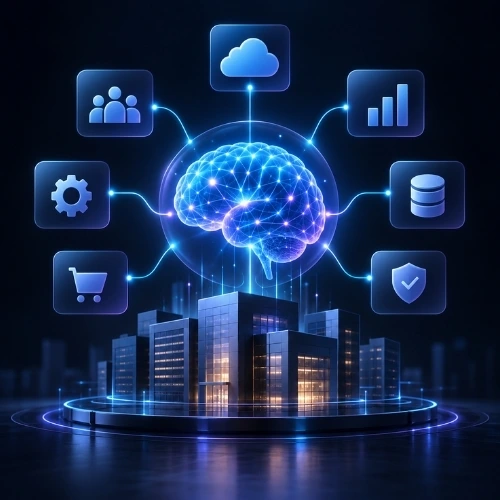
Generative AI architecture services connect models, enterprise data, application logic, and governance controls to build secure, scalable enterprise AI applications for production environments.
Model Architecture
Select and orchestrate foundation, open-source, multimodal, and specialized models through model orchestration based on accuracy, latency, cost, context, and deployment requirements.
Enterprise Data Integration
Connect AI applications with enterprise data sources, APIs, content repositories, vector databases, and business systems for contextual generation through RAG and enterprise data integration.
AI Application Engineering
Engineer APIs, application logic, user interfaces, workflows, and integrations for generative AI application development and LLM integration across production business applications.
Governance & Evaluation
Implement access controls, output validation, human review, monitoring, and generative AI model evaluation frameworks to maintain AI quality, security, compliance, and performance.
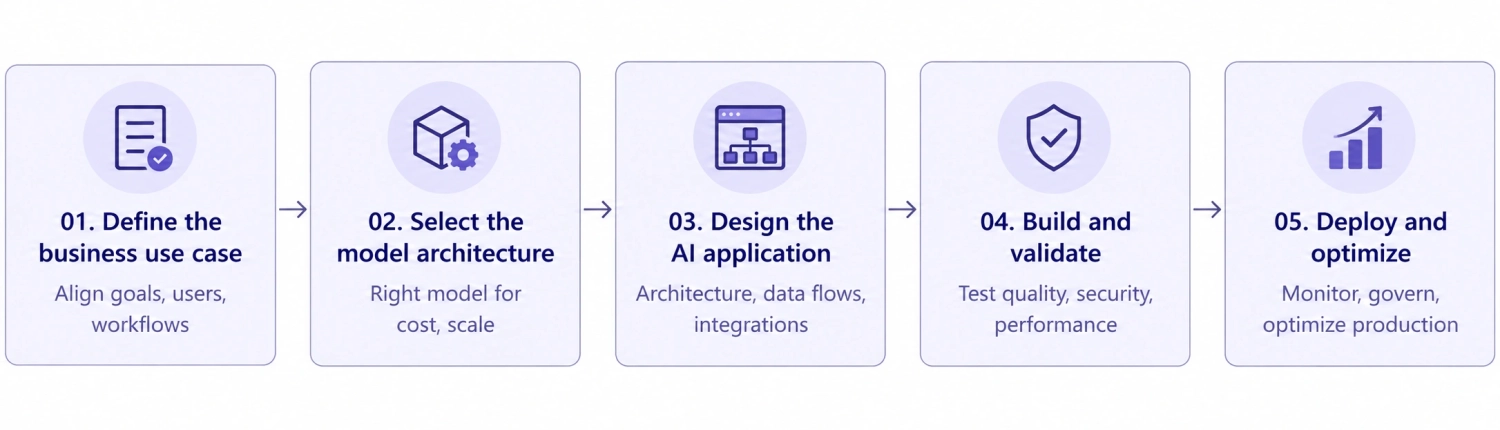
From GenAI Strategy to Production
A structured generative AI development process moves from business requirements and model selection to application engineering, validation, and production deployment, reducing implementation risk and accelerating time to business value.
Build With the Right GenAI Technology
Sigma’s generative AI development services combine LLMs, foundation models, multimodal AI, RAG, model orchestration, and AI application APIs to build scalable applications aligned with enterprise data, security, performance, and business requirements.
Why Businesses Choose Sigma for Generative AI Development Services
Sigma combines product engineering expertise with business-focused AI implementation to turn generative AI investments into measurable outcomes across products, engineering, operations, and customer experiences.
Faster Product Innovation
Launch AI-powered product capabilities faster, accelerate product evolution, and create more differentiated customer experiences.
Greater Engineering Productivity
Reduce repetitive development effort, accelerate software delivery, and increase engineering capacity.
Smarter Business Operations
Automate content and knowledge workflows, reduce manual effort, and improve operational efficiency.
Scalable AI Adoption
Expand GenAI from individual initiatives into repeatable, business-wide capabilities with measurable and sustainable outcomes.
Generative AI vs. Conversational AI
Sigma’s Generative AI Development Services embed generative AI into products, enterprise applications, content workflows, data environments, and business processes to create scalable AI-powered capabilities.
Generative AI
|
|
|
Conversational AI
|
|
|
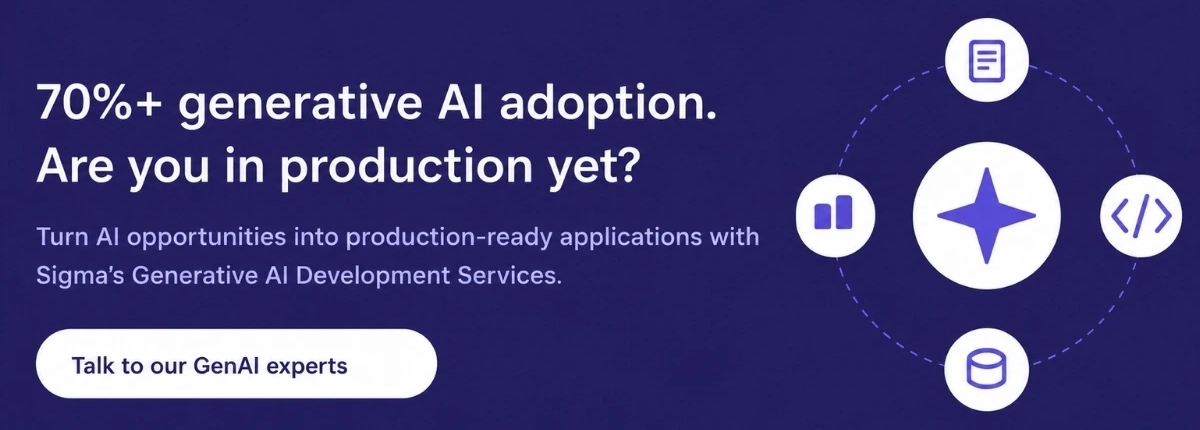
Generative AI Development Services. Real Business Impact.
Applying generative AI development, RAG, enterprise AI integration, and AI application engineering to modernize business systems, connect enterprise data, and build production-ready AI applications.
- Model Orchestration
- RAG
- Enterprise Data Integration
- Enterprise AI Integration
- AI Application Engineering
- Legacy Modernization
Build Generative AI Into the Software That Matters
Move beyond experimentation with generative AI development services engineered around your products, data, workflows, and business outcomes.
Our Clients





















Success Stories

Learn how AWS cloud modernization helped a U.S. lender achieve scalability, speed, and security across its lending and servicing operations.
Read more
Discover how a smarter LMS helped a U.S. lender boost scalability, streamline renewals, and improve transparency across loan servicing.
Read more
See how a leading U.S. banking association boosted efficiency, security, and member engagement through innovative tech solutions.
Read more
Frequently Asked Questions
What are Generative AI Development Services?
Generative AI development services cover the strategy, design, development, integration, and optimization of AI applications that generate or transform content, code, data, images, video, and other business outputs. These services support GenAI for enterprises, SaaS products, and AI-powered business workflows.
What does a Generative AI development company build?
A generative AI development company can build enterprise AI applications, AI copilots, knowledge assistants, content generation solutions, document intelligence systems, AI-powered personalization, and workflow automation solutions tailored to business requirements.
How can Generative AI be integrated into existing enterprise applications?
Generative AI integration services connect AI capabilities with existing applications, enterprise data, APIs, and workflows. Approaches such as RAG, vector databases, model orchestration, and LLM integration provide contextual intelligence without requiring complete application replacement.
Can Generative AI development support personalized marketing content?
Yes. Generative AI for personalized marketing content can generate audience-specific messaging, product content, campaign variations, and digital experiences using relevant customer, product, and behavioral context.
What is AI-powered code generation used for?
AI-powered code generation for developers can accelerate software development by generating code, tests, documentation, and modernization workflows. It can reduce repetitive engineering work while supporting application maintenance and legacy modernization.
Can Generative AI generate synthetic data for enterprise AI?
Yes. Synthetic data generation with generative AI creates realistic, controlled datasets for software testing, AI development, analytics, and experimentation where production data access is limited, sensitive, or impractical.
How do Generative AI consulting and development services differ?
Generative AI consulting focuses on identifying valuable opportunities, assessing data and technology readiness, selecting the right approach, and defining an implementation roadmap. Generative AI development services take those priorities into application architecture, engineering, integration, deployment, and optimization.
How do I choose a Generative AI development partner?
Evaluate partners based on generative AI development experience, enterprise application expertise, product engineering capabilities, integration experience, security practices, and production delivery. The right partner should connect GenAI investments to measurable business outcomes.