Why Alternative Investment Platforms Still Fail After You’ve Bought One: A Technology Leader’s Evaluation Framework

Five criteria decide whether alternative investment software survives contact with a real fund, and none of them appears in a standard demo: whether the data model tolerates irregular valuations, whether the waterfall can be configured rather than coded, whether the investor portal is a reporting surface or a marketing page, whether the audit trail satisfies an examiner rather than an internal reviewer, and whether reconciliation with the fund administrator is automated or manual.
Firms that skip these questions buy a license and keep the spreadsheets. The demo will not surface them, because a demo runs on curated data that behaves. This article sets out how to test each one before signing and what the answers imply for the build, buy, or hybrid decision.
Key Highlights:
- A fund selects a platform on the strength of a demo, then discovers it cannot model the waterfall or reconcile with the administrator, leaving spreadsheets running alongside a paid license.
- The demo will not surface this, because it runs on curated data that behaves; the gaps only appear once the platform meets a real fund’s actual complexity.
- Testing the data model against that complexity and requiring the vendor to configure one real waterfall during the evaluation turns the process into an actual test, producing either a platform that retires the spreadsheets or a documented reason to build.
- Sigma runs these evaluations as an independent technology partner, which keeps requirements definition and build-versus-buy analysis separable from implementation work.
What Is Alternative Investment Software?
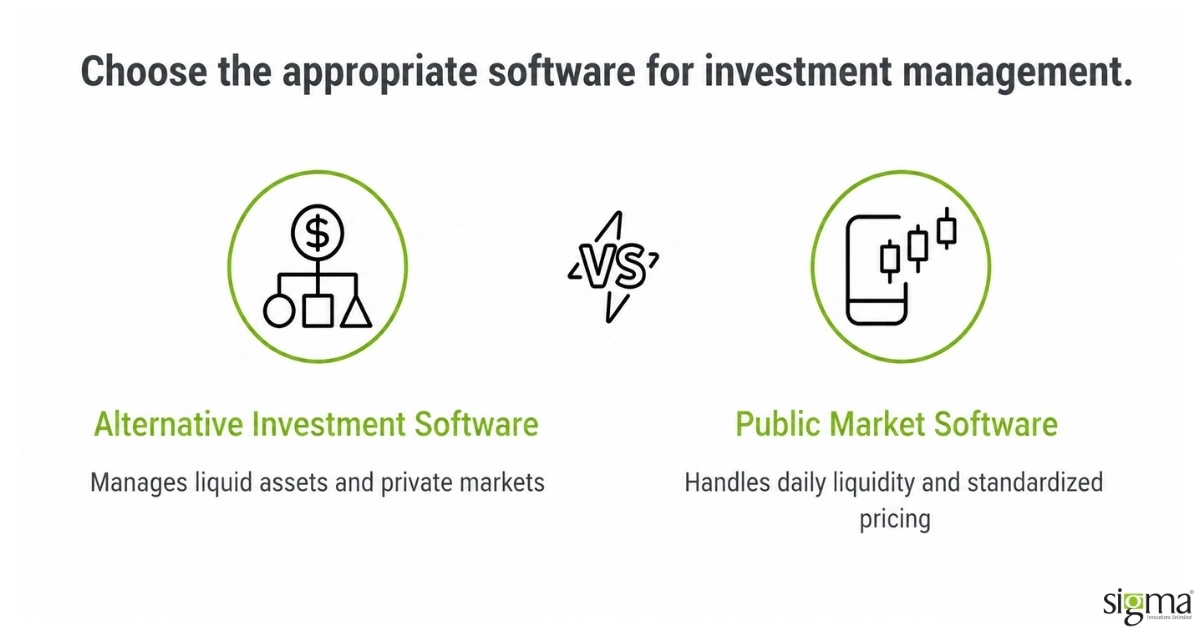
Alternative investment software is a system of record for private market funds that models illiquid assets, capital calls, distribution waterfalls, and investor reporting. Public market portfolio management software assumes daily liquidity, standardized pricing, and centralized exchange data. Private equity, private credit, and real assets have none of those, which is why general-purpose portfolio systems fail in this category rather than merely underperforming.
Read the blog: Wealthtech Platform: Closing the Experience Gap with Digital-First Investors
The Five Criteria Most Buyers Miss
Each criterion below has a test attached, because the criterion alone is not useful without a way to check it.
Data model flexibility for illiquid assets: Ask the vendor to load a portfolio company with three funding rounds, two valuation revisions, and a partial secondary sale. If the system requires a workaround for any of these, every future position with the same shape will require the same workaround.
Waterfall and capital call handling: Ask the vendor to configure your actual distribution waterfall during the evaluation, using your LPA (Limited Partnership Agreement) terms, with European and American variants if you run both. If the answer involves professional services after signature, the waterfall is not configurable; it is bespoke development sold as configuration.
Investor portal depth: Ask what an LP (Limited Partner) can do without contacting the firm. Retrieving signed agreements, viewing realized and unrealized gains, seeing valuation history, and downloading tax documents are the useful functions. A portal that displays a performance number and nothing else transfers no work away from the operations team.
Audit trail quality: Ask what the system records when a valuation changes: prior value, new value, who changed it, when, and against what supporting document. An audit trail that captures the change but not its justification will not survive an examination or an LP diligence request.
Fund administrator integration: Ask how positions, cash, and NAV reconcile with the fund administrator and how exceptions surface. Manual reconciliation against an administrator’s monthly file is the single most common reason a firm keeps its spreadsheets after implementation.
Weight these according to what actually breaks in your operation. A firm running one straightforward waterfall and five administrators weighs integration heavily. A firm running one administrator and four bespoke waterfall structures weighs configurability heavily. A generic weighting produces a generic answer.
Build an alternative investment platform that passes these five tests before you sign, not after.
Why Limited Partner (LP) Reporting Expectations Changed in 2026
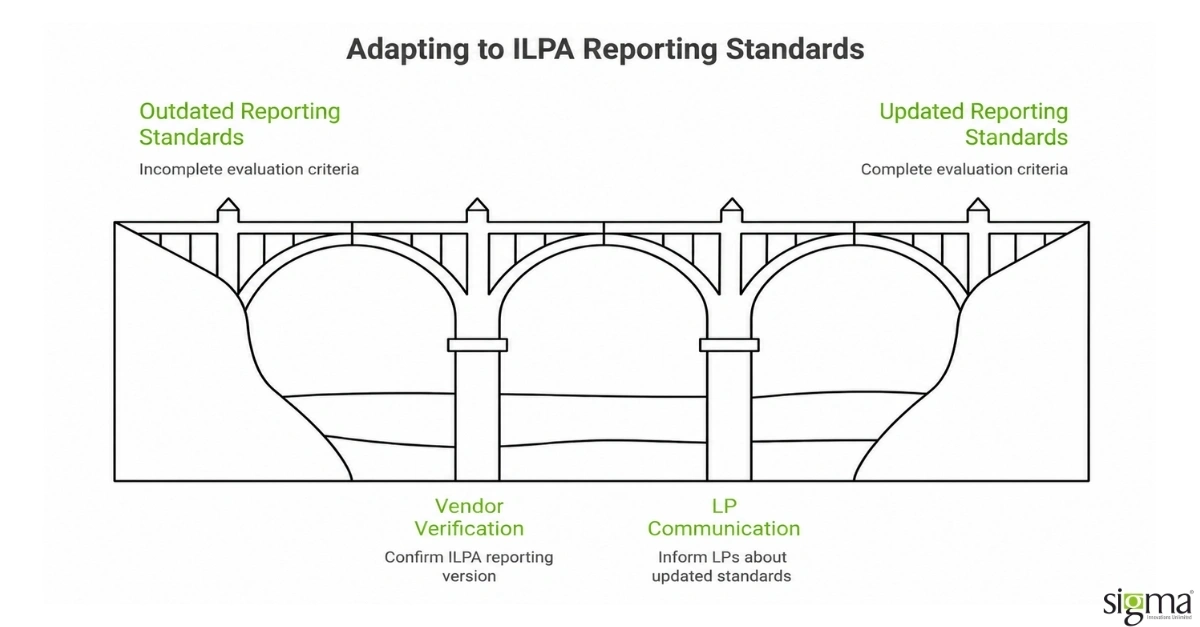
Evaluation criteria that were reasonable in 2023 are now incomplete because the reporting standard moved. The Institutional Limited Partners Association released version 2.0 of its Reporting Template in January 2025, the first update since the template was introduced in 2016, as part of its Quarterly Reporting Standards Initiative. Alongside it, ILPA introduced a performance template, which had no predecessor, and subsequently refreshed the Capital Call and Distribution Template to align with both.
Two consequences follow for a buyer. First, any platform evaluated before 2025 was assessed against the older template, so a vendor’s claim of ILPA reporting standards alignment needs a version attached to it. Second, ILPA has estimated that more than half of funds already used the original Reporting Template, which means the updated version will propagate through LP expectations regardless of whether a given fund’s LPs have asked for it yet.
Read the blog: Why Off-the-Shelf Investment Tools Are Failing—and How Investment Software Development Fills the Gap
Should You Build, Buy, or Combine the Two?
Comparison of approaches
| Criterion | Buy | Build | Hybrid |
| Time to first useful output | Weeks to months, assuming the data model fits | Six months and upward | Months, with the bought component live first |
| Waterfall fidelity | Constrained by the vendor’s configuration surface | Exact, at the cost of maintaining the logic | Exact where built, standard where bought |
| Ongoing cost profile | License plus professional services for each structural change | Engineering capacity, permanently | License plus a smaller engineering commitment |
| Administrator integration burden | Vendor-maintained where a connector exists, custom where it does not | Entirely yours | Split by component |
| Fit when strategies are unusual | Poor | Strong | Strong, if the boundary is drawn correctly |
| Key risk | Paying for a system that does not retire the spreadsheets | Underestimating reporting and audit scope | An unclear boundary producing duplicate data |
The hybrid column is where most mid-market funds land, and the reason is structural. Fund accounting, general ledger, and administrator reconciliation are commodity problems worth buying. Waterfall logic, LP-specific reporting, and the investor portal are where a firm’s actual differences live, and those are frequently worth building around a bought core.
Build the firm-specific logic that configuration alone won’t reach – waterfall rules, LP reporting, and portal depth, around a commodity core.
What a Requirements Definition Produces Before Any Vendor Is Contacted
The diagnostic that tells you an evaluation went wrong is simple. Six months after go-live, the operations team still maintains a spreadsheet, and that spreadsheet is authoritative for something. When Sigma is brought into these situations, the cause is almost never that the wrong vendor was selected. It is that the firm’s actual requirements were never written down in a form a vendor could be tested against, so the evaluation defaulted to comparing feature lists.
The work Sigma does first is therefore documentary rather than technical. Every recurring operational task is traced from trigger to output: who initiates it, which system holds the source data, what transformation happens, where the result lands, and which of those steps is currently a person with a spreadsheet. That map is what converts a feature comparison into a test. A vendor can claim capital call support, but the map states that your capital calls require investor-specific side letter treatment, and that specific claim can be checked in a demo environment.
Build-versus-buy analysis follows from the map rather than preceding it. Where the map shows commodity workflows, the recommendation is usually to buy. Where it shows firm-specific logic that recurs, building around a bought core is the answer, and the map defines exactly where the boundary sits.
This is the same requirements-first approach Sigma applies across growth-stage fintech and SaaS platforms more broadly, not just fund technology, the boundary-drawing discipline doesn’t change, only the domain logic does. Where a build is warranted in the fund context specifically, the shape of the work is visible in an engagement for a boutique capital formation firm that connects accredited investors to curated opportunities through a pooled club model.
See how the same requirements-first discipline applies across fintech product builds beyond fund technology.
Where a build is warranted, the shape of the work is visible in an engagement for a boutique capital formation firm that connects accredited investors to curated opportunities through a pooled club model. Its deal management, agreements, performance tracking, and investor communications were manual and fragmented. Sigma built a custom web platform with separate roles for administrators, operations staff, and investors. Portfolio company management handled funding rounds, equity details, and valuation history. Deal and agreement management generated deals with auto-generated codes and integrated DocuSign for e-signature, with templates by industry and investor type. The investor dashboard exposed total and current investment value, realized and unrealized gains, a cap table, industry-weighted performance, and downloadable signed agreements. Automated email alerts fired on valuation changes, with in-app notifications through WebSockets. Role-based access controls governed what each user type could see, and an audit trail captured valuation changes and deal creation specifically, because those are the two events an examiner asks about. The stack was React, Django, and PostgreSQL on AWS.
Read the full build behind a boutique capital formation firm’s investment operations platform.
Reporting sits adjacent to this and is often underscoped. In a separate engagement, Sigma built due diligence reporting on Power BI serving more than 50,000 users globally, which is the class of problem where the constraint is data lineage rather than visualization.
What remains with the firm throughout is worth naming, because misplaced expectations here are common. Sigma does not set valuation methodology, define accounting policy, or interpret LPA terms. Those belong to the CFO, the administrator, and counsel. What Sigma builds is the system that executes those decisions consistently and can evidence them afterward.
See how Power BI integration reshaped due diligence reporting at scale.
Conclusion
Alternative investment software fails buyers most often at the data model rather than at the feature list. The five criteria that decide the outcome are data model flexibility for illiquid assets, configurable waterfall and capital call handling, investor portal depth measured by what an LP can do unaided, audit trail quality measured by whether it records justification rather than only change, and the degree to which fund administrator reconciliation is automated. Each has a test that can be run inside an evaluation rather than discovered after signature.
Weighting those five against your own operation matters more than any vendor’s scoring matrix, because the criterion that breaks your fund is specific to your structures. Reporting expectations moved in January 2025 when ILPA released version 2.0 of its Reporting Template and introduced a Performance Template, which means a vendor’s claim of alignment now requires a version number attached. The build, buy, and hybrid comparison usually resolves toward hybrid for mid-market funds, with commodity accounting bought and firm-specific waterfall, reporting, and portal logic built around it. Drawing that boundary correctly depends on having mapped the operation first, which is why requirements definition precedes vendor contact rather than following it.
The diagnostic for an evaluation that went wrong is an authoritative spreadsheet still running six months after go-live, an outcome that traces back to requirements never written in testable form rather than to a poor vendor choice. Valuation methodology, accounting policy, and LPA interpretation remain with the firm regardless of what is bought or built. What the technology decides is only how consistently those judgments are executed and how well they can be evidenced later.
FAQs
What is alternative investment software?
Alternative investment software is a system of record for private market funds, covering illiquid asset valuation, capital calls, distribution waterfalls, and investor reporting. It differs from public market portfolio systems, which assume daily liquidity and standardized pricing that private equity, private credit, and real assets do not provide.
Should we build or buy fund software?
Buy the commodity layer: fund accounting, general ledger, and administrator reconciliation. Build where firm-specific logic recurs, typically waterfall calculation, LP-specific reporting, and the investor portal. Most mid-market funds land on a hybrid, and the boundary between the two is set by mapping operations before contacting vendors.
How long does implementation take?
A bought platform reaches useful output in weeks to months when the data model fits the fund’s structures. A build runs six months and upward. The variable that moves the timeline most is data migration off spreadsheets, which is consistently underestimated in vendor implementation schedules.
What integrations matter most?
Fund administrator reconciliation matters more than any other integration, because manual reconciliation is the reason spreadsheets survive implementation. After that, general ledger and document signature. Market data integrations matter less in private markets than buyers expect, since valuations are periodic rather than continuously priced.
Can the software model our waterfall?
Do not accept an assertion. Require the vendor to configure your actual waterfall during the evaluation, using your LPA terms and both European and American variants if applicable. If configuration requires post-signature professional services, the capability is custom development priced as a standard feature.