How Much Does React Native App Development Cost? Key Insights for Businesses in 2026

Key Highlights:
- Businesses that underestimate React Native app development complexity often face budget overruns, delayed launches, and growing maintenance costs caused by unclear scope definitions and integration challenges.
- React Native remains one of the most cost-efficient frameworks for cross-platform mobile app development, allowing businesses to reduce duplicate engineering effort by sharing up to 70% of code between iOS and Android applications.
- Sigma Infosolutions delivers React Native app development services with structured discovery, effort-based cost forecasting, and scalable cross-platform engineering models that improve budget predictability and delivery efficiency.
React Native app development has become a strategic choice for businesses looking to launch mobile applications faster without doubling engineering investments across iOS and Android platforms. As organizations prioritize digital products, customer engagement, and mobile-first experiences in 2026, understanding React Native app development cost is no longer just a budgeting exercise, it is a critical business planning decision that directly affects delivery timelines, scalability, and long-term product sustainability.
However, mobile app development pricing varies significantly depending on application complexity, backend architecture, third-party integrations, testing requirements, and the location of the engineering team. Many businesses enter development with incomplete scope definitions or unrealistic cost expectations, which often leads to budget overruns, delayed releases, and expensive post-launch revisions.
This blog breaks down the core factors that influence React Native app development cost in 2026, including project scope, engagement models, hidden expenses, infrastructure considerations, and maintenance planning. It also explores how businesses can evaluate development approaches more strategically to improve budget predictability, reduce technical debt, and accelerate time to market.
Sigma Infosolutions delivers React Native app development services with structured discovery, feature-level estimation, scalable cloud engineering expertise, and cross-platform product development capabilities that align technology investments with long-term business growth objectives.
Why Businesses Struggle to Budget React Native App Development
Estimating React Native app development cost accurately is one of the most common challenges businesses face before committing to a mobile project. Without a clear understanding of what drives pricing, organizations either underfund their builds or allocate budgets based on market averages that do not reflect their actual requirements. The result is scope expansion, delayed delivery, and strained vendor relationships.
The difficulty is compounded by the wide range of variables involved. App complexity, third-party integrations, backend infrastructure, and geographic location of the development team all affect the final cost. Businesses that treat mobile app development as a fixed-price commodity consistently encounter problems that structured planning would have prevented.
Core Factors That Determine React Native App Development Cost
App Complexity and Feature Scope
The single largest driver of React Native app development cost is the complexity of features the application must support. A basic informational app with static content and a contact form sits at a fundamentally different price point than a multi-role platform with real-time data sync, payment processing, and custom animations. Development hours scale directly with feature count, and underestimating this relationship is the most common source of budget overruns.
Authentication systems, push notifications, geolocation services, and offline functionality each require distinct engineering effort. When these features interact, such as syncing offline actions to a live backend upon reconnection, the complexity multiplies. Businesses should document every user story before requesting a quote, as vague briefs generate inaccurate estimates.
Development Team Location and Engagement Model
App development pricing varies significantly based on where the development team is located. US-based developers typically bill between $100 and $200 per hour, while offshore teams with equivalent technical expertise bill between $25 and $60 per hour. For a mid-complexity application requiring 1,500 to 2,000 development hours, this difference translates to a total cost variance of $60,000 or more.
The engagement model also affects total cost. A fixed-price contract provides budget certainty but limits flexibility when requirements change. A time-and-materials model offers adaptability but requires closer client oversight to prevent scope drift.
Third-Party Integrations and Backend Infrastructure
Modern mobile applications rarely operate in isolation. Integration with payment gateways, CRM platforms, ERP systems, or analytics tools adds both development hours and licensing costs that must be factored into 2026 app technology planning. Each integration requires API mapping, error handling, and testing cycles that add measurable time to the project timeline.
Backend infrastructure decisions also carry cost implications. A serverless architecture on AWS or Azure reduces upfront infrastructure costs but introduces per-transaction pricing that must be modeled against expected user volume. Businesses that defer these infrastructure decisions until late in the project often face costly architectural revisions.
React Native App Development Cost by Project Type
App Type | Estimated Hours | Approximate Cost (Offshore Team) | Approximate Cost (US-Based Team) |
|---|---|---|---|
Basic App (static content, simple UI) | 300–500 hours | $9,000 – $20,000 | $45,000 – $75,000 |
Mid-Complexity App (authentication, APIs, notifications) | 800–1,500 hours | $25,000 – $60,000 | $100,000 – $200,000 |
Complex App (real-time sync, payments, custom logic) | 2,000–4,000 hours | $65,000 – $150,000 | $250,000 – $500,000 |
Enterprise App (multi-role, integrations, analytics) | 4,000+ hours | $150,000+ | $500,000+ |
Hidden Costs That Affect Mobile App Development Budgets
Post-Launch Maintenance and Updates
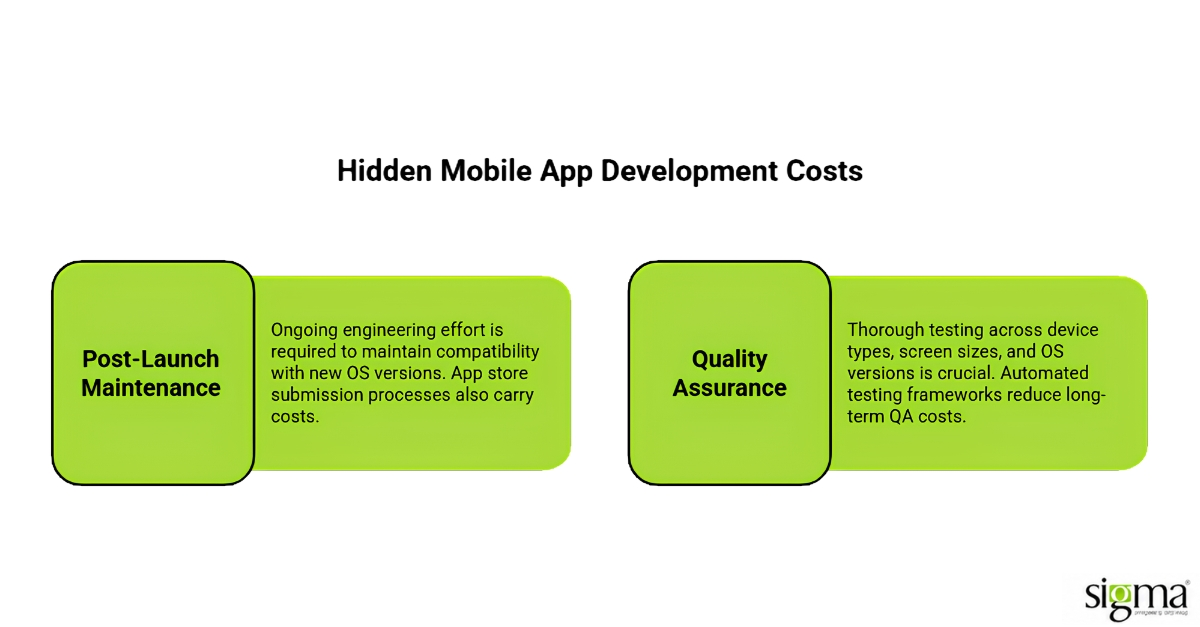
The app development pricing discussion rarely accounts adequately for post-launch costs. React Native releases updates regularly, and maintaining compatibility with new iOS and Android OS versions requires ongoing engineering effort. Businesses should budget approximately 15% to 20% of the initial development cost annually for maintenance, bug fixes, and minor feature updates.
App store submission processes also carry costs that are frequently overlooked. Apple’s developer program charges $99 per year, and both platforms require periodic resubmissions when core libraries or APIs are deprecated. Neglecting these obligations results in apps being removed from stores or flagged as incompatible with current operating systems.
Quality Assurance and Testing
Thorough testing across device types, screen sizes, and OS versions is not optional in professional mobile app development. A mid-complexity React Native application may require 150 to 300 hours of QA effort to achieve release-ready stability. Businesses that compress testing timelines to reduce cost typically absorb those costs later in the form of negative user reviews and emergency hotfix deployments.
Automated testing frameworks reduce long-term QA costs but require upfront investment in test infrastructure and configuration. This is a business insight for app development that experienced vendors will raise proactively during project scoping.
How Sigma Infosolutions Approaches React Native App Development
React Native app development costs are influenced by far more than frontend engineering hours. Businesses planning mobile applications in 2026 must account for backend integrations, API ecosystems, scalability requirements, modernization dependencies, release cycles, and long-term maintenance overhead when evaluating total project investment.
Sigma Infosolutions approaches React Native app development through a product engineering-led model designed to improve delivery predictability, optimize engineering efficiency, and support scalable mobile application growth across evolving business environments.
Scalable Product Engineering for Cross-Platform Mobile Applications
Many businesses initially approach React Native as a faster alternative to native app development, but long-term success depends on how well the application ecosystem scales as product requirements evolve. Feature expansion, user growth, analytics integrations, and platform extensions all influence future engineering effort and operational costs.
Through Enterprise Product Engineering Services, Sigma supports businesses building scalable digital products with:
- Cross-platform engineering expertise
- Product scalability planning
- Continuous feature enhancement support
- Faster release management workflows
- Long-term application sustainability strategies
This engineering approach helps businesses reduce rework cycles while supporting faster product evolution over time.
Agile Development Models That Improve Delivery Predictability
One of the biggest contributors to React Native budget overruns is uncontrolled scope expansion during development. Businesses often struggle with changing requirements, delayed feedback cycles, and unclear engineering visibility that impact delivery timelines and cost forecasting.
Agile Custom Software Development Services from Sigma improve React Native execution through:
- Sprint-based engineering delivery
- Iterative feature validation
- Faster stakeholder feedback loops
- Improved development transparency
- Better release planning and prioritization
This agile delivery structure improves flexibility while creating greater visibility into engineering progress and development effort.
API Integration Strategy for Connected Mobile Ecosystems
Modern React Native applications rarely function in isolation. Payment gateways, CRMs, ERP systems, analytics platforms, authentication layers, and third-party services all introduce integration complexity that directly affects mobile app development pricing.
Through Sigma’s API Development Services, Sigma strengthens mobile ecosystems with:
- API-first engineering approaches
- Third-party platform integrations
- Secure backend connectivity
- Real-time synchronization frameworks
- Enterprise interoperability support
This integration-focused engineering model reduces instability, improves scalability, and supports more efficient application performance.
Extending React Native Applications Across Web and Mobile Ecosystems
Many businesses building React Native applications also require connected web platforms for customer onboarding, dashboards, analytics, ecommerce workflows, and SaaS experiences. Aligning frontend engineering strategies across mobile and web environments improves development efficiency, UI consistency, and long-term product scalability.
Sigma supports unified frontend engineering across React Native and React.js ecosystems, helping businesses build scalable digital experiences that maintain consistency across mobile and web platforms. The company’s React-based engineering capabilities support reusable component architectures, scalable frontend development, API-connected user experiences, and long-term application maintainability across evolving product ecosystems.
Supporting Mobile-Led Product Modernization Initiatives
Many businesses investing in React Native applications are simultaneously modernizing legacy systems, replacing outdated platforms, or extending existing enterprise applications into mobile environments. Without modernization planning, businesses often inherit technical debt that increases long-term maintenance costs.
Sigma’s Software Modernization Services support React Native transformation initiatives through:
- Legacy application modernization
- Frontend and UI modernization
- Platform migration strategies
- Technical debt reduction
- Scalability-focused transformation planning
This modernization capability helps businesses align mobile application investments with broader digital transformation goals.
React Native Engineering Focused on Long-Term Business Scalability
Sigma’s React Native engineering teams work across navigation architecture, state management, backend integration, native module connectivity, cloud-aligned application delivery, and scalable mobile infrastructure planning. The company’s delivery approach focuses on creating React Native applications that support long-term business growth instead of short-term feature delivery alone.
By combining product engineering expertise, agile execution models, API integration capabilities, and modernization support, Sigma Infosolutions helps businesses improve React Native app development cost predictability while building scalable mobile application ecosystems designed for continuous growth and operational efficiency.
Read our success story: Forex Trade Alert Software for Real-Time Day Trading Notifications
Conclusion
React Native continues to be one of the most cost-efficient frameworks for businesses looking to build scalable cross-platform mobile applications without maintaining separate iOS and Android codebases. However, accurately estimating React Native app development cost in 2026 requires businesses to evaluate far more than frontend development effort alone. Application complexity, backend integrations, API ecosystems, infrastructure planning, QA requirements, scalability goals, and long-term maintenance strategies all play a critical role in determining total project investment.
Businesses that approach React Native development with clearly defined scope requirements, scalable engineering strategies, and structured delivery models are better positioned to control costs, accelerate time-to-market, and reduce long-term technical debt. As mobile ecosystems become increasingly connected across web, cloud, SaaS, and enterprise platforms, engineering scalability and architectural planning will continue to shape mobile app development pricing decisions.
Sigma Infosolutions combines React Native engineering expertise with product engineering, API integration, modernization, and agile software delivery capabilities to support scalable mobile application development aligned with long-term business growth objectives.
Plan scalable React Native applications with predictable development costs and faster delivery outcomes.
Frequently Asked Questions
Q: What is the average React Native app development cost for a mid-sized business app?
A: A mid-complexity React Native app with authentication, API integrations, and push notifications typically costs between $25,000 and $60,000 with an offshore development team. US-based development for the same scope generally falls between $100,000 and $200,000.
Q: How does mobile app development pricing differ between React Native and native development?
A: React Native reduces cost by sharing a single codebase across iOS and Android, which lowers total development hours compared to building two separate native applications. For most business use cases, the performance difference between React Native and fully native apps is negligible.
Q: What hidden costs should businesses anticipate in app development pricing?
A: Post-launch maintenance, OS compatibility updates, app store fees, and QA effort are frequently underrepresented in initial quotes. Budgeting 15% to 20% of the build cost annually for ongoing maintenance is a reasonable baseline for most applications.
Q: How does team location affect 2026 app technology budgets?
A: Developer hourly rates can range from $25 to $60 for offshore teams and $100 to $200 in the US, creating significant total cost differences for the same scope. Many businesses use a hybrid model with US-based project management and global engineering teams to balance cost and communication.
Q: What factors make a React Native project more expensive than initially estimated?
A: Scope changes after development begins, underspecified integrations, and insufficient QA planning are the most common causes of budget overruns. A structured discovery phase before development starts significantly reduces the risk of unplanned cost increases.
Q: How long does React Native app development typically take for a business application?
A: A mid-complexity application generally requires four to six months from discovery to app store submission, assuming a stable set of requirements and a dedicated development team. Enterprise-grade applications with complex integrations may require nine to twelve months.
Q: What business insights for app development should guide platform selection in 2026?
A: React Native is well-suited for businesses that need to reach both iOS and Android users without doubling their development investment. It is less appropriate for applications requiring deep hardware access or frame-rate-intensive graphics, where native development may be necessary.
Q: How should businesses evaluate a React Native development vendor?
A: Review the vendor’s portfolio for applications of similar complexity, verify their quality management processes, and request a detailed effort estimation breakdown before signing a contract. Vendors who provide only high-level quotes without feature-level breakdowns represent a budget risk.