How to Build an AI-Powered Recommendation Engine for Your App

Key Highlights
- Product teams at eCommerce, SaaS, and consumer app companies know that personalized recommendations drive engagement and revenue but lack the machine learning expertise to design and build them effectively.
- A well-architected AI recommendation engine using collaborative filtering, content-based filtering, or a hybrid ML approach can deliver real-time personalized recommendations that scale with your user base.
- Sigma Infosolutions designs and builds recommendation systems using proven ML architectures, productionizing them with measurable impact on user engagement, conversion, and retention.
Introduction
Every time a user sees “You may also like” or “Recommended for you,” a recommendation engine is working behind the scenes. These systems have moved from being a competitive advantage reserved for Amazon and Netflix to a baseline expectation for any consumer or B2B product that manages user behavior data. The gap between apps that personalize and apps that do not is now reflected directly in engagement metrics, average order value, and churn rates.
An AI-powered recommendation engine analyzes user behavior, item attributes, and contextual signals to surface content, products, or actions most relevant to each individual. Building one requires more than choosing an algorithm. It requires thoughtful data architecture, model selection, real-time infrastructure, and a feedback loop that improves predictions over time.
For CTOs and product leads who have the data but lack the ML engineering depth to build a production-grade system, this blog provides a practical walkthrough of how recommendation engines work, which approach fits which use case, and what it actually takes to ship one.
How AI Recommendation Engines Work
At their core, recommendation engines are machine learning models that predict which items a user is most likely to engage with or purchase, based on historical signals. These signals can include clicks, purchases, time spent, search queries, ratings, and even the sequence in which a user interacts with content.
The engine takes these signals, processes them through a model trained on your data, and produces a ranked list of items personalized to each user. The quality of the output depends on the volume and quality of the input data, the model architecture chosen, and how frequently the model is retrained or updated.
Most production recommendation systems operate across two phases. The first is candidate generation, where the system narrows a catalog of millions of items down to a few hundred candidates for a given user. The second is ranking, where a more precise model scores and orders those candidates based on predicted relevance. This two-stage architecture balances computational efficiency with recommendation quality.
Turn User Data into Intelligent Product Experiences
Building a recommendation engine requires more than a machine learning model. Sigma Infosolutions develops production-ready AI solutions—from recommendation systems and predictive analytics to intelligent search and generative AI applications, that drive measurable business outcomes.
Collaborative Filtering: Learning from User Behavior
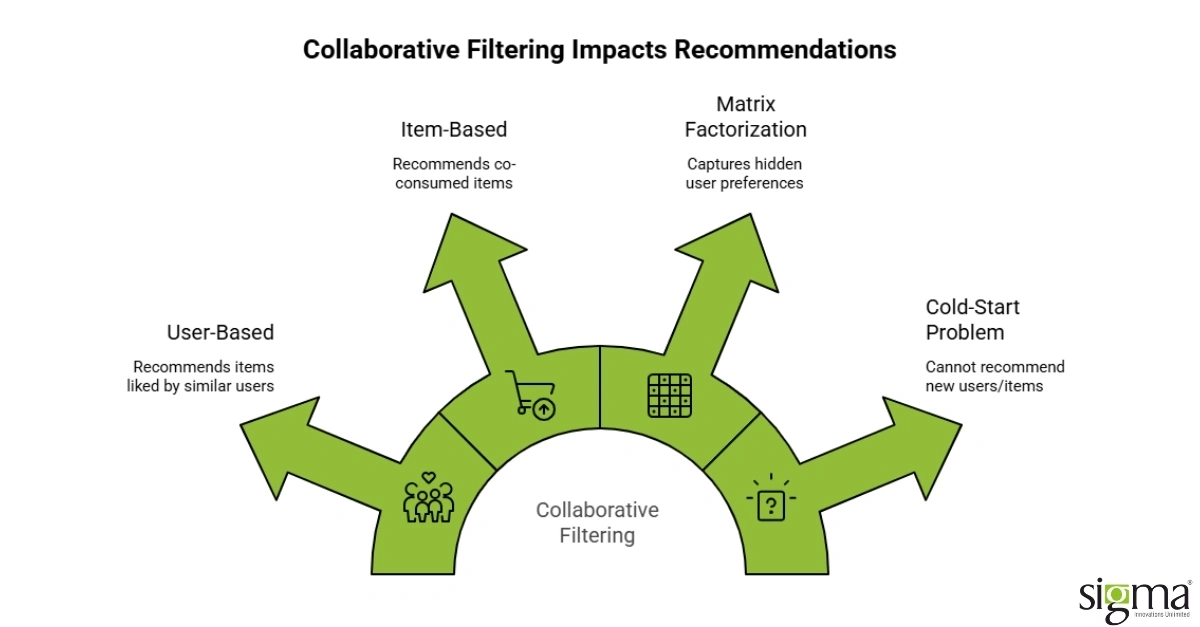
Collaborative filtering is the most widely used approach in recommendation system development. It works by identifying patterns across users rather than analyzing item content directly. The underlying logic is straightforward: if User A and User B have similar interaction histories, items that User B engaged with but User A has not yet seen become strong recommendations for User A.
There are two variants of collaborative filtering:
- User-based collaborative filtering: Finds users with similar behavior profiles and recommends items those users liked. This approach works well for platforms with dense interaction data but can degrade in performance as the user base scales.
- Item-based collaborative filtering: Finds items that tend to be co-consumed and recommends related items based on what the current user has already interacted with. This is typically more scalable and stable for large catalogs.
Matrix factorization techniques, including Singular Value Decomposition (SVD) and Alternating Least Squares (ALS), are the most common algorithmic implementations of collaborative filtering. They decompose the user-item interaction matrix into latent factor representations that capture hidden preferences. Libraries like Implicit and Surprise in Python make these models accessible to engineering teams getting started.
The main limitation of collaborative filtering is the cold-start problem. New users with no interaction history and new items with no engagement data cannot be effectively recommended using this approach alone.
Also, read the blog: AI Chatbot Development Cost in 2026: Key Factors, Price Ranges, and Budget Planning Tips
Content-Based Filtering: Using Item and User Attributes
Content-based filtering approaches the recommendation problem differently. Instead of relying on the behavior of other users, it builds a model of each user’s preferences based on the attributes of items they have already engaged with. If a user consistently reads articles about cloud infrastructure, the engine recommends more content with similar attributes.
This approach requires rich item metadata. For a product catalog, that means structured attributes like category, brand, price range, and material. For content, it means topic tags, author, reading level, and semantic embeddings generated from the text itself. Modern content-based systems use embeddings produced by transformer models like BERT or sentence transformers to represent items as dense vectors in a shared semantic space.
The practical advantage of content-based filtering is that it handles new items well. As soon as an item’s attributes are indexed, it can be recommended to users whose preference profile matches, without needing any engagement history on the new item. This makes it particularly effective for platforms with frequently updated catalogs or long-tail inventory.
Hybrid Recommendation Systems: The Production Standard
Most production recommendation engines do not rely on a single approach. Hybrid systems combine collaborative filtering, content-based filtering, and sometimes additional signals like recency, popularity, and contextual features to produce recommendations that are more robust and accurate than any single method.
The most mature eCommerce platforms use hybrid architectures. A typical hybrid system might use collaborative filtering to generate an initial candidate set, content-based signals to re-rank items for relevance, and a business rules layer to apply merchandising constraints or filter out out-of-stock products.
Building a hybrid system requires more engineering investment but pays off in recommendation quality and resilience. When one signal is weak, for example when a user is new, the other signals can compensate. This architecture also makes it easier to introduce new signals over time without rebuilding the core model.
Read our success story: How an AI-Powered Intake & CRM Platform Streamlined Patient Operations for a Leading Hair Restoration Clinic
Real-Time Recommendations: Infrastructure Considerations
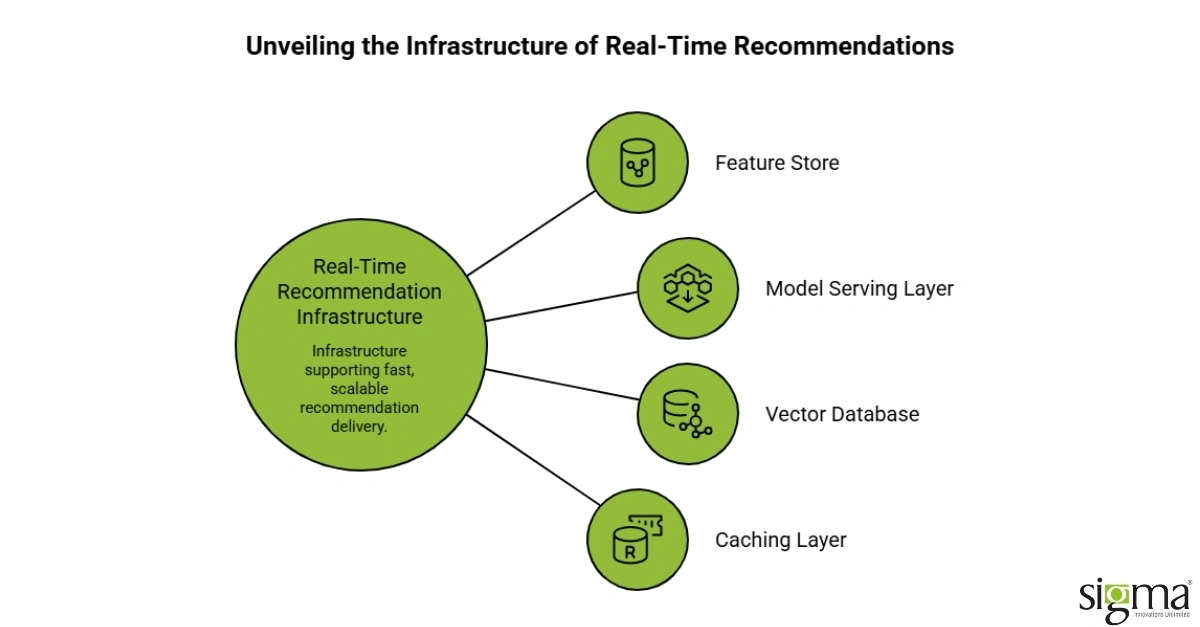
Serving recommendations in real time at scale introduces infrastructure requirements that go beyond the model itself. A user visiting your homepage or browsing a product page expects recommendations to load in under 200 milliseconds. Achieving that consistently across millions of users requires careful architecture.
Key infrastructure components for a production recommendation system include:
- Feature store: A centralized system for storing and serving user and item features in real time. Tools like Feast or Tecton are commonly used in production environments.
- Model serving layer: A low-latency inference endpoint that takes user context as input and returns a ranked list of recommendations. FastAPI, TensorFlow Serving, or managed options like SageMaker Endpoints are common choices.
- Vector database: For embedding-based retrieval, databases like Pinecone, Weaviate, or pgvector enable fast approximate nearest-neighbor search across large item catalogs.
- Caching layer: Pre-computing recommendations for high-traffic users and caching results in Redis significantly reduces latency and compute cost.
A mid-size eCommerce company that re-architected its recommendation infrastructure around a vector database and feature store reduced recommendation latency from over a second to under 100 milliseconds, directly contributing to a measurable lift in add-to-cart rate.
Also, read the blog: Building a Recommendation Engine That Doesn’t Feel Generic: The Architecture Behind True AI Personalization
Measuring Recommendation Engine Performance
Building the model is only part of the work. Measuring whether your recommendation engine is actually driving business outcomes requires both offline and online evaluation.
Offline evaluation uses historical data to measure how well the model predicts known interactions. Common metrics include Precision@K, Recall@K, Mean Average Precision (MAP), and Normalized Discounted Cumulative Gain (NDCG). These metrics are useful for comparing model versions before deployment but do not always translate directly into business impact.
Online evaluation through A/B testing provides the ground truth. Running a controlled experiment that compares recommendation-driven user journeys against a control group measures the actual lift in click-through rate, conversion rate, session depth, and revenue per user. A disciplined A/B testing process is essential for iterating on recommendation quality with confidence.
Measuring recommendation performance requires more than model metrics.
How Sigma Infosolutions Helps Build Production-Grade Recommendation Engines
Sigma Infosolutions works with CTOs and product leads at eCommerce, SaaS, and consumer app companies to design, build, and operationalize AI recommendation engines that deliver measurable engagement and revenue impact.
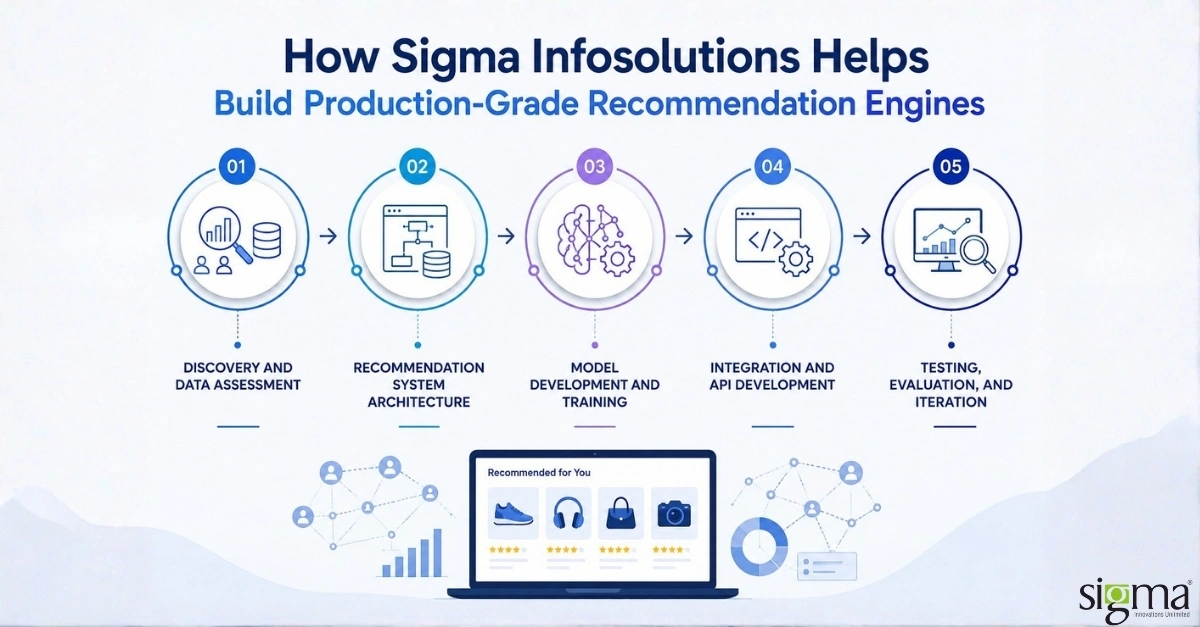
Discovery and Data Assessment
We start by evaluating your existing user behavior data, item catalog, and interaction history to determine which recommendation approach fits your product context. We identify data gaps, cold-start risks, and infrastructure constraints before designing the architecture.
Recommendation System Architecture
Our ML engineers design a recommendation architecture that fits your scale, latency requirements, and team’s ability to maintain it. We document the candidate generation strategy, ranking model design, and serving infrastructure before any code is written.
Model Development and Training
We build and train recommendation models using collaborative filtering, content-based filtering, or hybrid approaches depending on your use case. We use embeddings, matrix factorization, or deep learning architectures based on the data signals available and the quality of recommendations required.
Integration and API Development
We wrap the recommendation engine in a clean API layer that integrates with your frontend, mobile app, or backend services. Whether you need a recommendation API served at the edge or embedded within your existing product infrastructure, we design for reliability and low latency.
Testing, Evaluation, and Iteration
We implement offline evaluation pipelines and support A/B testing frameworks to measure recommendation quality before and after deployment. Post-launch, we iterate on the model as new interaction data accumulates.
Looking to accelerate AI-driven personalization initiatives?
Sigma Infosolutions partners with product and engineering teams to design scalable digital solutions that transform user engagement into measurable business growth.
Conclusion
An AI-powered recommendation engine is one of the highest-leverage investments a product team can make when user behavior data is available and personalization is a product priority. The difference between a well-built recommendation system and a generic one is visible in every engagement metric that matters to your business.
Choosing the right approach, whether collaborative filtering, content-based filtering, or a hybrid ML system, depends on your catalog size, the volume of user interaction data, and your real-time serving requirements. Getting the infrastructure right is as important as getting the model right. Both have to work together for recommendations to deliver consistent, measurable impact.
Recommendation engines are just one example of how modern software can create more personalized, data-driven user experiences. Whether you’re building a new digital product, modernizing legacy systems, or scaling a platform for growth, Sigma Infosolutions delivers custom software development solutions tailored to your business goals.
Frequently Asked Questions (FAQs)
1. What is an AI-powered recommendation engine?
An AI-powered recommendation engine is a machine learning system that analyzes user behavior, item attributes, and contextual data to deliver personalized recommendations. These recommendations can include products, content, services, or actions that are most relevant to each user.
2. How does a recommendation engine improve user engagement?
Recommendation engines increase engagement by presenting users with highly relevant content or products based on their interests and past interactions. Personalized experiences typically lead to higher click-through rates, longer session durations, improved retention, and increased conversions.
3. What are the main types of recommendation systems?
The three most common recommendation approaches are:
- Collaborative Filtering – Uses behavior patterns from similar users.
- Content-Based Filtering – Recommends items based on item attributes and user preferences.
- Hybrid Recommendation Systems – Combines multiple approaches to improve recommendation quality and accuracy.
4. What is collaborative filtering in recommendation engines?
Collaborative filtering identifies relationships between users and items based on historical interactions. It recommends products or content that similar users have engaged with, making it one of the most widely used recommendation techniques.
5. What is content-based filtering?
Content-based filtering recommends items with characteristics similar to those a user has previously engaged with. It relies on item metadata, tags, descriptions, categories, or AI-generated embeddings to identify relevant recommendations.
6. Why do most modern applications use hybrid recommendation systems?
Hybrid recommendation systems combine multiple recommendation techniques to overcome the limitations of individual models. They improve accuracy, address cold-start challenges, and provide more reliable recommendations across different user scenarios.
7. What is the cold-start problem in recommendation systems?
The cold-start problem occurs when a recommendation engine has insufficient data about new users or new items. Without historical interactions, the system struggles to generate accurate recommendations until enough engagement data is collected.
8. What data is required to build an AI recommendation engine?
Typical data sources include:
- User clicks and browsing behavior
- Purchase history
- Product or content metadata
- Search activity
- Ratings and reviews
- Session and engagement metrics
The more relevant and high-quality the data, the better the recommendation performance.
9. How are recommendation engines deployed in real-time applications?
Production-grade recommendation systems typically use a combination of feature stores, model serving infrastructure, vector databases, APIs, and caching layers to deliver recommendations with low latency and high scalability.
10. What role do vector databases play in recommendation systems?
Vector databases store and search embeddings that represent users, products, or content in a semantic space. They enable fast similarity searches, making them essential for modern AI-driven recommendation systems that use embeddings and retrieval-based architectures.
11. How do businesses measure recommendation engine performance?
Organizations typically measure recommendation effectiveness using:
- Click-Through Rate (CTR)
- Conversion Rate
- Average Order Value (AOV)
- Revenue Per User (RPU)
- Retention Rate
- Session Duration
- Precision@K, Recall@K, MAP, and NDCG metrics
A/B testing is commonly used to validate real-world business impact.
12. Which industries benefit most from AI recommendation engines?
Recommendation systems deliver value across multiple industries, including:
- eCommerce and Retail
- SaaS Platforms
- Streaming and Media
- EdTech
- FinTech
- Healthcare
- Travel and Hospitality
- Consumer Mobile Applications
13. How long does it take to build a recommendation engine?
The timeline depends on data readiness, complexity, and infrastructure requirements. A basic recommendation system can often be developed in a few weeks, while enterprise-scale hybrid recommendation platforms with real-time personalization may require several months.
14. Can AI recommendation engines integrate with existing applications?
Yes. Recommendation engines are typically exposed through APIs and can be integrated into web applications, mobile apps, eCommerce platforms, SaaS products, CRM systems, and customer-facing portals without requiring a complete platform rebuild.
15. How can Sigma Infosolutions help build a recommendation engine?
Sigma Infosolutions provides end-to-end AI recommendation engine development services, including data assessment, architecture design, model development, API integration, real-time deployment, testing, optimization, and ongoing model improvement. Our team builds scalable recommendation systems designed to improve engagement, conversions, and customer retention.