Website Development Cost in 2026: What Affects Pricing and How to Plan Your Budget

Key Highlights
- Sigma Infosolutions helps businesses plan and execute website development projects with defined scope, transparent pricing, and delivery accountability built into every engagement.
- A well-planned website budget prevents mid-project scope creep, reduces rework costs, and ensures the final product aligns with the business’s actual technical requirements.
- Businesses that proceed without a structured development cost estimate frequently encounter budget overruns, delayed launches, and functionality gaps that require expensive post-launch fixes.
- Global spending on web development services continues to rise, with demand for custom, performance-optimized websites growing steadily across the mid-market and enterprise segments.
Budgeting for a new website is one of the areas where business expectations and technical realities most frequently diverge. Companies often approach website development with a fixed number in mind, only to discover that their requirements, integrations, and performance standards push the actual cost significantly higher. Without a clear understanding of what drives website pricing, organizations make underfunded commitments that result in delayed launches and compromised outcomes. This blog outlines the primary cost factors in 2026, provides realistic budget benchmarks, and explains how to structure a development engagement that delivers measurable value.
What Drives Website Development Cost in 2026
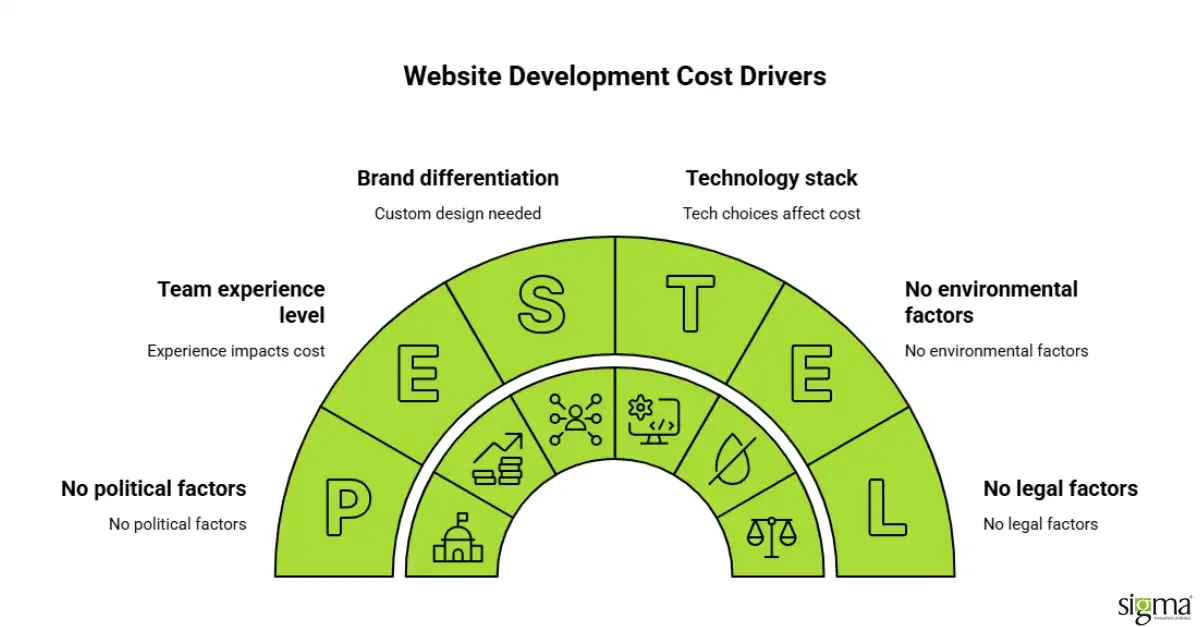
Website development cost is not determined by a single variable. It is the cumulative result of project scope, technology stack, design complexity, integration requirements, and the experience level of the team executing the work.
Custom design work commands a higher price than template-based builds because it requires dedicated UI/UX discovery, wireframing, and iterative review cycles. A site built on a pre-existing theme may cost a fraction of a fully custom design, but it carries constraints in flexibility, brand differentiation, and long-term scalability.
Backend complexity is another major cost driver. Sites requiring custom APIs, third-party integrations, multi-language support, or complex user authentication layers require significantly more engineering hours than standard brochure websites. Each integration adds testing requirements, which compounds both time and development cost.
Stay ahead of the curve – partner with Sigma Infosolutions to turn emerging digital marketing trends into measurable business growth. Get in touch today!
Website Pricing Benchmarks by Project Type
Understanding typical website pricing ranges helps organizations set realistic expectations before entering vendor conversations. The following table provides general benchmarks based on project type and scope.
Website Type | Typical Price Range | Key Cost Drivers |
| Brochure / Informational Site | $5,000 to $15,000 | Page count, copywriting, basic SEO setup |
| Small Business eCommerce | $15,000 to $40,000 | Product catalog size, payment gateway, and UX design |
| Mid-Market eCommerce Platform | $40,000 to $120,000 | Custom integrations, ERP/CRM sync, performance optimization |
| Enterprise Web Application | $120,000 to $300,000+ | Custom architecture, security compliance, and scalability requirements |
| SaaS or Portal Development | $80,000 to $250,000 | User roles, data management, API development, and ongoing iterations |
These figures reflect industry-standard market rates for professional development teams and should be treated as directional rather than fixed. Offshore or blended delivery models can reduce costs by 30 to 50 percent while maintaining quality, provided the vendor has established project management and communication protocols.
How to Build a Realistic Website Budget
A website budget is not simply a cost ceiling. It is a planning document that accounts for discovery, design, development, testing, launch, and post-launch support. Organizations that budget only for the build phase consistently underestimate total project investment.
Discovery and planning typically represent 10 to 15 percent of a project’s total development cost. This phase covers requirements gathering, technical architecture decisions, and content strategy. Skipping or compressing discovery is one of the most common reasons projects exceed budget during execution.
Ongoing costs must also be factored into the website budget from the beginning. Hosting, security updates, plugin or platform licensing, and performance monitoring are recurring expenses that begin the day the site goes live. A budget that accounts for 12 months of post-launch operations gives the organization a complete and accurate picture of total website investment.
Key Variables That Affect Website Pricing
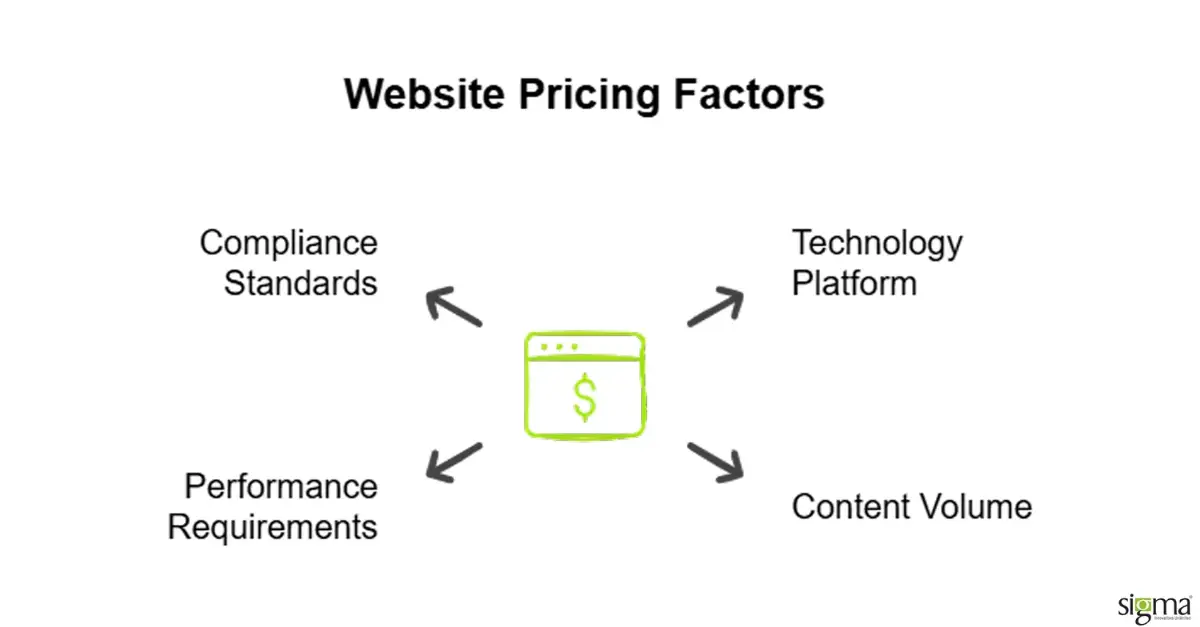
Several specific factors consistently influence final website pricing across project types. Understanding each one helps businesses have more productive conversations with development partners.
Technology platform selection. Open-source platforms such as WordPress or Magento carry lower licensing costs but require more custom development effort. Licensed platforms such as Shopify Plus or Salesforce Commerce Cloud include built-in features but charge subscription fees that add to long-term costs.
Content volume and migration. Organizations with large existing content libraries face additional costs related to content audits, migration, and reformatting. This is especially relevant for companies moving from legacy CMS platforms to modern headless or composable architectures.
Performance and compliance requirements. Sites that must meet specific Core Web Vitals thresholds, accessibility standards such as WCAG 2.1, or data security requirements such as GDPR or PCI DSS require additional engineering and QA investment. These requirements are non-negotiable in regulated industries and should be scoped explicitly.
Empower your teams with the flexibility of headless CMS. Talk to Sigma Experts to design a solution that balances developer freedom with seamless content delivery.
How Sigma Infosolutions Approaches Website Development Engagement
Beyond Building Websites to Structuring Delivery
Website development outcomes are not defined at the point of coding, they are defined much earlier in how the engagement is structured, scoped, and governed. Sigma Infosolutions approaches website development as an engineering-led delivery process where clarity, accountability, and execution discipline are established before development begins. This ensures that complexity is managed upfront and the final solution aligns with business intent, not just technical requirements.
1. Structured Engagement Model Across Project Types
Sigma delivers website development across eCommerce platforms, corporate websites, and SaaS-based portals, with each engagement following a structured delivery model tailored to the nature of the solution.
Rather than applying a one-size-fits-all process, engagements are shaped based on:
- Business model complexity (transactional vs informational vs platform-driven)
- Integration intensity across systems and third-party services
- Scalability expectations across user load and feature expansion
This ensures that delivery is aligned with long-term system behavior, not just initial release scope.
2. Delivery-Aligned Team Structure
Website development at Sigma is executed through specialized engineering pods aligned to domain expertise, including eCommerce engineering, product engineering, and SaaS platform development.
This structure enables:
- Domain-specific technical decision-making at the execution level
- Parallel progress across UI, backend, and integration layers
- Reduced dependency bottlenecks between functional areas
Client communication is managed through US-based engagement ownership, ensuring alignment between business stakeholders and distributed engineering teams.
3. Engineering Governance and Quality Control
Every engagement operates under a defined governance framework that ensures consistency in delivery quality across projects.
Sigma’s delivery governance is guided by:
- ISO 9001:2015 quality management standards, ensuring structured review cycles and controlled delivery processes
- Defined checkpoints across design, development, and release stages
- Standardized validation practices across modules and integrations
This reduces variability in output and ensures predictable execution quality across engagements.
4. Security and Compliance-First Execution Layer
For projects involving sensitive data flows, integrations, or regulated environments, security is embedded into the delivery process rather than treated as a post-development layer.
Sigma’s approach is supported by:
- ISO/IEC 27001:2022 certification for information security management
- Controlled access protocols across environments and systems
- Structured handling of client data, integrations, and deployment pipelines
This ensures that security and compliance considerations remain consistent throughout the development lifecycle.
5. Transparent Execution and Milestone-Based Delivery
Engagements are structured around clearly defined delivery milestones, ensuring that progress is measurable and aligned with business expectations.
This model supports:
- Incremental validation of functionality before full deployment
- Controlled financial and delivery risk distribution
- Continuous alignment between scope, execution, and outcomes
Instead of treating delivery as a single endpoint, the engagement is structured as a series of validated progression stages.
6. Scoping-Led Engagement Readiness
Before development begins, Sigma follows a structured scoping process to establish clarity across requirements, system dependencies, and execution approach.
This ensures:
- Reduced ambiguity in technical direction
- Clear alignment between business expectations and delivery plan
- Early identification of integration or scalability considerations
The objective is not just to estimate effort—but to define execution readiness.
From GDPR compliance to high-performing campaigns, we’ve got you covered. Talk to Sigma Infosolutions and build a smarter, compliant marketing automation strategy.
Conclusion: A Delivery Model Built for Clarity and Scale
Website development outcomes are ultimately shaped by how well execution is structured, not just how well it is estimated. Sigma Infosolutions focuses on creating clarity across scope, engineering alignment, and delivery governance so that complexity is managed upfront and not discovered mid-build. By combining specialized engineering teams, defined quality frameworks, and security-led practices, every engagement is designed to move from intent to execution with minimal ambiguity. The result is a delivery approach that prioritizes predictability, scalability, and long-term system stability over short-term implementation speed.
Frequently Asked Questions
Q: What is the average website development cost for a mid-size business in 2026?
A mid-size business website with custom design and standard integrations typically ranges from $20,000 to $60,000. The final development cost depends on feature requirements, platform selection, and the delivery model used.
Q: How does the technology platform affect website pricing?
Platform choice directly influences website pricing because licensed platforms carry subscription fees while open-source platforms require more custom development work. The total cost of ownership differs significantly between the two approaches over three years.
Q: What should be included in a website budget beyond the build cost?
A complete website budget should include discovery and planning, design, development, QA testing, launch support, and at least 12 months of post-launch maintenance. Omitting ongoing costs leads to budget shortfalls after the site goes live.
Q: How does offshore development affect development cost?
Offshore or blended delivery models can reduce development costs by 30 to 50 percent compared to fully onshore teams. Quality outcomes depend on the vendor’s project management structure, communication standards, and technical credentials.
Q: What factors cause website projects to exceed the original budget?
Scope changes, insufficient discovery, undocumented integration requirements, and late-stage design revisions are the most common causes of budget overruns. Defining detailed requirements before development begins are the most effective way to protect the original budget.
Q: How long does a custom website development project typically take?
A custom mid-market website generally takes between 10 and 20 weeks from discovery to launch, depending on scope and client feedback cycles. Enterprise builds with complex integrations may extend to 30 or more weeks.
Q: What is the difference in website development cost for eCommerce versus a corporate site?
E-commerce development cost is higher because it includes product catalog management, payment processing, inventory integration, and performance optimization at scale. A corporate informational site requires fewer technical layers and carries a proportionally lower investment.
Q: How should a business evaluate website pricing from multiple vendors?
Compare vendors based on scope specificity, not just the total number. A lower-priced quote that lacks detail on integrations, testing, and post-launch support will often result in higher total expenditure than a higher-priced proposal with a fully defined delivery plan.