Mobile App Development Services: A Buyer’s Guide to Platform Choice

Buyers evaluating mobile app development services routinely collect three proposals that differ fivefold in price and contain no shared basis for comparison. The instinct is to interrogate the numbers, which is the wrong move, because the spread is a symptom of an unmade decision rather than a pricing disagreement.
Two decisions govern a mobile build, they have to happen in sequence, and reversing them is what produces incomparable quotes and a framework choice that becomes expensive eighteen months later. The first decision establishes what the product actually requires. The second establishes who can deliver against that requirement and remain accountable after launch.
Key Highlights:
- Proposals for the same app arrive with a fivefold price spread because no shared requirement definition exists for suppliers to price against.
- Settle the platform decision from product requirements first, then evaluate partners on architecture, testing, and release ownership against that fixed definition.
- Quotes become comparable, and the framework choice stops surfacing as a rewrite cost in the second year.
- Sigma selects the framework from the requirements rather than from internal bench strength, which occasionally means recommending the option that bills less.
Mobile App Development Services Are Usually Bought in the Wrong Order
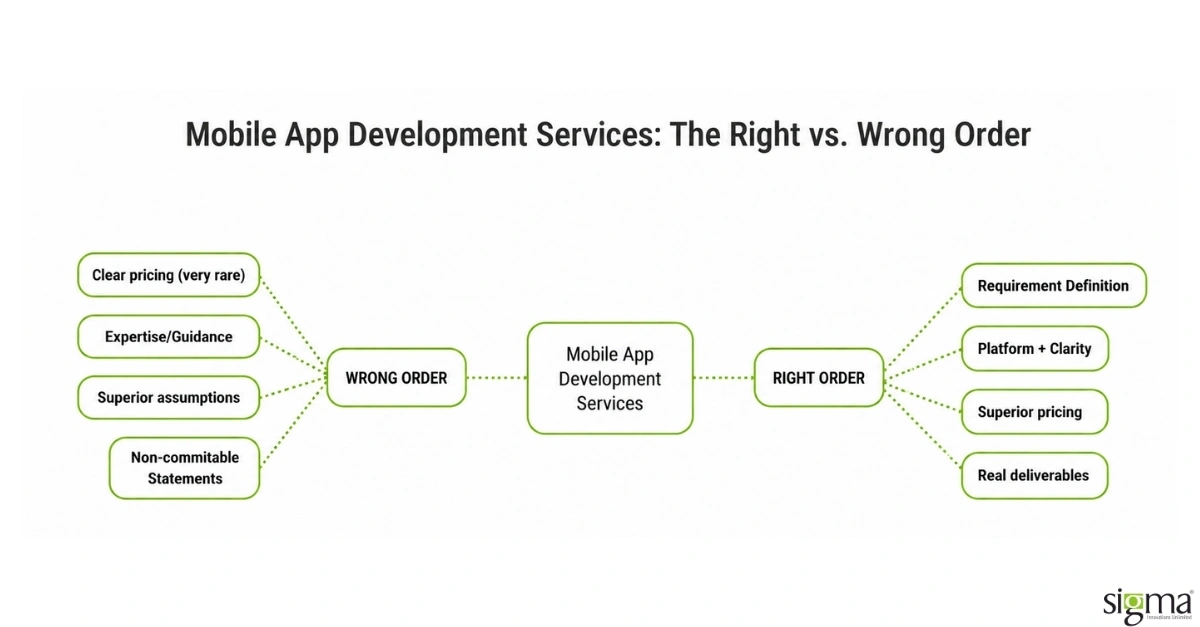
Mobile app development services cover the design, engineering, release, and ongoing operation of applications distributed through the Apple App Store and Google Play. Most buyers begin by requesting proposals, which means suppliers are asked to price an outcome that has not been specified, and each one silently substitutes its own assumptions about platform, scope, and quality bar. The resulting documents are not comparable in any useful sense, and the buyer is left comparing confidence rather than substance.
The order that works inverts this. A requirement definition detailed enough to constrain the platform choice comes first, produced independently of any supplier who has a commercial interest in the answer. Suppliers then price the same defined thing, and the differences that remain are real differences in approach, team composition, and included scope. That single change in sequence eliminates most of the fivefold spread, and it exposes which suppliers were relying on ambiguity.
Get a requirement definition that makes competing proposals comparable.
Decision One: What the Product Requires, Before What the Team Prefers
Platform choice should follow from four product properties, and none of them is a preference. Hardware dependency comes first: sustained camera processing, Bluetooth peripherals, background location, or on-device inference push toward native, because cross-platform abstractions over these capabilities lag the underlying platforms and the lag lands during a release deadline. Interface expectation comes second, since a product whose users will compare it directly against category-leading native applications carries a higher bar than an internal tool.
Release cadence is the third property and the most commonly ignored. A product shipping monthly across two platforms benefits substantially from a shared codebase, whereas a product shipping twice a year gains far less. Team continuity is the fourth, and it is a business question rather than a technical one: maintaining two native codebases requires access to two skill sets indefinitely, which is a commitment beyond the build.
| Property | Points toward native | Points toward cross-platform |
| Hardware and sensor use | Heavy or latency sensitive | Light, standard APIs sufficient |
| Interface expectation | Competing against category leaders | Functional parity is acceptable |
| Release cadence | Infrequent, large releases | Frequent releases across both platforms |
| Long-term maintenance | Two skill sets sustainably available | One team maintaining one codebase |
| Platform divergence | Materially different experience per platform | Substantially the same experience |
React Native can enable up to 70% code sharing between iOS and Android, making shared code one of the strongest advantages of cross-platform development. But that percentage should not be treated as a guarantee for every application. The remaining platform-specific work can be concentrated around the features that matter most, particularly hardware integrations, native APIs, performance-sensitive workflows, or platform-specific UX. A product can therefore achieve high overall code reuse while still requiring significant native engineering for a small number of business-critical features.
One caution applies to the table above. These properties are weighed together rather than counted, and a single strong signal can outrank three weak ones. A product whose entire value rests on sustained sensor processing sits on native regardless of how favorable its release cadence and maintenance picture look, because the property that defines the product governs the decision. Buyers who score the criteria evenly and take a majority arrive at defensible-looking answers that fail against the one requirement that mattered.
Why Quotes for the Same Application Differ by a Factor of Five
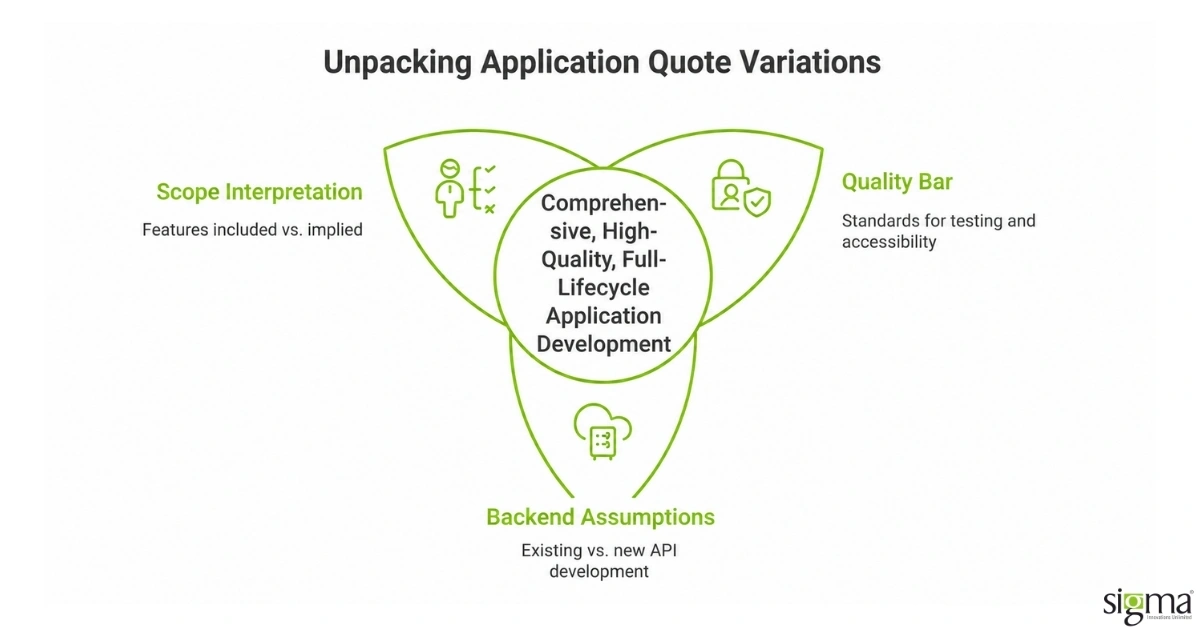
Four variables account for nearly all the spread, and asking about them directly is more productive than negotiating rates. Scope interpretation is the largest: one supplier prices the described features, while another prices those features plus the authentication, offline behavior, error handling, and administrative tooling that the description implied but did not state. Quality bar is second, covering automated test coverage, accessibility, and device matrix breadth, none of which appears in a feature list and all of which change effort materially.
The backend assumption is the third variable and the most consequential. A proposal assuming existing APIs is pricing a different project from one assuming those APIs must be built. Post-launch ownership is the fourth, and where one proposal ends at store approval while another includes monitoring, crash triage, and the operating system upgrade cycle, the difference is a multi-year commitment rather than a line item. Sigma’s published estimate puts a mid-complexity application for a midsize business in the range of $40,000 to $100,000, and a proposal far outside that band is usually describing a different scope rather than a different price.
Decision Two: Evaluating a Partner on Architecture, Testing, and Release Ownership
Three areas separate suppliers once scope is fixed, and none of them is visible in a portfolio. Architecture discipline shows up in how a candidate answers a question about a decision they later regretted. A supplier who cannot produce one has either not operated a product long enough to accumulate consequences or is not being candid, and both possibilities matter.
Testing posture is the second and the most reliably diagnostic. Ask what breaks their release, what the device matrix covers, and how a regression reaches production. Suppliers who treat testing as a phase rather than a property will describe a quality assurance stage near the end, which is where defects become expensive rather than where they get prevented.
Release ownership is the third. Store submission is governed by Apple’s published App Review Guidelines, which cover safety, performance, business, design, and legal requirements, and rejections are routine rather than exceptional. A partner who has operated applications through repeated review cycles will describe the rejection categories they hit and the remediation pattern, while one who has not will describe submission as a formality.
Reference checking deserves more weight than it usually receives, and the productive question is not whether the supplier delivered. Ask a former client what happened when something went wrong: a missed date, a defect in production, or a disagreement about scope. Every engagement of any length contains at least one, and how a supplier behaved during it predicts the next twelve months far better than a successful launch does. Suppliers confident about this will offer the reference themselves.
The Order of Operations That Decides Whether a Mobile Build Survives Its First Year
Sigma sequences mobile engagements against a specific principle: every decision that is expensive to reverse happens before every decision that is cheap to reverse. That ordering sounds obvious and is routinely violated, because the reversible decisions are the visible ones that make a project feel like it has started.
The requirement definition comes first and produces the platform decision as an output rather than an input. Sigma runs this before proposing a team composition, which occasionally produces a recommendation that reduces the engagement, since a product with light hardware use and a frequent release cadence does not need the two native teams a larger scope would justify. Selecting the framework from bench availability is the industry’s most common failure and the hardest for a buyer to detect, because the justification is always technically defensible after the fact.
Backend and integration architecture comes second, before any interface work. The reason is structural: the data model and the synchronization strategy constrain what the interface can do, and interfaces designed against an assumed backend generate rework once the real constraints appear. Offline behavior belongs to this stage as well, because retrofitting it into an application built on the assumption of connectivity is close to a rebuild.
Release engineering comes third and before feature development rather than after it. Continuous integration, signing, the device matrix, and the store submission path get established while there is nothing at stake, so the first production release is a repetition of something already done rather than a first attempt under deadline. Teams that defer this discover their submission problems in the week they intended to launch, which is when platform review criteria stop being a documentation question and become a schedule risk.
Feature development comes last, which is counterintuitive to stakeholders who measure progress by visible screens. Sigma states this trade-off at the outset, because the first several weeks produce foundations rather than demonstrations, and a client who has not agreed to that shape will lose confidence at precisely the moment the sequencing is paying off.
One consequence of this ordering deserves stating plainly, because it affects the commercial conversation rather than the engineering one. A sequenced build looks slower for roughly the first third of its duration and then accelerates, while an unsequenced build looks faster early and then decelerates as foundational decisions get revisited under pressure. Both reach a launch date. The difference appears in the second year, when one product absorbs a platform upgrade and a significant feature addition without drama, and the other requires a rewrite conversation that nobody budgeted for.
See how a patient-facing platform was built around real operational workflows. Read the intake and CRM platform engagement
Post-launch ownership is where the sequencing either proves itself or does not, since performance work on a live product is constrained by decisions made long before anyone measured anything.
Understand what performance ownership looks like after launch. Read the platform performance engagement
Conclusion
Buying mobile app development services productively depends less on supplier selection than on the order in which the two governing decisions are made. Defining the product requirement before soliciting proposals removes most of the price spread that makes comparison impossible, because suppliers are then pricing the same thing rather than their own assumptions. Platform choice follows from hardware dependency, interface expectation, release cadence, and the maintenance commitment the business can sustain, none of which is a matter of technical preference. Partner evaluation then turns on architecture discipline, testing posture, and demonstrated release ownership, all of which require direct questioning because none appears in a portfolio. Reversing that sequence produces comparable-looking proposals for incomparable work and a framework decision that resurfaces as a rewrite in the second year.
FAQs
Q1. How do you choose between native and cross-platform mobile development?
A1. Four product properties decide it: how heavily the app uses hardware and sensors, whether it competes against category-leading native apps, how frequently it releases across both platforms, and whether the business can sustain two skill sets long term. Team preference should not enter the decision.
Q2. Why do mobile app quotes vary so widely for the same project?
A2. Four variables account for most of the spread between competing proposals. Suppliers interpret the stated scope differently, assume different quality bars for automated testing and accessibility, make opposite assumptions about whether backend APIs already exist, and include very different amounts of post-launch ownership beyond initial store approval.
Q3. What should you ask a mobile development partner before signing?
A3. Ask about an architectural decision they later came to regret, what specifically breaks their release process, and how a regression actually reaches production. Ask which store rejection categories they hit repeatedly. Then ask a former client what happened when something went wrong during their engagement.
Q4. What does a mid-complexity mobile application cost to build?
A4. Sigma’s published estimate places a mid-complexity application for a midsize business somewhere between $40,000 and $100,000, varying with target platform, feature set, and delivery model. Proposals falling well outside that range are usually describing a materially different scope rather than simply offering a different price.
Q5. In what order should a mobile build actually proceed?
A5. Decisions that are expensive to reverse come before decisions that are cheap to reverse. Requirement definition and platform choice come first, then backend and integration architecture, then release engineering and the store submission path, and only then feature development. Reversing that order reliably creates rework under deadline.