How to Actually Measure AI Productivity Gains: A Framework for Engineering and Operations Leaders
Key Takeaways:
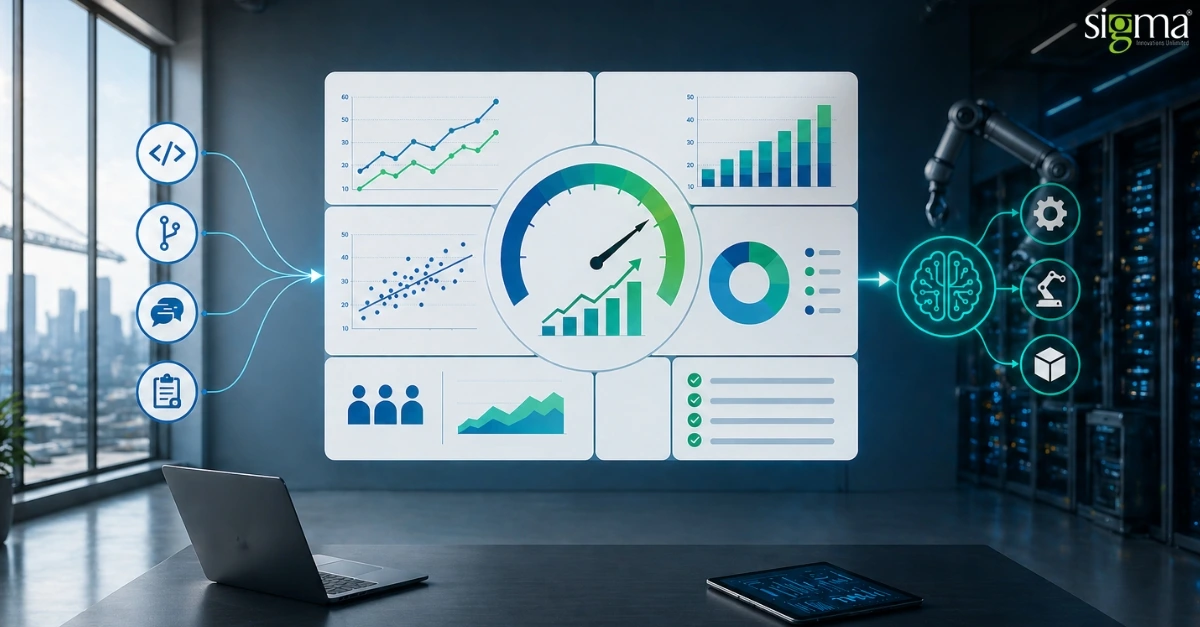
- Stop relying on how fast developers feel. Sigma helps you track the metrics that actually show up on a P&L, like system velocity and net productivity gain.
- Generic AI tools often lead to “organizational slack.” We specialize in Purpose-Built AI that embeds directly into your unique engineering workflows to eliminate specific bottlenecks.
- You can’t prove progress without a baseline. Sigma’s BI & Analytics services help you instrument your “Day Zero” data so every gain is financially verifiable.
Most enterprises report that AI makes developers “feel faster“, yet fewer than a quarter can prove measurable ROI. It is a strange paradox. Teams are shipping code snippets in seconds and generating documents with a click, but the bottom line remains stubborn. Leaders are pouring millions into seat licenses, only to realize that a busy developer isn’t always a productive one. This gap between the “feeling” of speed and actual financial results is what we call the ROI Mirage.
The problem is that most companies are flying blind. They see high adoption rates and think they are winning, but they lack visibility into the real impact. Teams are currently obsessed with activity signals, like how many prompts someone wrote or how much code was generated, rather than actual outcomes. To move from guesswork to a data-driven certainty, forward-thinking leaders are now leveraging Artificial Intelligence Development Services to build custom tools. By integrating AI & Data Analytics Solutions for Fintech Growth and robust BI & Analytics Development Services, engineering experts at Sigma Infosolutions help organizations bridge this gap.
This blog introduces a practical, engineering-first framework to measure AI productivity across multiple layers, ensuring your investment shows up in the bank account, not just the chat window.
Why Most AI Productivity ROI Efforts Fail
Right now, many leaders are chasing “vanity metrics.” They track lines of code generated, the number of prompts sent, or how often a tool is opened. These numbers look great in a slide deck, but they tell you absolutely nothing about AI business impact. In fact, they are often misleading. You can generate 1,000 lines of code in a minute, but if that code creates security holes or doesn’t solve a customer problem, your AI productivity is actually negative.
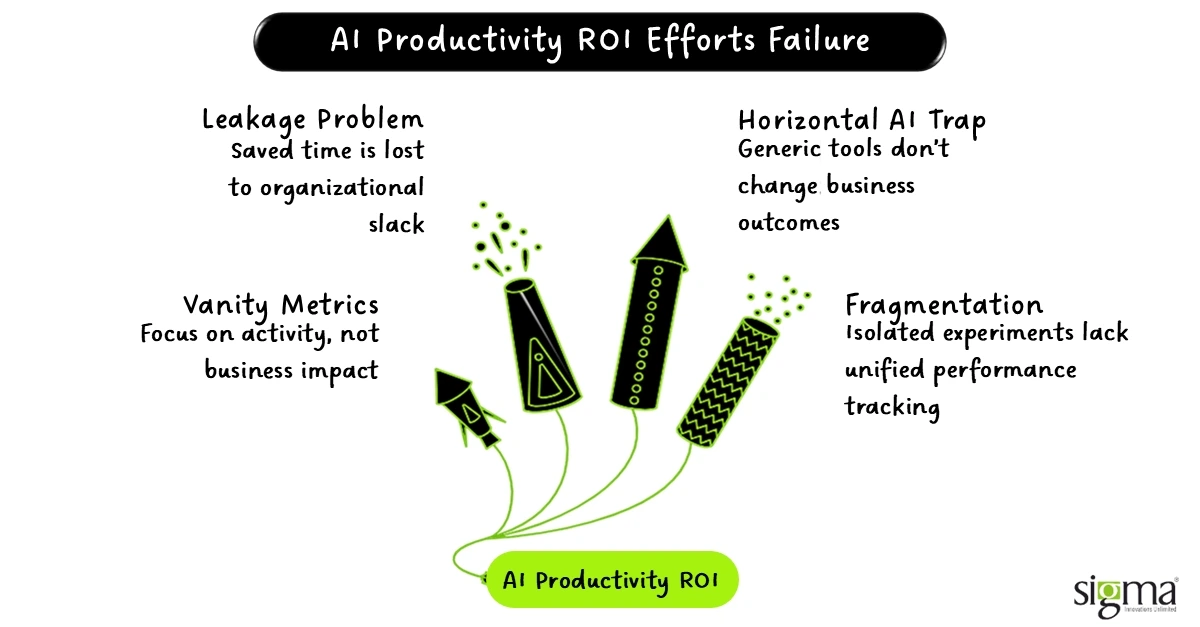
Most efforts to prove AI ROI fail because of three structural traps:
- First is the Leakage Problem, where a developer saves two hours a day, but that time is lost to “organizational slack” instead of being reinvested into shipping features.
- Second is the Horizontal AI Trap, using generic copilots that make life easier but don’t actually change the business outcome.
- Finally, there is Fragmentation, where different departments run isolated AI experiments with no unified way to track AI performance metrics.
By the next year, experts predict that “75% of enterprises will fail to realize the full value of AI” because they treat it as a tool purchase rather than a workflow transformation. To fix this, leaders must stop tracking activity and start tracking value.
Turn AI Experiments Into Measurable Business Impact
Explore Sigma’s AI Innovation Hub to build purpose-driven AI systems with measurable productivity and ROI outcomes.
Measuring Your AI Productivity Metrics
To truly understand how AI productivity works, you have to look at engineering throughput metrics. It is not about how fast the individual is typing, but how fast the team is delivering value. If your AI development services are working correctly, you should see a measurable drop in “Lead Time for Changes” and an increase in “Deployment Frequency.” These are the numbers that matter to a CTO.
When you invest in custom AI solutions, you aren’t just buying software, but also re-engineering how work gets done. This requires a deep look at the custom AI workflow measurement. Are your developers spending less time on “toil” and more time on high-level architecture? If you can’t answer that, you are still stuck in the ROI Mirage. By focusing on AI productivity for operations teams, you can identify exactly where the bottlenecks are and remove them.
Moving forward, the goal is to create a unified AI productivity framework. This means using AI performance tracking to see how every dollar spent on a seat license turns into a dollar earned in revenue. This requires not only being a “tech-forward” company, but also gaining a competitive edge in a market where efficiency is the only thing that keeps you alive.
Why You Can’t Measure What You Didn’t Capture
The biggest mistake leaders make with AI productivity isn’t how they measure the future, but how they ignore the past. Most organizations rush into deployment without a “before” snapshot, making any eventual AI ROI completely unverifiable. You cannot claim a 30% improvement if you never knew your starting speed. Without a rigid baseline, your progress stays “directionally positive but financially invisible.”
To fix this, you must capture three specific categories of data before scaling custom AI solutions.
- First is the engineering baseline, tracking PR throughput, cycle time, and rework rates.
- Second is the operational baseline, measuring cost per transaction and error rates.
- Finally, there is the perceptual baseline, which gauges developer friction and daily satisfaction.
Measurement must be longitudinal, comparing data over long stretches of time, rather than a snapshot. If you don’t instrument the “before,” you are essentially guessing at the “after.”
The Sigma Triple-Layer AI Productivity Framework
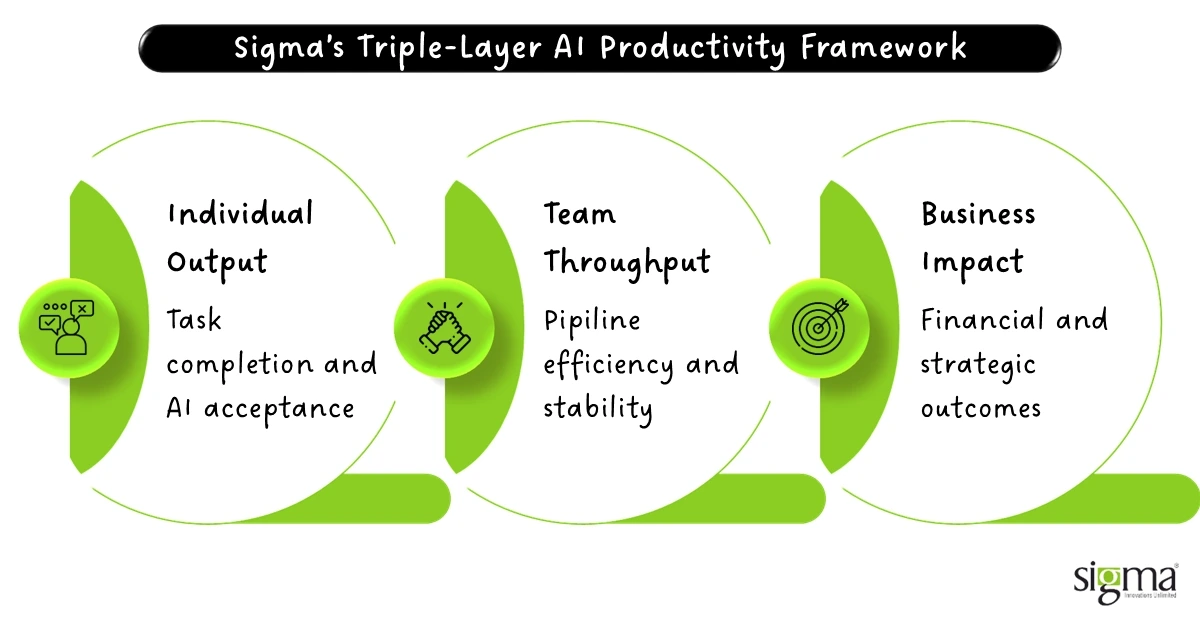
To escape the trap of “vibes-based” management, leaders need a structured way to look at their operations. At Sigma Infosolutions, we don’t look at AI productivity as a single score. Instead, we use a three-tier system that bridges the gap between a developer’s keyboard and the company’s bank account. This is the only way to turn AI performance tracking into a defensible business strategy.
Layer 1: Individual Output (The Micro-Efficiency Layer)
This is where most companies start, and unfortunately, where most of them stop. At this level, we look at granular task completion time and the AI acceptance vs. override rate. We calculate “human-equivalent hours saved” to see how much “grunt work” the machine is actually taking off a person’s plate.
However, the critical insight here is that individual speed does not equal organizational productivity, and this is very simple to understand. Just because a developer writes code faster doesn’t mean the product is getting to the customer any sooner.
Layer 2: Team Throughput (The System Velocity Layer)
This layer measures the health of your entire pipeline. We move beyond the individual and look at engineering throughput metrics like Lead Time (the time from an idea to production) and Deployment Frequency. We also keep a sharp eye on the Change Failure Rate (CFR). If AI helps you code faster but your system crashes more often, your net gain is zero.
True custom AI workflow measurement ensures that AI changes the overall shape of delivery, removing bottlenecks rather than just creating a pile-up of unreviewed code.
Layer 3: Business Impact (The Outcome Layer)
This is the “P&L Relevance” layer. Here, we map technical gains to actual dollars. We track the cost per feature, the impact on time-to-market, and revenue-linked metrics like customer churn or conversion rates. The ultimate calculation is the Net Productivity Gain, which is the total value of hours saved minus the total cost of the AI infrastructure.
Only when all three layers are aligned can AI productivity be considered real. When these tiers sync up, you stop guessing about AI ROI and start proving it with every release cycle.
By the end of this year, it is estimated that companies using a layered AI performance tracking approach will see “40% higher realization of their tech investments”. Also, the projection says that this year, modern engineering leaders will be using custom AI solutions to automate the collection of these metrics, so that 60% of high-performing engineering teams can use automated “value stream mapping” to justify their AI spend.
Remember, true AI adoption ROI happens when you align these three layers into a single, traceable engine.
Read our success story – Operationalizing Structured Intervention Through Tiered Student Support
The Missing Link Between AI Usage and ROI
Most companies don’t fail because their AI is “dumb.” They fail because their systems are “blind.” There is a massive gap between a developer using a tool and a leader seeing the result. To close this gap, you need a robust measurement stack. This isn’t just about one dashboard, but a closed-loop measurement system that tracks every step of the journey.
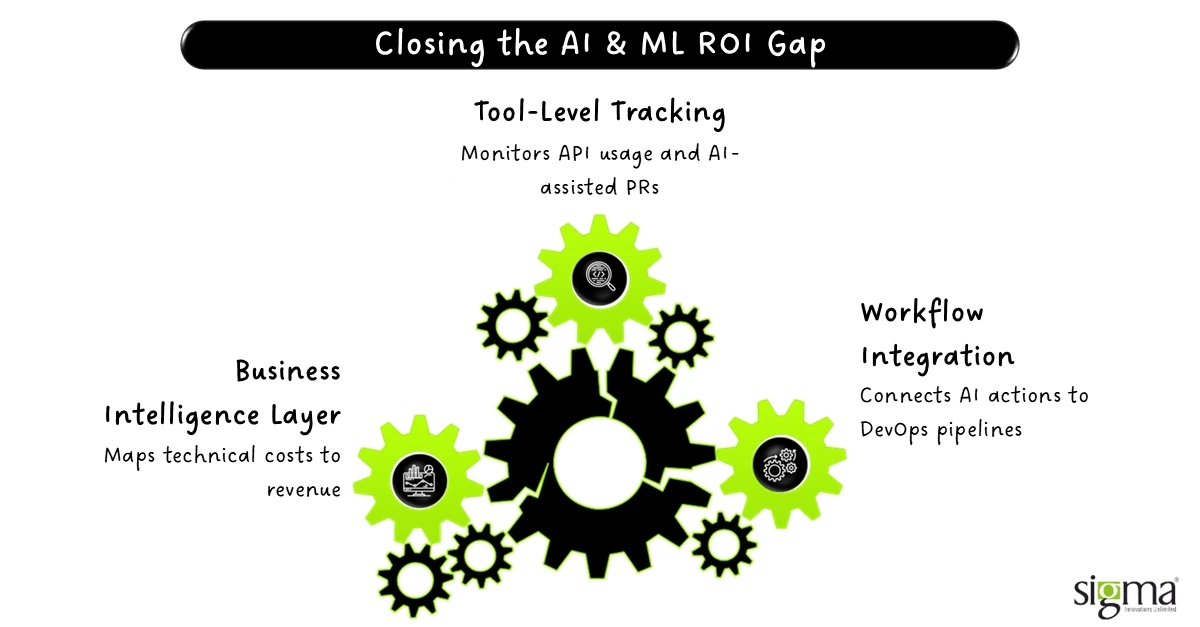
A complete stack includes three things:
- First, you need tool-level tracking to see things like API usage and the percentage of AI-assisted PRs.
- Second, you need workflow integration to connect those actions to your DevOps pipelines.
- Finally, you need a business intelligence layer to map technical costs to revenue.
For example, you should be able to track a piece of AI-generated code from the moment it is written, through the PR merge time, to its final production deployment and its effect on a business KPI. This is where BI & Analytics Development Services become the backbone of your strategy. Without this instrumentation, your AI investment stays a “black box” where money goes in, but proof never comes out.
Also, read the blog – Application Development for Business Goals: How to Align Your App Roadmap with Revenue Outcomes
Moving From Horizontal Tools to Purpose-Built AI
There is a big difference between “Horizontal AI” and “Purpose-Built AI.” Generic copilots are great for writing a quick email or a simple script, but they often plateau because they don’t understand your specific business rules. Real AI ROI happens when the technology is embedded directly inside your most valuable workflows.
Think about the difference in impact. In fintech, generic AI might help write a report, but AI & Data Analytics Solutions for Fintech Growth can automate fraud detection or speed up underwriting. In engineering, it’s the difference between a tool that suggests code and a custom system that automates your entire test generation pipeline. At Sigma, we believe AI doesn’t create value in isolation, but creates value when it is tightly coupled with your specific domain workflows through Artificial Intelligence Development Services. When the tool fits the task perfectly, the AI productivity gains aren’t just visible, but also massive.
How Leaders Can Start Measuring AI ROI
Ready to get started? Don’t try to boil the ocean. Use this simple 3-phase model to bring discipline to your AI productivity framework:
- Baseline Phase (0–60 days): Capture your current engineering, operational, and perceptual metrics. You need to know your “speed limit” before you add a turbocharger.
- Adoption Phase (60–120 days): Track how many people are actually using the tools and if they trust the output. If trust is low, AI ROI will be zero.
- Impact Phase (120+ days): Measure velocity, quality, and financial outcomes. Use A/B testing to compare AI-enabled teams against traditional ones.
One sharp warning! If you skip the workflow redesign, your ROI will plateau. You can’t just give people new tools and expect old processes to work better.
Common Pitfalls That Distort AI Productivity Measurement
Even with a good plan, it’s easy to trip up. A major mistake is measuring individuals instead of teams. This usually leads to “gaming the system“, developers might push more code just to hit a metric, even if that code is low quality. Another trap is ignoring the “hidden costs.” Between seat licenses, training, and maintenance, the total cost of ownership can be 2–3x the sticker price. Finally, don’t just look at short-term wins. True AI adoption ROI shows up in long-term capability building, not just a slightly faster sprint this week.
Final Thoughts
The “ROI Mirage” is real, but it is also avoidable. Many leaders are frustrated because they see the potential of AI productivity, but they lack the framework to prove it. By moving away from vanity metrics and adopting the Sigma Triple-Layer Productivity Framework, you can finally bridge the gap between technical activity and bottom-line value.
At Sigma, we know that AI ROI isn’t an abstract feeling, but a data-driven certainty. Whether you are looking for custom AI solutions or deep engineering productivity metrics, you need to move from tracking what people are doing to tracking what the business is gaining. By 2028, it is expected that “80% of the market leaders in every industry will be those who treated AI as a workflow transformation” rather than a simple software upgrade.
Don’t let your AI investment stay a black box. It is time to instrument your success and build a traceable, defensible, and high-performance future.
Are you ready to stop guessing and start growing?
Contact AI & ML experts at Sigma Infosolutions today to discuss how our Artificial Intelligence Development Services and BI & Analytics Development Services can turn your AI vision into a measurable competitive advantage.
Frequently Asked Questions
1. How do you actually measure AI productivity beyond just lines of code?
We focus on engineering throughput metrics rather than activity signals. This includes tracking “Lead Time for Changes,” “Deployment Frequency,” and “AI Acceptance Rates.” The goal is to see if the team is delivering value faster, not just typing faster.
2. How can leaders prove AI ROI to stakeholders?
To prove ROI, you must map technical gains to business outcomes. This involves calculating “Net Productivity Gain“, the total value of human hours saved minus the cost of the AI infrastructure and licenses, and showing its impact on time-to-market.
3. What are the best AI productivity metrics for operations teams?
The most effective metrics are longitudinal and outcome-oriented. We recommend tracking the “Change Failure Rate” (to ensure quality isn’t dropping), “Cost per Transaction,” and “Cycle Time” from ideation to production.
4. Is there a specific AI productivity framework for engineering teams?
Yes, Sigma uses a Triple-Layer AI productivity Framework which includes Individual Output (Micro-Efficiency), Team Throughput (System Velocity), and Business Impact (The Outcome Layer). This ensures AI isn’t just making individuals faster, but making the entire organization more profitable.