React Native vs Swift: Which Should You Choose for iOS in 2026?

Key Highlights
- Startup founders, product managers, and CTOs evaluating iOS development strategies in 2026 face a consequential architectural decision between React Native and Swift that directly affects app performance, development speed, team scalability, and long-term maintenance costs, yet many organizations make this choice without a clear framework for evaluating the trade-offs.
- A structured comparison of React Native and Swift across performance, scalability, user experience, speed to market, and total cost of ownership gives technical and business decision-makers the clarity they need to select the mobile architecture that best fits their product goals and organizational context.
- Sigma Infosolutions helps businesses evaluate, choose, and build the right mobile architecture based on their specific product requirements, UX expectations, team structure, and scalability goals, delivering iOS applications that perform reliably and grow with the business.
Introduction
Choosing between React Native and Swift for iOS development is one of the most consequential early decisions a product team can make. It shapes the composition of the engineering team, the performance characteristics of the application, the pace of feature development, and the total cost of maintaining the product over its lifetime. Getting this decision right from the outset saves months of remediation work and prevents the technical debt that accumulates when the wrong architecture is forced to support requirements it was not designed to meet.
React Native vs Swift is not a question with a universal answer. Both technologies are mature, well-supported, and capable of powering high-quality iOS applications. The right choice depends on the specific context of the product being built: the target user experience, the organization’s existing engineering capabilities, the importance of cross-platform development, the performance demands of the application, and the timeline and budget available for initial development and ongoing maintenance.
For startup founders weighing speed to market against long-term scalability, for product managers balancing feature velocity against user experience quality, and for CTOs evaluating team structure and maintenance costs, this comparison provides the framework needed to make an informed, defensible architectural decision in 2026.
Understanding the Core Difference Between React Native and Swift
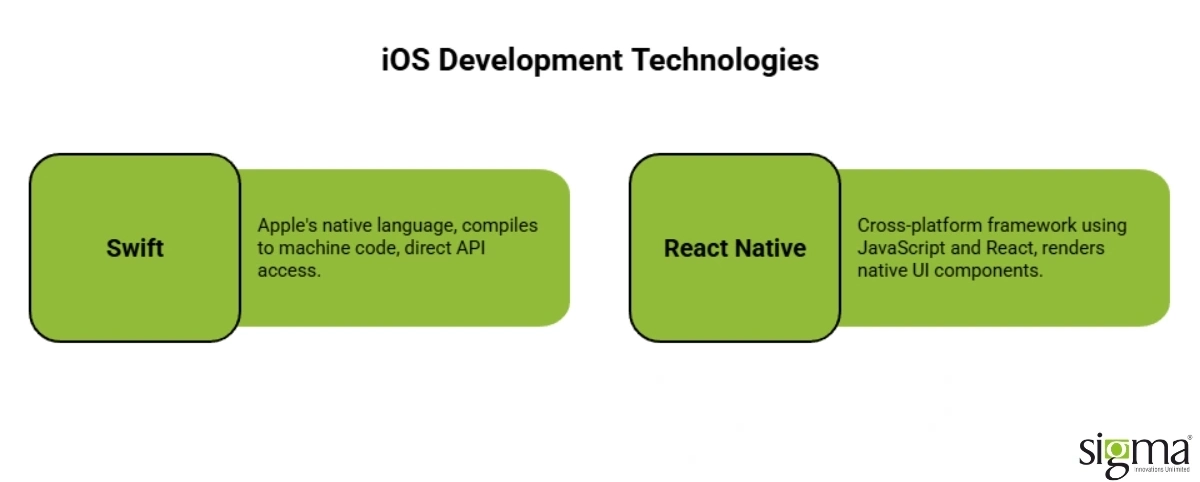
Before comparing the two technologies across specific dimensions, it is important to understand what each one is and how it approaches iOS application development at a fundamental level.
Swift is Apple’s native programming language for iOS, macOS, watchOS, and tvOS development. Applications built with Swift compile directly to native machine code and interact with iOS APIs without any intermediate layer. The result is an application that has direct, unmediated access to every capability the iOS platform offers and that performs with the full efficiency of native execution on Apple hardware.
React Native is a cross-platform mobile development framework created by Meta that allows developers to build iOS and Android applications using JavaScript and React. React Native applications render using native UI components rather than a web view, which distinguishes them from hybrid frameworks and gives them a user experience closer to native than traditional web-based approaches. However, the bridge between JavaScript code and native iOS APIs introduces a layer of abstraction that has performance and architectural implications that vary depending on the specific capabilities the application requires.
This fundamental difference in architecture is the origin of most of the trade-offs that define the React Native vs Swift decision, and understanding it provides the context needed to evaluate each dimension of the comparison accurately.
Performance: Where Swift Holds a Structural Advantage
Performance is the dimension where Swift holds its clearest structural advantage over React Native. Because Swift applications compile to native machine code and interact directly with iOS APIs, they execute with maximum efficiency on Apple hardware and have access to the full suite of platform optimization capabilities that Apple provides to native developers.
React Native applications run JavaScript logic on a separate thread and communicate with the native layer through a bridge that introduces latency for certain types of operations. In the original React Native architecture, this bridge was a significant performance bottleneck for applications with complex animations, high-frequency state updates, or intensive graphics requirements. The new architecture introduced by Meta, which replaces the bridge with a JavaScript Interface that enables synchronous communication with native modules, has substantially reduced this overhead and improved React Native’s performance profile for many use cases.
For most business applications, productivity tools, e-commerce platforms, and content consumption apps, React Native’s performance in 2026 is more than adequate to deliver a smooth, responsive user experience that users will not distinguish from a native application. The performance gap between React Native and Swift becomes meaningful primarily for applications with demanding graphics requirements such as games and augmented reality experiences, applications that perform intensive real-time data processing on the device, and applications that require very tight integration with specific iOS hardware capabilities such as the Neural Engine or specialized camera APIs.
For the majority of iOS applications being built by startups and enterprise product teams in 2026, performance is not a decisive reason to choose Swift over React Native. The decision becomes more nuanced when the specific use case places the application in the performance-sensitive category.
Speed to Market and Development Efficiency
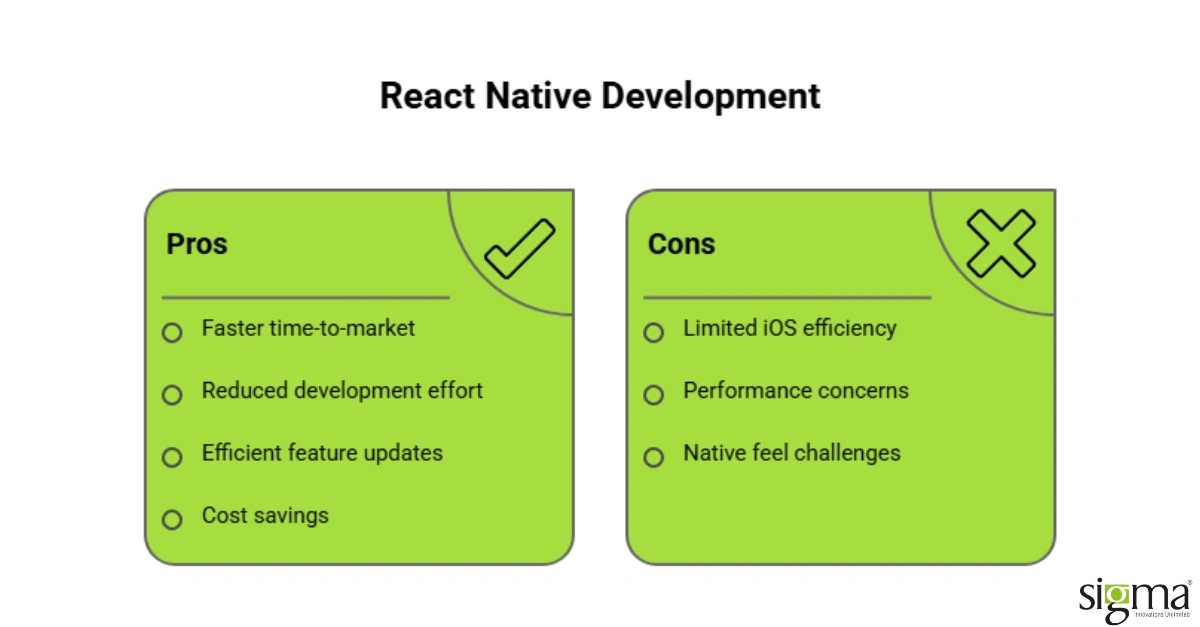
Speed to market is the dimension where React Native offers its most compelling advantage for organizations that need to serve both iOS and Android users without building and maintaining two separate native codebases.
A React Native application shares the majority of its business logic, data management code, and UI component library across iOS and Android platforms. This code sharing typically reduces the total development effort required to launch on both platforms by a significant margin compared to building separate Swift and Kotlin applications. For startups with limited engineering resources and the need to validate a product across both platforms quickly, this efficiency advantage can be decisive.
The development velocity benefit extends beyond the initial launch. When a new feature is added to a React Native application, it is implemented once in JavaScript and deployed to both platforms simultaneously. In a world of separate native codebases, the same feature must be designed, implemented, tested, and deployed twice, by separate teams working in different languages and different development environments. The cumulative cost of this duplication over the lifetime of a product is substantial.
Swift development, by contrast, offers maximum efficiency for iOS-only applications where the cross-platform benefit of React Native does not apply. When a product team is building exclusively for Apple platforms and does not anticipate an Android version, the productivity argument for React Native weakens considerably. Swift’s tight integration with Xcode, its mature tooling ecosystem, and the depth of Apple’s official documentation make it a highly productive environment for experienced iOS developers working on Apple-specific products.
User Experience and Platform Fidelity
User experience fidelity is an area where Swift has a natural advantage that stems directly from its native architecture. Swift applications can implement every iOS design pattern, animation, and interaction paradigm exactly as Apple intended, with no risk that platform-specific behaviors will be approximated rather than precisely reproduced. When Apple introduces new iOS capabilities, Swift developers can adopt them immediately using official APIs without waiting for React Native to add framework support.
React Native’s approach to UI rendering uses native components under the hood, which means that React Native applications can achieve a high degree of platform fidelity for standard interface patterns. The experience of using a well-built React Native application is indistinguishable from a native application for the vast majority of interactions that typical business applications involve.
The fidelity gap becomes more visible in applications that rely heavily on complex custom animations, platform-specific interaction patterns, or deep integration with iOS system features such as widgets, Live Activities, SharePlay, or advanced accessibility APIs. Implementing these capabilities in React Native requires additional effort and sometimes involves workarounds that add complexity without fully matching the native implementation quality.
For applications where the iOS experience is a primary differentiator and where Apple platform fidelity is a core product value, the user experience argument favors Swift. For applications where cross-platform consistency and development efficiency are more important than platform-specific polish, React Native delivers a user experience that serves the product’s goals effectively.
Team Structure, Hiring, and Long-Term Maintenance
The organizational implications of the React Native vs Swift decision extend beyond the immediate development project to the structure of the engineering team, the ease of hiring, and the long-term cost of maintaining and evolving the application.
React Native applications are built with JavaScript and React, which are among the most widely known technologies in the global developer community. Organizations building with React Native have access to a significantly larger pool of potential engineering hires than those building with Swift, and developers with React experience can typically contribute to a React Native codebase productively after a relatively short onboarding period.
Swift is a language with a smaller but deeply specialized developer community. Experienced Swift developers are highly capable and command strong salaries that reflect the scarcity of deep iOS expertise. For organizations that are committed to native iOS development as a long-term strategy, building a team of skilled Swift developers is a worthwhile investment. For organizations that need to scale their mobile engineering team rapidly or that cannot compete for senior Swift talent, the hiring advantage of React Native is a practical consideration.
Long-term maintenance costs also favor React Native for organizations maintaining cross-platform products, because a single shared codebase requires less total maintenance effort than two separate native applications. For iOS-only products, the maintenance calculus is more balanced, and Swift’s tight alignment with Apple’s platform evolution roadmap can reduce the effort required to adopt new iOS capabilities as they are released.
Read the blog: App Development Cost in 2026: What Influences Pricing and How to Estimate Your Budget
When to Choose React Native and When to Choose Swift

Based on the comparison across performance, speed to market, user experience, and team structure, the following guidelines help product teams apply the framework to their specific situation.
Choose React Native when:
- The product must launch on both iOS and Android within a constrained timeline or budget.
- The application’s core functionality does not require intensive graphics processing, complex animations, or deep integration with platform-specific hardware capabilities.
- The engineering team has existing JavaScript and React expertise that can be applied directly to mobile development.
- Rapid feature iteration and cross-platform consistency are higher priorities than platform-specific UI polish.
- The organization needs to scale its mobile engineering team quickly using a widely available skill set.
Choose Swift when:
- The product is designed exclusively for Apple platforms and cross-platform development is not a requirement.
- The application’s use case involves demanding graphics, augmented reality, intensive on-device computation, or tight integration with Apple-specific hardware and software capabilities.
- The product experience depends on immediate adoption of the latest iOS features and interaction patterns as Apple releases them.
- The engineering team already has deep Swift and iOS expertise and the hiring strategy supports continued investment in native iOS development.
- Platform fidelity and the distinctiveness of the iOS experience are core elements of the product’s value proposition.
How Sigma Infosolutions Helps You Make the Right Mobile Architecture Decision
Sigma Infosolutions helps startup founders, product managers, mobile teams, and CTOs navigate the React Native vs Swift decision with a structured, outcome-focused consulting approach that starts with understanding the product’s specific goals rather than defaulting to a preferred technology. Sigma’s mobile engineering expertise spans both React Native and Swift, giving the team the credibility and perspective to recommend the architecture that genuinely fits the client’s context rather than the one that is easiest to staff.
Discovery and Architecture Consultation
Sigma begins every mobile engagement with a discovery process that examines the product’s target user experience, performance requirements, cross-platform ambitions, team composition, and timeline. This discovery produces a clear architectural recommendation with documented rationale that gives stakeholders the confidence to commit to a direction and move forward efficiently.
React Native Development and Cross-Platform Engineering
For clients whose product goals align with the React Native architecture, Sigma’s cross-platform engineering team builds performant, maintainable React Native applications that share business logic and UI components across iOS and Android while delivering the native-quality experience that users expect. Sigma’s React Native practice incorporates the new architecture’s performance improvements and applies proven patterns for managing the platform-specific customizations that every cross-platform application requires.
Swift and Native iOS Development
For clients whose product requirements favor native iOS development, Sigma’s Swift engineering team builds applications that take full advantage of Apple’s platform capabilities, design language, and performance optimization tools. Sigma’s iOS practice covers the full spectrum of Apple platform development, including SwiftUI, UIKit, Core Data, and integration with Apple’s latest platform features.
Ongoing Support and Platform Evolution
Sigma provides continuous support for mobile applications after launch, managing platform updates, performance optimization, and feature development as the product evolves and user needs grow.
Conclusion
The React Native vs Swift decision in 2026 is ultimately a question of fit between the technology’s characteristics and the specific requirements of the product being built. React Native offers compelling advantages in cross-platform development efficiency, speed to market, and access to a broad engineering talent pool that make it the right choice for a wide range of iOS applications, particularly those that must also serve Android users. Swift offers the performance ceiling, platform fidelity, and deep Apple ecosystem integration that make it the right choice for applications where native iOS excellence is a core product requirement.
Neither technology is universally superior. The organizations that make the best mobile architecture decisions are those that evaluate their specific context honestly, resist the temptation to default to the most familiar technology, and seek counsel from engineering partners who have deep experience with both approaches and the objectivity to recommend the one that serves the product’s goals most effectively.
Sigma Infosolutions brings that experience and objectivity to every mobile architecture engagement. Whether the right answer is React Native, Swift, or a hybrid approach that combines elements of both, Sigma helps businesses make the decision with confidence and execute it with engineering excellence.
Ready to choose the right mobile architecture for your product?