Kubernetes vs Docker Swarm: Which Container Orchestrator Fits Your Scale?
Key Highlights
- Platform engineers, enterprise architects, and DevOps leaders evaluating container orchestration strategies face a consequential infrastructure decision between Kubernetes and Docker Swarm that directly affects operational scalability, deployment complexity, team capability requirements, and the long-term cost of managing containerized workloads at enterprise scale.
- A structured comparison of Kubernetes and Docker Swarm across scalability, operational complexity, ecosystem maturity, resilience, and total cost of ownership gives technical decision-makers the framework they need to select the container orchestration platform that genuinely fits their organization’s current scale and future growth trajectory.
- Sigma Infosolutions modernizes enterprise infrastructure using Kubernetes, container orchestration best practices, and scalable cloud-native architectures that help platform engineering teams build reliable, efficient, and future-ready container environments aligned with their product and operational requirements.
Introduction
Containerization has become the standard approach to packaging and deploying software in modern technology organizations. The operational question that follows the adoption of containers is not whether to orchestrate them but which orchestration platform best serves the organization’s specific scale, complexity, and operational capability. For most teams evaluating this decision in 2026, the choice comes down to Kubernetes vs Docker Swarm, two mature platforms with fundamentally different philosophies about how container orchestration should work.
Kubernetes is the most widely adopted container orchestration platform in the world, backed by the Cloud Native Computing Foundation and supported by every major cloud provider. It offers a comprehensive feature set that covers virtually every operational requirement of large-scale containerized infrastructure, from sophisticated traffic management and automated scaling to advanced deployment strategies and extensible API-driven customization. Its capabilities come with genuine operational complexity that requires investment in specialized knowledge and tooling to manage effectively.
Docker Swarm is Docker’s native clustering and orchestration solution, designed around the principle that container orchestration should be simple, accessible, and deeply integrated with the Docker tooling that engineering teams already know. It provides a meaningful subset of Kubernetes’ capabilities with dramatically lower operational overhead, making it a compelling choice for organizations whose scale and complexity requirements do not justify the investment that Kubernetes demands.
For platform engineers designing infrastructure architecture, for enterprise architects evaluating cloud-native modernization strategies, and for CTOs determining where to invest engineering capability, this comparison provides the clarity needed to make an informed, defensible container orchestration decision in 2026.
Understanding the Fundamental Difference in Philosophy
Before comparing Kubernetes and Docker Swarm across specific operational dimensions, it is important to understand the philosophical difference that underlies every specific trade-off between the two platforms.
Kubernetes was designed from the beginning to handle the most demanding container orchestration requirements at any scale. Its architecture reflects this ambition through a rich set of abstractions, an extensible API that supports custom resource definitions and operators, and a pluggable component model that allows teams to replace or extend core functionality to meet specialized requirements. Kubernetes does not simplify orchestration. It provides the tools to manage orchestration complexity at any level of sophistication the organization requires.
Docker Swarm was designed to make container orchestration accessible to engineering teams that are already using Docker and do not want to learn a new operational paradigm to deploy containerized applications in a clustered environment. Its architecture reuses Docker’s existing concepts and CLI conventions, making it immediately approachable for teams with Docker experience. Docker Swarm simplifies orchestration by constraining the feature set to what most applications need, trading flexibility and extensibility for operational simplicity.
This philosophical difference means that choosing between Kubernetes and Docker Swarm is ultimately a question of matching orchestration philosophy to organizational context. Neither platform is universally superior. The right choice depends on the scale of the workloads being orchestrated, the operational maturity of the team managing the infrastructure, and the complexity of the deployment and networking requirements the platform must support.
Ready to Design a Future-Ready Enterprise Architecture Built for Cloud-Native Scale?
Architecture Comparison: How Each Platform Is Structured
Understanding the architectural differences between Kubernetes and Docker Swarm provides important context for evaluating their respective capabilities and operational characteristics.
Kubernetes Architecture
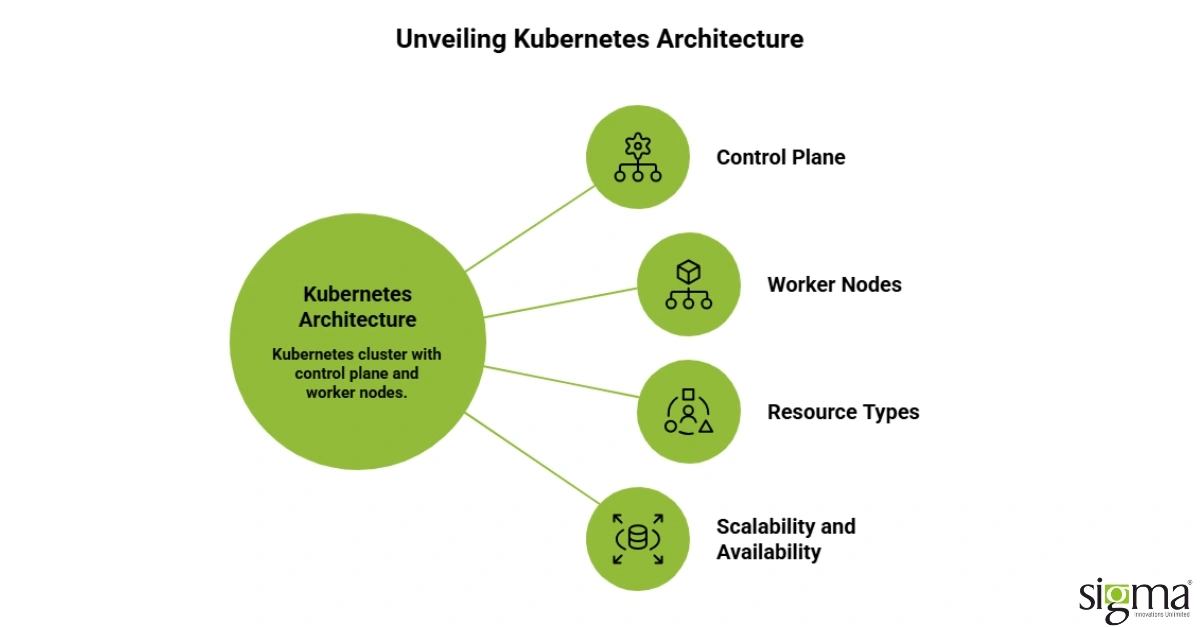
A Kubernetes cluster consists of a control plane and a set of worker nodes. The control plane components include the API server, which is the central management interface for all cluster operations, the etcd distributed key-value store that persists all cluster state, the scheduler that assigns pods to worker nodes based on resource availability and placement constraints, and the controller manager that runs the control loops responsible for maintaining desired cluster state.
Worker nodes run the kubelet agent that communicates with the control plane, the container runtime that executes containers, and the kube-proxy that manages network routing for services. Kubernetes workloads are defined using a rich set of resource types including Pods, Deployments, StatefulSets, DaemonSets, Services, Ingresses, ConfigMaps, and Secrets, each with its own specification format and behavioral semantics.
This architecture is designed for high availability, fault tolerance, and horizontal scalability of the control plane itself, making Kubernetes suitable for managing thousands of nodes and tens of thousands of pods in a single cluster.
Also Read the blog: From Chaos to Cohesion: The Power of Full-Stack Product Engineering Services
Docker Swarm Architecture
A Docker Swarm cluster consists of manager nodes and worker nodes. Manager nodes handle cluster orchestration, maintain cluster state using the Raft consensus algorithm, and schedule service tasks across worker nodes. Worker nodes execute the container tasks assigned to them by the manager nodes and report their status back to the management layer.
Docker Swarm’s resource model is significantly simpler than Kubernetes. The primary abstractions are services, which define the desired state of a containerized workload, including the image, replica count, network configuration, and update policy; and stacks, which group related services into a deployable unit using the Docker Compose file format. This simpler resource model dramatically reduces the learning curve for teams transitioning from single-host Docker deployments to clustered environments.
Scalability: Where Kubernetes Demonstrates Its Structural Advantage
Scalability is the dimension where the difference between Kubernetes and Docker Swarm is most pronounced and most consequential for organizations planning long-term infrastructure growth.
Kubernetes is designed to scale to clusters of thousands of nodes running tens of thousands of concurrent pods. Its scheduler is sophisticated enough to place workloads based on custom resource requirements, node affinity rules, pod topology spread constraints, and priority classes that ensure critical workloads receive resources preferentially when cluster capacity is constrained. The Horizontal Pod Autoscaler and Vertical Pod Autoscaler adjust workload resource allocation automatically in response to real-time metrics, and the Cluster Autoscaler provisions and deprovisions worker nodes dynamically based on pending pod demand.
This autoscaling stack enables Kubernetes clusters to handle highly variable workload patterns efficiently, scaling out during peak demand periods and scaling back during off-peak periods to minimize infrastructure cost. For SaaS platforms with unpredictable traffic patterns, fintech systems with periodic processing spikes, and enterprise applications with global user bases across time zones, this dynamic scaling capability is essential.
Docker Swarm supports horizontal scaling of services through replica count adjustments and can distribute workloads across a meaningful number of nodes. However, its scheduling capabilities are significantly less sophisticated than Kubernetes’, and it lacks the ecosystem of autoscaling tools that make Kubernetes clusters self-managing at large scale. Docker Swarm performs well for workloads with relatively stable resource requirements and moderate cluster sizes, but it begins to show limitations as cluster size and workload variability increase.
For organizations running fewer than twenty nodes with relatively stable workload patterns, Docker Swarm’s scaling capabilities are typically adequate. For organizations planning to scale beyond this range or managing workloads with significant variability, Kubernetes provides the scalability foundation that Docker Swarm cannot match.
Operational Complexity: Where Docker Swarm Offers a Genuine Advantage
Operational complexity is the dimension where Docker Swarm’s design philosophy delivers its most tangible advantage. Setting up a production-ready Docker Swarm cluster requires significantly less specialized knowledge and configuration effort than an equivalent Kubernetes cluster, and the operational overhead of managing a Swarm cluster on an ongoing basis is meaningfully lower.
Initializing a Docker Swarm cluster requires a single command on the first manager node and a join command on each subsequent node. Deploying an application to Swarm requires a Docker Compose file that most Docker users can write without consulting documentation. Adding nodes to the cluster, rolling out service updates, and scaling service replicas are all operations that follow directly from Docker CLI conventions that teams already know.
Kubernetes cluster setup, by contrast, involves configuring and securing the control plane components, managing TLS certificates for internal cluster communication, configuring networking through a CNI plugin, setting up persistent storage through storage classes and persistent volume provisioners, and establishing RBAC policies that govern access to cluster resources. Managed Kubernetes services such as Amazon EKS, Google GKE, and Azure AKS significantly reduce the burden of control plane management, but they do not eliminate the operational complexity of managing worker nodes, configuring networking, and administering the Kubernetes API layer.
The operational complexity difference translates directly into team capability requirements and ongoing maintenance costs. A team with strong Docker experience but limited Kubernetes knowledge can be productive with Docker Swarm within days. Building the Kubernetes expertise required to operate a production cluster reliably typically requires months of dedicated learning and hands-on experience. For organizations with small platform engineering teams or limited DevOps investment capacity, this capability requirement is a practical constraint that the theoretical capability advantages of Kubernetes cannot override.
Networking and Service Discovery
Networking is an area where Kubernetes and Docker Swarm take meaningfully different approaches, with implications for the complexity of multi-service application architectures and the sophistication of traffic management capabilities available to the platform engineering team.
Kubernetes Networking
Kubernetes networking is built around a flat network model where every pod receives its own IP address and can communicate directly with every other pod in the cluster without network address translation. Services provide a stable virtual IP address that load balances traffic across the pods that back them, and the kube-dns service provides DNS-based service discovery that allows services to reference each other by name.
Beyond basic service networking, Kubernetes supports Ingress resources that define HTTP and HTTPS routing rules for external traffic, and the ecosystem of Ingress controllers, including NGINX, Traefik, and Istio, provides sophisticated traffic management capabilities, including path-based routing, header-based routing, canary deployments, circuit breaking, and mutual TLS authentication between services.
The Kubernetes network model’s power comes with complexity. Configuring network policies, ingress rules, and service mesh integrations correctly requires a solid understanding of Kubernetes networking concepts that takes time to develop.
Docker Swarm Networking
Docker Swarm networking uses overlay networks that provide encrypted communication between services across cluster nodes. Services can reference each other by name within shared overlay networks, and the built-in load balancing distributes traffic across services. replicas transparently. External traffic is handled through published ports and the routing mesh that forwards external requests to any node in the cluster, regardless of which node the target service replicas are running on.
Docker Swarm’s networking model is simpler and immediately comprehensible to teams with Docker experience. It handles the majority of networking requirements for typical multi-service applications without requiring specialized networking knowledge. Advanced traffic management capabilities, such as path-based routing, canary deployments, and service mesh integration, require additional tooling that is not as well-integrated with Swarm as the equivalent ecosystem is with Kubernetes.
Ecosystem, Tooling, and Community Support
The ecosystem surrounding a container orchestration platform is as important as the platform’s built-in capabilities for organizations evaluating a long-term infrastructure investment.
Kubernetes has the most extensive cloud-native ecosystem of any container orchestration platform. The Cloud Native Computing Foundation hosts over one hundred projects that extend and complement Kubernetes capabilities, covering observability with Prometheus and Grafana, service mesh with Istio and Linkerd, continuous delivery with ArgoCD and Flux, secrets management with Vault, and policy enforcement with Open Policy Agent. Every major cloud provider offers a managed Kubernetes service with deep integration into their broader infrastructure offering. The Kubernetes job market is mature, with a substantial pool of certified Kubernetes administrators and developers available for hire.
Docker Swarm’s ecosystem is significantly smaller. It benefits from the broader Docker ecosystem and tooling but lacks the specialized orchestration tooling that has grown up around Kubernetes. Community activity around Docker Swarm has declined as Kubernetes has become the dominant container orchestration standard, and the pool of engineers with deep Docker Swarm expertise is smaller and shrinking relative to the Kubernetes community.
For organizations making a long-term infrastructure investment, the ecosystem maturity and community trajectory of Kubernetes provide a level of confidence in the platform’s future that Docker Swarm’s declining community activity cannot match.
Resilience and High Availability
Both platforms provide mechanisms for maintaining application availability in the face of node failures and rolling deployments, but their approaches differ in sophistication and the level of control they provide.
Kubernetes health checking through liveness probes, readiness probes, and startup probes provides fine-grained control over how the platform determines whether a container is functioning correctly and whether it should receive traffic. When a container fails its liveness probe, Kubernetes restarts it automatically. When a container fails its readiness probe, Kubernetes removes it from the load balancing pool without restarting it, ensuring that traffic is only routed to containers that are ready to handle requests. Pod disruption budgets ensure that rolling updates and node maintenance operations do not reduce service availability below defined thresholds.
Docker Swarm provides health checking at the service level and automatically replaces failed containers to maintain the desired replica count. Its health checking capabilities are less granular than Kubernetes’ probe-based model, but they are sufficient to maintain service availability for most application architectures. Docker Swarm’s rolling update mechanism supports configurable update parallelism and failure action policies that provide meaningful control over update risk without the complexity of Kubernetes’ deployment strategy configuration.
When to Choose Kubernetes and When to Choose Docker Swarm
Based on the comparison across scalability, operational complexity, networking, ecosystem maturity, and resilience, the following guidelines help platform engineers and technical decision-makers apply the framework to their specific context.
Choose Kubernetes when:
- The organization is managing or planning to manage large-scale containerized workloads across many nodes with significant traffic variability.
- The platform engineering team has the capacity and commitment to invest in Kubernetes expertise or is already experienced with the platform.
- The application architecture requires sophisticated traffic management, service mesh capabilities, advanced deployment strategies, or custom resource extensions.
- Long-term ecosystem alignment with the cloud-native computing landscape and access to a broad pool of Kubernetes-experienced engineers are strategic priorities.
- The organization is running workloads on a managed cloud platform such as EKS, GKE, or AKS where control plane management is abstracted away.
Choose Docker Swarm when:
- The organization is running a moderate number of nodes with relatively stable workload patterns that do not require sophisticated autoscaling.
- The engineering team has strong Docker expertise but limited capacity to invest in Kubernetes learning and operational overhead.
- Operational simplicity and speed of initial deployment are higher priorities than ecosystem extensibility and advanced orchestration capabilities.
- The organization is migrating from single-host Docker deployments and needs a clustering solution that minimizes operational disruption during the transition.
- The cost and complexity of adopting Kubernetes cannot be justified by the scale and complexity of the workloads being orchestrated.
How Sigma Infosolutions Helps Enterprises Choose and Implement the Right Container Orchestration Platform
Sigma Infosolutions brings deep expertise in Kubernetes, cloud-native architecture, and platform engineering to help organizations evaluate, implement, and operate container orchestration infrastructure that fits their specific scale, team capabilities, and long-term growth trajectory. Sigma’s platform engineering practice covers the full lifecycle from initial architecture assessment through cluster implementation, workload migration, and ongoing operational support.
Architecture Assessment and Platform Selection
Sigma works with platform engineering teams and enterprise architects to assess current infrastructure maturity, evaluate workload characteristics, and define the container orchestration requirements that should drive the platform selection decision. This assessment produces a clear, documented recommendation with rationale that gives technical and business stakeholders the confidence to commit to a direction and begin implementation.
Kubernetes Implementation and Cluster Engineering
For organizations whose requirements align with Kubernetes, Sigma’s cloud-native engineering team implements production-grade Kubernetes clusters on managed cloud platforms, including Amazon EKS, Google GKE, and Azure AKS. Cluster implementations include networking configuration, storage class setup, RBAC policy design, observability stack deployment, and CI/CD pipeline integration that enables the engineering team to deploy workloads to the cluster confidently from day one.
Docker Swarm Implementation and Workload Migration
For organizations whose scale and operational context favor Docker Swarm, Sigma implements and configures Swarm clusters optimized for the client’s specific workload architecture and operational requirements. Workload migration from single-host Docker environments or legacy infrastructure is managed with minimal disruption to running services.
Platform Modernization and Kubernetes Migration
For organizations running Docker Swarm that are ready to migrate to Kubernetes as their scale and complexity requirements grow, Sigma provides a structured migration methodology that moves workloads incrementally, validates behavior at each stage, and transfers operational knowledge to the client’s engineering team throughout the process.
Ongoing Platform Engineering and Optimization
Sigma provides continuous platform engineering support that covers cluster upgrades, performance optimization, cost management, security hardening, and capability expansion as the organization’s infrastructure requirements evolve.
Conclusion
The Kubernetes vs Docker Swarm decision in 2026 is not a question of which platform is technically superior in an absolute sense. It is a question of which platform’s capabilities, operational requirements, and ecosystem alignment best match the organization’s current scale, team capabilities, and growth trajectory.
Kubernetes is the right choice for organizations managing large-scale, complex containerized workloads that require sophisticated autoscaling, advanced traffic management, and access to the richest cloud-native ecosystem available. Docker Swarm is the right choice for organizations whose workload scale and operational context do not justify Kubernetes’ complexity and whose engineering teams can deliver reliable container orchestration with a simpler, more immediately accessible platform.
The organizations that make the best container orchestration decisions are those that evaluate their specific context honestly, match the platform’s capabilities to their actual requirements rather than their aspirational ones, and partner with engineering teams that have deep experience with both platforms and the objectivity to recommend the one that genuinely serves the organization’s goals.
Sigma Infosolutions brings that experience and objectivity to every platform engineering engagement. Whether the right answer is Kubernetes, Docker Swarm, or a migration path from one to the other as the organization scales, Sigma helps enterprises make the decision with clarity and execute it with the engineering excellence that modern cloud-native infrastructure demands.
FAQs
What is the main difference between Kubernetes and Docker Swarm?
Kubernetes offers advanced scalability and orchestration capabilities, while Docker Swarm focuses on simplicity, faster setup, and easier container management.
Which is better for enterprise-scale container orchestration: Kubernetes or Docker Swarm?
Kubernetes is better suited for enterprise-scale environments that require high availability, autoscaling, and complex cloud-native infrastructure management.
Is Docker Swarm easier to learn than Kubernetes?
Yes, Docker Swarm has a simpler architecture and Docker-native workflow, making it easier for teams to learn and manage compared to Kubernetes.
Why do companies prefer Kubernetes in 2026?
Organizations prefer Kubernetes for its scalability, rich ecosystem, automated scaling, advanced networking, and strong cloud provider support.
Can Docker Swarm handle production workloads effectively?
Docker Swarm can efficiently manage small to medium-sized production workloads with stable traffic and less operational complexity.
How does Kubernetes improve container orchestration performance?
Kubernetes improves performance through automated scaling, intelligent scheduling, self-healing capabilities, and optimized resource utilization.
What factors should businesses consider when choosing a container orchestrator?
Businesses should evaluate workload scale, operational complexity, team expertise, scalability requirements, and long-term infrastructure goals before selecting Kubernetes or Docker Swarm.
How does Sigma Infosolutions help with Kubernetes and Docker Swarm implementation?
Sigma Infosolutions helps enterprises design, deploy, optimize, and modernize container orchestration environments using Kubernetes, Docker Swarm, and scalable cloud-native architectures.