Reducing Technical Debt with Multi-Cloud DevOps and Infrastructure as Code
Key Highlights:
- Manual, undocumented infrastructure slows release cycles, creates vendor lock-in risk, and accumulates technical debt that becomes more expensive to fix with every passing quarter.
- Multi-cloud DevOps practices combined with infrastructure as code convert fragile, hand-configured environments into version-controlled, portable, and repeatable infrastructure that deploys consistently across providers.
- Companies that keep provisioning infrastructure through console clicks and undocumented scripts will face longer incident recovery times, failed audits, and engineering teams too afraid to touch production because nobody knows what is configured or why.
Introduction
There is a specific moment when infrastructure technical debt stops being a background annoyance and becomes a real problem. It usually happens during an incident. Someone needs to roll back a configuration change, but there is no record of what changed, when, or why. Or a team needs to spin up a staging environment that mirrors production, but nobody can reproduce the production setup because it was built through months of manual console work.
For growth-stage SaaS, FinTech, and eCommerce companies running on a single cloud provider with manually provisioned infrastructure, this moment arrives faster than expected. Multi-cloud DevOps is not just about distributing workloads across AWS, Azure, and GCP.
It is about adopting the engineering practices, tooling, and infrastructure as code discipline that make infrastructure reproducible, portable, and safe to change. This article covers where infrastructure technical debt actually comes from, why it compounds, and how to pay it down without halting product development.
How Infrastructure Technical Debt Accumulates
Nobody sets out to build undocumented infrastructure. It happens incrementally. An engineer creates a VPC through the AWS console during a sprint. Another engineer adds a security group rule at 2 AM during an incident. A database parameter gets tuned manually to fix a performance issue. Each change works. None of them get recorded anywhere except CloudTrail logs that nobody reads.
Over 12 to 18 months, this produces what practitioners call “snowflake infrastructure.” Every server, network config, and IAM policy is slightly different from what the team thinks it is.
The business cost shows up in three places. Release velocity drops because deploying to an environment nobody fully understands takes longer. Incident recovery slows because engineers cannot rebuild what they cannot define. And vendor lock-in deepens because everything is built using provider-specific console workflows that do not translate elsewhere.
The DORA State of DevOps research found that teams dealing with frequent configuration drift had 2.3 times higher change failure rates than teams maintaining consistent IaC practices. That is not a marginal difference. It is a structural disadvantage.
Read the blog: Paying the ‘Legacy Tax’? How ISVs Can Modernize Without Disrupting Customers
Why Infrastructure as Code Is the Fix
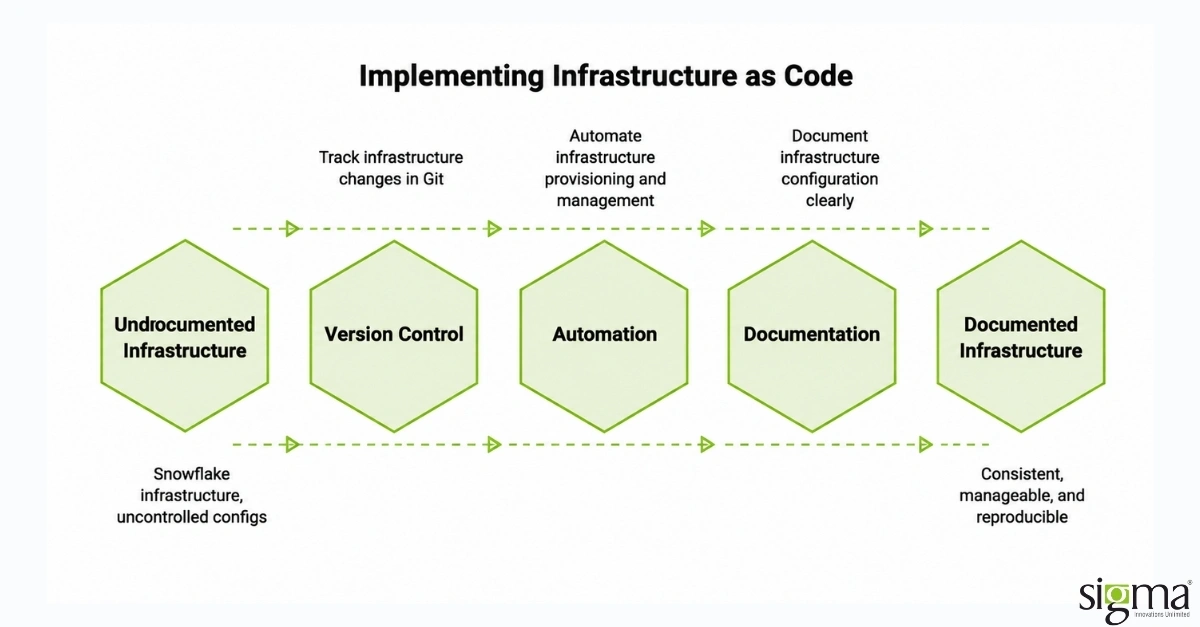
Infrastructure as code treats infrastructure configuration the same way engineering teams treat application code. Servers, networks, databases, IAM policies, and monitoring rules are defined in declarative configuration files, stored in version control, reviewed through pull requests, and deployed through automated pipelines.
This changes three things that matter for technical debt reduction.
First, every change has a history. When infrastructure is defined in Terraform or Pulumi and stored in Git, every modification is traceable. You can see who changed a security group rule, when they changed it, what the previous state was, and why (through the commit message). That traceability alone eliminates one of the most expensive categories of incident response time.
Second, environments become reproducible. A staging environment defined in code is identical to production, not “close enough.” This eliminates the class of bugs that only appear in production because staging was configured differently by a different engineer six months ago.
Third, infrastructure becomes portable. Terraform’s provider model lets teams define resources using a consistent language across AWS, Azure, and GCP. A VPC, a Kubernetes cluster, or a managed database can be described once and deployed to multiple providers with parameter changes. This is the foundation of a real cloud native migration strategy: not rewriting everything at once, but making infrastructure portable enough that switching or distributing across providers becomes an engineering decision rather than a multi-year project.
Looking to establish reusable infrastructure, automated deployments, and cloud engineering best practices?
What Multi Cloud DevOps Looks Like in Practice
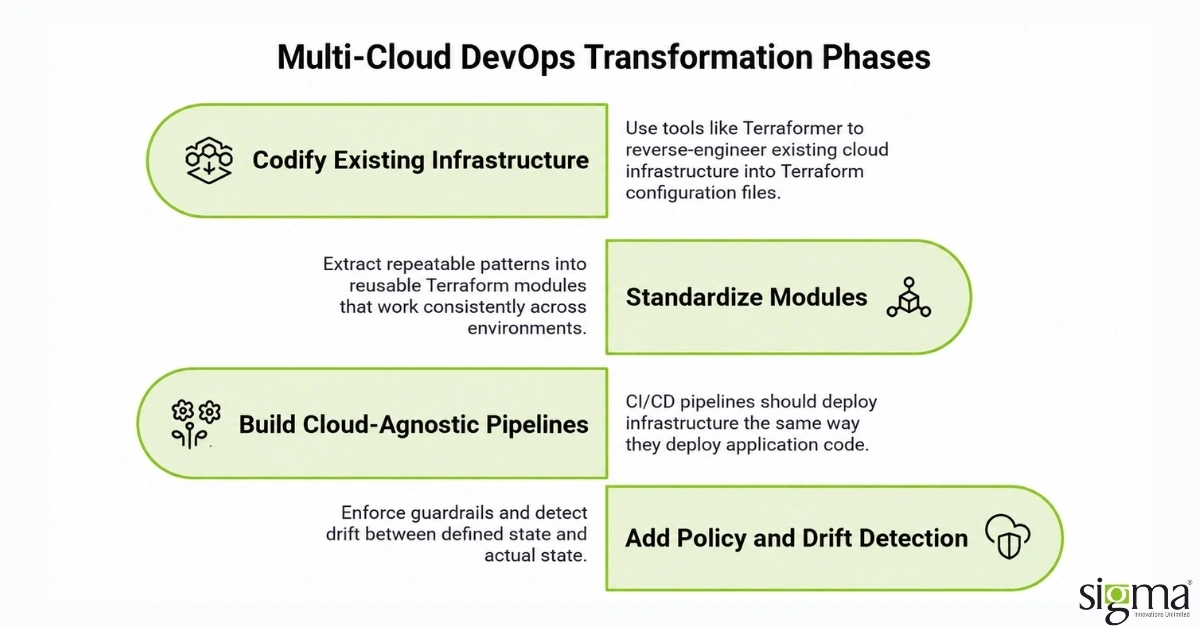
Moving from single-cloud manual provisioning to multi-cloud DevOps is not an overnight transformation. For most growth-stage teams, it happens in phases.
Phase 1: Codify what exists. Tools like Terraformer can reverse-engineer existing cloud infrastructure into Terraform configuration files. This gives teams a starting point without requiring a rebuild. The generated code will need cleanup, but it is dramatically faster than writing everything from scratch.
Phase 2: Standardize modules. Once the baseline is in code, extract repeatable patterns into reusable Terraform modules. A VPC module, a Kubernetes cluster module, and a managed database module that work consistently across environments reduce the per-deployment effort and eliminate configuration drift between dev, staging, and production.
Phase 3: Build cloud-agnostic pipelines. CI/CD pipelines (GitHub Actions, GitLab CI, or Jenkins) should deploy infrastructure the same way they deploy application code: through pull requests, automated plan reviews, and gated applications. This removes the “one engineer with console access” bottleneck.
Phase 4: Add policy and drift detection. Tools like Open Policy Agent or Sentinel enforce guardrails (no public S3 buckets, no overly permissive IAM roles) at the pipeline level, before changes reach production. Scheduled Terraform plan jobs detect drift between defined state and actual state, catching manual changes before they compound.
Implementing a multi-cloud DevOps strategy requires more than selecting tools. It requires designing cloud architectures, automating infrastructure provisioning, and establishing governance that scales with your business. Sigma’s AWS Cloud Solutions help organizations accelerate cloud modernization through Infrastructure as Code, Kubernetes, DevOps automation, and cloud-native architecture.
The following table compares manual provisioning against IaC-driven multi-cloud DevOps across the dimensions that matter most:
| Dimension | Manual Provisioning | IaC-Driven Multi-Cloud DevOps |
| Change traceability | CloudTrail logs (reactive, hard to search) | Git history (proactive, reviewable) |
| Environment consistency | Drift accumulates over time | Identical, reproducible environments |
| Deployment speed | Hours to days per environment | Minutes per environment |
| Vendor portability | Locked to provider-specific console workflows | Portable across providers via Terraform modules |
| Incident recovery | Manual reconstruction from memory | Automated rebuild from code |
| Compliance audit readiness | Manual documentation (often outdated) | Code is the documentation |
Read our success story: AI-Driven Mortgage POS Modernization Using AWS and Next.js
The Common Mistakes That Slow Teams Down
Trying to codify everything at once. Start with the most critical and most frequently changed resources. Let the rest follow incrementally.
Ignoring state management. Terraform state files contain sensitive data and must be stored remotely with encryption and access controls. Teams that commit state to Git create both security risks and coordination problems.
Treating IaC as a one-time project. Without drift detection, policy enforcement, and regular module updates, the codebase accumulates its own technical debt over time.
How Sigma Infosolutions Approaches Infrastructure Modernization
Reducing infrastructure technical debt requires more than adopting new cloud tools. Organizations need a modern engineering foundation that standardizes infrastructure, automates deployments, and supports continuous application evolution. Sigma Infosolutions combines its expertise in Platform Engineering, AWS Cloud Solutions, and Software Modernization Services to help growth-stage SaaS, FinTech, and eCommerce companies transform manually managed cloud environments into scalable, cloud-native platforms that are easier to operate, secure, and evolve.
Assess Infrastructure and Eliminate Technical Debt
Every modernization initiative begins with understanding the current state of the infrastructure. Sigma evaluates existing cloud environments to identify configuration drift, manual provisioning, legacy deployment practices, security gaps, and operational bottlenecks that contribute to technical debt. Rather than replacing existing infrastructure, the team incrementally converts cloud resources into Infrastructure as Code using Terraform, creating reusable modules and version-controlled configurations that establish consistency across development, staging, and production environments.
Build an Automated Cloud Platform
Through its Platform Engineering practice, Sigma develops standardized cloud platforms where infrastructure provisioning, application deployment, and operational governance are fully automated. Infrastructure changes move through CI/CD pipelines with automated validation, policy enforcement, and approval workflows, while observability, monitoring, and security controls are integrated from the outset. This enables engineering teams to provision environments consistently, reduce configuration drift, and accelerate software delivery without compromising reliability or compliance.
Modernize Applications for Cloud-Native Operations
Infrastructure modernization delivers the greatest value when paired with application modernization. Sigma helps organizations evolve monolithic and legacy applications into containerized, cloud-native workloads running on modern orchestration platforms such as Kubernetes and Amazon EKS. By modernizing applications alongside the underlying infrastructure, organizations gain greater scalability, resilience, deployment flexibility, and operational efficiency while avoiding the risks associated with large-scale lift-and-shift migrations.
Enable Long-Term Scalability and Operational Excellence
Modern infrastructure should continue delivering value long after the initial implementation. Sigma builds reusable Terraform modules, automated governance policies, monitoring frameworks, and deployment standards that enable internal engineering teams to manage cloud environments independently. The result is a modern cloud platform that reduces infrastructure technical debt, improves deployment consistency, supports multi-cloud strategies, and provides the operational foundation needed to scale products and engineering teams with confidence.
Infrastructure modernization delivers the greatest business value when applications evolve alongside the underlying cloud platform. Sigma combines Platform Engineering, AWS expertise, and Software Modernization to help organizations build resilient, cloud-native software ecosystems designed for continuous innovation.
Conclusion
Infrastructure technical debt is invisible until it is not. It hides in console-configured security groups, in staging environments that do not match production, and in the two hours your team spends trying to reproduce a deployment that used to take ten minutes. Multi-cloud DevOps and infrastructure as code are how growth-stage companies pay that debt down. Not by rebuilding everything from scratch, but by systematically converting manual, undocumented infrastructure into version-controlled, portable, and repeatable code. Sigma Infosolutions helps teams make that transition inside their existing stack, building the Terraform modules, CI/CD pipelines, and policy guardrails that turn fragile infrastructure into a genuine engineering asset.
Frequently Asked Questions
What is multi-cloud DevOps and why does it matter for technical debt?
Multi-cloud DevOps combines infrastructure automation, CI/CD pipelines, and IaC practices across multiple cloud providers. It reduces technical debt by replacing manual, provider-specific provisioning with version-controlled, portable configurations that deploy consistently across AWS, Azure, or GCP, eliminating drift and improving change traceability.
How does infrastructure as code reduce technical debt?
Infrastructure as code defines servers, networks, and policies in declarative files stored in Git. Every change is traceable, reviewable, and reversible. This eliminates snowflake configurations, makes environments reproducible, and ensures that incident recovery is automated rather than dependent on an engineer’s memory of what was configured.
What tools are commonly used for multi-cloud infrastructure as code?
Terraform is the most widely adopted tool for multi-cloud IaC, holding 32.8% market share. Pulumi offers an alternative using general-purpose programming languages. OpenTofu provides an open-source Terraform fork. These tools are typically combined with CI/CD platforms such as GitHub Actions and policy engines such as Open Policy Agent to achieve complete automation.
When should a company start investing in legacy modernization of infrastructure?
The tipping point typically arrives when release velocity slows noticeably, incident recovery takes hours instead of minutes, or compliance audits expose undocumented configurations. For most growth-stage companies, this happens 18 to 24 months after initial cloud setup. Starting legacy modernization earlier costs less than retrofitting after technical debt has compounded.
How does Sigma Infosolutions help with cloud native migration?
Sigma imports existing cloud resources into Terraform, organizes them into reusable modules, builds multi-cloud CI/CD pipelines, and implements drift detection and policy enforcement. The team works within the client’s stack and trains their engineers to maintain the framework independently, ensuring that cloud-native migration delivers lasting portability rather than a one-time cleanup.