The Rise of Platform Engineering: Why DevOps Teams Are Shifting in 2026
Key Highlights
- Traditional DevOps models that rely on centralized platform teams to serve as intermediaries between developers and infrastructure are creating bottlenecks, cognitive overload, and delivery slowdowns that prevent engineering organizations from scaling their software development capabilities at the pace modern business demands.
- Platform engineering addresses this challenge by building internal developer platforms that abstract infrastructure complexity, standardize operational tooling, and enable development teams to self-serve the capabilities they need to build, test, and deploy software without depending on centralized operations teams for every infrastructure interaction.
- Sigma Infosolutions builds internal developer platforms and scalable automation systems that improve engineering productivity, reduce operational overhead, and help enterprise engineering organizations make the structural shift from traditional DevOps models to platform engineering disciplines that scale with the business.
Introduction
Something significant is happening in how leading technology organizations structure their engineering operations. The DevOps model that defined the last decade of software delivery thinking is evolving into a more deliberate, product-oriented discipline called platform engineering. DevOps leaders, platform teams, CTOs, and enterprise engineering managers across industries are reconsidering how they organize the relationship between software development and infrastructure operations, and the answers they are arriving at consistently point toward internal developer platforms, golden paths, and engineering productivity as the organizing principles of modern software delivery.
Platform engineering is not a rejection of DevOps values. It is an evolution of DevOps practice in response to the realities of large-scale engineering organizations, where the original DevOps vision of every developer owning the full lifecycle of their software has created cognitive overload, inconsistent security and compliance postures, and operational complexity that slows delivery rather than accelerating it. The platform engineering discipline responds to these realities by treating the internal developer experience as a product problem and building the tools, automation, and standards that allow developers to move fast without accumulating the operational knowledge burden that modern cloud computing infrastructure would otherwise require.
For DevOps leaders evaluating their team’s organizational model, for CTOs planning engineering capability investments, and for enterprise engineering managers responsible for developer productivity, understanding the platform engineering shift and its practical implications is essential context for the infrastructure and tooling decisions that will shape delivery capability for years to come.
What Drove the Evolution from DevOps to Platform Engineering
To understand why platform engineering is gaining momentum in 2026, it helps to understand the specific pressures that have pushed traditional DevOps models toward their limits in large engineering organizations.
The Cognitive Load Problem
The DevOps movement’s most ambitious aspiration was that developers should own the full lifecycle of their software, including infrastructure provisioning, deployment pipeline management, monitoring configuration, and incident response. This vision worked well in small, highly skilled teams where every engineer had the capacity to develop deep expertise across the full operational stack.
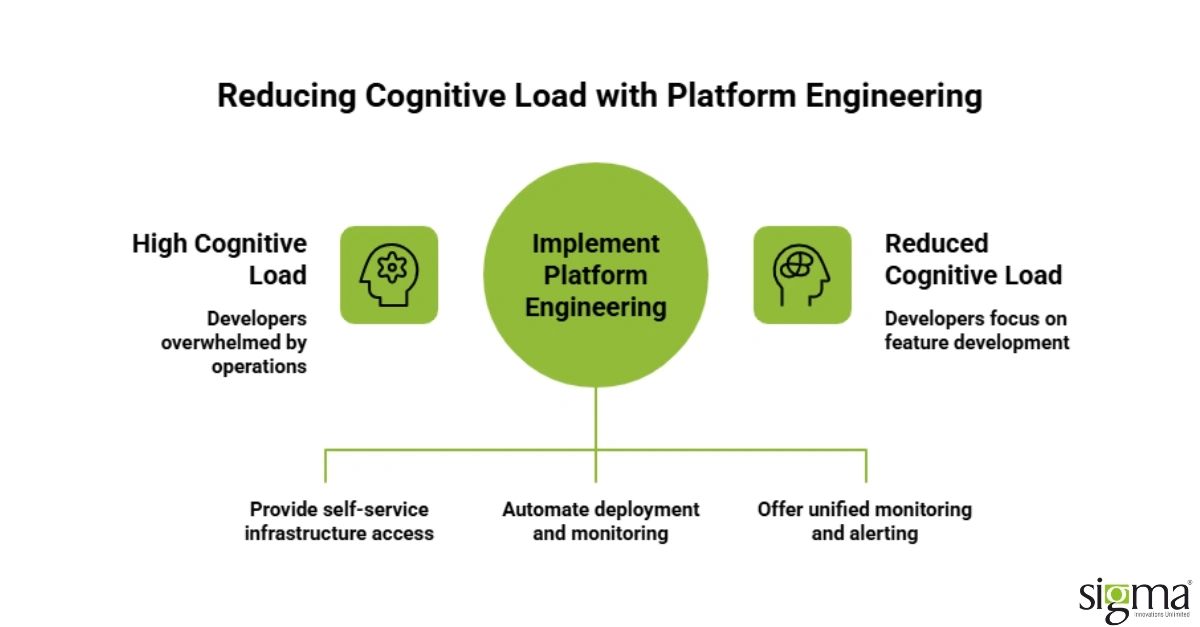
As engineering organizations scaled, the cognitive load of full-stack ownership became a significant productivity drag. Developers building application features found themselves spending increasing proportions of their working week navigating Kubernetes configurations, debugging CI/CD pipeline failures, configuring observability tooling, and managing cloud resource provisioning. The time spent on these operational concerns came directly at the expense of the feature development work that drove business value.
The cognitive load problem compounded as cloud computing infrastructure grew more complex. The sprawling service catalogs of major cloud providers, the proliferation of container orchestration concepts, and the growing complexity of security and compliance requirements created an operational knowledge surface that no individual developer could reasonably be expected to master while simultaneously developing high-quality application software.
The Inconsistency Problem
When every development team manages its own infrastructure and tooling independently, the result is an operational landscape of inconsistent configurations, divergent technology choices, and varied security postures that create risk and maintenance overhead at the organizational level. One team runs applications on managed Kubernetes while another uses serverless functions. One team enforces strict secrets management practices while another stores credentials in environment variables. One team has comprehensive observability, while another relies on application logs for production diagnosis.
This inconsistency makes it difficult for security teams to enforce standards, for platform teams to provide meaningful support, and for engineers to move between teams without a significant ramp-up period to understand each team’s unique operational approach. It also creates compliance risk for organizations operating under regulatory frameworks that require consistent security controls across all software development activities.
The Scaling Problem
Traditional DevOps models that rely on a central platform team to support a growing number of development teams create a structural scaling problem. As the development organization grows, the platform team’s support burden grows proportionally, but the platform team rarely grows at the same rate. The result is an increasingly stressed platform team that becomes a bottleneck for the development teams that depend on them, with growing queues of infrastructure requests, delayed pipeline fixes, and deferred tooling improvements.
Platform engineering addresses the scaling problem by shifting the platform team’s role from reactive support to proactive product development. Instead of handling individual infrastructure requests from development teams, a platform engineering team builds the self-service tools, automated workflows, and standardized templates that allow development teams to provision and manage their infrastructure needs independently, within guardrails that enforce organizational standards automatically.
What Platform Engineering Actually Means in Practice
Platform engineering is the discipline of designing, building, and operating internal developer platforms that provide development teams with the capabilities they need to build, test, deploy, and operate software effectively, without requiring them to develop deep expertise in the underlying infrastructure.
The Internal Developer Platform
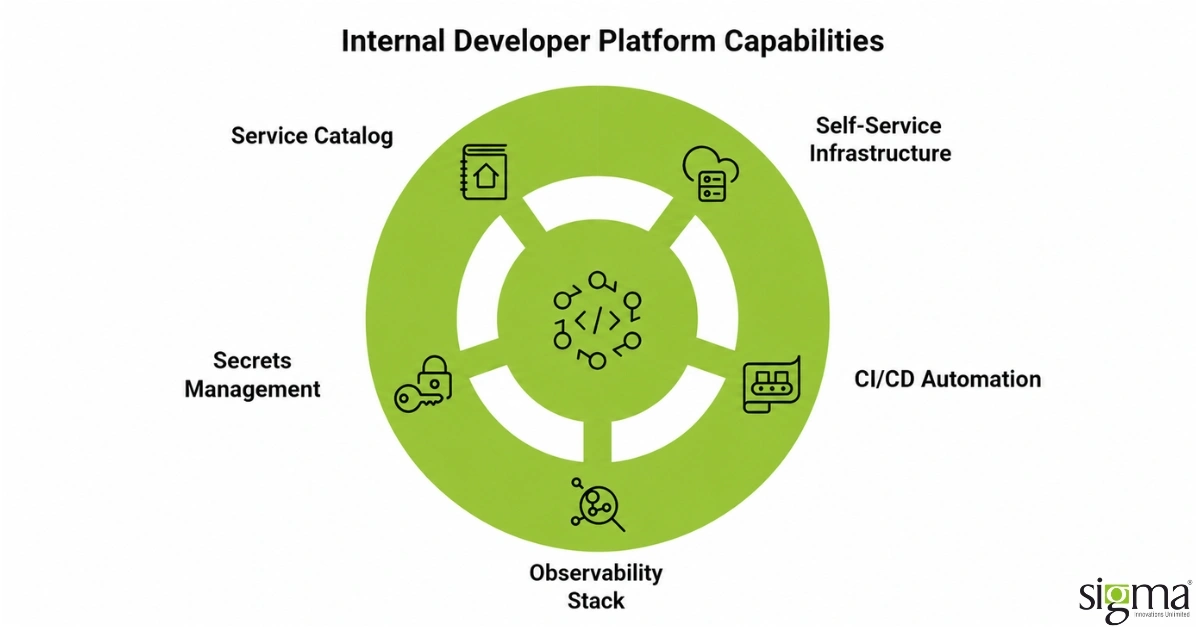
An internal developer platform is the tangible product that a platform engineering team builds and maintains. It is not a single tool but a curated, integrated set of tools, services, workflows, and abstractions that together constitute the operational environment in which development teams work.
A mature internal developer platform typically provides self-service infrastructure provisioning that allows developers to create and configure cloud resources through standardized templates without writing low-level infrastructure code; a CI/CD platform that handles build, test, and deployment automation with sensible defaults that teams can customize within defined boundaries; an observability stack that instruments applications automatically and provides consistent dashboards and alerting configurations without requiring each team to configure monitoring from scratch; a secrets management system that provides secure, audited access to credentials and configuration without exposing sensitive values to individual developers, and a service catalog that documents available platform capabilities and provides the starting points that teams need to build new services according to organizational standards.
Golden Paths and Paved Roads
The golden path concept is central to platform engineering philosophy. A golden path is a supported, documented, and tool-assisted route from idea to production that embodies the organization’s best practices for software development, security, and operational excellence. When developers follow the golden path, they benefit from automation, standardization, and organizational knowledge that would take significant time to accumulate independently.
Golden paths do not eliminate developer autonomy. They establish a well-supported default that works well for the majority of use cases while preserving the ability for teams with specific requirements to diverge from the path when they have a compelling reason to do so. The key difference from prescriptive mandates is that golden paths make the right thing easy rather than making the wrong thing impossible.
Platform as a Product
Perhaps the most important conceptual shift in platform engineering is treating the internal developer platform as a product with customers, rather than as infrastructure with users. Platform engineering teams apply product management discipline to their work, conducting user research with developer teams, defining product roadmaps based on developer needs, measuring platform adoption and satisfaction, and iterating on platform capabilities based on feedback and usage data.
This product orientation changes how platform teams prioritize their work and how they measure success. A platform team operating as a product team measures success by developer productivity, deployment frequency, and mean time to recovery rather than by infrastructure uptime and ticket resolution time. This shift in success metrics drives fundamentally different decisions about where to invest platform engineering effort.
How Platform Engineering Changes the Role of DevOps Teams
The rise of platform engineering does not eliminate DevOps practice. It reorganizes DevOps expertise into more specialized roles that collectively deliver better outcomes than the generalist DevOps model that preceded them.
The Platform Engineering Team
The platform engineering team is responsible for building and operating the internal developer platform. This team combines software engineering capability with deep infrastructure expertise, applying software development discipline to the creation of platform products rather than application products. Platform engineers write code that other engineers use to build and operate software, making the quality and usability of their output as important as its technical correctness.
Platform engineering teams in mature organizations operate with a product manager who maintains the platform roadmap, a set of software engineers who build platform capabilities, infrastructure specialists who design and operate the underlying systems, and developer experience advocates who ensure that the platform meets the actual needs of its developer customers.
The Application Development Team
Development teams in a platform engineering model operate within the environment that the platform team provides, consuming platform services through self-service interfaces rather than requesting infrastructure support through tickets. This shift frees development teams from operational concerns that the platform handles automatically and allows them to focus their expertise on the application domain problems that create business value.
Development teams in this model still practice DevOps in the sense that they own their application’s behavior in production and are responsible for monitoring, alerting, and incident response within their domain. The difference is that the operational tooling they use to fulfill these responsibilities is provided, standardized, and maintained by the platform team rather than assembled independently by each development team.
Read the blog: Accelerating Time-to-Market Through DevOps-Enabled Product Engineering Services
Key Capabilities That Define Mature Platform Engineering
Organizations building platform engineering disciplines in 2026 focus their investment on several capabilities that deliver the highest leverage for developer productivity and operational consistency.
Infrastructure as Code and Self-Service Provisioning
Mature platform engineering organizations provide development teams with curated infrastructure as code modules that encapsulate organizational standards for security, networking, observability, and cost management. Developers provision infrastructure by selecting and configuring these modules rather than writing low-level Terraform or CloudFormation from scratch, ensuring consistency while preserving meaningful customization within established boundaries.
Self-service provisioning portals built on platforms such as Backstage provide a graphical interface for infrastructure provisioning that makes organizational standards accessible to developers who are not infrastructure specialists, reducing the learning curve for new team members and accelerating the time from idea to running infrastructure.
Automated Security and Compliance Enforcement
Platform engineering enables security and compliance requirements to be enforced automatically through policy as code rather than through manual review processes that slow delivery and introduce inconsistency. Open Policy Agent and AWS Service Control Policies provide mechanisms for defining and enforcing security guardrails that apply automatically to all resources provisioned through the platform, ensuring that compliance requirements are met without requiring development teams to develop deep compliance expertise.
Automated security scanning integrated into the platform’s CI/CD infrastructure checks every code change for known vulnerabilities, secrets exposure, and compliance violations before they reach production, shifting security left in the development process and reducing the cost and risk of remediation.
Developer Portal and Service Catalog
A developer portal built on an open platform such as Backstage provides a single entry point for all platform capabilities, documentation, service dependencies, and organizational knowledge. The service catalog component of the developer portal documents every service in the organization’s software ecosystem, including ownership information, dependency relationships, operational runbooks, and API documentation, giving developers the context they need to understand how their work fits into the broader system.
Software templates in the developer portal provide starting points for new services that encode organizational standards for code structure, testing patterns, observability configuration, and CI/CD integration, reducing the time required to create a new production-ready service from days to hours.
Platform Observability and Developer Experience Metrics
Platform engineering teams measure the effectiveness of their platforms through developer experience metrics that capture the friction developers encounter when using platform capabilities. Metrics such as deployment frequency, lead time for changes, change failure rate, and mean time to recovery provide a picture of how effectively the platform is enabling development teams to deliver software reliably.
Developer satisfaction surveys and platform adoption rates provide qualitative and quantitative signals about which platform capabilities are meeting developer needs and which require investment to improve usability or capability.
Also, read the blog: Product Engineering Services and PLM: Building Software Products for Long-Term Success
Common Challenges in Platform Engineering Adoption
Organizations adopting platform engineering disciplines consistently encounter a set of challenges that require deliberate management to navigate successfully.
Organizational resistance from development teams accustomed to full infrastructure autonomy can slow platform adoption. Addressing this resistance requires demonstrating concrete value through well-designed platform capabilities that genuinely make developer work easier, rather than mandating platform adoption through policy before the platform has earned developer trust.
Building a platform engineering team requires a combination of software engineering and infrastructure expertise that is difficult to hire directly. Many organizations build platform engineering capability by evolving existing DevOps and SRE teams, investing in software engineering skill development for infrastructure specialists and infrastructure knowledge development for software engineers.
Defining the boundary between platform responsibility and development team responsibility requires ongoing negotiation as the organization’s needs evolve and the platform’s capabilities mature. Clear documentation of the platform contract, the supported use cases, and the escalation path for requirements that fall outside the platform’s scope reduces friction and confusion at this boundary.
How Sigma Infosolutions Helps Enterprises Build Platform Engineering Capabilities
Sigma Infosolutions brings deep expertise in platform engineering, DevOps automation, cloud computing infrastructure, and internal developer platform development to help enterprise engineering organizations make the structural shift from traditional DevOps models to platform engineering disciplines that scale with their business.
Platform Engineering Assessment and Strategy
Sigma works with DevOps leaders, CTOs, and enterprise engineering managers to assess the current state of the organization’s developer experience, infrastructure consistency, and operational scalability. This assessment produces a platform engineering strategy that defines the internal developer platform capabilities required to address the organization’s specific productivity and consistency challenges, prioritized by expected impact and implementation feasibility.
Internal Developer Platform Development
Sigma’s platform engineering team designs and builds internal developer platforms tailored to the client’s technology stack, cloud environment, and organizational structure. Platform capabilities, including self-service provisioning, CI/CD automation, observability integration, secrets management, and developer portal implementation are built as integrated, production-grade systems rather than collections of disconnected tools.
Golden Path and Template Engineering
Sigma designs and implements golden paths and software templates that encode the client’s best practices for software development, security, and operational excellence into the platform’s default experience. Golden paths are designed in collaboration with development teams to ensure that they reflect actual developer needs and workflows rather than theoretical ideals that developers will work around in practice.
DevOps Automation and CI/CD Platform Engineering
Sigma implements the CI/CD platform infrastructure, automated testing frameworks, and deployment automation systems that form the operational backbone of the internal developer platform. Automation systems are built with observability, maintainability, and extensibility as design requirements, ensuring that the platform team can evolve the automation as organizational needs change.
Platform Adoption and Developer Experience Optimization
Sigma supports platform adoption by helping organizations measure developer experience metrics, identify adoption barriers, and iterate on platform capabilities based on real developer feedback.
Conclusion
Platform engineering represents the most significant evolution in software delivery organizational design since the DevOps movement transformed the relationship between development and operations a decade ago. The shift is driven by the real-world limitations of traditional DevOps models at scale: cognitive overload on development teams, operational inconsistency across the organization, and structural bottlenecks that prevent the development organization from growing its delivery capability proportionally with its headcount.
The internal developer platform is the concrete expression of the platform engineering discipline, providing development teams with the self-service capabilities, golden paths, and operational automation that allow them to focus on building software rather than managing infrastructure. Organizations that build mature platform engineering capabilities consistently outperform those that do not on the delivery metrics that matter most: deployment frequency, lead time for changes, change failure rate, and mean time to recovery.
The transition from traditional DevOps to platform engineering is not a simple reorganization. It requires investment in new capabilities, new organizational structures, and new ways of measuring engineering effectiveness. The organizations that navigate this transition successfully are those that approach it with a clear strategy, a product mindset, and the right engineering partners to build the platform capabilities that their development teams need.
Sigma Infosolutions is the strategic platform engineering transformation partner that DevOps leaders, platform teams, CTOs, and enterprise engineering managers trust to design and build the internal developer platforms and automation systems that power modern software delivery at scale.
FAQs
What is platform engineering?
Platform engineering is the practice of building internal developer platforms that standardize infrastructure, automation, CI/CD workflows, security controls, and developer tooling. The goal is to improve developer productivity, reduce operational complexity, and allow engineering teams to self-serve infrastructure and deployment capabilities efficiently.
Why are DevOps teams shifting toward platform engineering in 2026?
Many organizations are evolving beyond traditional DevOps models because developers are experiencing increasing cognitive overload from managing cloud infrastructure, Kubernetes, CI/CD pipelines, observability, and security tooling alongside application development. Platform engineering addresses this by abstracting operational complexity through standardized internal platforms and automation systems.
How is platform engineering different from DevOps?
DevOps is a cultural and operational philosophy focused on collaboration between development and operations teams. Platform engineering is a specialized discipline that operationalizes DevOps principles by building reusable internal platforms, golden paths, and self-service tooling that simplify software delivery at scale.
What is an internal developer platform (IDP)?
An internal developer platform is a centralized platform that provides developers with self-service capabilities for infrastructure provisioning, CI/CD automation, observability, secrets management, deployment workflows, and service templates. It creates a consistent and scalable software delivery environment across engineering teams.
What are golden paths in platform engineering?
Golden paths are standardized, well-supported workflows and templates that guide developers through approved processes for building, testing, deploying, and operating software. They simplify development while enforcing organizational standards for security, compliance, and operational reliability.
How does platform engineering improve developer productivity?
Platform engineering reduces the operational burden placed on developers by automating repetitive infrastructure tasks, standardizing tooling, and simplifying deployment workflows. This allows engineering teams to spend more time building product features and less time troubleshooting infrastructure issues.
Why is cognitive load a major concern for engineering teams?
Modern cloud-native environments require developers to understand complex infrastructure concepts such as Kubernetes, observability stacks, infrastructure as code, CI/CD pipelines, networking, and security policies. Excessive operational complexity slows development velocity and impacts software quality.
What role does Infrastructure as Code play in platform engineering?
Infrastructure as Code (IaC) enables organizations to automate infrastructure provisioning using reusable templates and standardized configurations. Platform engineering teams use IaC to create scalable, self-service infrastructure workflows that enforce consistency and governance across environments.
How does platform engineering support security and compliance?
Platform engineering integrates automated security policies, compliance controls, secrets management, and policy-as-code frameworks directly into the software delivery lifecycle. This ensures organizational standards are enforced consistently without slowing down development teams.
What tools are commonly used in platform engineering?
Common platform engineering tools include Kubernetes, Backstage, Terraform, Jenkins, GitHub Actions, and Open Policy Agent for automation, governance, and developer experience management.
What is platform engineering as a product mindset?
Platform engineering teams treat the internal developer platform as a product with developers as customers. This means platform capabilities are designed around developer experience, adoption, usability, automation, and measurable productivity outcomes rather than only infrastructure management objectives.
How does platform engineering improve software delivery scalability?
Platform engineering creates reusable automation systems and self-service workflows that scale across multiple development teams without requiring centralized operations teams to manually support every infrastructure request. This reduces bottlenecks and accelerates software delivery.
What challenges do organizations face when adopting platform engineering?
Common challenges include organizational resistance to standardized workflows, defining ownership boundaries between platform teams and development teams, integrating legacy infrastructure, and building teams with both software engineering and infrastructure expertise.
How does platform engineering improve CI/CD operations?
Platform engineering standardizes CI/CD pipelines, deployment automation, testing frameworks, observability integration, and rollback mechanisms. This improves deployment consistency, reduces release failures, and accelerates delivery cycles across engineering teams.
How does Sigma Infosolutions support platform engineering transformation?
Sigma Infosolutions designs and builds internal developer platforms, cloud-native automation systems, CI/CD infrastructure, observability frameworks, and self-service engineering environments that improve developer productivity, operational scalability, and software delivery performance for enterprise engineering organizations.