What Is Platform Engineering and How Is It Different From DevOps?

Key Highlights:
- As engineering organizations scale beyond 10 to 15 engineers, developer productivity stalls because teams spend too much time managing infrastructure and not enough time building products.
- Platform engineering introduces an internal developer platform (IDP) with golden paths and self-service infrastructure, enabling developers to ship faster without deep infrastructure expertise.
- Sigma designs and builds internal developer platforms, CI/CD pipelines, and self-service infrastructure tooling for SaaS, FinTech, and eCommerce engineering teams so they can focus on product delivery at scale.
Introduction
Engineering teams across the industry are hitting the same wall. As organizations grow, the overhead of managing infrastructure, tooling, and deployment workflows begins to consume the bandwidth of your best developers. The result is slower release cycles, inconsistent environments, and a developer experience that frustrates rather than empowers.
Platform engineering has emerged as the discipline that solves this problem at scale. By treating the internal developer platform as a product and engineering teams as its customers, organizations can standardize workflows, reduce cognitive load, and dramatically improve developer productivity.
Unlike traditional DevOps, which focuses on culture and collaboration between development and operations, platform engineering creates the systems and tooling that make those workflows self-service. Companies that make this shift report faster onboarding, more consistent deployments, and fewer production incidents.
Understanding the difference between platform engineering and DevOps is no longer an academic exercise. For CTOs, Founders, VPs of Engineering, and Heads of Product at scaling companies, it is a strategic decision that directly affects how fast you can ship and how reliably your systems operate.
Standardize software delivery with Internal Developer Platforms, CI/CD automation, Infrastructure as Code, and self-service infrastructure built for engineering teams.
What Is Platform Engineering?
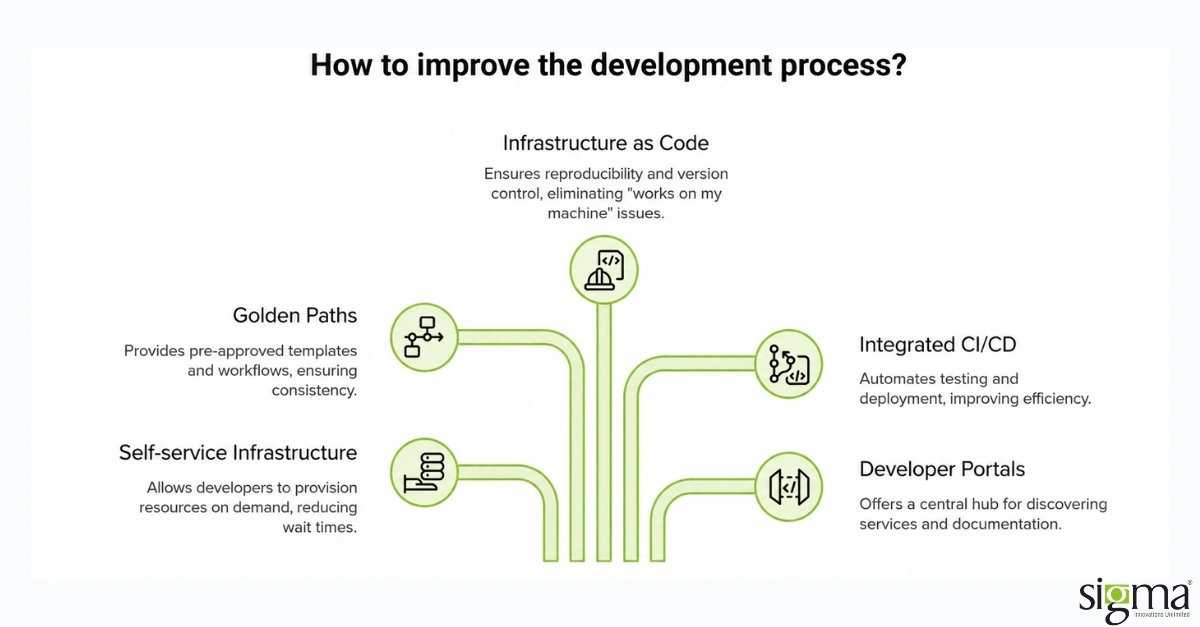
Platform engineering is the practice of designing, building, and maintaining the internal infrastructure, tooling, and workflows that software development teams rely on to build and ship products. The output of a platform engineering team is typically an internal developer platform (IDP), a curated set of self-service capabilities that developers can use without needing deep infrastructure knowledge.
The core philosophy is straightforward: treat your internal platform like a product with real users, roadmaps, and quality standards. Platform engineering teams build golden paths, which are opinionated, well-supported routes that guide developers from code to production without friction.
Key components of a modern internal developer platform include:
- Self-service infrastructure: Developers can provision environments, databases, and services on demand without waiting for an operations ticket.
- Golden paths: Pre-approved templates and workflows that represent the best way to build, test, and deploy a service.
- Infrastructure as code (IaC): All infrastructure is version-controlled and reproducible, removing the “works on my machine” problem.
- Integrated CI/CD pipelines: Automated testing, building, and deployment that is consistent across all teams and services.
- Developer portals: A single pane of glass where developers can discover services, documentation, and deployment status.
Also, read: The Rise of Platform Engineering: Why DevOps Teams Are Shifting in 2026
What Is DevOps, and Why Is It Still Relevant?
DevOps is a cultural and organizational movement that emerged to close the gap between software development and IT operations. The core idea is that developers and operations engineers should work collaboratively throughout the entire software lifecycle, sharing responsibility for reliability, security, and deployment.
DevOps introduced transformative practices, including continuous integration, continuous delivery, automated testing, and shared ownership of production systems. These practices remain foundational to how modern software teams operate.
DevOps is not a role or a tool. It is a mindset and a set of practices. Many organizations that claim to have “done DevOps” have actually implemented some DevOps tooling, such as a CI/CD pipeline, without fully embracing the cultural shift. That distinction matters when evaluating whether your organization needs platform engineering as a next step.
DevOps culture is a prerequisite for platform engineering to succeed. You cannot build an effective internal developer platform inside an organization where development and operations still operate in silos.
Platform Engineering vs DevOps: Understanding the Difference
The most common misconception is that platform engineering replaces DevOps. It does not. Platform engineering is what DevOps scaling looks like in practice when you have dozens or hundreds of engineers.
Here is how the two disciplines differ across key dimensions:
| Dimension | DevOps | Platform Engineering |
| Focus | Culture, collaboration, shared ownership | Products, tooling, self-service systems |
| Output | Improved processes and communication | Internal developer platform |
| Team Structure | Embedded across development and ops | Dedicated platform team |
| Primary Users | Cross-functional engineering teams | Application developers |
| Key Metrics | Deployment frequency, MTTR | Developer productivity, platform adoption |
DevOps asks: “How do we get development and operations to work better together?”
Platform engineering asks: “How do we build systems so every developer can work faster without depending on specialists?”
Both questions are valid and important. The difference is scope and maturity. When DevOps practices are in place, and your teams are still slowed down by infrastructure complexity, platform engineering is the next investment
Also, read: Paying the ‘Legacy Tax’? How ISVs Can Modernize Without Disrupting Customers
When Does a Company Need Platform Engineering?
Not every organization needs a dedicated platform engineering function. The discipline becomes essential when the cost of infrastructure complexity starts to outweigh the cost of building a platform team.
Signs your organization is ready for platform engineering:
- Developer onboarding takes weeks, not days, because of environment setup complexity.
- Teams maintain their own CI/CD pipelines, leading to duplicated effort and inconsistent standards.
- Deployment bottlenecks are limiting release frequency across multiple teams.
- Infrastructure knowledge is concentrated in a small group of senior engineers, creating single points of failure.
- Security and compliance requirements are difficult to enforce consistently across services.
For engineering teams in the US or Australia operating under SOC 2, CCPA, or Australian Privacy Act requirements, platform engineering also becomes the mechanism for enforcing security and compliance policies consistently across every service, not just in the teams that have the most senior engineers.
A US-based B2B SaaS company with 30 engineers, for example, might find that three or four engineers spend the majority of their time responding to infrastructure requests from the rest of the team. A platform engineering investment transforms that reactive model into a self-service one, freeing both the platform engineers and the product teams to do higher-value work.
The threshold is not a specific team size. It is the point at which infrastructure friction becomes a measurable drag on product velocity.
The Role of CI/CD and Infrastructure as Code in Platform Engineering
CI/CD pipelines and infrastructure as code are not new concepts. DevOps teams have used them for years. What platform engineering adds is standardization, discoverability, and governance at scale.
In a platform engineering model, CI/CD is not something each team builds for themselves. The platform team builds a standard pipeline template that meets security, testing, and deployment requirements. Application teams adopt it through golden paths rather than building from scratch each time.
Infrastructure as code moves from being a team practice to being a platform feature. Developers request infrastructure through self-service interfaces, and the platform generates the appropriate IaC manifests, runs them through a validation layer, and provisions the environment. This approach improves consistency, reduces drift, and makes compliance auditable by default.
Many engineering organizations that adopted CI/CD early under DevOps now face a proliferation problem: dozens of slightly different pipeline configurations, each maintained by a different team. Platform engineering solves this by consolidating that complexity into a managed, versioned platform layer.
Read our success story: Engineered a cloud-native lending platform using AWS, Terraform, and Jenkins to automate loan processing for a financial services company.
How Sigma Infosolutions Helps Engineering Teams Build and Scale Their Internal Developer Platform
Sigma Infosolutions works with CTOs, Founders, VPs of Engineering, Heads of Product, and technical leaders at scaling SaaS, FinTech, and eCommerce product companies to design and build internal developer platforms that reduce infrastructure friction and improve developer productivity. We typically engage through dedicated engineering teams, T&M arrangements, or long-term product partnerships, not fixed-bid handoffs.
Discovery and Strategy
Sigma begins with a platform engineering assessment, mapping the current state of your tooling, CI/CD workflows, infrastructure provisioning, and developer experience. This discovery phase identifies the highest-leverage improvements and informs the platform roadmap.
Solution Architecture
Sigma’s engineers design an IDP architecture aligned to your team’s technology stack, cloud environment, and compliance requirements. This includes defining golden paths, selecting or building a developer portal, and establishing IaC standards that the entire organization can adopt.
Agile Development
Platform capabilities are delivered incrementally, with application teams involved as early users. Sigma follows agile development principles to iterate quickly and validate that platform features genuinely reduce developer friction before investing in broader rollout.
CI/CD Pipeline Engineering
Sigma builds standardized, reusable CI/CD pipeline templates that enforce quality gates, security scanning, and deployment policies consistently across all teams. This eliminates duplicated pipeline maintenance and reduces deployment errors.
Self-Service Infrastructure and Tooling
Sigma implements self-service infrastructure tooling that gives developers on-demand access to the environments and services they need, without requiring infrastructure tickets or specialist intervention. This directly improves developer productivity and reduces the burden on platform and ops teams.
Deployment and Ongoing Support
After initial delivery, Sigma provides ongoing platform support, helping engineering teams evolve the IDP as product and team needs change. This includes training internal teams to manage and extend the platform independently over time.
Extend your platform investments with Sigma’s Product Engineering Services, delivering cloud-native applications, modern architectures, AI/ML capabilities, and dedicated engineering teams that accelerate product innovation.
Conclusion
Platform engineering is not a replacement for DevOps. It is the natural evolution of DevOps practices in organizations where team size and product complexity have made infrastructure consistency and developer productivity major constraints.
The distinction between DevOps and platform engineering matters because it shapes how you invest. DevOps is the cultural foundation. Platform engineering is the systematic effort to build the tools and systems that make DevOps practices scalable, repeatable, and accessible to every developer on your team.
Organizations that invest in an internal developer platform report meaningful improvements in deployment frequency, developer onboarding time, and release reliability. They also reduce the single points of failure that come from concentrating infrastructure knowledge in a small group of specialists.
FAQ’s
What is platform engineering?
Platform engineering is the practice of building internal developer platforms, self-service infrastructure, and standardized workflows that improve developer productivity and software delivery.
How is platform engineering different from DevOps?
DevOps focuses on culture and collaboration, while platform engineering creates the tools and platforms that make DevOps practices scalable and self-service.
What is an Internal Developer Platform (IDP)?
An Internal Developer Platform is a centralized self-service environment that provides developers with infrastructure, deployment pipelines, and development tools.
When should a company invest in platform engineering?
Organizations should consider platform engineering when infrastructure complexity, onboarding delays, and deployment bottlenecks begin impacting development velocity.
How does platform engineering improve developer productivity?
Platform engineering reduces infrastructure overhead by providing automated workflows, self-service provisioning, and reusable deployment templates.
What role does Infrastructure as Code (IaC) play in platform engineering?
Infrastructure as Code enables consistent, version-controlled, and automated infrastructure provisioning across development and production environments.
Why are CI/CD pipelines important in platform engineering?
Standardized CI/CD pipelines automate testing, security checks, and deployments, helping teams release software faster and with fewer errors.
What are the benefits of implementing an Internal Developer Platform?
An Internal Developer Platform improves onboarding speed, deployment reliability, developer experience, operational consistency, and overall engineering efficiency.