Digital Product Engineering: When Your Roadmap Needs an Outside Engineering Partner

Engineering leaders at software companies, ISVs, and digital-first enterprises rarely reject a product engineering partner outright. More often, they defer the decision while the roadmap slips, critical expertise remains concentrated in a few people, and open roles take months to fill.
Digital product engineering partnerships fail often enough that the caution is earned. But those failures tend to cluster around predictable conditions that were visible before the engagement began.
The useful question is not whether an external engineering partner works in general. It is whether the constraint slowing your roadmap is one a product engineering partner can actually relieve.
That distinction matters because adding engineering capacity to an architectural, product, or leadership problem does not solve the constraint. It can make it more expensive.
Key Highlights:
- Roadmap commitments can outgrow available engineering capacity long before leadership formally recognizes the gap.
- Two or more signals, such as velocity decay, hiring plateaus, concentrated expertise, deferred modernization, or excess roadmap scope, justify evaluating an external engineering model.
- A product engineering partner should add more than individual capacity. The engagement should establish defined ownership, delivery governance, technical accountability, and a path to knowledge transfer.
- Staff augmentation and dedicated product engineering solve different problems. The right model depends on whether the constraint is temporary capacity or sustained product delivery responsibility.
- A credible engineering partner should sometimes recommend against an external engagement when product direction, engineering leadership, or scope is not ready for it.
Digital Product Engineering Is About Ownership, Not Extra Hands
Digital product engineering is the practice of building and evolving software as a continuing product rather than a sequence of disconnected projects. It brings architecture, delivery, quality, modernization, and ongoing product improvement into the same engineering model.
That distinction matters commercially.
Staff augmentation primarily adds people to an existing delivery structure. The client typically owns task assignment, technical direction, prioritization, and day-to-day management.
A dedicated product engineering model is different. It establishes a structured team with defined engineering responsibilities, delivery governance, technical participation, and accountability for the systems and product areas it owns.
The difference is not simply the number of engineers involved. It is who owns the work required to keep the product moving.
A project vendor is measured on whether the specified work was delivered on the agreed date. A product engineering team is also concerned with what happens after delivery: whether the architecture can support the next release, whether technical debt is accumulating, whether quality is improving, and whether the next feature becomes cheaper or harder to build.
Buying a product engineering capability while managing it like staff augmentation creates the outsourcing experience many engineering leaders want to avoid. The partner becomes a queue of tickets, internal engineers remain responsible for the hardest decisions, and management overhead rises without creating meaningful ownership.
The better model starts by identifying the constraint and then matching the engagement structure to it.
Five Conditions That Indicate a Product Engineering Partner May Help
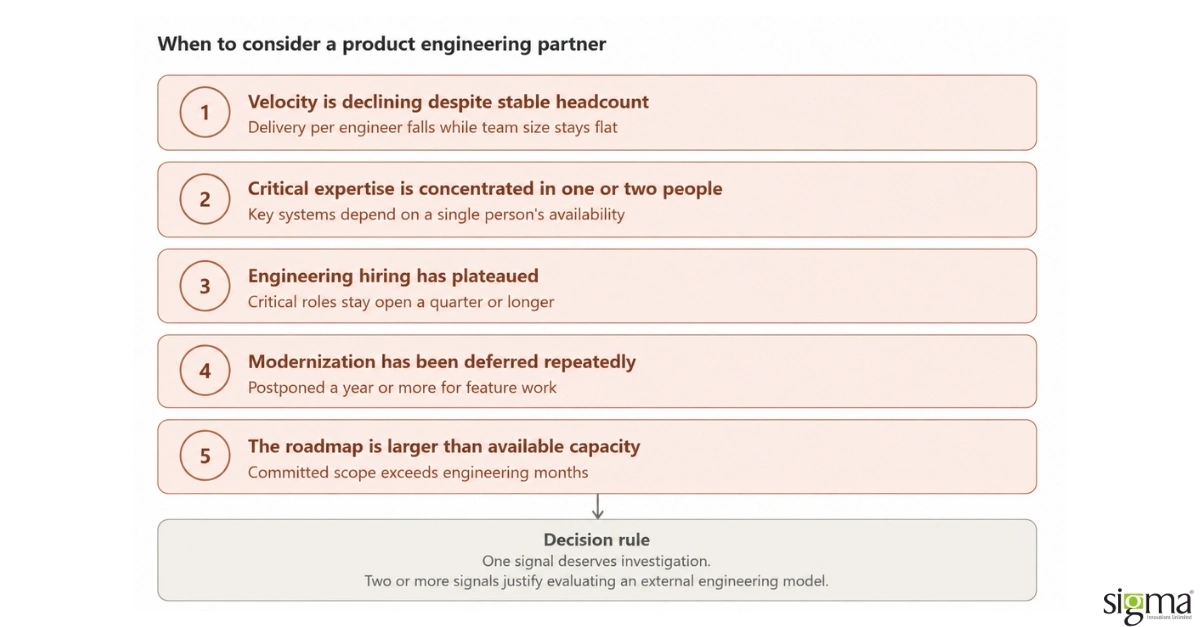
1. Velocity Is Declining Despite Stable Headcount
Signal: Delivery per engineer is falling quarter over quarter while the engineering team remains roughly the same size.
What it indicates: The constraint may no longer be simple capacity. Architectural drag, accumulated technical debt, inefficient delivery processes, or fragile dependencies can make additional hiring less effective.
Business consequence: Adding more engineers to a system that is already slow to change can increase coordination without producing proportional roadmap progress.
When to act: Evaluate the engineering system before adding permanent headcount. A partner can be useful when additional capacity needs to arrive alongside modernization or delivery improvements.
2. Critical Expertise Is Concentrated in One or Two People
Signal: One person understands the payment integration, pricing engine, legacy service, or core business logic that several roadmap items depend on.
What it indicates: The organization has a knowledge concentration risk that can turn individual availability into a roadmap dependency.
Business consequence: Releases, architectural decisions, and production fixes begin routing around individual calendars.
When to act: Bring in additional engineering ownership before the dependency becomes a business continuity problem. The objective should be knowledge distribution, not simply adding another person who depends on the same expert.
3. Engineering Hiring Has Plateaued
Signal: Critical engineering roles repeatedly remain open for a quarter or longer.
What it indicates: The hiring plan is no longer a reliable mechanism for closing the roadmap capacity gap.
Business consequence: Roadmap commitments continue to assume capacity that has not materialized.
When to act: Plan against demonstrated hiring velocity rather than projected headcount. A product engineering partner can provide interim or sustained capacity while the organization determines which capabilities should remain internal.
4. Modernization Has Been Deferred Repeatedly
Signal: Engineering leadership agrees that a system needs modernization, but the work has been postponed for a year or more because customer-facing features always take priority.
What it indicates: The organization has a structural prioritization problem, not a temporary backlog problem.
Business consequence: Technical debt continues increasing while every new feature becomes more expensive to deliver.
When to act: Separate modernization from feature delivery through a protected workstream with defined ownership, rather than waiting for an internal team to find spare capacity.
5. The Roadmap Is Larger Than Available Engineering Capacity
Signal: Committed scope exceeds available engineering months, while the plan continues assuming future hires will close the gap.
What it indicates: The roadmap and the actual engineering capacity are operating against different assumptions.
Business consequence: Something eventually gives: delivery dates, quality, modernization, employee capacity, or product scope.
When to act: Quantify the gap before the next planning cycle and determine whether permanent hiring, reprioritization, or an external product engineering team is the appropriate response.
Decision rule: One signal deserves investigation. Two or more signals justify evaluating an external engineering model.
These conditions often compound. A hiring plateau can leave single-point expertise unresolved. Velocity decay makes modernization harder to fund. Deferred modernization makes the next feature slower. A roadmap that already exceeds capacity then becomes even less achievable.
The objective is not to add engineers because the roadmap looks large. It is to identify the constraint that is actually preventing the roadmap from moving.
Is your roadmap outgrowing your engineering capacity?
Three Conditions Where a Product Engineering Partner Can Make Things Worse
A credible engineering partner should sometimes tell you not to engage one.
1. Product Direction Is Still Unclear
If priorities change materially every few weeks because the organization has not settled what the product is supposed to achieve, an external engineering team amplifies the churn.
The team will build against the agreed direction and then rebuild when that direction changes.
Internal teams can absorb some ambiguity through shared context and constant interaction. A partner should not be expected to compensate for an unresolved product strategy.
Resolve product direction first.
2. Engineering Leadership Is Absent
A product engineering partner needs an internal counterpart with enough authority to make architectural decisions, resolve priority conflicts, and answer critical questions quickly.
Where that role is vacant or lacks technical authority, decisions accumulate without resolution and delivery stalls.
Establish engineering ownership first.
3. The Requirement Is One Short, Fixed Deliverable
A dedicated product engineering relationship is not the right instrument for every software requirement.
If the need is one tightly scoped deliverable with a definite beginning and end, project delivery may be more appropriate.
The partner should not sell a long-term engineering model when the business has a bounded project problem.
Match the engagement model to the work.
Staff Augmentation vs. Dedicated Product Engineering
The distinction matters because both models can add engineering capacity, but they do not create the same operating model.
| Dimension | Staff Augmentation | Dedicated Product Engineering |
| Primary purpose | Fill a specific capacity or skill gap | Extend sustained product delivery capability |
| Team structure | Individual engineers added to the client’s team | Defined engineering team or pod |
| Day-to-day management | Primarily client-owned | Shared governance with defined partner delivery ownership |
| Architecture involvement | Usually client-led | Shared or explicitly defined responsibility |
| Best fit | Temporary capacity or specialist needs | Persistent roadmap, modernization, or engineering capacity constraints |
| Success measure | Additional engineering capacity | Delivery progress, engineering ownership, quality, and roadmap outcomes |
| Knowledge transfer | Primarily embedded in the client’s existing model | Explicitly planned as part of the engagement |
| Ownership | Client retains most delivery coordination | Defined product and engineering responsibilities across both teams |
The decision should therefore start with the constraint.
If the organization has strong engineering leadership, stable architecture, and a temporary gap in a specific capability, staff augmentation may be enough.
If the problem is sustained roadmap capacity, modernization, delivery ownership, or a need for a dedicated engineering capability, a product engineering model is more appropriate.
Match the Engagement Model to the Constraint
| Constraint | Recommended engagement | Why |
| Temporary skill or capacity gap | Staff augmentation | Adds targeted capability without changing the broader delivery model |
| Persistent roadmap capacity gap | Dedicated product engineering | Creates sustained engineering capacity with defined ownership |
| Declining velocity caused by technical friction | Dedicated product engineering + modernization | Addresses capacity and the system slowing delivery |
| Deferred technical debt | Modernization workstream | Protects modernization from continuous feature reprioritization |
| Uncertain architecture or technical direction | Architecture and technical due diligence | Establishes the technical baseline before committing to larger delivery |
| One bounded, well-specified requirement | Project delivery | Avoids over-engineering the engagement model |
| Unclear product direction | Resolve internally first | External delivery cannot compensate for unresolved product strategy |
| No engineering decision-maker | Establish internal ownership first | A partner needs an accountable counterpart for technical decisions |
The right question is therefore not:
“Should we outsource engineering?”
It is:
“What constraint are we trying to remove, and what engagement model gives us the right ownership to remove it?”
What a Product Engineering Partnership Should Actually Include
A product engineering partnership should be concrete enough that both sides can explain who owns what before delivery begins.
A well-structured engagement should establish:
- Named engineers and defined team composition: The client should know who is responsible for the product area rather than receiving an anonymous pool of resources.
- Technical ownership: Architecture, code ownership, quality, and engineering responsibilities should be explicitly defined.
- An engineering counterpart: A client-side decision-maker should have authority over product and technical priorities.
- Delivery cadence: Sprint, release, and planning rhythms should be agreed before execution begins.
- Architecture participation: The partner should understand and contribute to architectural decisions within its defined scope.
- Transparent delivery reporting: Progress should be visible through roadmap movement, delivery predictability, risks, dependencies, and agreed engineering measures.
- Code and IP ownership: Repository access, source code, documentation, intellectual property, and other technical artifacts should be contractually defined.
- Documentation and knowledge transfer: Critical system knowledge should not remain exclusively with the partner.
- Handover model: The engagement should define how ownership can transition if the client brings capabilities back in-house or changes partners.
This is where a product engineering partner differs most from a body-shop model.
The goal is not to create dependency on an external team. The goal is to create additional engineering capability while preserving the client’s ability to understand, govern, and ultimately own its product.
The First 90 Days Determine Whether the Partnership Is Working
A product engineering partner should not be expected to deliver at full velocity on day one.
The first 90 days should be structured around three stages.
Days 0–30: Understand
The first month should establish the engineering baseline.
The team should understand:
- Product priorities
- Architecture and system dependencies
- Deployment and release processes
- Critical business logic
- Existing technical debt
- Engineering ownership boundaries
- Documentation gaps
- Immediate roadmap risks
The goal is not to maximize ticket output. It is to understand what prevents sustainable delivery.
Days 31–60: Integrate
The second phase moves from observation into shared execution.
The partner should:
- Take ownership of defined product areas
- Establish the agreed delivery cadence
- Pair with internal engineers on critical paths
- Resolve early delivery blockers
- Participate in architectural decisions
- Establish transparent reporting
- Begin addressing agreed modernization priorities
The internal team should increasingly spend less time explaining the system and more time working alongside the partner.
Days 61–90: Accelerate
By the third phase, the engagement should begin demonstrating independent delivery capability.
The team should be able to:
- Deliver against defined roadmap commitments
- Operate within the established engineering cadence
- Own agreed components or product areas
- Reduce identified delivery friction
- Begin measurable modernization work
- Document critical knowledge
- Demonstrate a clear path for continued knowledge transfer
The first 90 days should therefore be judged on progression toward independent engineering ownership, not simply the number of tickets completed.
What Product Engineering Looks Like When the Product Starts Outgrowing Its Foundation
A product engineering partner should do more than add capacity. The value comes from identifying what is constraining the product, addressing the underlying engineering problem, and creating a foundation that supports the next stage of growth.
Modernize Without Putting the Roadmap on Hold
Products often outgrow the architecture that helped validate the original idea. A lightweight website or application can become a constraint once integrations, transaction volumes, product complexity, or customer expectations increase.
The answer is not always to stop feature delivery and rebuild everything. The stronger approach is to modernize the parts of the architecture creating the greatest delivery friction while keeping the product roadmap moving.
This can include restructuring legacy components, strengthening the platform layer, reducing technical debt, or creating clearer boundaries between product capabilities.
Build the Foundation Behind Complex Integrations
As products mature, their value increasingly depends on the systems around them. Third-party platforms, APIs, data providers, payment systems, and business services all introduce different requirements, response times, dependencies, and failure conditions.
A US lending marketplace illustrates this transition. Its initial WordPress-based presence was sufficient to validate demand, but supporting pre-qualification across multiple lenders required a fundamentally different architecture.
The engineering challenge was not simply adding features to the existing site. It was creating a platform foundation capable of orchestrating multiple lender integrations while maintaining a coherent customer experience.
See how a validated digital product evolved into a working lending marketplace.
Sequence Engineering Work Around the Real Constraint
The most visible feature is not always the most important engineering priority.
When architecture is slowing delivery, prioritizing another customer-facing feature may create short-term progress while increasing the underlying constraint. A stronger approach is to establish the technical foundation first, then build the product capabilities that depend on it.
That means determining:
- Which architectural constraints are affecting the roadmap
- Which dependencies need to be resolved first
- Which modernization work cannot be postponed further
- Which product capabilities can proceed in parallel
- Where technical decisions will affect future delivery cost
The result is a roadmap that reflects engineering dependencies as well as product priorities.
Reduce Dependency on Individual Engineering Knowledge
A product can quietly become dependent on one person who understands a critical integration, legacy service, pricing engine, or business process.
The risk is not simply that someone leaves. It is that releases, architectural decisions, production fixes, and modernization work begin depending on individual availability.
A stronger engineering model distributes that knowledge through shared ownership, documentation, paired work on critical systems, and deliberate handover practices.
See how Sigma addressed operational dependency through automation.
Extend Engineering Capacity Without Extending Management Overhead
Adding engineers does not automatically increase roadmap velocity. If every additional engineer requires more coordination, clarification, architectural oversight, and internal management, the organization can gain headcount without gaining proportional delivery capacity.
A dedicated product engineering team should operate within a defined delivery structure, with named engineers, clear responsibilities, established cadence, technical accountability, and an internal counterpart who can make decisions quickly.
The objective is to increase the organization’s ability to execute without turning internal engineering leadership into a permanent coordination layer.
Build for the Product’s Next Stage, Not Its Last One
The point at which a product outgrows its original foundation is not necessarily a signal to replace everything. It is a signal to determine which parts of the engineering system are now limiting growth.
That could mean modernizing a legacy architecture, strengthening integration infrastructure, removing single-point expertise, creating dedicated engineering capacity, or restructuring how product and engineering work is sequenced.
The right approach depends on the constraint.
The goal is not simply to add more engineering capacity. It is to remove the constraint preventing the product from moving forward.
Should You Bring in a Product Engineering Partner?
Before selecting a partner, answer four questions:
- What is actually slowing the roadmap?
Capacity, architecture, modernization, product ambiguity, or engineering leadership? - Is the constraint temporary or structural?
A short-term skills gap may need augmentation. A persistent delivery constraint may require a dedicated product engineering model. - What ownership needs to change?
Adding people without changing ownership may simply increase coordination. - Is the organization ready to partner?
Product direction, engineering leadership, access to systems, decision authority, and knowledge-transfer expectations should be established before delivery begins.
If the answers point to sustained engineering capacity, roadmap pressure, modernization needs, or delivery ownership, a dedicated product engineering partnership may be appropriate.
If the constraint is unclear product direction, absent engineering leadership, or a single bounded deliverable, solve that problem first.
Conclusion
Digital product engineering partnerships should begin with diagnosis, not vendor selection.
Five conditions indicate that a product engineering partner may relieve the binding constraint: declining delivery velocity, concentrated system expertise, persistent hiring limitations, repeatedly deferred modernization, and a roadmap that exceeds available engineering capacity.
Three conditions point in the opposite direction: unclear product direction, absent engineering leadership, and a single tightly scoped deliverable.
The engagement model matters just as much. Staff augmentation can address targeted capacity gaps. Dedicated product engineering is better suited to sustained roadmap execution, modernization, and defined engineering ownership. Project delivery remains appropriate for bounded work.
The principle is simple:
Diagnose the constraint first. Then choose the engagement model that gives you the right capacity, ownership, and control to remove it.
A product engineering partner should not simply give a business more engineers. It should give the roadmap a more reliable path to execution.
Is Your Roadmap Outgrowing Your Engineering Capacity? Let’s identify the constraint and build the right engineering path forward.
FAQs
Q1. What is digital product engineering?
Digital product engineering is the practice of building and evolving software as a continuing product rather than a series of discrete projects. It combines product delivery, architecture, quality, modernization, and ongoing engineering ownership around a continuing product lifecycle.
Q2. When should a company bring in a product engineering partner?
A company should evaluate a product engineering partner when persistent capacity constraints, declining delivery velocity, concentrated technical expertise, deferred modernization, or roadmap commitments beyond available engineering capacity are preventing sustainable product delivery.
Q3. What is the difference between staff augmentation and product engineering?
Staff augmentation primarily adds individual engineering capacity to an existing delivery structure. Digital product engineering adds a defined engineering team with explicit delivery responsibilities, technical participation, governance, and ownership of agreed product areas.
Q4. When is a product engineering partner the wrong choice?
A product engineering partner is usually the wrong choice when product direction remains unresolved, there is no internal engineering decision-maker with authority to resolve technical issues, or the requirement is a single tightly scoped deliverable better suited to project delivery.
Q5. How long does it take to onboard a product engineering partner?
The initial onboarding period typically involves understanding the product, architecture, deployment process, dependencies, technical debt, and delivery practices. A structured 90-day model can move from understanding to integration and then toward independent delivery ownership.
Q6. Who owns the code when working with a product engineering partner?
Code and intellectual property ownership should be explicitly defined in the engagement terms. This should cover source code, repositories, documentation, technical artifacts, access rights, intellectual property, and the process for transferring ownership if the engagement ends.
Q7. Why do outsourced engineering engagements sometimes require more management than expected?
This often happens when a product engineering relationship is managed as staff augmentation or contracted as a fixed-scope project. The client remains responsible for detailed task coordination and technical decisions while the external team lacks defined ownership. A clear operating model reduces that management burden.
Q8. How do you choose between in-house engineering and an external product engineering partner?
Start with the constraint rather than the sourcing model. Compare the cost and availability of internal hiring against the roadmap’s urgency, required capabilities, modernization needs, management capacity, and desired ownership. The right answer may be internal hiring, augmentation, dedicated product engineering, or a combination.