Cloud-Native Application Development: Modernize Legacy Architecture Without a Costly Rewrite

Every architect running a maturing platform can describe the target state, and almost none of them can get it approved. Cloud-native application development is rarely blocked by a shortage of technical understanding. It is blocked by the fact that a rewrite requires a large budget, produces no customer-visible value for its duration, and asks a board to accept substantial risk in exchange for benefits that are real but difficult to express in the language of a quarterly review.
That constraint is not going to lift, and treating it as an education problem to be solved with a better presentation wastes years. The productive response is to design a modernization path that never requires the approval that will not come.
Key Highlights
- Releases are slow and risky, scaling means over-provisioning the entire application, and a full rewrite cannot be justified to the people holding the budget.
- Decompose incrementally against the coupling that is actually constraining the business, funding each increment from the roadmap rather than from a separate transformation budget.
- Release frequency and scaling cost improve progressively, without a period during which the organization is paying for two systems and shipping nothing.
- Sigma decomposes what constrains the business first and leaves the rest alone, which is what allows modernization to proceed without a budget line that would never survive review.
Cloud-Native Application Development Is Constrained by Funding, Not Technology
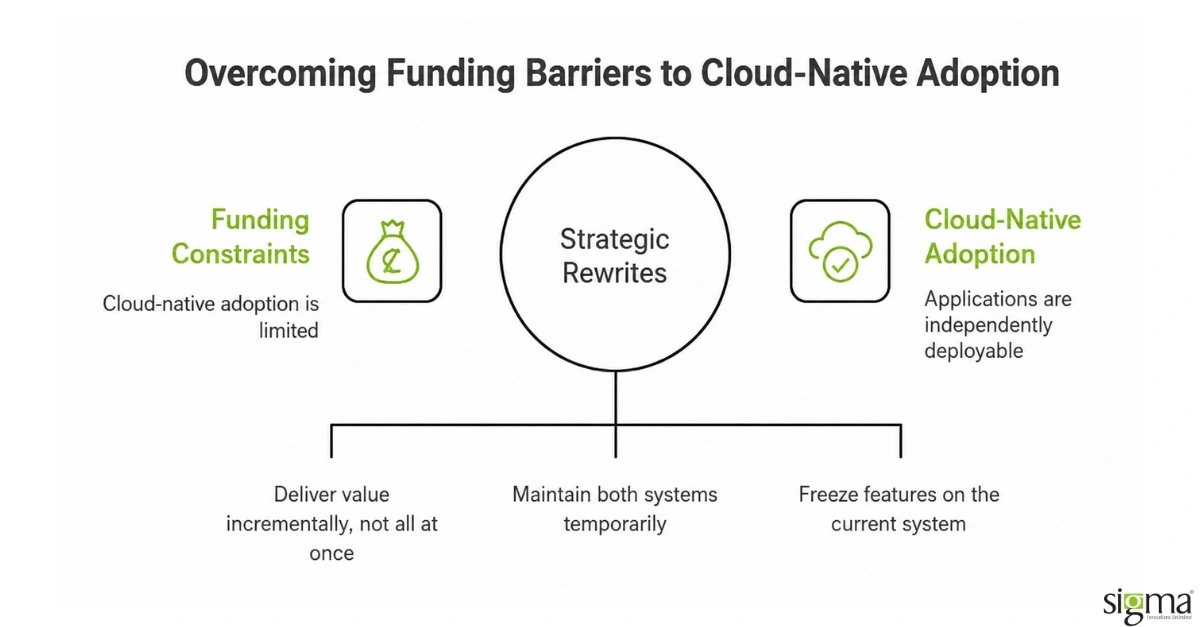
Cloud-native application development is the practice of building applications as independently deployable, independently scalable services designed for elastic infrastructure, rather than as a single unit deployed and scaled together. The technical case is well established and largely uncontested by the engineers who would do the work. The commercial case is where these initiatives die.
A rewrite has a distinctive risk profile that makes it uniquely difficult to approve. It requires two systems to be maintained simultaneously, which means either double the cost or a feature freeze on the product that is currently earning revenue. It delivers nothing observable until it delivers everything. It has a well-earned reputation for overrunning, and most executives with a decade of experience have watched one do exactly that. A CTO asking for a rewrite is asking a board to accept concentrated, correlated risk with a deferred and uncertain payoff, and a board declining that request is behaving rationally rather than short-sightedly.
How Coupling Converts Into Release Frequency, Scaling Cost, and Hiring Difficulty
Legacy architecture imposes costs that appear on no technology budget, which is why the case for modernization is usually argued in the wrong currency. Coupling produces three business effects, and expressing them as business effects is what makes the conversation possible.
Release frequency falls because a change anywhere requires regression testing everywhere. Deployment becomes an event requiring coordination across teams, so it happens monthly rather than daily, and the cost is not the deployment overhead but the feedback delay: every product decision waits weeks to learn whether it was correct.
Scaling cost rises because the unit of scaling is the whole application. A checkout path under load forces the provisioning of every other component alongside it, including the reporting module nobody is using at that moment. On metered infrastructure this is a direct and continuing charge.
Hiring difficulty increases in a way that compounds quietly. A tightly coupled system takes months for a new engineer to become productive in, because nothing can be understood in isolation, and this extends the period during which each hire is a net cost.
| Business symptom | Architectural cause | Incremental remedy |
| Monthly releases, high rollback rate | Shared deployment unit across all features | Extract the highest-change component first |
| Infrastructure cost rising faster than traffic | Whole application scales to meet one path’s peak | Separate the load-bearing path onto its own service |
| New engineers productive after months | No component comprehensible in isolation | Establish clear boundaries and ownership per service |
| Integration requests take quarters | Data reachable only through the application | Expose stable APIs over existing data first |
| One team blocks another routinely | Overlapping ownership of a single codebase | Align service boundaries to team boundaries |
Translating these symptoms is the work that unlocks the budget. An architect describing tight coupling to a finance committee is describing something that sounds like a preference. The same architect describing a fixed monthly release cadence that delays every product correction by four weeks, or infrastructure spend growing faster than transaction volume, is describing a business problem with a measurable cost. Nothing about the underlying situation changes between those two sentences, and only one of them gets funded.
Modernize the parts that constrain the business, and leave the rest alone.
The Strangler Path Is Slower, and It Is the One That Gets Approved
Incremental decomposition works by placing new functionality outside the existing system and gradually routing traffic away from the old implementation until it can be retired. The approach is documented across the industry as a standard application modernization pattern, and its technical merits are not the interesting part.
The interesting part is financial. Each increment is small enough to fund from the product roadmap rather than a transformation budget, which means it never requires the board decision that would kill it. Each increment delivers observable improvement, so the case for the next one rests on evidence rather than argument. Risk stays bounded, since a failed increment affects one capability rather than the entire platform. Incremental work is also reversible in a way a rewrite is not, and reversibility is what makes approval easy.
The honest cost is that this path is slower in total elapsed time and produces an awkward intermediate state, sometimes for years, in which two architectural styles coexist and engineers have to hold both in their heads. Teams pursuing purity find this genuinely uncomfortable. It remains the correct trade, because a slower path that is actually funded beats a faster path that stays in a slide deck.
A second consideration makes the intermediate state more tolerable than it first appears. The old and new implementations do not have to be equally well maintained. Once traffic for a capability has moved, the legacy path can be frozen rather than kept current, which reduces the cost of coexistence substantially and concentrates effort on the components that are still evolving. Teams that attempt to hold both sides to the same standard throughout create most of the overhead they later cite as evidence that incremental modernization does not work.
Read the blog: Why the C-Suite Can’t Ignore Microservices-Based App Development Services
Choosing the First Seam Determines Whether There Is a Second
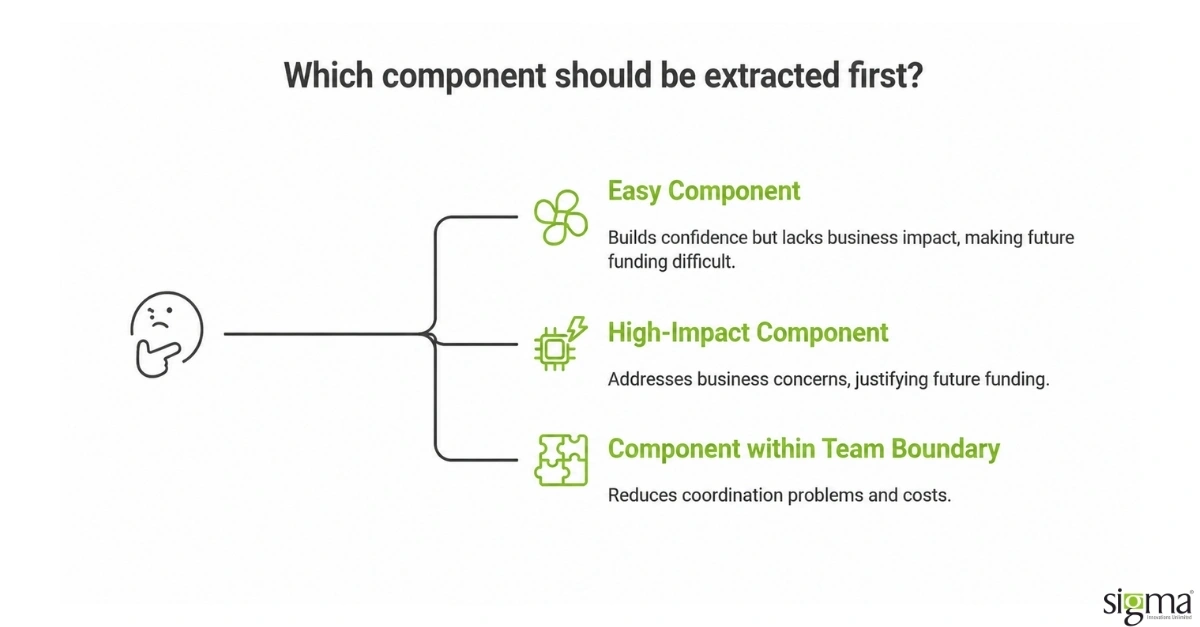
First extraction selection is the highest-leverage decision in the whole program, and the common instinct is to start with something easy in order to build confidence. That produces a successful first increment with no measurable business effect, and the second increment then competes for funding on the strength of a result nobody noticed.
Selecting against business impact works better. The component to extract first is the one carrying the symptom leadership already complains about, which is usually either the highest-change area of the codebase or the path that forces the expensive scaling. Extracting it produces evidence in the currency the funding conversation uses, and the next increment becomes straightforward to justify.
Team boundaries deserve equal weight in the selection, because a service extracted across an organizational seam inherits a coordination problem that the architecture cannot solve. Where two teams share ownership of a component, separating it into an independently deployable service without also separating responsibility produces the same release bottleneck in a more complicated arrangement. Aligning the first extraction to a boundary that already exists organizationally makes the increment cheaper and the ownership question answerable on day one.
Getting the first extraction right isn’t a solo exercise, it takes architectural judgment and organizational reading simultaneously, and most teams only get one shot at building credibility for the second increment.
Sigma’s product engineering team helps you make that call correctly the first time: identifying which component actually carries business-visible impact, mapping it against your real team boundaries, and structuring the extraction so it earns a budget for what comes next instead of burning it.
Decoupling Databases That Were Never Designed to Come Apart
Database decoupling is often where incremental modernization becomes materially harder. Application services can be separated at the code layer while remaining tightly coupled through shared tables, triggers, stored procedures, and referential integrity. If those dependencies remain intact, organizations end up with distributed services that still behave like a monolith.
Establish Boundaries Before Extracting Services
A sustainable modernization starts by defining service boundaries and integration contracts before moving functionality out of the existing application. This prevents extracted components from simply recreating dependencies on the original database.
Sigma approaches this through incremental, interface-first modernization. Stable RESTful APIs can replace tightly coupled interfaces and give surrounding systems a consistent contract while the underlying implementation evolves. This allows database and application changes to proceed in controlled increments rather than requiring a single migration event.
This approach was applied while modernizing a large portfolio of legacy PHP applications, where database restructuring, REST API adoption, cloud migration, authentication modernization, and application standardization had to progress without disrupting live systems. See how Sigma approached legacy PHP application modernization.
Treat Database Dependencies as an Architecture Problem
Database decoupling requires more than splitting tables across new databases. Teams need to identify which applications read or write shared data, where business rules are enforced through triggers or stored procedures, and which relationships depend on transaction boundaries within the existing system.
The objective is to establish clear ownership of data and business logic. Each extracted service should increasingly control its own data and expose required information through defined APIs or events rather than direct access to another service’s database.
This reduces the risk of creating a distributed architecture with centralized database dependencies underneath it.
Modernize Cross-Cutting Services Independently
Authentication, notifications, file handling, and other shared functions can become hidden coupling points during modernization. Treating these capabilities as independent increments allows the application estate to evolve without reproducing the same infrastructure dependencies inside every new service.
For example, centralizing authentication can remove database-based credential dependencies from individual applications, while externalizing email or storage services can provide independent scalability, monitoring, and operational control.
The principle is straightforward: extract the dependency, not just the code that calls it.
Standardize the Engineering Layer
Modernization also creates an opportunity to establish common engineering practices across applications that previously evolved independently. Consistent code structures, deployment workflows, security controls, observability, and integration patterns reduce the operational complexity of running a partially modernized estate.
This standardization matters because organizations may operate legacy and modern components simultaneously for an extended period. Without common practices, the result can become two separate technology estates rather than a controlled transition toward one.
Apply the Same Decoupling Principle to the Front End
Database decoupling is one part of a broader architecture strategy. In commerce environments, the storefront can face similar constraints when its release cycle remains tied to the underlying commerce platform.
Separating the presentation layer from core commerce services allows storefront experiences to evolve independently while established commerce capabilities remain in place. Sigma applied this principle through a Magento upgrade and headless architecture implementation, separating frontend and backend concerns while addressing performance, cross-platform compatibility, and unnecessary platform dependencies. Explore the headless architecture approach in Sigma’s Magento modernization engagement.
The broader principle is the same: create boundaries around components whose change velocity differs from the system around them.
Conclusion
Cloud-native application development stalls in mature organizations for commercial reasons rather than technical ones, and a board declining to fund a rewrite is usually making a defensible decision about concentrated risk. Coupling should be argued in the currency leadership already uses, since release frequency, infrastructure cost that outpaces traffic, and slow engineer onboarding are business symptoms rather than architectural preferences. Incremental decomposition takes longer in elapsed time and produces an uncomfortable intermediate period, and it remains the correct path because each step is small enough to fund from the roadmap and reversible enough to approve. Choosing the first extraction against business impact rather than technical ease determines whether a second increment ever gets funded. The database is where these programs actually succeed or fail, because components separated in code and still joined underneath deliver the cost of distribution with none of the independence.
Turn modernization constraints into a fundable cloud-native application development roadmap.
FAQs
Q1. What is cloud-native application development?
A1. Cloud-native application development builds software as independently deployable and independently scalable services designed for elastic infrastructure, rather than as one unit that deploys and scales together. The defining property is that each component can change and scale without requiring the others to change with it.
Q2. Why do boards reject full application rewrites?
A2. Because a rewrite concentrates risk unusually badly. It requires maintaining two systems simultaneously or freezing the product currently earning revenue, it delivers nothing observable until it delivers everything, and it has a well-documented tendency to overrun. Declining that particular risk profile is a defensible commercial judgment.
Q3. How do you modernize legacy architecture without a rewrite?
A3. Place new functionality outside the existing system and route traffic away from the old implementation incrementally until the legacy path can be retired. Each step stays small enough to fund from the product roadmap, delivers observable improvement, and remains reversible, which is precisely what makes approval achievable.
Q4. Which component should you extract from a monolith first?
A4. Extract the component causing the symptom leadership already complains about, usually the highest-change area of the codebase or the path forcing expensive scaling. Starting with something technically easy produces a successful increment nobody notices, leaving the second increment competing for funding without any supporting evidence.
Q5. Why does database coupling matter more than code coupling?
A5. Services can be cleanly separated in code while remaining entirely joined underneath through shared tables, triggers, and referential integrity constraints. That arrangement delivers the coordination cost and failure exposure of a distributed system without granting any of the operational independence that justified doing the work at all.