Solving SaaS Integration Roadblocks with an API First Approach
Key Highlights:
- Point-to-point integrations break with every third-party update, slow down partner onboarding, and pile up integration debt that drains engineering bandwidth from core product work.
- API first SaaS development replaces fragile, one-off connectors with a reusable API layer that scales as your integration ecosystem grows, without requiring proportional engineering headcount.
- SaaS companies that keep bolting on custom integrations will lose enterprise deals to competitors whose products integrate in days, not months.
Introduction
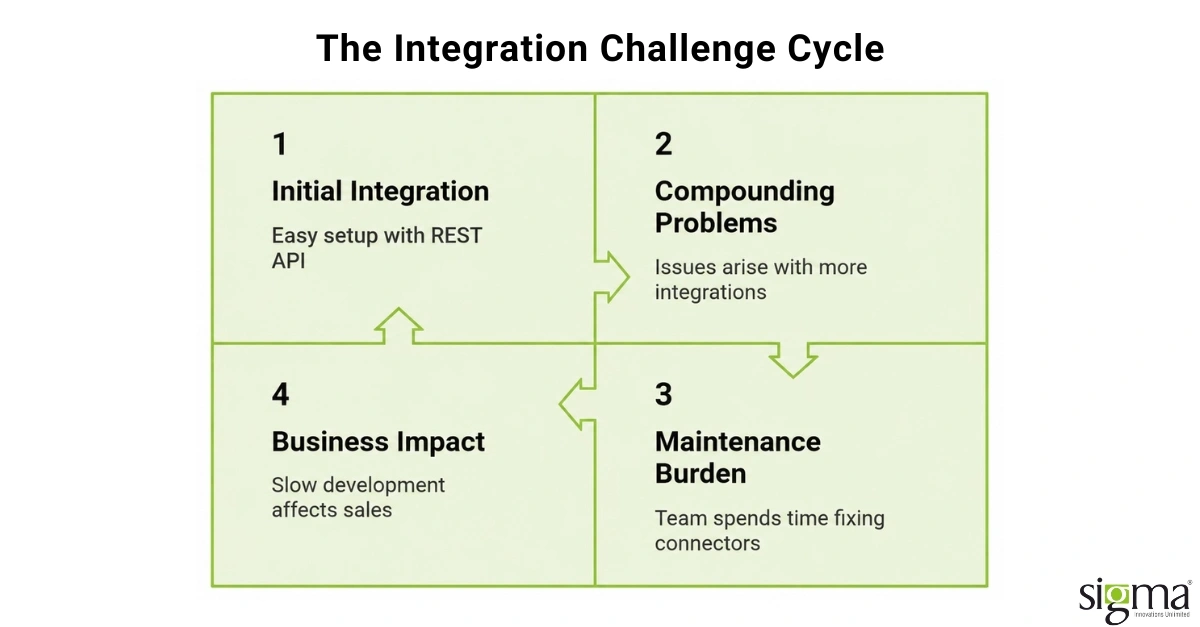
If you run a growth-stage B2B SaaS company, you have probably lived through this cycle. A prospect asks if your product integrates with their CRM. Your team builds a custom connector in two weeks. It works. Six months later, the CRM vendor releases an API update, and the connector breaks. Your engineers pause roadmap priorities to fix it.
Meanwhile, three more prospects have requested integrations with different platforms, and the backlog is growing faster than the team can clear it. This is integration debt, and it is one of the most expensive yet least visible challenges in B2B SaaS. Every point-to-point integration built as a one-off creates a long-term maintenance burden that compounds as your product ecosystem expands.
The market is already shifting toward a different model. According to Postman’s State of the API Report, 82% of organizations have adopted some level of an API-first approach, while 65% generate revenue directly from their APIs. Among those organizations, 74% report that APIs contribute at least 10% of their total revenue, underscoring that APIs have evolved from technical connectors into strategic business assets.
The fix is not to stop building integrations. It is to stop building them the wrong way. API-first SaaS development treats APIs as the product’s primary interface rather than an afterthought added after the application is built. When designed correctly, it transforms a growing integration catalog from an engineering burden into a scalable platform that accelerates enterprise onboarding, reduces maintenance overhead, and supports long-term product growth.
Building APIs that scale beyond your next integration?
Why Point-to-Point Integrations Fall Apart at Scale
The first integration is always easy. Connect your product to Salesforce, HubSpot, or QuickBooks using their REST API, write some mapping logic, and ship it. The problems start with the second integration, and they compound from there.
Each point-to-point connector carries its own authentication flow, data format, error handling, rate limiting, and pagination logic. At five integrations, your team is maintaining five independent codebases that share almost no infrastructure. At fifteen, you have a full-time engineer doing nothing but fixing broken connectors and chasing API deprecation notices from third-party vendors.
The business impact goes beyond engineering cost. Slow connector development timelines mean slower partner onboarding. When a strategic partner or enterprise prospect asks for an integration, and the answer is “eight to twelve weeks,” they start evaluating competitors who can say “it is already live.” Integration velocity becomes a sales bottleneck, and the engineering team takes the blame for a problem that is fundamentally architectural.
What API-First Architecture Actually Changes
API first SaaS development inverts the typical build sequence. Instead of designing the UI first and adding API endpoints later, the team defines the API contract before writing application code. That contract becomes the single source of truth for how data enters, moves through, and leaves the product.
This changes three things at once.
First, it separates internal product logic from external integration logic. When your API is well-defined and versioned, a change to your product’s internal data model does not automatically break every integration that depends on it. The API contract absorbs the change and exposes it through a new version while keeping the old version stable.
Second, it makes enterprise app integration predictable. Partners and customers building against a documented, versioned API know exactly what to expect. They do not need your engineering team to hand-hold every connection. Self-service integration becomes possible, which is a requirement for enterprise deals where the buyer’s IT team expects to connect your product to their stack without filing support tickets.
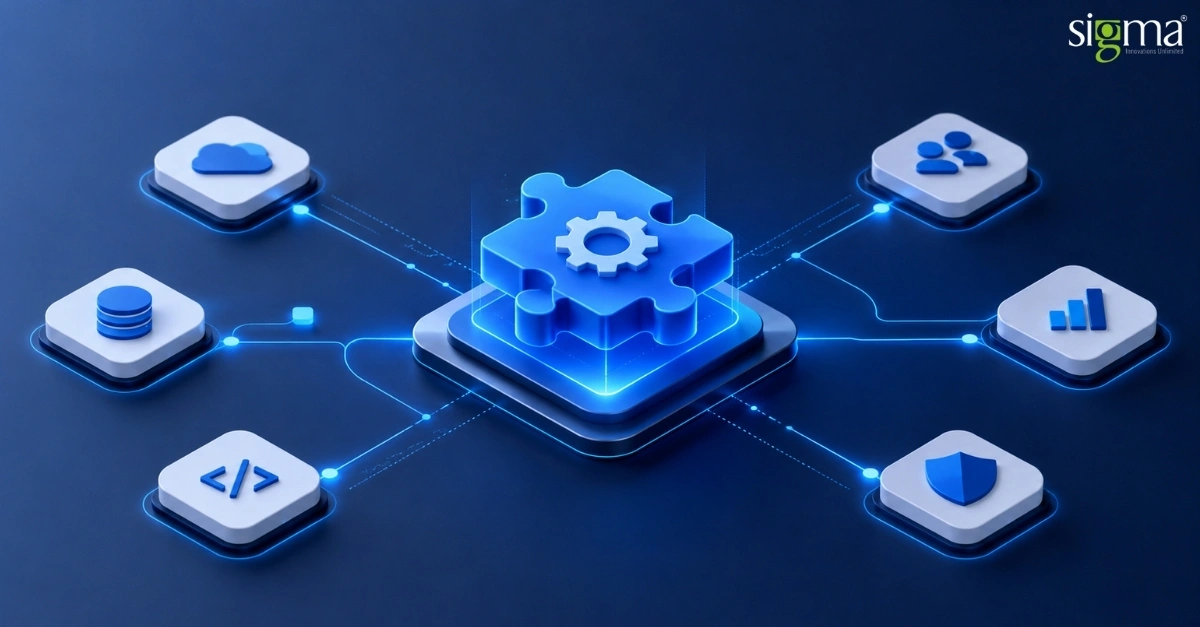
Third, it reduces the marginal cost of each new integration. When the API layer handles authentication, rate limiting, pagination, error handling, and data normalization centrally, building a new connector means writing the mapping logic for the specific third-party system. The infrastructure is already there.
Building more than APIs?
The Integration Debt Tipping Point
Most growth-stage SaaS companies hit the integration debt tipping point somewhere between 8 and 20 live integrations. Below that number, the maintenance burden is annoying but manageable. Above it, the cost curve bends sharply.
The following table shows how integration architecture affects engineering cost as the connector count grows:
| Factor | Point-to-Point (Custom) | API-First (Reusable Layer) |
| New connector build time | 4 to 12 weeks per integration | 1 to 3 weeks per integration |
| Maintenance per connector | Dedicated monitoring and patching | Centralized, shared infrastructure |
| Third-party API change impact | Breaks individual connector entirely | Isolated to mapping layer only |
| Partner self-service capability | None, requires engineering involvement | Possible via documented, versioned API |
| Engineering time on integrations | Grows linearly with connector count | Grows sub-linearly after initial investment |
The pattern is consistent. SaaS companies that invest in a reusable API layer early spend more upfront but dramatically reduce the per-integration cost as the catalog grows. Companies that defer that investment spend less initially but hit a ceiling where integration maintenance consumes 30% to 40% of engineering capacity.
Building the Reusable API Layer: What It Takes
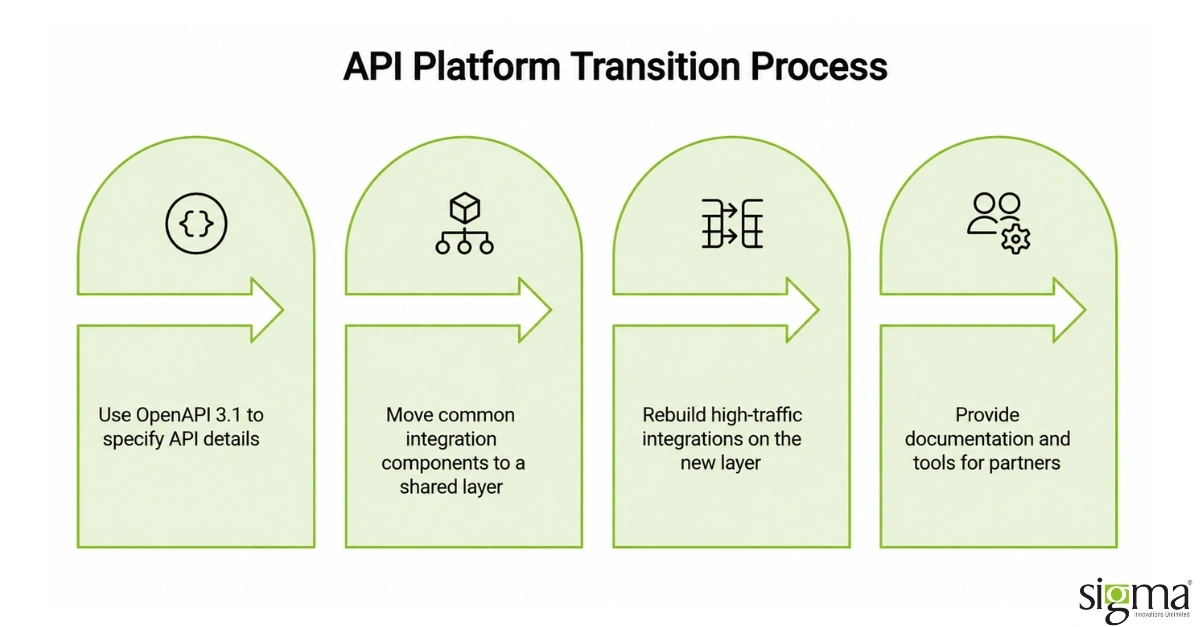
Moving from point-to-point integrations to a reusable API platform is not a weekend project, but it does not require a year-long rewrite either. For most growth-stage SaaS teams, the transition happens in phases.
Phase 1: Define the API contract. Use OpenAPI 3.1 to specify every endpoint, data schema, authentication method, and error response. This spec becomes the single source of truth for frontend, backend, QA, and integration partners.
Phase 2: Extract shared integration infrastructure. Move authentication, rate limiting, pagination, webhook management, and error normalization into a shared layer that every connector uses.
Phase 3: Migrate existing connectors. Rebuild your highest-traffic integrations on the new shared layer, starting with the ones that break most often.
Phase 4: Enable self-service. Publish API documentation, provide sandbox environments, and create a developer portal so technical partners can build integrations without your engineering team’s involvement.
This phased approach lets a team of 10 to 50 engineers make the transition without freezing product development. The shared layer typically takes 6 to 10 weeks to build, and each migrated connector takes 1 to 2 weeks after that.
Read the blog: Agile Development: Strategies for Rapid SaaS Feature Delivery
How Sigma Infosolutions Fits Into This Picture
Sigma works with growth-stage SaaS companies that have already hit the integration debt wall and need an engineering partner who can help them build through it without pulling their core product team off the roadmap.
The shape of the engagement depends on where the company is. Some teams have a half-built API layer that never got finished because product priorities kept pushing it down the backlog. Sigma picks that up, completes the shared infrastructure, migrates the most fragile connectors onto it, and hands it back to the internal team in a state where they can maintain and extend it. Others are earlier in the process. They know their integration architecture is not going to survive the next 12 months of partner growth, but they do not have a dedicated team to rearchitect it. Sigma provides the SaaS integration services team for a focused engagement: define the API contract, build the reusable layer, migrate the top connectors, and document the framework so the internal team can add new integrations independently.
What Sigma does not do is build another collection of point-to-point connectors and call it a platform. The goal is always a reusable framework that the client’s own engineers can extend without calling Sigma back for every new integration. That is the difference between a vendor and a partner.
Modernizing more than your APIs?
Conclusion
Integration debt is quiet until it is not. It does not show up on the product roadmap or the sprint board, but it shows up in the deals you lose because an integration takes too long, the engineers you burn out maintaining brittle connectors, and the partner relationships that stall because your API is not ready for self-service. API first SaaS development is the architectural decision that prevents that debt from compounding. It turns each new integration from a custom project into a configuration exercise, and it gives enterprise buyers the self-service connectivity they now expect. Sigma Infosolutions helps growth-stage SaaS teams make that transition without derailing the product roadmap, building the reusable API layer and connector development framework that scales with the business.
Ready to eliminate integration debt?
Frequently Asked Questions
What is API first SaaS development and why does it matter?
API first SaaS development means designing the API contract before the UI or backend business logic. This ensures the API is a first-class product interface, not an afterthought. It reduces integration maintenance, enables partner self-service, and makes the product ready for enterprise environments where programmatic connectivity is a procurement requirement.
How does integration debt affect B2B SaaS growth?
Integration debt accumulates when each new connector is built as a standalone project with its own authentication, error handling, and data mapping. Over time, maintenance consumes engineering bandwidth that should go to product development. It also slows partner onboarding and creates fragile connections that break when third-party APIs update.
What is the difference between custom API integration and a reusable API layer?
A custom API integration connects two specific systems through dedicated code. A reusable API layer centralizes shared infrastructure like authentication, rate limiting, and error handling so that each new connector only requires the mapping logic. The reusable approach cuts build time from weeks to days as the integration catalog grows.
When should a SaaS company invest in enterprise app integration architecture?
Most companies hit the tipping point between 8 and 20 live integrations, when maintenance starts consuming over 20% of engineering time. If your team spends more time fixing broken connectors than building new features, enterprise app integration architecture is overdue. Starting the transition earlier costs less than retrofitting later.
How does Sigma Infosolutions help SaaS companies fix integration debt?
Sigma designs and builds the reusable API layer that replaces brittle point-to-point connectors. The engagement covers API contract definition, shared infrastructure development, connector migration, and documentation so the client’s internal team can extend the framework independently through scalable SaaS integration services delivery.