How to Scope an MVP: What to Include, What to Cut, and Why

Key Highlights:
- Founders and product leads routinely over-engineer their MVPs, delaying launch by months and burning budget on features that do not drive early traction, user validation, or investor confidence.
- A structured MVP scoping framework that anchors every feature decision to a specific learning objective or user problem keeps scope tight, launch timelines realistic, and early-stage resources focused where they matter most.
- Sigma Infosolutions runs collaborative MVP scoping initiatives with founders and product leaders and delivers focused, launch-ready MVPs within defined timelines and budgets that maximize early market learning.
Introduction
The minimum viable product is one of the most misunderstood concepts in startup product development. Most founders understand the idea at a surface level: build only what you need to launch. In practice, the definition of “what you need” expands continuously as features feel necessary, edge cases demand handling, and the gap between the product in your head and the product in your code widens. By the time many MVPs reach users, they are not minimal. They are an early version of the full product, built at startup speed with startup resources, and the budget is largely gone.
The cost of over-scoping an MVP is not just financial. Every week spent building features that users will not use in the first thirty days is a week of market feedback that could have informed a sharper product direction. Investors do not fund feature lists. They fund evidence of a real problem being solved for real users. The faster you get to that evidence, the stronger your position becomes.
For startup founders, technical co-founders, and product leads preparing for a first launch, this guide provides a structured approach to MVP feature prioritization: how to define what belongs in scope, how to make defensible decisions about what to cut, and how to avoid the over-engineering patterns that delay launch without improving your odds of product-market fit.
Build an MVP That Reaches the Market Faster
The goal of an MVP is not to launch every feature. It is to validate the right problem with the right users as quickly as possible.
What an MVP Is Actually For
Before scoping any features, it helps to be precise about what an MVP is designed to do. The original build-measure-learn framework from Eric Ries defines the MVP as the smallest thing you can build to test your most important assumption. Not the smallest version of your full product vision. The smallest experiment capable of generating the learning you need to take the next step.
This distinction changes how you think about scope entirely. If you are trying to learn whether users will pay for a solution to a specific problem, the MVP needs to demonstrate the solution clearly enough to generate a genuine willingness-to-pay signal. It does not need integrations, customization options, or a polished onboarding flow. If you are trying to learn whether users will change their workflow to use your product, the MVP needs to be usable in the context of their actual work. It does not need a mobile app, a reporting dashboard, or an admin panel.
Every feature in your MVP should map to a specific assumption you are testing or a specific user action you need to enable to make the product usable. Features that do not serve either purpose are candidates for the post-launch roadmap, regardless of how obvious or necessary they feel right now.
Read the blog: From MVP to Market Leader: How Strategic Product Engineering Services Drive Long-Term Software Success
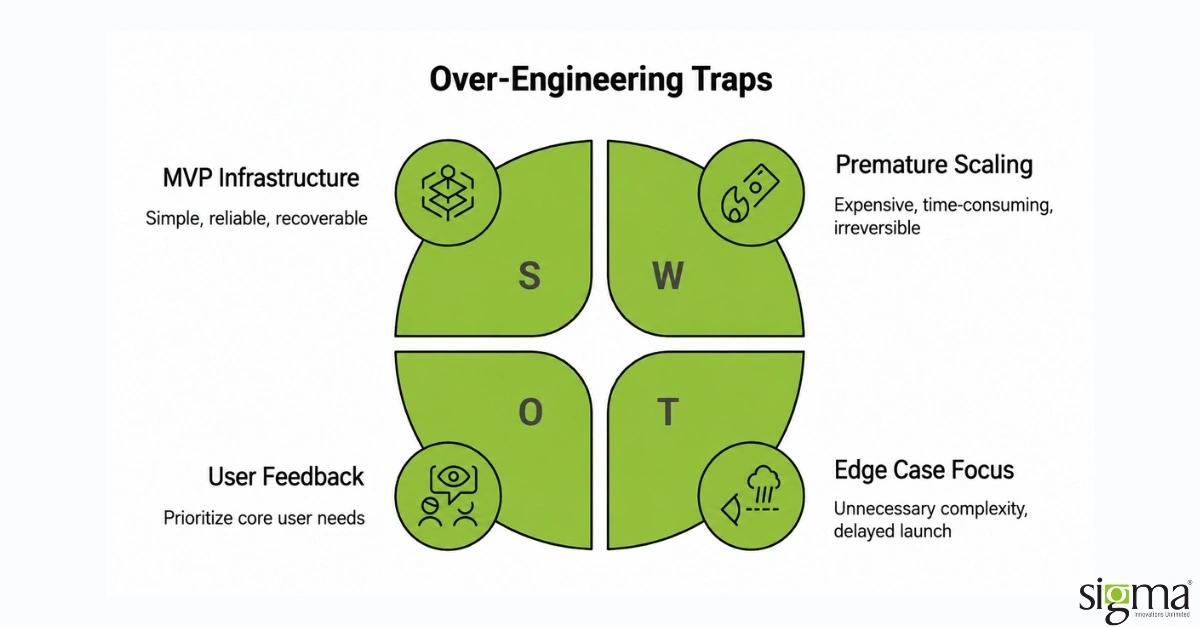
The Most Common Over-Engineering Traps
Building for Scale Before You Have Users
Infrastructure and architecture decisions that optimize for scale at launch are one of the most expensive forms of over-engineering in early-stage products. Multi-region deployments, real-time synchronization, and horizontally scalable microservices architectures are genuine engineering requirements at significant user volumes. They are unnecessary costs at zero users.
The appropriate MVP infrastructure is the simplest architecture that is reliable enough to demo, onboard early users, and collect usage data. Technical debt accumulated at this stage is recoverable. Time and budget spent on premature scaling is not.
Build the Right Software, Not Just More Software
Successful MVPs require thoughtful architecture, focused execution, and the flexibility to evolve as user needs become clearer.
Designing for Every Edge Case
Edge cases are real, but they are not launch blockers unless they affect the primary user journey for your core customer segment. A payment flow that fails when a user enters a non-standard address format is a problem. A setting that allows users to configure their notification preferences in twelve different combinations is not an MVP requirement.
The practical rule is to design the happy path end to end, identify the five percent of users for whom the happy path fails, and decide explicitly whether supporting them is a launch requirement or a post-launch iteration. Documenting this decision is more valuable than building around it silently.
Assuming Users Need Everything You Would Want
Founders build products they would want to use. The features that feel indispensable to you, based on your domain knowledge and your vision for the product, are not always the features that early users need to decide whether your product solves their problem. This is the core argument for getting to users quickly rather than building to completeness before launch.
A founder building a B2B workflow automation product spent four months building a custom analytics dashboard before launch, convinced that customers would not pay without visibility into their automation performance. After launching without the dashboard as a temporary simplification, early users signed contracts and explicitly said the dashboard was not a decision factor. The four months of dashboard development happened entirely outside the critical path.
A Practical MVP Scoping Framework
Effective MVP scoping is a structured process, not a judgment call made in a single meeting. The following framework provides a repeatable approach to feature prioritization that produces defensible scope decisions.
Step 1: Define the Single Core User Journey Identify the one workflow that, if it works reliably and delivers clear value, constitutes a successful MVP. Every feature in scope should either be part of that workflow or directly enable it. Features that serve secondary workflows, edge case users, or future use cases belong on the roadmap, not in the MVP.
Step 2: List Every Proposed Feature and Classify It For each feature on your initial list, classify it into one of three categories:
- Core: Required for the primary user journey to function and deliver value to the target user.
- Supporting: Improves the experience but is not required for the primary journey to work.
- Nice to Have: Adds polish, breadth, or flexibility but has no impact on whether the MVP validates your primary assumption.
Only Core features belong in the MVP scope. Supporting features may be included if time and budget permit after Core features are complete. Nice to Have features are explicitly deferred.
MVP Success Depends on More Than Feature Prioritization
The most successful startups combine disciplined MVP scoping with strong product execution.
Step 3: Validate Each Core Feature Against a Learning Objective For every feature classified as Core, write one sentence explaining what user behavior or business assumption it enables you to test. If you cannot write that sentence, the feature may not be as core as it appears. This step surfaces features that feel essential but are actually scope creep dressed up as requirements.
Step 4: Define Done for the MVP Scope without a definition of done expands indefinitely. Before development begins, define explicitly: what user action or outcome constitutes a successful MVP launch? How many users need to complete the core journey? What qualifies as validated learning? This definition becomes the commit that holds scope accountable throughout the build.
What to Cut: A Decision Checklist
When evaluating whether a specific feature belongs in your MVP, the following questions provide a consistent decision framework:
- Does this feature appear in the primary user journey for your target customer?
- Does removing it prevent users from experiencing the core value proposition?
- Does it address an assumption that is critical to validate before raising your next round or signing your next customer?
- Would a manual workaround be good enough for the first thirty to sixty users?
If the answer to the first two questions is no, the feature should be cut or deferred. If a manual workaround exists that does not meaningfully degrade the first user experience, the automation of that workaround is a post-launch optimization, not a launch requirement.
Scope creep in MVP development almost always comes from conflating “the product should eventually do this” with “the MVP needs to do this now.” Maintaining the discipline to separate these two categories is what keeps MVP development on schedule and on budget.
How Sigma Infosolutions Helps Founders Scope and Ship Focused MVPs
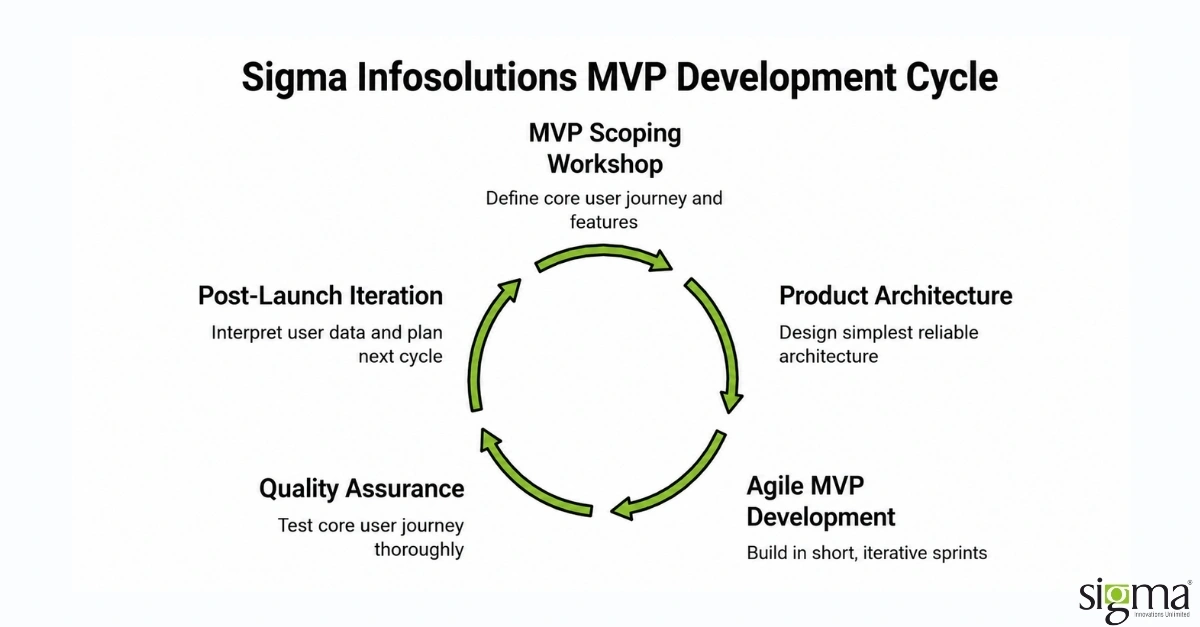
Sigma Infosolutions works with startup founders, technical co-founders, and product leads to run structured MVP scoping workshops and deliver focused, launch-ready products within defined timelines and budgets.
MVP Scoping Efforts
We facilitate a structured scoping session with your founding team that defines the core user journey, classifies all proposed features, maps each core feature to a learning objective, and produces a documented MVP scope with explicit deferral decisions. This workshop typically reduces initial scope by thirty to fifty percent without compromising the product’s ability to validate its core assumption.
Product Architecture and Technical Feasibility
Our engineers review the scoped MVP against your technical constraints and recommend the simplest reliable architecture that supports launch. We identify over-engineering risks early and design a technical foundation that supports the MVP without locking in unnecessary complexity.
Agile MVP Development
We build MVPs in short, iterative sprints with working software at the end of each cycle. Founders review progress against the original scope definition at each sprint, which keeps the build accountable to the launch commitment and creates opportunities to incorporate early user feedback before development is complete.
Quality Assurance and Launch Readiness
We test the core user journey thoroughly before launch, ensuring that the primary path works reliably for the target user profile. Edge case coverage is scoped to the launch definition, not extended indefinitely.
Post-Launch Iteration Support
After launch, we help you interpret early user behavior data, prioritize the first iteration based on what users actually do rather than what you assumed they would do, and plan the next development cycle around validated learnings.
Conclusion
Scoping an MVP is a discipline that most founders underestimate until they have built one product that took twice as long and cost twice as much as it should have. The features that feel indispensable before launch are frequently not the features that early users care about. The infrastructure that seems necessary for a credible product is often unnecessary at the scale of an initial launch.
The founders who ship effective MVPs are those who define one core user journey, cut everything that does not serve it, and get to user feedback before their conviction about the product hardens into assumption. The build-measure-learn cycle only works when the build phase is short enough to leave time for the measure and learn phases to inform the next iteration.
Sigma Infosolutions brings the product scoping methodology and engineering discipline to help you launch leaner, faster, and with greater market confidence. If you are preparing for a first product launch and want to ensure your scope reflects what users actually need, contact Sigma Infosolutions to start with an MVP scoping workshop.
Ready to Scope Your MVP the Right Way?
Sigma Infosolutions helps founders define, build, and launch focused MVPs that accelerate market validation.
Frequently Asked Questions
What is the main purpose of building an MVP?
An MVP tests your most critical product assumption with real users using the least amount of time and budget possible.
How do you decide what features to include in an MVP?
Include only features essential to the primary user journey and directly tied to the core assumption you are validating.
What is the biggest mistake founders make when scoping an MVP?
Over-engineering by building for scale, covering every edge case, and adding features users have not yet asked for before launch.
How long should MVP development take for a B2B SaaS product?
A well-scoped B2B SaaS MVP typically takes eight to sixteen weeks depending on complexity, integrations, and engineering team size.
When should a startup invest in a dedicated development team for MVP delivery?
When internal engineering capacity is insufficient to meet a defined launch timeline or specialized domain expertise is required.
What is the difference between an MVP and a prototype?
A prototype simulates design and user flow without functionality, while an MVP is a working product built to validate a real business assumption.
How does MVP scoping reduce startup runway burn?
Eliminating out-of-scope features cuts development time and cost, extending runway and accelerating the point at which validated learning informs the next decision.
What should happen immediately after an MVP launches?
Measure user behavior against defined success criteria, collect qualitative feedback, and prioritize the first post-launch iteration before building anything new.