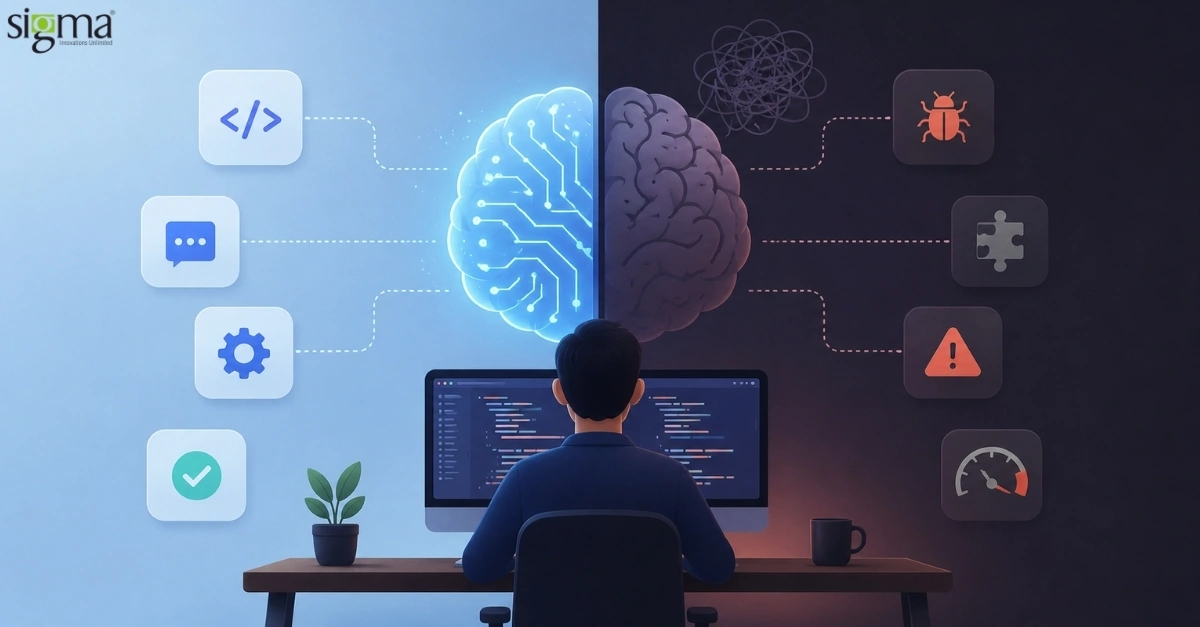
Generative AI in Software Development: Where It Helps and Where It Falls Short
Key Highlights:
- Engineering leaders are under pressure to integrate generative AI into development workflows but lack a clear, evidence-based framework for where it adds value and where it introduces risk.
- A deliberate, use-case-driven approach to generative AI adoption, grounded in real developer workflow analysis, helps teams capture productivity gains while managing code quality and security risks.
- Sigma Infosolutions integrates AI-assisted development practices into engineering workflows and builds custom generative AI tooling within responsible engineering frameworks that protect code quality and team velocity.
Introduction
Generative AI has entered the software development lifecycle faster than any previous class of tooling. AI code generation assistants, automated code review tools, and natural language to code interfaces are now mainstream options for engineering teams at companies of every size. The productivity claims are real, but so are the failure modes. Engineering leaders who adopt these tools without a structured evaluation framework are as likely to introduce new risks as they are to gain new efficiencies.
The honest picture of generative AI in software development is more nuanced than either the optimist or the skeptic position suggests. For certain tasks, AI-assisted development genuinely compresses time, reduces cognitive overhead, and helps developers focus on higher-judgment work. For other tasks, current generative AI capabilities are unreliable in ways that are difficult to detect, creating quality and security problems that cost more to fix than the time the tool saved.
This article provides a balanced, practical assessment of where generative AI adds durable value in software development workflows and where it consistently falls short, along with guidance on how to integrate these tools responsibly without compromising engineering standards.
Where Generative AI Genuinely Accelerates Development
Boilerplate and Scaffolding Generation
Generative AI delivers its most consistent value in tasks that involve high-volume, low-ambiguity code production. Writing boilerplate for REST API endpoints, scaffolding data models, generating CRUD operations from a schema, or producing configuration files are tasks where AI code generation tools produce accurate, usable output with minimal review overhead.
Developers using tools like GitHub Copilot or Cursor on scaffolding-heavy tasks report meaningful reductions in time spent on work that is necessary but cognitively uninteresting. This frees attention for architecture decisions, edge case handling, and the problem-specific logic that actually requires engineering judgment.
Unit Test Generation
Writing unit tests is widely acknowledged as an important practice that many development teams do inconsistently, often because test writing is time-consuming relative to its immediate perceived value. Generative AI tools significantly reduce the friction of test creation by generating test cases from existing function signatures, docstrings, and implementation code.
AI-generated unit tests are not a substitute for a thoughtful testing strategy. They tend to test the happy path reliably and miss edge cases that require domain understanding. However, as a starting point that a developer reviews and extends, they measurably increase test coverage with a modest investment of time. Several engineering teams have reported that AI-assisted test generation doubled their test suite size within a single sprint cycle.
Documentation and Code Explanation
Technical documentation is consistently under-produced in software teams, not because developers do not value it but because maintaining it alongside active development is difficult to prioritize. Generative AI tools that generate docstrings, inline comments, and README sections from existing code significantly reduce the documentation burden.
Code explanation is an equally valuable use case, particularly for onboarding new engineers or when developers are working in unfamiliar parts of a codebase. Asking an AI assistant to explain a complex function or data flow in plain language compresses the time it takes to understand existing code before making changes.
Debugging Assistance and Error Interpretation
Generative AI tools are effective at interpreting error messages, stack traces, and unexpected behavior in code. When a developer encounters an unfamiliar error or is debugging an issue in a library they are not deeply familiar with, AI assistance can surface relevant context, suggest likely root causes, and propose diagnostic steps faster than a manual search.
This use case benefits from the breadth of training data these models have been exposed to. Errors that are common across the open-source ecosystem are well represented in model training, which makes AI-assisted debugging genuinely useful for a broad range of routine issues.
Build intelligent applications, automate engineering workflows, and unlock measurable business outcomes with custom AI and machine learning solutions.
Where Generative AI Consistently Falls Short
Complex Architecture and System Design
Current generative AI tools are not reliable partners for high-level system design decisions. They produce architecturally plausible-sounding suggestions that may not hold up under the specific constraints of your system, your team’s operational capabilities, or your scaling requirements. An AI assistant asked to design a distributed caching strategy will produce a coherent-sounding answer that may be entirely inappropriate for the actual problem at hand.
Architecture requires context that generative AI tools cannot fully access: the history of technical decisions in your system, the failure modes your team has encountered, the constraints imposed by your infrastructure, and the operational trade-offs your organization is willing to accept. Treating AI output as a starting point for architecture discussion is reasonable. Treating it as authoritative is a reliability risk.
Security-Sensitive Code
Code generation tools have a well-documented tendency to produce code that contains security vulnerabilities. Research from Stanford University found that developers using AI code assistants were more likely to introduce security flaws than those coding without AI assistance, in part because the generated code appeared credible and was accepted without sufficient review.
Common security issues in AI-generated code include improper input validation, insecure defaults, SQL injection vulnerabilities, and the use of deprecated cryptographic functions. Any code generated by an AI tool that handles authentication, authorization, data access, or external input should be treated as untrusted and reviewed against your security standards before merging.
Domain-Specific and Business Logic Implementation
Generative AI tools produce code based on patterns in their training data. When the problem being solved is specific to your business domain, your proprietary data model, or your organization’s workflow, the model has no prior exposure to the correct solution. The output in these cases is superficially plausible but functionally incorrect in ways that may not be immediately visible in a code review.
Billing logic, compliance calculations, pricing rule engines, and domain-specific state machines are examples of code where AI assistance provides little practical value and the risk of subtle incorrectness is high. These areas require the developer to own the logic end to end, with AI tools playing at most a formatting or boilerplate role.
Long-Horizon Tasks and Multi-File Reasoning
Current generative AI tools work best on bounded, single-function or single-file tasks. When a task requires understanding the relationships between multiple files, tracking state across a complex module, or implementing a feature that touches many layers of the codebase, model output quality degrades significantly.
Context window limitations mean that AI assistants often miss relevant information that exists elsewhere in the codebase. They produce code that compiles and looks reasonable in isolation but breaks existing contracts, duplicates logic that already exists in another module, or ignores conventions established in adjacent code. Multi-file reasoning remains a meaningful limitation that engineering teams should account for when evaluating where AI assistance is appropriate.
Also, read the blog: AI Chatbot Development Cost in 2026: Key Factors, Price Ranges, and Budget Planning Tips
Integrating Generative AI Responsibly into Development Workflows
Engineering leaders who want to capture the productivity benefits of generative AI without accepting the associated risks need a structured adoption framework rather than an open invitation to use any available tool.
Effective responsible integration includes:
- Defining approved use cases: Specify which tasks in your workflow AI tools are expected to help with and which require fully manual implementation. Clear guidance reduces inconsistency and sets expectations for code review standards.
- Establishing review standards for AI-generated code: Treat AI-generated code as untrusted by default. Security-sensitive, domain-specific, and architecturally significant code should receive more rigorous review regardless of its origin.
- Selecting tools deliberately: Not all AI coding tools are equivalent in quality, security posture, or data handling practices. Evaluate tools against your organization’s compliance requirements and choose those with documented security practices and data residency controls.
- Measuring actual impact: Track the effect of AI tool adoption on meaningful engineering metrics such as deployment frequency, defect rate, and time to review. Productivity claims from tool vendors should be validated against your team’s actual experience.
How Sigma Infosolutions Helps Teams Adopt Generative AI Deliberately
Sigma Infosolutions works with CTOs, VP Engineering, and engineering managers at product companies to integrate AI-assisted development practices into their workflows and build custom generative AI tooling that serves their specific engineering context.
AI Workflow Assessment
We evaluate your current development workflow and identify the highest-value opportunities for AI tool integration, based on task type, team skill profile, and code quality requirements. Our assessment produces a prioritized adoption roadmap, not a blanket recommendation.
Responsible Integration Framework
We help engineering teams establish guidelines for AI tool use that cover approved use cases, code review standards for AI-generated output, and security review requirements. This framework allows teams to move fast with AI assistance while maintaining the engineering standards their product depends on.
Custom GenAI Tooling Development
Where off-the-shelf AI coding tools do not fit the specific needs of your engineering environment, we design and build custom generative AI tooling that integrates with your codebase, your internal documentation, and your development workflow. This includes code generation tools trained or prompted on your domain-specific context.
Developer Enablement and Training
We provide hands-on training for development teams on effective prompt engineering, output review practices, and the practical limits of current AI tools. Teams that understand where to trust and where to verify AI output are significantly more effective than those using tools without a structured mental model.
Ongoing Engineering Partnership
We work alongside your engineering team as an embedded partner, integrating AI-assisted practices into ongoing development and iterating on the tooling as model capabilities and your workflow evolve.
Read our success story: AI-Native BRP Platform for a US-based Manufacturing Enterprise to Replace Legacy ERP Complexity
Conclusion
Generative AI is a genuine productivity tool for software development teams, and dismissing it entirely is as ill-advised as adopting it uncritically. The tasks where it delivers consistent value, including boilerplate generation, test scaffolding, documentation, and debugging assistance, are real and meaningful. The areas where it falls short, including security-sensitive code, domain-specific business logic, and complex multi-file reasoning, are equally real and require deliberate guardrails.
Engineering leaders who define clear adoption frameworks, establish appropriate review standards, and select tools with the same rigor they apply to any other engineering decision will capture the productivity benefits of generative AI without accumulating the quality debt that unstructured adoption creates.
Sigma Infosolutions brings the engineering experience and the practical AI knowledge to help your team adopt generative AI deliberately and build custom tooling that fits your specific development context.
Ready to move beyond AI experimentation and implement solutions that deliver measurable engineering and business outcomes?
FAQs
What is generative AI in software development?
Generative AI in software development refers to AI models that can generate, explain, review, and optimize code using natural language prompts. These tools assist developers with tasks such as code generation, testing, documentation, debugging, and code analysis.
How does generative AI improve developer productivity?
Generative AI reduces time spent on repetitive development tasks such as boilerplate code creation, unit test generation, documentation writing, and error interpretation. This allows engineering teams to focus more on architecture, business logic, and product innovation.
What are the limitations of generative AI for software engineering?
Generative AI can struggle with complex system architecture, domain-specific business logic, security-sensitive code, and multi-file reasoning. Human oversight remains essential for ensuring code quality, security, and alignment with business requirements.
Can generative AI replace software developers?
No. Generative AI is a productivity enhancement tool rather than a replacement for software engineers. Developers are still required to make architectural decisions, validate business logic, review code quality, and ensure security and compliance standards are met.
Is AI-generated code safe for production environments?
AI-generated code can be used in production environments, but it should undergo the same review, testing, and security validation processes as manually written code. Organizations should treat AI-generated code as untrusted until it has been properly verified.
Which software development tasks are best suited for generative AI?
Generative AI is most effective for boilerplate code generation, API scaffolding, unit test creation, documentation generation, code explanation, debugging assistance, and developer productivity workflows.
How can engineering leaders adopt generative AI responsibly?
Responsible adoption involves defining approved use cases, establishing code review standards, implementing security controls, selecting enterprise-ready AI tools, and measuring productivity outcomes against quality and reliability metrics.
What should organizations consider before implementing AI-assisted development tools?
Organizations should evaluate data privacy requirements, security controls, compliance obligations, integration capabilities, developer workflows, and governance policies before deploying AI-assisted development tools across engineering teams.
Can custom generative AI tools be built for software development teams?
Yes. Organizations can develop custom generative AI solutions that integrate with proprietary codebases, internal documentation, engineering workflows, and domain-specific knowledge to provide more accurate and context-aware assistance.
How does Sigma Infosolutions support generative AI adoption?
Sigma Infosolutions provides AI/ML Development Services that include AI workflow assessments, responsible AI adoption frameworks, custom generative AI tool development, developer enablement programs, and ongoing engineering partnership services to help organizations implement AI effectively and securely.