How to Build a Multi-Tenant SaaS Application: Architecture and Best Practices
Key Highlights:
- SaaS founders and engineering teams building multi-tenant platforms frequently struggle with tenant isolation, data security, and performance degradation as their customer base scales.
- Choosing the right tenancy model, implementing a robust isolation strategy, and designing for scalability from the start produces a multi-tenant SaaS architecture that is secure, performant, and operationally manageable.
- Sigma Infosolutions architects and builds multi-tenant SaaS platforms with the appropriate isolation model, identity and access management, and scalability patterns aligned to each product’s specific requirements.
Introduction
Multi-tenant architecture is the technical foundation that makes SaaS economics work. By serving multiple customers from a shared infrastructure, SaaS products reduce per-customer operational costs, simplify deployment, and enable the unit economics that support growth. However, building multi-tenancy correctly is one of the most consequential early decisions a SaaS engineering team makes, and getting it wrong creates compounding problems in security, performance, and scalability that become progressively harder to fix.
The core challenge in multi-tenant SaaS development is balancing efficiency and isolation. Shared infrastructure reduces cost. Isolation protects customer data and prevents one tenant’s activity from degrading another’s experience. The architecture decisions that govern how these two requirements are balanced shape everything from your database schema to your authentication model to your deployment pipeline.
For CTOs and technical co-founders building or redesigning a B2B SaaS platform, this guide covers the primary multi-tenancy patterns, tenant isolation strategies, database architecture options, and the security and scalability considerations that determine whether your architecture holds up under real-world growth.
Understanding Multi-Tenant Architecture: What It Means in Practice
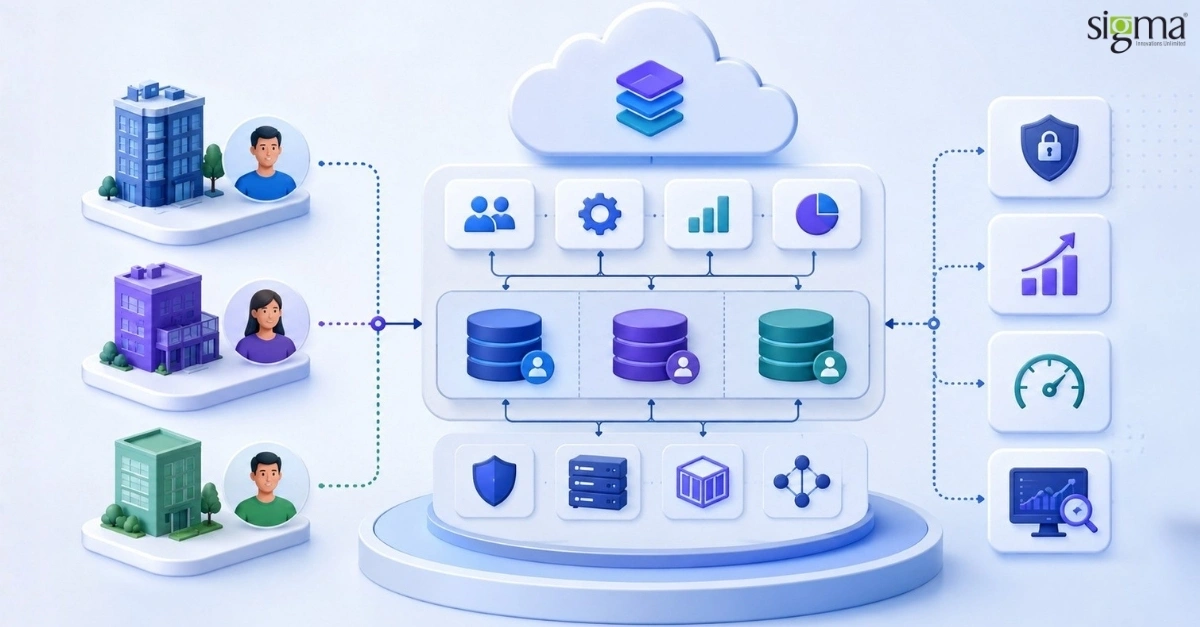
Multi-tenancy means that a single instance of your application serves multiple customers, with each customer’s data and configuration isolated from all others. From the customer’s perspective, the product feels dedicated to them. From the engineering perspective, the product runs on shared compute, storage, and application logic.
This is distinct from single-tenant SaaS, where each customer gets a dedicated application instance and dedicated infrastructure. Single-tenant deployments offer strong isolation but at a significantly higher operational cost per customer. They are appropriate for highly regulated enterprise use cases where contractual or compliance obligations require dedicated environments.
Most B2B SaaS products are multi-tenant by default, and the architecture decisions made in the early stages of the product determine how securely and efficiently that multi-tenancy scales. The three most important architectural decisions are the tenancy model, the data isolation strategy, and the identity and access management approach.
Building a multi-tenant SaaS platform requires more than shared infrastructure.
Multi-Tenancy Models: Choosing the Right Pattern
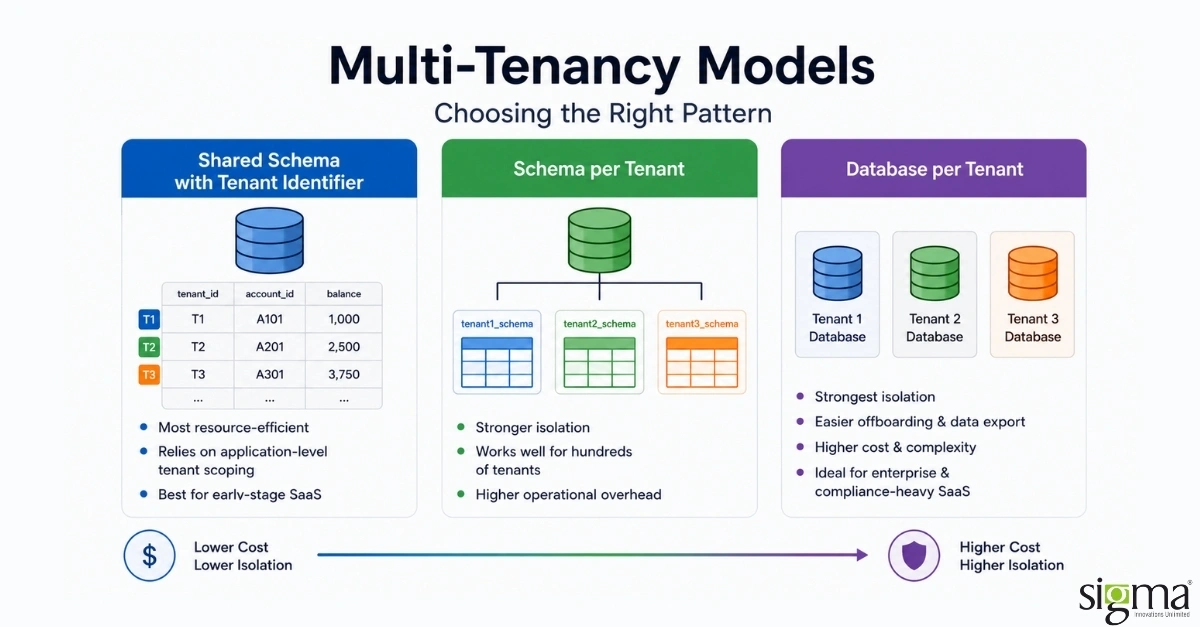
There is no universal multi-tenancy architecture. The appropriate model depends on your customer segment, compliance requirements, performance expectations, and operational capacity. The three primary patterns each represent a different point on the cost-versus-isolation spectrum.
Shared Schema with Tenant Identifier
In this model, all tenants share the same database schema and the same tables. Every row includes a tenant identifier column that is used in every query to scope data access to the correct tenant. This approach is the most resource-efficient and operationally simple option for early-stage products.
The tradeoff is that isolation depends entirely on the application layer enforcing tenant scoping consistently on every query. A missed WHERE clause in a single endpoint can expose one tenant’s data to another. Automated enforcement through a data access abstraction layer, such as row-level security in PostgreSQL or a middleware query interceptor, is essential for making this pattern safe at scale.
Schema per Tenant
Each tenant gets a dedicated schema within a shared database instance. Tables are duplicated per tenant, but the underlying database server is shared. This pattern offers stronger isolation than shared schema, since a misconfigured query in one tenant’s schema cannot accidentally access another tenant’s data.
Schema per tenant works well for products with moderate tenant counts (typically in the hundreds rather than thousands) and strong per-tenant configuration requirements. The operational overhead of schema provisioning, migration management, and connection pool management increases with tenant count, which limits how far this pattern scales without additional tooling.
Database per Tenant
Each tenant gets a fully isolated database instance. This provides the strongest data isolation, makes tenant offboarding and data export straightforward, and allows per-tenant performance tuning. It is the appropriate model for enterprise B2B SaaS products serving customers with strict data residency or compliance requirements.
The cost and operational complexity of databases per tenant are significantly higher than shared approaches. Managing migrations across hundreds or thousands of isolated databases requires robust automation. This model is most practical when combined with a managed database service that abstracts provisioning and scaling operations.
Also, read the blog: How Modular SaaS Architecture Can Speed Up Your Time to Market
Tenant Data Isolation: Making It Enforceable, Not Just Intended
Regardless of which tenancy model you choose, data isolation is only as strong as the enforcement mechanism. Relying on individual developers to remember to include tenant scoping in every query is not a security architecture. It is a vulnerability waiting to surface.
Effective isolation enforcement patterns include:
- Row-Level Security (RLS): PostgreSQL’s native RLS feature allows tenant scoping to be enforced at the database level, below the application layer. A policy attached to the table prevents any query from accessing rows that belong to a different tenant, even if the application sends an unscoped query. This is one of the most robust enforcement mechanisms available for shared schema architectures.
- Middleware query interception: An application-level data access layer that automatically appends tenant scoping to every query before execution. This approach works across any SQL database and can be implemented using ORM lifecycle hooks or a custom repository pattern.
- Tenant context propagation: A request-scoped tenant context object that is established during authentication and passed through every layer of the application. Services that access data read the tenant context to scope their operations, making it difficult to accidentally perform cross-tenant data access.
The noisy neighbor problem, where one tenant’s high-volume activity degrades performance for others sharing the same resources, requires a separate architectural response. Rate limiting at the API gateway level, per-tenant connection pool limits, and workload queuing for background jobs all contribute to preventing resource contention from spreading across tenants.
Identity, Access Management, and Tenant Onboarding
Multi-tenant SaaS applications require an identity model that handles both the platform-level identity, who is the authenticated user, and the tenancy-level identity, which organization does this user belong to, and what are they authorized to do within it.
The most common approach is a role-based access control model scoped to the tenant context. A user authenticated by the platform is associated with one or more tenant memberships, each with a defined role. The application enforces permissions based on both the user’s identity and their role within the active tenant context.
Tenant onboarding automation is a frequently underestimated engineering investment. Each new tenant requires provisioning of data storage, configuration defaults, IAM entries, and potentially custom subdomain or URL routing. Building a reliable, automated onboarding pipeline from early in the product lifecycle reduces operational load and supports self-serve growth. Manual tenant provisioning steps that work fine at twenty customers become a bottleneck at two hundred.
OAuth 2.0 and OIDC-based identity providers such as Auth0, Okta, or AWS Cognito provide a solid foundation for multi-tenant authentication without requiring your team to manage the underlying authentication infrastructure directly. Many enterprise B2B SaaS products also need to support SAML-based SSO for enterprise customers, which should be accounted for in the identity architecture from the start.
Scalability Patterns for Multi-Tenant SaaS Platforms
Building a multi-tenant SaaS platform that scales requires thinking beyond the data layer. Application architecture, caching strategy, and infrastructure design all need to account for the multi-tenant context.
Key scalability considerations include:
- Stateless application tier: Application servers should be stateless and horizontally scalable. Tenant context should be carried in the request or derived from the authentication token, not stored in application server memory.
- Per-tenant caching isolation: Caching layers must be scoped to the tenant context. A cached response intended for Tenant A must never be served to Tenant B. Cache key design should include the tenant identifier as a prefix.
- Async processing and queue isolation: Background jobs and asynchronous processing pipelines should be queue-isolated per tenant or use a fair-scheduling mechanism that prevents high-volume tenants from monopolizing processing capacity.
- Feature flagging and tenant configuration: A robust configuration system that supports per-tenant feature flags, plan-based feature entitlements, and custom configuration values enables product flexibility without requiring code changes for each tenant variation.
Also, read the blog: Agile Development: Strategies for Rapid SaaS Feature Delivery
How Sigma Infosolutions Helps Build Scalable Multi-Tenant SaaS Platforms
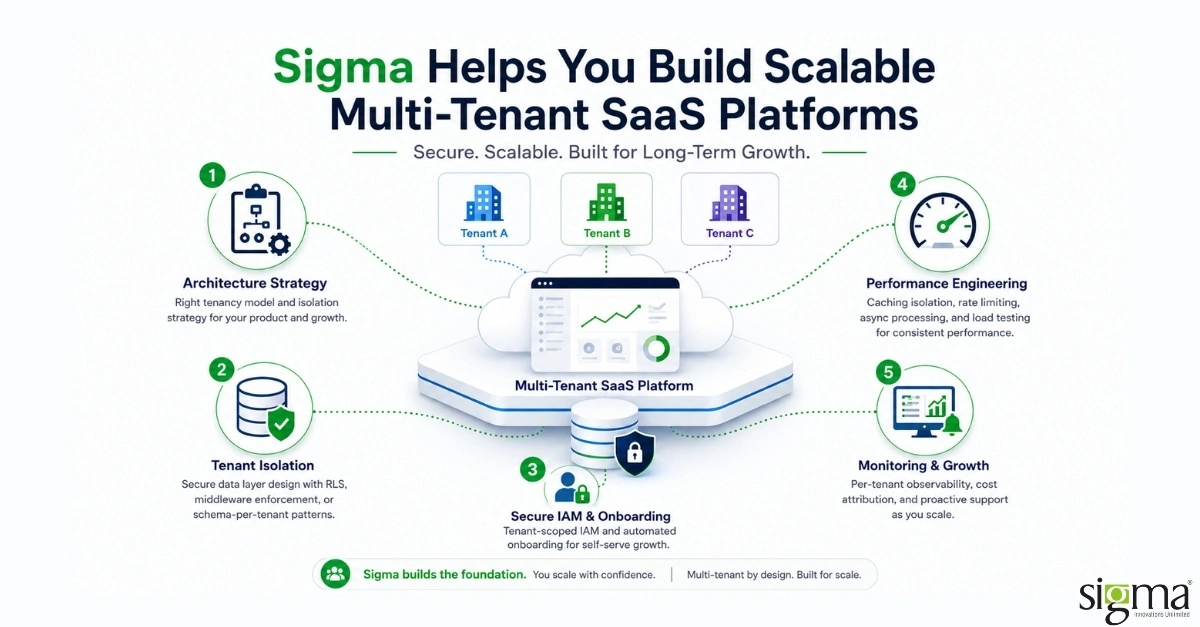
Sigma Infosolutions works with CTOs and technical co-founders at B2B SaaS startups and scale-ups to architect and build multi-tenant platforms that are secure, scalable, and designed for long-term product growth.
Architecture Discovery and Tenancy Model Selection
We evaluate your product requirements, customer segment, compliance obligations, and growth trajectory to recommend the appropriate tenancy model and isolation strategy. Our discovery process produces a documented architecture decision record before any build begins.
Data Layer Design and Isolation Implementation
Our engineers design the database schema, implement tenant isolation enforcement using RLS, middleware interception, or schema-per-tenant patterns, and build the migration tooling that keeps your data layer consistent as the product evolves.
Identity, Access Management, and Onboarding Automation
We design and implement the tenant-scoped IAM model, integrate your chosen identity provider, and build automated tenant onboarding pipelines that support self-serve growth without manual provisioning overhead.
Performance and Scalability Engineering
We implement caching isolation, rate limiting, async processing patterns, and load testing frameworks that ensure your platform performs consistently for all tenants as usage scales.
Deployment, Monitoring, and Ongoing Support
We set up per-tenant observability, cost attribution, and alerting, and provide ongoing engineering support as your platform adds features, integrates enterprise requirements, and scales its tenant base.
Read our success story: Scaling Loan Processing and Empowering Growth through MicroServices Architecture
Conclusion
Multi-tenant SaaS architecture is not a single decision but a set of interconnected choices that collectively determine how securely and efficiently your platform serves customers at scale. The tenancy model, isolation enforcement mechanism, identity architecture, and scalability patterns all need to work together coherently. Getting them right from the start is significantly less costly than redesigning them after your product has grown.
The teams that build multi-tenant platforms well are those that treat tenancy as a first-class architectural concern from day one, enforce isolation at the infrastructure and application layer rather than relying on developer discipline, and design onboarding and configuration systems that support growth without operational overhead.
Sigma Infosolutions brings deep SaaS engineering experience and a structured architecture methodology to help your team build a multi-tenant platform that scales confidently.
FAQs
What is a multi-tenant SaaS application?
A multi-tenant SaaS application is a software platform where a single application instance serves multiple customers (tenants) while keeping each tenant’s data, configurations, and user access isolated and secure.
What are the benefits of multi-tenant SaaS architecture?
Multi-tenant architecture reduces infrastructure costs, simplifies maintenance, accelerates product updates, improves resource utilization, and supports scalable SaaS growth while serving multiple customers from shared infrastructure.
What is the difference between single-tenant and multi-tenant SaaS?
Single-tenant SaaS provides dedicated infrastructure and application instances for each customer, whereas multi-tenant SaaS uses shared infrastructure with logical or physical isolation mechanisms to separate tenant data and workloads.
Which multi-tenancy model is best for a SaaS application?
The best model depends on business requirements. Shared schema offers lower costs and easier management, schema-per-tenant provides stronger isolation, and database-per-tenant delivers the highest level of security and customization for enterprise SaaS platforms.
How do you ensure tenant data isolation in a multi-tenant application?
Tenant data isolation can be enforced through techniques such as row-level security (RLS), schema separation, database-per-tenant architecture, middleware-based query filtering, tenant-aware access controls, and robust authentication mechanisms.
What is the noisy neighbor problem in multi-tenant SaaS?
The noisy neighbor problem occurs when one tenant consumes excessive resources, negatively affecting application performance for other tenants. Rate limiting, workload isolation, caching strategies, and resource quotas are commonly used to mitigate this issue.
What database architecture is recommended for multi-tenant SaaS platforms?
The ideal database architecture depends on scalability, compliance, and isolation requirements. Early-stage SaaS products often use shared databases with tenant identifiers, while enterprise-focused platforms may adopt schema-per-tenant or database-per-tenant architectures.
How does authentication work in a multi-tenant SaaS application?
Multi-tenant SaaS platforms typically use role-based access control (RBAC), OAuth 2.0, OpenID Connect (OIDC), SAML SSO, and tenant-aware identity management systems to ensure users only access authorized tenant resources.
What scalability best practices should be followed when building a multi-tenant SaaS platform?
Best practices include designing stateless application services, implementing tenant-aware caching, using asynchronous processing, automating tenant provisioning, enforcing rate limits, and building observability and monitoring capabilities from the start.
When should a SaaS company consider migrating to a different tenancy model?
A SaaS company should evaluate tenancy model changes when customer counts increase significantly, enterprise customers require stronger isolation, regulatory requirements evolve, or performance bottlenecks emerge in the existing architecture.
What security considerations are important for multi-tenant SaaS development?
Key considerations include tenant isolation enforcement, encryption at rest and in transit, secure authentication, least-privilege access controls, audit logging, compliance monitoring, vulnerability management, and continuous security testing.
How can Sigma Infosolutions support multi-tenant SaaS development?
Sigma Infosolutions provides SaaS architecture consulting, multi-tenant application development, tenant isolation implementation, IAM integration, onboarding automation, cloud scalability engineering, and ongoing platform optimization for growing B2B SaaS companies.