LLM Integration for Growth-Stage Companies: Practical Use Cases and What to Avoid
Key Highlights:
- Founders, CTOs, and Heads of Product at growth-stage SaaS, FinTech, eCommerce, and HealthTech companies are under pressure to ship AI-powered features, but face real concerns around hallucination, data privacy, and unpredictable infrastructure costs that stall progress and create organizational risk without the right engineering partner.
- A structured approach to LLM integration, grounded in Retrieval Augmented Generation, systematic prompt engineering, and responsible AI guardrails, allows growth-stage teams to deploy LLMs safely, with measurable business impact, and without a large in-house AI research team.
- Sigma Infosolutions builds production-grade LLM-powered applications for growth-stage companies in the US, Canada, Australia, and New Zealand, serving as a long-term AI engineering partner across RAG architectures, fine-tuning, guardrails, and ongoing model operations, reducing risk while delivering reliable results at scale.
For founders, CTOs, and Heads of Product at growth-stage companies, LLM integration has moved from an exploratory initiative to a board-level priority. Competitors are shipping AI-powered features, investors are asking for an AI strategy, and product roadmaps increasingly include capabilities that depend on language model infrastructure. The business case for acting is clear. The challenge is acting in a way that does not create more risk than it resolves.
Most early LLM projects look functional in a controlled demo and break down in production. The failure modes are consistent: a model generates a confident but factually incorrect response during a live customer interaction, a feature launches without a privacy review, creating regulatory exposure, or infrastructure costs scale faster than anticipated, eroding the business case. These are not edge cases. They are the predictable outcomes of moving fast without the right architecture.
The difference between a successful LLM deployment and a failed one is rarely the model choice. It is the architecture surrounding the model, the engineering discipline applied to prompting and validation, and whether the team building it has done so in production before. This guide is written for SaaS, FinTech, eCommerce, and HealthTech companies evaluating where LLMs create real business value, what it takes to build them reliably, and which implementation decisions introduce risk that is not worth taking.
Accelerate AI Adoption with Sigma’s AI/ML Development Services
From LLM-powered applications and Retrieval Augmented Generation (RAG) architectures to custom machine learning models and intelligent automation, Sigma delivers Artificial Intelligence Development Services built for scalability, security, and measurable business outcomes.
Where LLMs Genuinely Add Value for Growth-Stage Companies
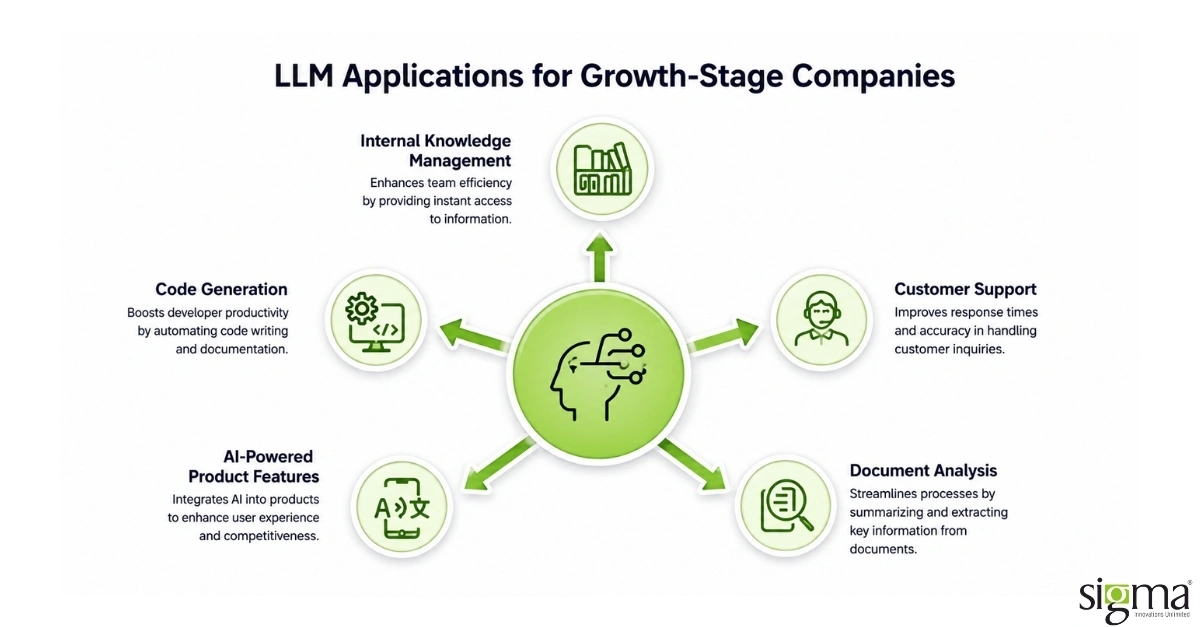
The best ways to use LLMs usually involve a few things: lots of messy text, a need for speed that humans can’t match, and a situation where a small mistake isn’t the end of the world. Here is where that usually makes sense for a growing business.
Internal Knowledge Management and Search
As companies grow from 10 to 100 people, knowledge gets buried everywhere, in Slack, Notion, support tickets, and random docs. It becomes a nightmare to find anything.
By using Retrieval Augmented Generation (RAG), you can connect an LLM to your internal files so it can answer team questions instantly with actual citations. For a 50-person startup, this is a game-changer because it means new hires can get up to speed faster and you don’t have to rely on one “old-timer” who knows where everything is hidden.
Customer Support Triage and Draft Generation
LLMs are great at doing the “first pass” on support tickets. They can sort requests, suggest help articles, or even write a draft response for a human agent to check. Having a person review everything before it goes to a customer keeps things accurate and builds trust in the new system.
This is an easy win for growth-stage companies because the ROI is clear and the risk is low; fixing a bad draft is a lot cheaper than dealing with a frustrated customer. For FinTech and HealthTech companies where support requests usually explode faster than you can hire, this is often the smartest first move.
Document Analysis and Extraction
If your team spends hours reading contracts, regulatory files, or meeting notes, LLMs can do the heavy lifting. They are excellent at summarizing documents or pulling out key terms. The model doesn’t have to replace your human reviewers; it just makes sure they don’t have to spend all day reading before they can actually do their jobs. This is huge for digital lenders or HealthTech platforms that deal with mountains of paperwork.
For alternative lenders and NBFCs, this capability is often integrated directly into the underwriting workflow. For instance, Sigma’s digital lending platform, LendFoundry, uses secure data extraction pipelines to process applicant documentation, accelerating time-to-decision without sacrificing risk oversight.
AI-Powered Product Features
For SaaS and eCommerce companies, AI is increasingly a product feature rather than a back-office tool. In modern digital commerce, these capabilities must be engineered to run at scale without introducing performance bottlenecks.
Technical partners like Sigma integrate AI-driven semantic search, automated catalog tagging, and personalization engines across leading platforms, including Adobe Commerce (Magento), utilizing lightweight Hyvä themes, Shopify Plus, and BigCommerce, ensuring these features drive conversion without hurting Core Web Vitals.
For SaaS platforms, natural language interfaces and automated summary features reduce time-to-value for end users and strengthen the product’s position during sales cycles. This is also where implementation errors carry the highest visibility risk, because the customer experiences the failure directly.
Code Generation and Developer Productivity
AI coding tools are already helping engineering teams build faster. They can write boilerplate code, draft documentation, or help create tests. For a small team of 6 to 50 developers, saving even a few hours a week per person adds up fast. The key is to never treat the AI’s output as finished; you still need human eyes to verify everything.
Common LLM Integration Pitfalls and How to Avoid Them
Knowing what not to do is just as important as knowing what to build. Most of the failures we see at Sigma Infosolutions come from a few common mistakes.
Relying on Base Model Knowledge for Your Proprietary Data
Standard LLMs only know what they were trained on from the public internet. They don’t know your products, your policies, or your customers. If you ask them a specific company question, they might give you a very confident, but totally wrong, answer.
The fix for this is RAG. This architecture pulls the right documents from your own data at the moment they are needed and gives them to the model. This keeps the AI grounded in reality and lets you show the user exactly where the information came from. If you’re building a support tool or a knowledge assistant, RAG is a requirement, not an option.
Sending Sensitive Data to External Model APIs Without a Privacy Layer
LLMs need text to work, but if that text has private info like names, bank records, or health data, you could be asking for trouble. Sending that data to a public API can lead to massive legal headaches, especially under rules like HIPAA in the US or the Australian Privacy Act.
You need a “privacy layer” that spots and hides sensitive info before it ever leaves your system. For companies with the strictest rules, it’s often better to run an open-source model in your own private cloud. It is much cheaper to build this privacy now than to try and fix it after a compliance audit.
Deploying LLMs in High-Stakes Workflows Without Human Review Checkpoints
LLMs are based on probability, which means they are usually right but occasionally weirdly wrong. If you use them for things like financial advice or medical info without a human checking the work, you are taking a massive risk.
The best approach is a “human-in-the-loop” design. The AI creates a draft or a recommendation, and a qualified person hits “approve”. As the system proves it’s reliable over time, you can start to step back, but you shouldn’t start without that safety net.
Underestimating Prompt Engineering as an Engineering Discipline
Many teams think integrating an LLM is just a quick API task. In reality, the quality of what the AI says depends entirely on how you talk to it. Good prompt engineering involves testing for weird edge cases, managing different versions of prompts, and making sure the output format stays consistent. If you treat this as an afterthought, you’ll likely end up doing a lot of expensive rework later when things start breaking.
Building a Production-Ready LLM Integration Architecture
If you want your AI to be reliable and secure, you need a solid foundation. You don’t have to build everything at once, but your design should plan for these pieces:
- RAG pipeline: You will require a vector database (such as Pinecone or pgvector) to index document embeddings. Your chunking strategy, metadata enrichment, and vector storage architecture directly determine the context accuracy and relevance of the model’s outputs.
- Prompt management layer: This is a system for managing your prompt versions and making sure the AI doesn’t get “tricked” by bad inputs.
- Guardrails and output validation: These are programmatic verification layers that evaluate model output before it is exposed to the user. For high-stakes workflows, this includes utilizing stateful orchestration tools like LangGraph to execute step-by-step reasoning validation and schema checks on generated data. This is especially vital for regulated fields like FinTech or HealthTech.
- Observability and logging: Programmatic tracing is necessary to monitor token unit economics, model latency, and behavioral drift in real time. Deploying these monitoring frameworks within structured cloud infrastructures, such as AWS, leveraging Sigma’s expertise as an AWS Partner Network (APN) member, ensures your team maintains full visibility over cloud costs and prompt-response loops.
- Model fine-tuning where warranted: Sometimes, simple prompting isn’t enough. Training a smaller model on your specific data can often save money and work better.
How Sigma Infosolutions Helps Growth-Stage Teams Integrate LLMs Responsibly
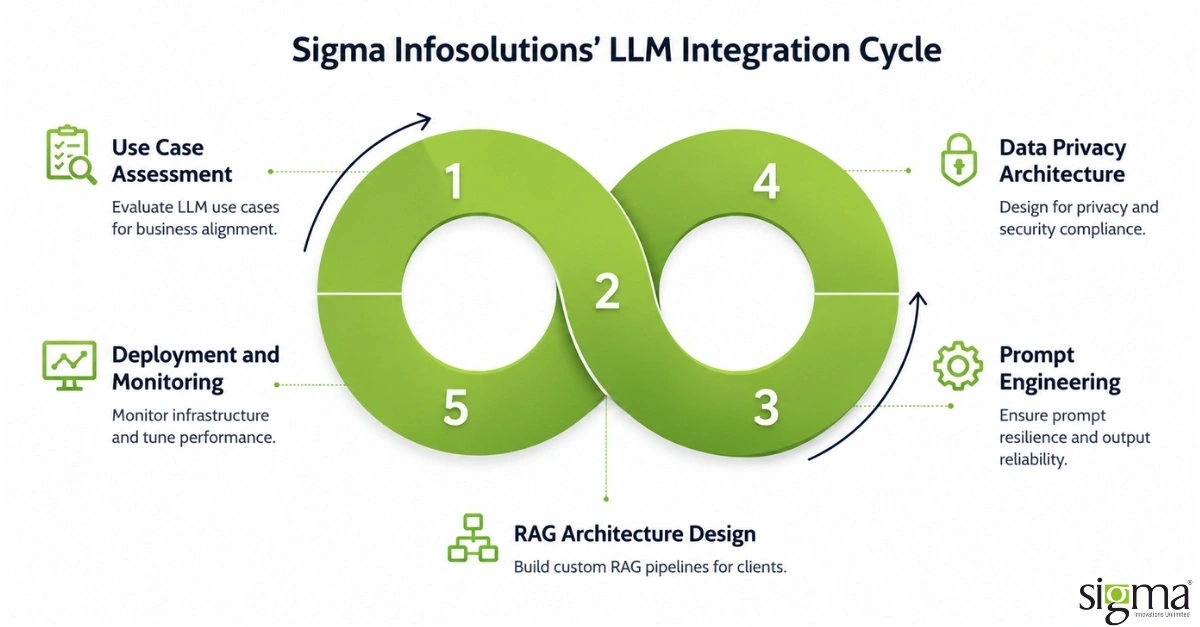
Sigma Infosolutions works with tech leaders across the US, Canada, Australia, and New Zealand to build AI that actually works in production. The engagement model is structured for the long term, with Sigma acting as a continuing engineering partner as product requirements and model capabilities evolve.
- Use Case Assessment and Feasibility: Sigma’s team evaluates which LLM use cases align with business priorities and which carry more complexity than value at the current stage.
- RAG Architecture and Knowledge Base Design: Sigma’s engineers build custom RAG pipelines tailored to each client’s specific database and application architectures, leveraging our certified expertise as a Salesforce Consulting Partner to cleanly integrate AI search models with core enterprise CRM systems.
- Prompt Engineering and Output Reliability: We conduct rigorous adversarial testing and systematic prompt evaluation (red-teaming) to ensure prompt resilience, prevent injection exploits, and maintain structured JSON output formatting.
- Data Privacy and Security Architecture: Sigma designs for privacy from day one, with architecture that addresses HIPAA requirements in the US and Australian Privacy Principles for ANZ clients.
- Deployment, Monitoring, and Long-Term Partnership: Sigma stays on post-deployment to monitor infrastructure costs, tune model performance, and support the rollout of new features as the product evolves.
Conclusion
Integrating LLMs can change your business, but the companies that win aren’t always the ones that move the fastest. They are the ones that take the time to build for reliability and privacy.
For a company with 6 to 200 people, the stakes are high. A single big mistake or a massive cloud bill can be devastating. Getting the architecture right the first time is always cheaper than fixing it under pressure later. Sigma Infosolutions brings the engineering depth and production experience to help growth-stage teams move from an LLM proof-of-concept to a reliable, scalable AI system without absorbing the cost of getting the architecture wrong.
If your team is evaluating LLM integration or looking to move an existing AI project into production, reach out to the Sigma Infosolutions AI engineering team at sigmainfo.net to discuss your use case and find out how Sigma can support your roadmap.
Partner with Sigma for Artificial Intelligence Development Services
Build smarter products, automate complex workflows, and unlock new growth opportunities with custom AI and machine learning solutions engineered for scale.
Contact Sigma’s AI/ML Experts Today to discuss your project and explore the right AI strategy for your business.
FAQ’s
What is LLM integration for businesses?
LLM integration connects AI language models with business applications to automate workflows, improve insights, and enhance user experiences.
Which industries benefit most from LLM integration?
SaaS, FinTech, HealthTech, eCommerce, and customer support teams gain significant value from LLM-powered automation and analytics.
What is Retrieval Augmented Generation (RAG)?
RAG combines LLMs with enterprise knowledge sources to deliver accurate, context-aware responses grounded in company data.
How can businesses reduce LLM hallucinations?
Using RAG, prompt engineering, output validation, and human review workflows helps minimize inaccurate AI-generated responses.
Is LLM integration secure for sensitive business data?
Yes, when implemented with privacy controls, data masking, access management, and compliance-focused architecture.
What are the most common LLM implementation mistakes?
Relying on base model knowledge, ignoring privacy requirements, and deploying AI without validation are common pitfalls.
How do LLMs improve customer support operations?
LLMs automate ticket triage, draft responses, summarize conversations, and help support teams resolve issues faster.
Why is prompt engineering important in LLM projects?
Prompt engineering improves response accuracy, consistency, and reliability while reducing costly AI errors in production environments.