Real Time Payments Explained: What Is RTP and Why Your Business Needs It in 2026
Key Highlights
- Sigma Infosolutions helps financial institutions and businesses integrate real-time payment infrastructure through its fintech product and custom digital payment solutions.
- Businesses that adopt instant payments gain a direct operational advantage: faster cash flow, reduced reconciliation delays, and improved customer retention.
- Organizations that continue relying on legacy payment processing systems risk increased settlement risk, customer attrition, and compliance exposure as regulatory standards evolve.
- According to industry forecasts, the global real-time payments market is projected to exceed $200 billion in transaction value by 2028, driven by demand from B2B and consumer segments alike.
Real-time payments have moved from an emerging capability to an operational requirement for businesses that process high volumes of financial transactions. As digital commerce accelerates and corporate treasury functions grow more complex, the gap between batch-settlement systems and immediate fund availability has become a measurable liability. This blog explains what RTP is, how instant payments work at a technical and operational level, and what financial institutions and businesses must do to remain competitive. It also outlines how Sigma Infosolutions supports organizations navigating the shift to modern payment processing infrastructure.
What Are Real-Time Payments?
Real-time payments refer to payment processing systems that transfer funds between accounts within seconds, at any hour of the day, on any day of the year, including weekends and holidays. Unlike ACH batches or wire transfers that settle within hours or business days, RTP rails complete the full transaction cycle, including authorization, clearing, and settlement, in near-instant timeframes. The term “real time” is not a marketing descriptor; it is a technical specification that defines how payment infrastructure must perform.
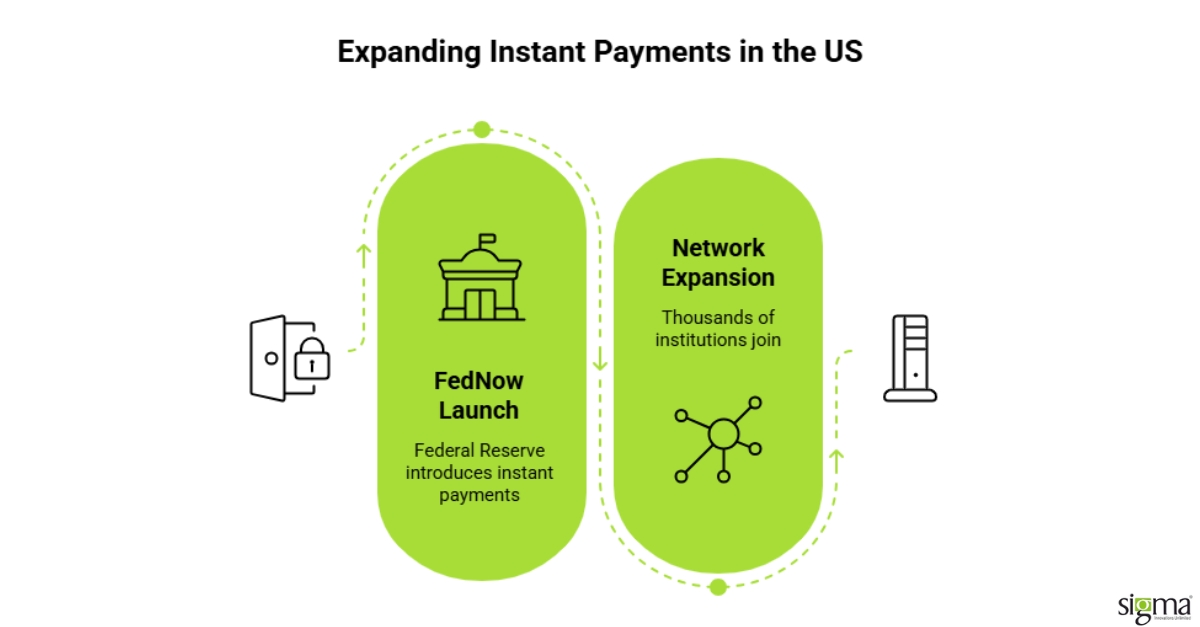
The primary RTP network is operated by The Clearing House and has been available to financial institutions since 2017. The Federal Reserve’s FedNow Service, launched in 2023, expanded access further and introduced a government-backed instant payment option for depository institutions. These two networks now collectively serve thousands of participating financial entities across the country.
For businesses, the practical difference between a real-time payment and a traditional payment is not just speed. It is the certainty of finality. Once an RTP transaction is confirmed, the payment cannot be reversed in the way that ACH transactions can be subject to returns, which significantly changes how treasury teams manage risk and liquidity.
Also, read the blog: Payment Gateway vs Full-Stack Digital Payment Solutions — What Businesses Need
How RTP Differs from Traditional Digital Payments
Understanding the distinction between RTP and other digital payment methods is essential before making infrastructure decisions. The table below compares the key characteristics across payment types commonly used in business contexts.
| Payment Type | Settlement Time | Operating Hours | Reversibility | Best Use Case |
| ACH (Standard) | 1 to 3 business days | Business hours | Returnable for errors | Payroll, recurring billing |
| ACH (Same Day) | Same business day | Business hours | Returnable | Urgent vendor payments |
| Wire Transfer | Same day to 24 hours | Business hours only | Irrevocable after sent | High-value, one-time transfers |
| Real-Time Payments (RTP) | Under 10 seconds | 24/7/365 | Irrevocable | Time-sensitive B2B, gig payments |
| FedNow | Under 10 seconds | 24/7/365 | Irrevocable | Government disbursements, SME payments |
The irrevocability of RTP transactions requires businesses to build stronger prepayment validation controls into their systems. This is a critical operational consideration that is often underestimated during initial implementation planning.
Read our success story: Understand the Architecture Behind the Experience – Creating B2C Mobile App and Admin Portal for Digital Payments
Why Businesses Are Adopting Instant Payments in 2026
The Operational Case for Speed
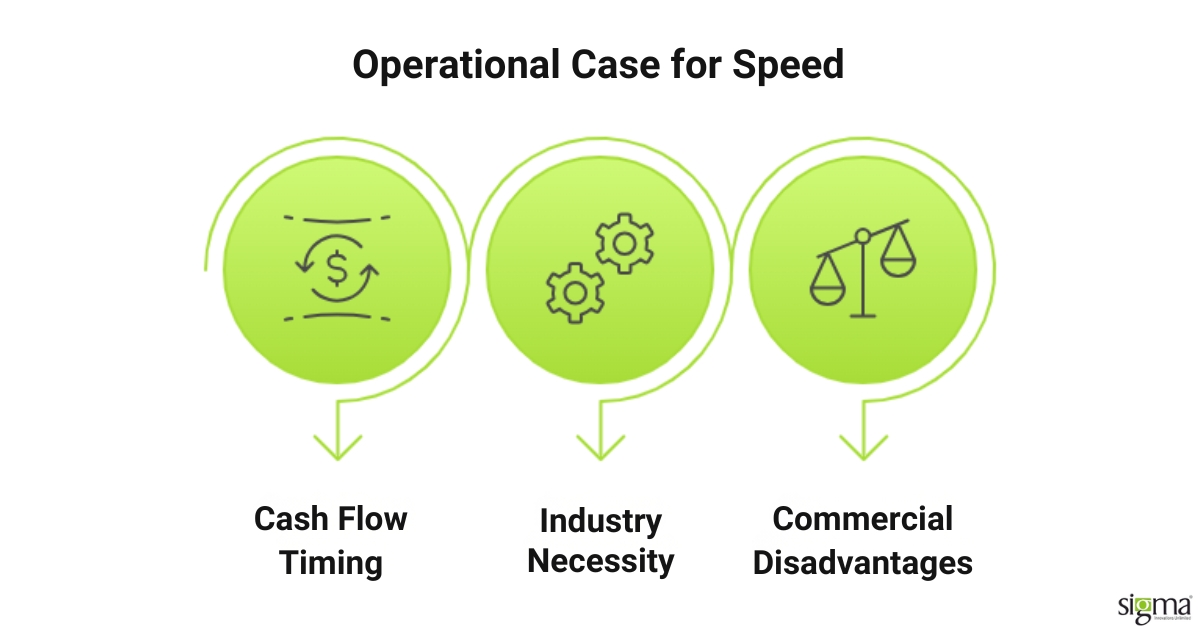
Cash flow timing has always been a constraint for businesses of all sizes. A payment that settles in two business days creates a two-day gap in working capital, which compounds across hundreds or thousands of monthly transactions. Instant payments eliminate that gap, allowing treasury teams to operate with real-time visibility into available balances rather than projected balances.
For industries like construction, staffing, healthcare reimbursement, and logistics, where subcontractors and suppliers often operate on thin margins, same-day or real-time settlement is not a convenience feature. It is a condition of doing business. Vendors increasingly factor payment speed into their pricing and priority relationships, which means that businesses still on legacy schedules face commercial disadvantages they may not be measuring directly.
The Regulatory and Compliance Dimension
Financial regulators in the United States and internationally are accelerating mandates around payment transparency and speed. The Consumer Financial Protection Bureau has signaled greater scrutiny of payment processing delays, and global frameworks like ISO 20022, which governs the data standards for modern financial messaging, are being adopted by RTP networks as a baseline requirement. Businesses that have not assessed their payment infrastructure against ISO 20022 compatibility are likely to face integration friction as their financial institution partners upgrade their systems.
B2B Payment Modernization
Business-to-business payment modernization is one of the largest untapped opportunities within the financial technology space. Historically, B2B payments have lagged behind consumer payments in adopting new rails because of the complexity of invoice matching, ERP integrations, and approval workflows. However, newer payment platforms now support rich remittance data within the RTP message itself, enabling automated reconciliation that removes the manual work that has traditionally made real-time B2B payments impractical at scale.
Also, read the blog: From Compliance Headaches to Seamless Banking: Lessons for Digital Lenders
Key Implementation Challenges for Financial Institutions
Deploying real-time payments capability is not simply a matter of connecting to The Clearing House or FedNow. Financial institutions must address a set of technical and operational prerequisites that extend across core banking systems, fraud detection engines, and customer-facing interfaces.
Fraud risk is the most frequently cited barrier. Because RTP transactions are irrevocable and settle in seconds, the window for fraud intervention is extremely narrow. Institutions need to deploy machine learning models that can assess transaction risk in milliseconds, not minutes. Legacy rule-based fraud systems are structurally inadequate for this requirement and often need to be replaced or supplemented with AI-driven scoring engines.
Core banking system compatibility is the second major barrier. Many financial institutions operate on core platforms that were designed for batch processing and cannot support the 24/7 real-time availability requirement of RTP rails without significant middleware development or core replacement. This creates a tiered implementation challenge where front-end payment experience improvements often must wait for back-end infrastructure upgrades to be completed first.
How Sigma Infosolutions Enables Real-Time Payment Infrastructure
Real-time payment infrastructure is no longer just about connecting to RTP networks—it’s about building a system that can process, validate, and reconcile transactions instantly across channels. For most financial institutions and fintech platforms, the real challenge lies in enabling low-latency, always-on payment processing without disrupting legacy systems.
Sigma Infosolutions helps organizations design and implement API-first, real-time payment infrastructure that integrates seamlessly with existing banking, lending, and payment ecosystems—turning RTP adoption into a scalable, production-ready capability.
API-First Payment Orchestration for RTP Integration
Modern real-time payments depend on API-driven payment orchestration layers that can manage multiple payment rails in parallel. Sigma enables businesses to unify RTP, ACH, card networks, and digital wallets through a single orchestration framework.
This allows:
- Faster RTP integration with minimal core disruption
- Intelligent routing across payment rails
- Scalable transaction processing with reduced latency
The result is a future-ready payment architecture that adapts as real-time payment networks evolve.
Omnichannel Real-Time Payment Experiences
Real-time payments must function consistently across every user touchpoint. Sigma builds omnichannel payment systems that support web, mobile, embedded finance, and enterprise workflows—ensuring a frictionless experience regardless of how transactions are initiated.
By combining RTP capabilities with seamless UX design, businesses can:
- Reduce payment friction and drop-offs
- Improve transaction success rates
- Deliver consistent real-time payment experiences across channels
Built-In Compliance and Real-Time Fraud Prevention
With RTP transactions being instant and irreversible, fraud detection and compliance must operate in real time. Sigma embeds AI-driven fraud detection and compliance frameworks directly into the payment flow.
Key capabilities include:
- Real-time transaction risk scoring before authorization
- PCI-compliant payment processing environments
- Integrated KYC and identity verification workflows
This ensures secure, compliant RTP processing without slowing down transaction speed.
Real-Time Payment Analytics and Operational Visibility
A critical component of real-time payment infrastructure is live transaction intelligence. Sigma enables organizations to monitor and optimize payment performance through real-time analytics.
Teams can:
- Track transaction status and failures instantly
- Monitor fraud signals and anomalies
- Improve authorization and settlement efficiency
This transforms RTP from a processing upgrade into a data-driven operational advantage.
Scalable, Cloud-Native Payment Infrastructure
Built on cloud-native principles and aligned with Amazon Web Services standards, Sigma’s digital payment solutions support high-availability, 24/7 real-time transaction environments.
This includes:
- Event-driven architectures for instant payment processing
- High-availability systems for uninterrupted RTP flows
- Infrastructure that scales with transaction volume growth
Organizations can adopt real-time payments without compromising on performance or reliability.
From RTP Capability to Business Impact
Sigma’s approach goes beyond enabling real-time payments—it focuses on aligning RTP infrastructure with measurable business outcomes. Whether it’s instant loan disbursements, faster collections, or improved cash flow visibility, the goal is to make real-time payments operationally meaningful.
By combining payment orchestration, real-time processing, and compliance-ready architecture, Sigma helps businesses move from fragmented payment systems to fully integrated real-time payment ecosystems.
Conclusion: Real-Time Payments Are No Longer Optional
Real-time payments have shifted from a forward-looking capability to a core requirement for businesses operating in high-velocity financial environments. The ability to move funds instantly—combined with immediate settlement finality, directly impacts cash flow visibility, operational efficiency, and customer expectations.
For financial institutions and enterprises, the transition to RTP is not just about speed. It requires rethinking payment architecture, strengthening fraud prevention, and enabling always-on systems that can process and validate transactions in seconds. Organizations that continue to rely on batch-based infrastructure will face increasing friction as payment ecosystems evolve toward real-time standards.
The opportunity, however, extends beyond faster transactions. When implemented correctly, real-time payments unlock measurable business value, automated reconciliation, improved liquidity management, and enhanced customer experiences across B2B and consumer use cases.
As RTP adoption accelerates and regulatory frameworks mature, the question is no longer whether to adopt real-time payments, but how quickly organizations can operationalize them at scale.
Frequently Asked Questions
Q: What is the difference between real-time payments and instant payments?
The terms are largely interchangeable in industry usage, though “instant payments” is more commonly used in European regulatory contexts, while “real-time payments,” or “RTP,” is the preferred terminology, specifically referencing The Clearing House network. Both refer to payment transactions that settle within seconds, around the clock.
Q: Is RTP the same as FedNow?
No, they are separate networks. RTP is operated by The Clearing House, a private entity owned by large commercial banks, while FedNow is operated by the Federal Reserve. Both process instant payments, but they have different participating institutions, fee structures, and transaction limits.
Q: What is the transaction limit for RTP payments in 2026?
As of 2025, The Clearing House RTP network supports a maximum transaction limit of $10 million per payment, following an increase from the earlier $1 million cap. FedNow’s limit varies by participating institution and can be set by each financial institution individually up to the network maximum.
Q: How does RTP affect business payment processing workflows?
RTP removes settlement delays from payment processing cycles, which improves cash flow visibility and reduces the working capital requirements associated with waiting for funds to clear. It also requires businesses to update reconciliation processes since the immediate finality of RTP means manual correction of misfiled payments is no longer straightforward.
Q: What fraud risks come with instant payments?
Because digital payments over RTP rails are irrevocable and settle in seconds, there is no practical window for post-authorization fraud intervention using traditional methods. Businesses and financial institutions must implement real-time fraud scoring systems that assess transaction risk before authorization, not after.
Q: Can small businesses use real-time payments?
Yes. Both the Clearing House RTP network and Fed Now they are accessible to businesses through their bank or credit union, provided those institutions are enrolled in the network. Many business banking platforms now offer RTP as a standard payment option alongside ACH and wire.
Q: What is ISO 20022, and why does it matter for RTP?
ISO 20022 is the international financial messaging standard that governs the data format used in modern payment networks, including RTP and FedNow. It supports richer remittance data within a single payment message, which is critical for automated invoice matching and reconciliation in B2B payment environments.
Q: How does Sigma Infosolutions support payment automation?
Sigma Infosolutions enables lenders and financial institutions to integrate payment rails, including real-time payment networks, as modular components within a broader loan origination and servicing workflow. This approach reduces the time and cost of building custom payment automation while meeting the security requirements of regulated financial environments.