What Is Product Lifecycle Management Software and Who Needs It?
Key Highlights:
- Growth-stage companies in SaaS, HealthTech, eCommerce, and hardware-adjacent sectors managing product data, bills of materials, and compliance requirements across spreadsheets and shared drives face costly errors, version conflicts, and compliance failures as their product complexity scales, and most don’t have the internal engineering capacity to build a purpose-fit solution.
- Product lifecycle management (PLM) software provides a centralized platform for managing product data, BOM (Bill of Materials) structures, engineering changes, and compliance requirements across the entire product development lifecycle, purpose-built for teams where product accuracy and regulatory traceability are non-negotiable.
- Sigma builds and customizes PLM solutions that integrate with ERP, and supply chain systems, acting as a long-term engineering partner for growth-stage companies in the US, Canada, Australia, and New Zealand who need end-to-end product data management tailored to their specific workflows without hiring a large internal development org to build it.
Introduction
Product complexity doesn’t announce itself. It accumulates quietly, one spreadsheet, one shared drive, one email thread at a time, until your team realizes that no single person or system holds a reliable, current view of what the product actually is.
If you’re a CTO, founder, or Head of Product at a growth-stage company, you’ve probably already felt this. You’re managing a product that’s real and getting more complex, but the tooling you started with spreadsheets, shared folders, maybe a loosely configured project management tool- is starting to visibly buckle.
For companies building software-hardware products, configurable SaaS platforms, regulated health technology, or complex eCommerce product catalogs, this inflection point arrives faster than expected and costs more than anticipated. Product lifecycle management software is a category of platform designed to solve it.
A PLM system is the system of record for everything a product is from initial concept through design, engineering, manufacturing, configuration, compliance, and end-of-life. It centralizes product data, manages bill of materials structures, tracks engineering changes, and enforces compliance requirements across teams, geographies, and supply chain or vendor partners.
This article explains what PLM software does, which types of growth-stage companies genuinely need it, how it differs from ERP, and what to know before making the build-versus-buy-versus-partner decision.
What Is Product Lifecycle Management Software?
Product lifecycle management software is an enterprise application that manages all data, processes, and workflows associated with a product across its entire lifecycle. Unlike ERP systems, which manage transactional business processes like procurement, finance, and production scheduling, PLM software manages the product itself: its structure, its design history, its change records, and its compliance status.
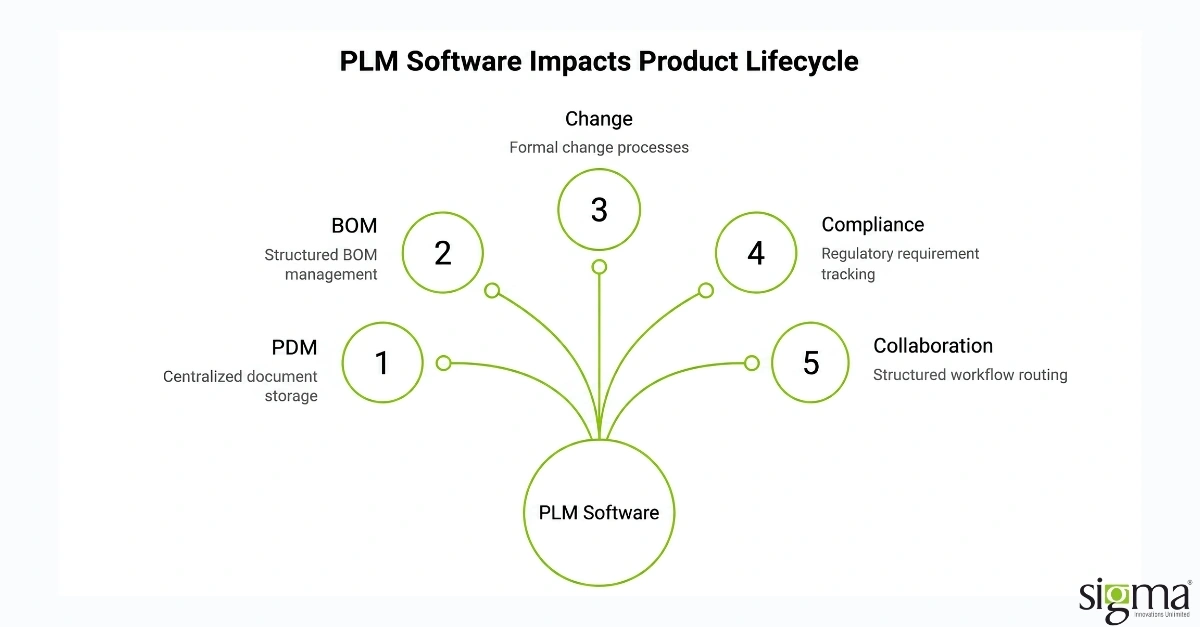
A mature PLM system typically covers the following capability areas:
Product data management (PDM): Centralized storage and version control for all product-related documents, specifications, test reports, technical drawings, and product configuration data.
Bill of materials management: Structured, version-controlled BOM management across engineering, manufacturing, configuration, and service variants.
Engineering change management: Formal processes for proposing, reviewing, approving, and implementing changes to product designs or configurations, with full audit trails.
Compliance and regulatory tracking: Management of material declarations, certifications, and regulatory requirements from RoHS and REACH in hardware to FDA requirements in HealthTech and data governance requirements in SaaS products.
Collaboration and workflow: Structured workflows that route review and approval tasks to the right stakeholders at the right stage of the product development lifecycle are especially important when your team is distributed across the US, ANZ, or European time zones.
Some PLM platforms also extend into quality management, supplier collaboration, and product portfolio planning, depending on configuration and industry context.
Build a PLM Solution That Scales with Your Products
Replace spreadsheets and disconnected systems with custom Product Lifecycle Management (PLM) software solutions that centralize product data, automate engineering change management, streamline BOM management, and integrate with ERP, CAD, and supply chain platforms.
PLM Software vs ERP: Understanding the Difference
One of the most common points of confusion when evaluating PLM is how it relates to an existing ERP system. The two platforms are complementary, not competitive, but they serve fundamentally different purposes.
ERP systems manage business transactions. They track inventory, process purchase orders, manage production schedules, and record financial data. An ERP system knows how many units of a component are in stock and what they cost. It does not know which revision of the component is in the product, who approved the last engineering change, or whether it meets current compliance requirements.
PLM software manages product knowledge. It defines what the product is, how it is structured, how it has changed, and what regulatory obligations it carries. PLM is the source of truth that informs ERP when a new product version is released. PLM communicates the updated BOM or configuration to ERP so that procurement and operations run from the correct specification.
For growth-stage teams at companies with 6–200 employees, the failure mode typically isn’t having a bad ERP; it’s having no structured product data layer at all. Teams operating with ERP plus spreadsheets for product data are carrying silent risk: version conflicts, compliance gaps, and manual re-entry errors that surface as expensive problems at the worst possible time.
Read the blog: Product Engineering Services and PLM: Building Software Products for Long-Term Success
Who Genuinely Needs PLM Software?
Not every organization needs a full PLM implementation. The investment is most justified when specific products and organizational conditions are present. Here’s where it applies most directly to growth-stage companies in Sigma’s core markets.
SaaS and Software-Hardware Companies
B2B SaaS platforms with complex, configurable products or companies building software that ships alongside physical hardware increasingly face PLM-type challenges as their product catalogs grow. Managing product configurations, versioned specifications, and feature-compliance documentation in shared drives creates exactly the version control and traceability gaps PLM is designed to close.
For vertical SaaS companies serving regulated industries, the compliance traceability requirements are often indistinguishable from hardware PLM requirements. A vertical SaaS platform serving construction, energy, or manufacturing clients may carry documentation obligations that warrant a structured PLM approach.
HealthTech and Medical Device Companies
This is a category where PLM is not optional; it’s a regulatory requirement. Design history files, device master records, and traceability requirements under FDA 21 CFR Part 820 and ISO 13485 require structured, auditable documentation management.
For growth-stage HealthTech companies in the US and ANZ markets, managing compliance documentation in spreadsheets is a real regulatory liability. A structured PLM system, purpose-built or customized, provides the audit trail and document control that FDA and TGA submissions require.
eCommerce and Consumer Product Companies
Brands managing large product catalogs, seasonal ranges, multi-supplier sourcing, and cross-market compliance documentation use PLM to coordinate product specifications, material sourcing, and regulatory compliance across supplier tiers and geographies. For omnichannel retailers and marketplace operators scaling from one market to multiple, PLM closes the documentation and version control gaps that spreadsheet-based product management creates.
Hardware and Electronics Companies
Hardware companies face overlapping challenges: rapid design iteration, component obsolescence management, regulatory compliance across the US, Canadian, and ANZ markets, and tight integration between CAD systems and downstream manufacturing or fulfilment processes. PLM software is purpose-built for this environment, and the investment is typically justified well before a team reaches 200 people.
PLM Software vs Spreadsheets: Why the Switch Matters
Most growth-stage companies start their product data management in spreadsheets. For a small team building a simple product, it works. The problems emerge as the product and team scale, and they tend to emerge simultaneously, making them harder to untangle.
The core limitations of spreadsheet-based product data management include:
- Version control failures: Multiple versions of the same BOM or specification exist simultaneously, with no reliable mechanism to identify which is current, especially painful when teams are distributed across US, Australian, or New Zealand time zones.
- Concurrent editing conflicts: Teams in different functions or locations edit the same files, overwriting each other’s changes without visibility.
- No formal change management: Product changes happen informally, without approval workflows, impact assessments, or audit trails, creating compliance exposure in regulated categories.
- Compliance gaps: Material declarations and certification tracking fall out of sync with actual product configurations as designs evolve.
- Integration absence: Spreadsheets cannot connect to ERP platforms, CAD systems, or supplier portals, creating manual re-entry work and transcription errors at every handoff.
For a growth-stage team, the tipping point is usually a specific, painful incident, a component substitution made during a supply chain disruption that was applied to the manufacturing BOM but never reflected in the compliance documentation, for example. The cost of that gap in rework, resubmission, or recall typically exceeds the cost of a PLM implementation by a significant margin.
The stronger argument for acting before that incident is this: at 6–50 employees, implementing PLM is a focused engineering project. At 150+ employees with a complex product portfolio and multiple compliance obligations, it becomes a multi-year transformation.
When to Implement PLM Software
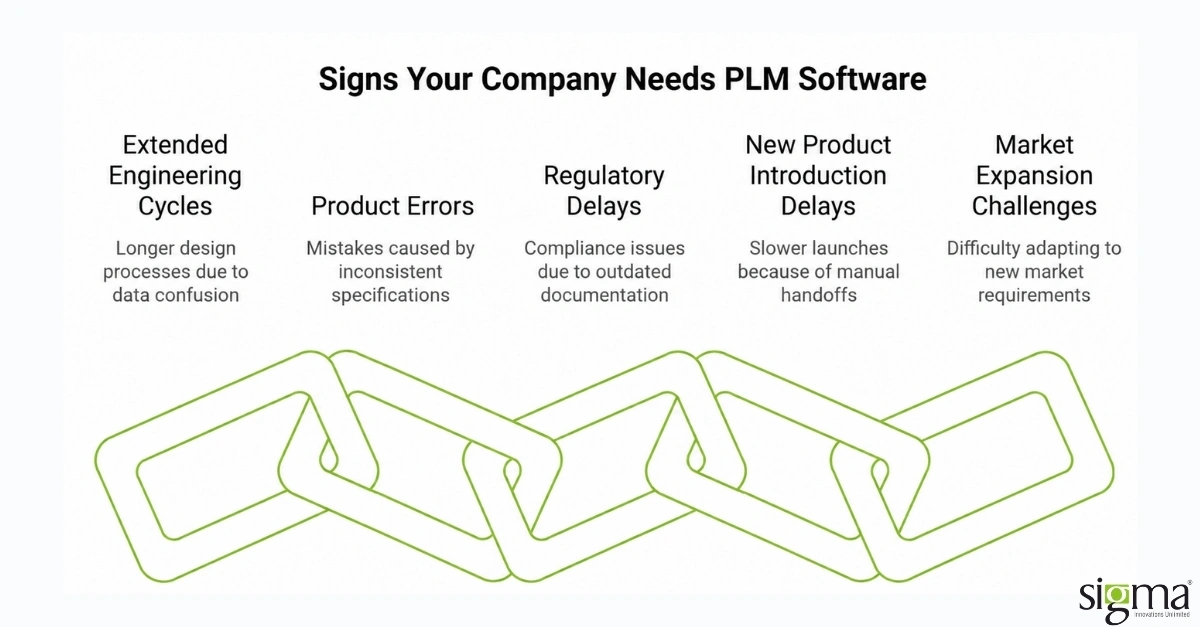
The right time to implement PLM is before the cost of unmanaged product data becomes visible as a production, compliance, or customer-facing failure. The signals that a growth-stage company is ready include:
- Engineering or product change cycles are taking longer because the team cannot confidently identify the downstream impact of a proposed change
- Product errors are traceable to discrepancies between different versions of the same specification
- Regulatory submissions, FDA, TGA, CE, or otherwise, are delayed because compliance documentation is out of sync with the current product configuration
- New product introduction timelines are extending because design handoffs between functions involve manual document transfers and version reconciliation
- The company is expanding into new markets from the US to Canada or ANZ, or from ANZ to the US, with different compliance requirements that current processes can’t accommodate
Growth-stage companies that wait for a compliance failure or a significant product error to trigger the PLM investment typically spend substantially more on remediation than they would have spent on the platform.
How Sigma Infosolutions Helps Growth-Stage Companies Build and Customize PLM Solutions
Sigma Infosolutions works with CTOs, founders, VPs of Engineering, and Heads of Product at growth-stage companies in the US, Canada, Australia, and New Zealand to implement, customize, and integrate PLM solutions that fit specific product workflows without the overhead of large enterprise software vendors or the risk of building from scratch without domain experience.
Sigma operates as a long-term engineering partner, not a fixed-bid project vendor. That distinction matters for PLM, where the platform needs to evolve as your product portfolio grows, your team scales, and your compliance obligations shift.
Discovery and Requirements Analysis
Every engagement starts with a structured discovery phase that maps your existing product data flows, identifies BOM or configuration management gaps, documents compliance requirements by market, and defines integration points with existing CAD, ERP, and supply chain or vendor systems. This ensures the PLM solution is designed around your actual workflows rather than a generic template.
PLM Platform Selection and Custom Development
Based on discovery findings, Sigma advises on the right platform strategy: configuration of an established PLM platform, custom development of a purpose-built solution, or extension of an existing internal system. For companies with highly specific industry workflows, HealthTech compliance requirements, vertical SaaS configuration complexity, or eCommerce multi-market product management, Sigma builds custom PLM modules that standard platforms don’t accommodate out of the box.
ERP, and Supply Chain Integration
Sigma’s integration engineering capability connects the PLM system reliably with your ERP platform, and supplier collaboration portals. This eliminates the manual handoffs and data re-entry that undermine the value of a PLM investment and create the version conflicts that spreadsheet-based management leaves unresolved.
Engineering Change Management Workflows
Sigma configures or builds engineering change management workflows matched to your approval structure, product complexity, and compliance obligations, including automated routing, impact assessment tooling, and audit trail documentation designed to withstand regulatory review.
Quality Assurance and Deployment
Every PLM implementation Sigma delivers includes structured testing against your actual product data, BOM validation, change workflow testing, and integration verification before go-live. Sigma also provides training and documentation so your internal team can operate and extend the system independently.
Long-Term Engineering Partnership
Product data requirements evolve as portfolios grow and regulatory landscapes shift. Sigma structures PLM engagements as ongoing T&M or retainer partnerships so the system continues to match your organizational needs as you scale, without the cost and friction of re-engaging a new vendor every time a requirement changes.
Looking for Custom Product Lifecycle Management (PLM) Software Solutions?
See how Sigma Infosolutions delivers custom PLM software solutions that centralize product data, automate engineering change management, and integrate with ERP and supply chain systems.
Conclusion
Product lifecycle management software is not a tool reserved for large manufacturers with hundred-million-dollar engineering budgets. It is an operational necessity for any growth-stage company, SaaS, HealthTech, eCommerce, or hardware-adjacent, where product accuracy, version control, and compliance documentation directly affect product quality, time to market, and regulatory standing.
For a company of 6–200 people, the case for acting early is straightforward: the cost of implementing PLM before you hit the complexity wall is substantially lower than restructuring a broken product data environment while simultaneously managing growth, new market entry, and escalating compliance obligations.
The teams that get this right, who ship reliable, compliant products with confidence across the US, Canadian, and ANZ markets, typically do so with a specialist engineering partner who understands both the domain complexity and the practical constraints of a growth-stage company building toward scale.
Sigma Infosolutions brings the engineering depth and product domain experience to build, customize, and integrate PLM solutions that fit your specific workflows, not a generic enterprise template. Whether you’re evaluating PLM for the first time or looking to modernize an existing system, Sigma designs solutions that work for your product, your team, and your compliance context.
Ready to bring order to your product data?
FAQs
What is Product Lifecycle Management (PLM) software?
PLM software centralizes product data, workflows, engineering changes, and compliance information across the entire product lifecycle.
Who should use Product Lifecycle Management software?
PLM software is ideal for SaaS, HealthTech, eCommerce, manufacturing, and hardware companies managing complex product data and compliance requirements.
How is PLM software different from ERP software?
PLM manages product information and lifecycle processes, while ERP focuses on business operations such as inventory, procurement, and finance.
What are the key benefits of implementing a PLM system?
PLM improves product data accuracy, streamlines collaboration, enhances compliance management, and accelerates product development cycles.
Why do growing companies outgrow spreadsheets for product management?
Spreadsheets lack version control, workflow automation, audit trails, and integration capabilities needed to manage complex product portfolios efficiently.
How does PLM software support regulatory compliance?
PLM provides document control, traceability, audit trails, and change management processes that help organizations meet industry compliance standards.
When is the right time to implement a PLM solution?
Companies should adopt PLM when product complexity, compliance requirements, engineering changes, or product data management challenges begin impacting growth.
Can PLM software integrate with ERP, CAD, and supply chain systems?
Yes, modern PLM platforms integrate with ERP, CAD, CRM, and supply chain systems to create a unified product information ecosystem.