Agentic AI Workflows in the Enterprise: Where They Actually Add Value

Key Highlights:
- Most organizations cannot tell where agentic AI delivers real ROI versus where it is just an expensive experiment or another chatbot.
- Target multi-step, measurable workflows, build them with guardrails and human oversight, prove the return, then scale.
- Sigma designs, builds, and integrates agentic AI workflows with the governance, security, and scale enterprise use demands.
Introduction
Ask ten executives what agentic AI is, and you will get ten answers, most of them fuzzy and half of them lifted from a vendor deck. Behind the noise, though, something real is happening. Agentic AI workflows are starting to do actual work inside enterprises, not just answer questions in a chat window.
That gap between hype and reality is the problem. Most companies have run a pilot or two, wired up a chatbot, and walked away unsure whether any of it moved a real number. Meanwhile, the budget questions get harder. Do you spend more on something you cannot measure, or fall behind competitors who are quietly figuring it out?
The way through is to get specific about where agentic AI earns its keep and where it does not. This piece defines what agentic AI actually is, how it differs from the generative AI you already use, where it delivers measurable value in enterprise workflows, and what it takes to deploy it without creating a governance headache.
What Is Agentic AI?
Agentic AI is software that pursues a goal, not just a prompt. Instead of waiting for one instruction and returning one answer, an AI agent can break a goal into steps, decide what to do next, use tools and data, and keep going until the job is done or it hits a limit you set.
The shift is from responding to acting. A generative model writes an email when you ask. An agent can read the incoming message, check a system, draft the reply, and schedule the follow-up, all as one agentic workflow. Autonomous AI agents handle the sequence, not just a single turn.
That autonomy is both the point and the risk. Done well, agents take repetitive, multi-step work off human plates. Done carelessly, they take actions nobody reviewed. Which is why enterprise adoption is really a question of control as much as capability.
Agentic AI vs Generative AI
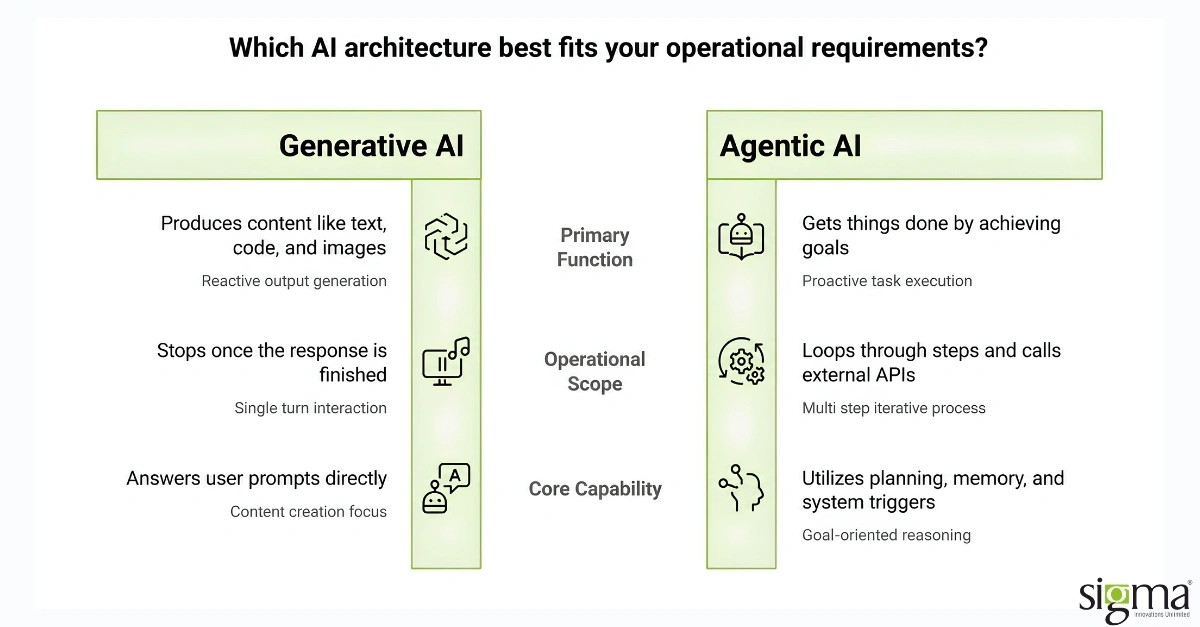
People blur agentic AI and generative AI, but the difference is simple. Generative AI produces content: text, code, images, summaries. You ask, it generates. It is reactive, and it stops once the response is done.
Agentic AI uses generative models as an engine but wraps them in planning, memory, and the ability to act. It can call APIs, query databases, trigger other systems, and loop through steps toward a goal. Put plainly, generative AI answers; agentic AI gets things done.
Most real systems combine the two. The language model supplies the reasoning and the words. The agent layer supplies the goal, the tools, and the judgment about what to do next.
Ready to move beyond AI pilots?
How AI Agents Actually Work
Under the hood, how AI agents work is less mysterious than it sounds. A typical agent runs a loop:
- Understand the goal and the current situation.
- Plan the next step toward that goal.
- Act by calling a tool, an API, or another agent.
- Observe the result and decide whether to continue or stop.
Unlike RPA, which follows a fixed script step by step, an agent can change its approach when the situation changes. For complex jobs, several LLM agents can split the work, one researching, one drafting, one checking, coordinated by an orchestration layer. This is where multi-agent systems come in. And in almost every serious enterprise setup, a human stays in the loop for the decisions that matter.
Read the blog: Generative AI in Software Development: Where It Helps and Where It Falls Short
Where Agentic AI Actually Adds Value
The honest answer to “where does agentic AI add value” is this: in workflows that are multi-step, rules-heavy, and full of swivel-chair work between systems. A few patterns show up again and again.
- Customer operations: Agents triage requests, gather context from several systems, draft responses, and escalate only the hard cases.
- Back-office processing: Invoice handling, claims intake, and onboarding- the document-heavy flows where an agent reads, checks, and routes.
- IT and engineering support: Agents investigate alerts, pull logs, propose fixes, and open tickets, cutting time to resolution.
- Research and analysis: Agents gather information across sources, synthesize it, and prepare a draft a human can refine.
- Revenue operations: Agents enrich leads, update records, and prep account summaries so teams spend time selling, not searching.
The common thread is not intelligence for its own sake. It is removing the manual glue between steps and systems that quietly eats hours across an organization. That is the kind of workflow automation enterprise AI agents are genuinely good at today, and it is where agentic workflows tend to prove themselves first.
Where Agentic AI Is Still Oversold
Just as important is knowing where agentic AI is not ready to run free. Be skeptical when a use case involves:
- High-stakes, irreversible decisions with no human check.
- Fuzzy goals that even a person would struggle to define.
- Processes where an error is expensive and hard to catch.
- Data or system access you cannot safely grant to software.
The failure mode is not that agents cannot attempt these things. It is that they will attempt them confidently and get them wrong. The teams seeing real returns start narrow, with bounded and measurable workflows, and expand only as trust is earned.
What Makes an Agentic AI Project Succeed
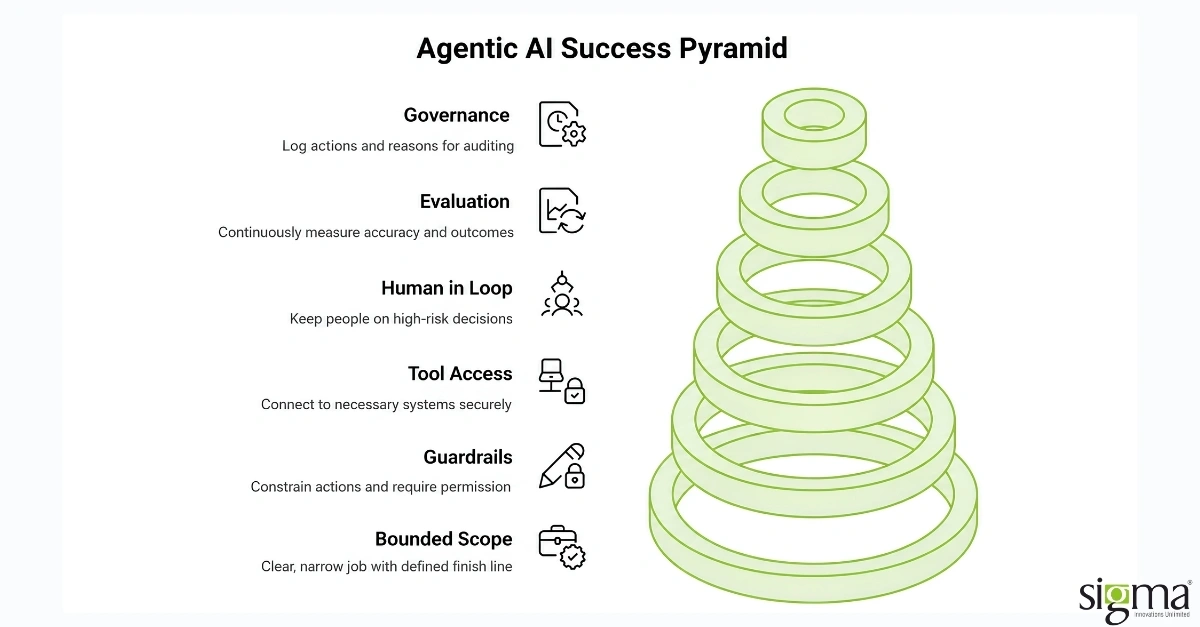
The difference between a demo and a deployment usually comes down to a handful of design choices:
- Bounded scope: Give the agent a clear, narrow job with a defined finish line.
- Guardrails: Constrain what actions it can take and where it must ask permission.
- Tool and data access: Connect it only to the systems it needs, with proper security.
- Human in the loop: Keep people on the decisions that carry real risk.
- Evaluation: Measure accuracy and outcomes continuously, not just at launch.
- Governance: Log what the agent did and why, so you can audit and improve it.
Skip these, and you get an impressive prototype nobody trusts in production. Build them in, and you get a system operations leaders are actually willing to rely on.
Is Agentic AI Worth It? Measuring the ROI
Is agentic AI worth it? Only if you can measure what it changes. The agentic AI ROI question gets much easier when you tie each workflow to a concrete metric before you build: hours saved, cases handled per person, cycle time, error rate, or cost per transaction.
Pick workflows where those numbers are already painful and already tracked. Run the agent alongside the current process, compare the results, and scale what works. Value that cannot be measured tends to be value that was never really there.
The enterprises pulling ahead treat agentic AI as an operations investment with a return, not a science project. Agentic AI has moved fast from flashy demos to production pilots, and the ones that stick are the ones with a number attached.
How Sigma Infosolutions Helps Operationalize Agentic AI Workflows
Getting from a promising idea to a governed, production-grade agent is where most enterprise AI efforts stall. Sigma Infosolutions helps organizations cross that gap, designing, building, and integrating agentic AI workflows that hold up in the real world.
Use-Case Discovery
Sigma starts by finding the workflows where agents will actually pay off, screening for the multi-step, measurable processes that fit rather than chasing the flashiest idea in the room.
Solution Architecture and Orchestration
Sigma designs the agent architecture and AI orchestration, drawing on hands-on experience with frameworks like LangGraph to build stateful agents that handle multi-step work reliably.
Build analytics-driven AI assistants with Sigma. Click now
Agent Development
Sigma builds the agents themselves, wiring large language models to the tools, data, and logic they need, with human-in-the-loop checkpoints wherever the stakes call for them.
Integration
Agents are only useful when connected. Sigma integrates them into your existing systems, from CRMs and ERPs to internal APIs, so they act on real data instead of a sandbox.
Governance, Security, and Scale
Backed by cloud-native engineering and ISO-certified security practices, Sigma builds in logging, guardrails, and monitoring, then scales what works across the organization.
Conclusion
Agentic AI workflows are moving from novelty to genuine utility, but only in the right places. The value is real where work is multi-step, repetitive, and stuck between systems, and it is oversold where decisions are high-stakes, fuzzy, or unwatched. Knowing the difference is most of the skill.
For enterprise leaders, the smart path is not to chase every agentic demo. It is to pick bounded, measurable workflows, build them with guardrails and human oversight, prove the return, and scale from there. That is how agentic AI stops being an experiment and starts becoming infrastructure.
Sigma Infosolutions helps organizations operationalize agentic AI with the governance, security, and scale that enterprise use demands.
FAQs
What is agentic AI in enterprise workflows?
Agentic AI uses autonomous agents to plan, execute, and complete multi-step business tasks with minimal human intervention.
How is agentic AI different from generative AI?
Generative AI creates content, while agentic AI takes actions, makes decisions, and orchestrates workflows toward a business goal.
What are the benefits of agentic AI for enterprises?
Agentic AI improves operational efficiency, reduces manual work, accelerates decision-making, and streamlines complex workflows.
Which business processes are best suited for agentic AI?
Customer support, claims processing, IT operations, research, onboarding, and revenue operations are ideal use cases for agentic AI.
What is a multi-agent AI system?
A multi-agent AI system coordinates multiple specialized AI agents that collaborate to complete complex business tasks.
How do enterprises ensure governance in agentic AI workflows?
Organizations use guardrails, audit logs, role-based access controls, and human oversight to maintain compliance and accountability.
How can companies measure agentic AI ROI?
Agentic AI ROI is measured through reduced processing time, lower operational costs, improved accuracy, and increased productivity.
How does Sigma Infosolutions help implement agentic AI solutions?
Sigma Infosolutions designs, integrates, and scales secure agentic AI workflows that automate enterprise processes while maintaining governance and control.