AI in Loan Underwriting: How Machine Learning Is Changing Credit Decisions
Key Highlights:
- Digital lenders and embedded finance platforms scaling past early traction face a hard ceiling with manual or rules-based underwriting: slow credit decisions, rising risk costs, and a structural inability to serve thin-file borrowers who lack traditional credit histories. For a venture-backed lender trying to move fast, this ceiling is a competitive liability.
- Machine learning-powered underwriting engines ingest alternative data sources, score applicants in real time, and produce explainable credit decisions that outperform traditional models on accuracy, speed, and portfolio performance without requiring a large internal data science team to build from scratch.
- Sigma Infosolutions is a long-term product engineering partner for digital lenders, alternative finance companies, and embedded finance platforms in the US, Canada, Australia, and New Zealand. We build end-to-end AI underwriting platforms covering model development, alternative data integration, decision engine architecture, and ongoing model operations so your team ships faster without carrying the full build burden internally.
Introduction
If you’re leading a growth-stage digital lending business, you’ve probably hit a version of this problem: your underwriting process was designed for a different scale. It worked when loan volume was manageable, and your team could manually review edge cases. But as you’ve grown, the cracks have become harder to ignore. Decisioning queues slow down conversion. Your rules engine requires constant manual tuning. Thin-file applicants, gig economy workers, and recent immigrants with real creditworthiness are getting declined because your model doesn’t know what to do with them.
AI underwriting is the structural solution to this problem. Machine learning models can process hundreds of variables simultaneously, incorporate alternative data sources unavailable to traditional bureaus, and return a credit decision in seconds. For digital lenders and embedded finance platforms operating in the US, Canada, Australia, and New Zealand, this is not a distant opportunity; it is an active competitive pressure reshaping which lenders grow and which plateau.
Lenders that continue running legacy rules-based systems face a widening gap: slower decisioning, higher operational costs, greater exposure to credit losses, and an inability to serve a broader borrower population. The lenders investing in automated underwriting today are capturing market share, improving portfolio quality, and building proprietary data assets that make their models stronger over time.
This article explains how machine learning transforms loan underwriting, what it takes to build and deploy an AI credit decision engine at a growth-stage company, and how to make this transition without introducing new model risk or overextending your engineering team.
As application volumes grow, underwriting bottlenecks can quickly become a growth constraint. Learn how AI-driven lending automation enables faster decisions, operational efficiency, and more scalable lending operations.
How Traditional Underwriting Fails Growing Lenders
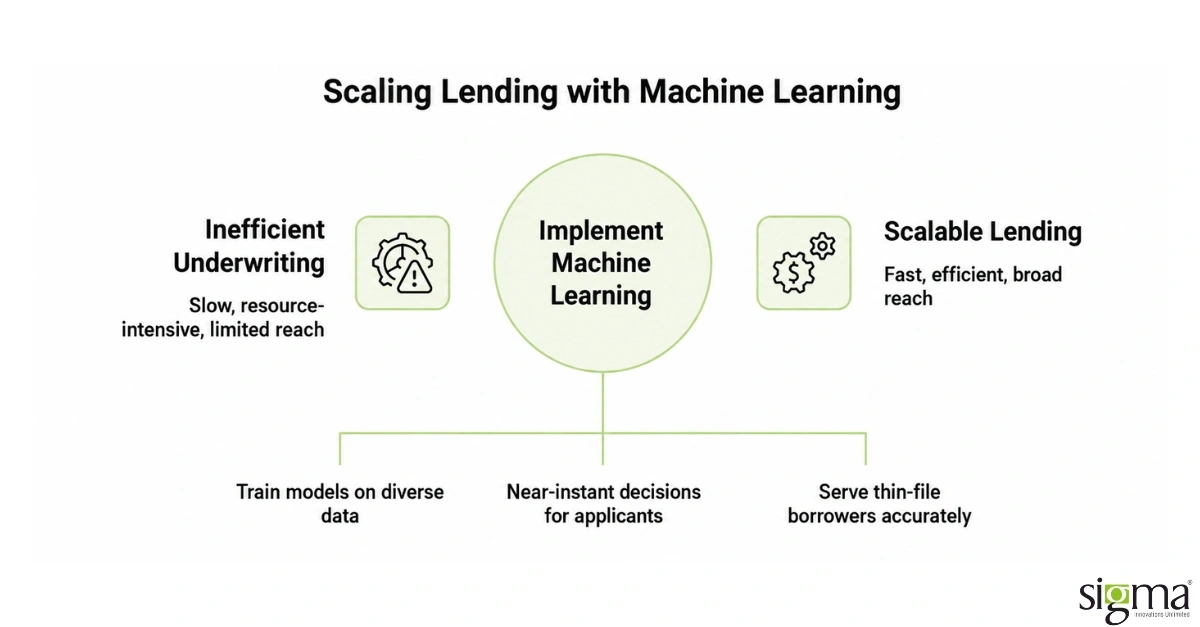
Rules-based underwriting systems were built for a different era and a different scale. They evaluate a fixed set of applicant attributes against manually coded thresholds and policy rules. When market conditions shift, when new borrower segments emerge, or when portfolio performance signals that risk models are miscalibrated, updating a rules engine is slow and resource-intensive. For a lean engineering team at a growth-stage company, it consumes disproportionate capacity.
The limitations become acute in digital lending contexts where applicants expect near-instant decisions. A multi-day underwriting queue is incompatible with the checkout-embedded lending experience or the mobile-first loan application flow that borrowers in the US, Canada, and Australia now expect as baseline. In consumer and SMB lending, slow decisions correlate directly with application abandonment, a metric that hits revenue before it ever shows up in credit loss data.
The thin-file problem is equally significant. Millions of creditworthy borrowers in your target markets, gig workers, recent immigrants, young professionals, and new-to-credit borrowers lack sufficient traditional credit data to generate a reliable bureau score. Rules-based systems either decline these applicants or price them punitively. For a growth-stage lender trying to differentiate on borrower reach, this is a missed market, not a managed risk.
Machine learning models trained on alternative data can accurately serve this population. That capability is what separates scaling lenders from those stuck at a ceiling.
How Machine Learning Changes Credit Decisions
Machine learning brings a fundamentally different approach to credit risk assessment. Instead of applying fixed rules to a small variable set, ML models learn statistical patterns from large historical datasets, identifying complex, non-linear relationships between applicant attributes and repayment behavior that human underwriters and rules engines cannot detect.
Feature Engineering and Alternative Data
A machine learning credit scoring model can incorporate a much wider range of inputs than traditional systems. Beyond bureau data, modern underwriting engines ingest:
- Bank transaction history and cash flow patterns
- Utility and rent payment records
- Employment verification and income variability signals
- Device and behavioral data from the application session
- Merchant transaction data in embedded lending contexts
- Open banking data accessed through API connections
Each additional data source adds a predictive signal, particularly for thin-file applicants where bureau data alone is insufficient. In Australia and New Zealand, open banking frameworks under the Consumer Data Right (CDR) have made real-time cash flow underwriting practical at scale. In the US, open banking integrations via Plaid, MX, and Finicity provide equivalent capability. In Canada, the evolving open banking regulatory environment is accelerating similar access. For lenders already operating across these markets, a unified alternative data strategy is a meaningful competitive asset.
Read the blog: Simplifying Loan Journeys: What Modern Digital Lending Software Should Actually Do
Real-Time Decision Engines
The architecture of an AI underwriting engine is designed for low-latency decisioning. When an applicant submits a loan application, the decision engine orchestrates data ingestion from multiple sources, runs the applicant profile through one or more trained models, applies policy rules and regulatory constraints, and returns a credit decision with an associated risk grade and pricing recommendation often in under three seconds.
This real-time capability is what makes AI underwriting essential for consumer lending products where decisions need to happen at the point of need. For embedded finance platforms integrated into checkout flows, that three-second window is the difference between a completed transaction and an abandoned cart.
Continuous Model Learning
Unlike static rules engines, machine learning models improve as they accumulate performance data. A lender that deploys an ML underwriting model today has a materially more accurate model twelve months from now, informed by actual repayment outcomes from its own portfolio. This compounding improvement translates directly into better risk pricing, lower default rates, and a growing competitive advantage over lenders still running static systems.
For a growth-stage lender, this is one of the most underappreciated benefits: the model becomes a proprietary data asset that gets harder for competitors to replicate over time.
Underwriting data can do more than support credit decisions. Discover how AI and data analytics help lenders uncover portfolio trends, strengthen risk strategies, and identify new growth opportunities across the lending lifecycle.
Model Explainability and Regulatory Compliance
Lenders adopting AI underwriting across US, Canadian, and Australian markets frequently encounter a legitimate concern: how do you explain a machine learning credit decision to a regulator or to a declined applicant?
Regulatory frameworks in the United States including the Equal Credit Opportunity Act (ECOA) and the Fair Credit Reporting Act (FCRA) require lenders to provide adverse action notices that explain why a credit application was declined or approved at less favorable terms. In Australia, the National Consumer Credit Protection Act and APRA’s prudential standards impose comparable obligations. A black-box model that cannot produce interpretable reason codes does not meet these requirements in any of these markets.
Modern AI underwriting platforms address this through explainability techniques such as SHAP (SHapley Additive exPlanations) values, which attribute each model prediction to specific input features. The output is a ranked list of factors that most influenced the credit decision mapping directly to the adverse action reason codes required by regulation.
Building explainability into the underwriting engine from the start is far less costly than retrofitting it after deployment. For growth-stage lenders who may be approaching their first regulatory examination or preparing for a Series B audit, this is not a theoretical concern. It is a compliance and due diligence requirement that affects fundraising, licensing, and partnerships.
Navigating evolving compliance requirements? Explore how regulatory compliance automation can streamline governance, audit readiness, and oversight.
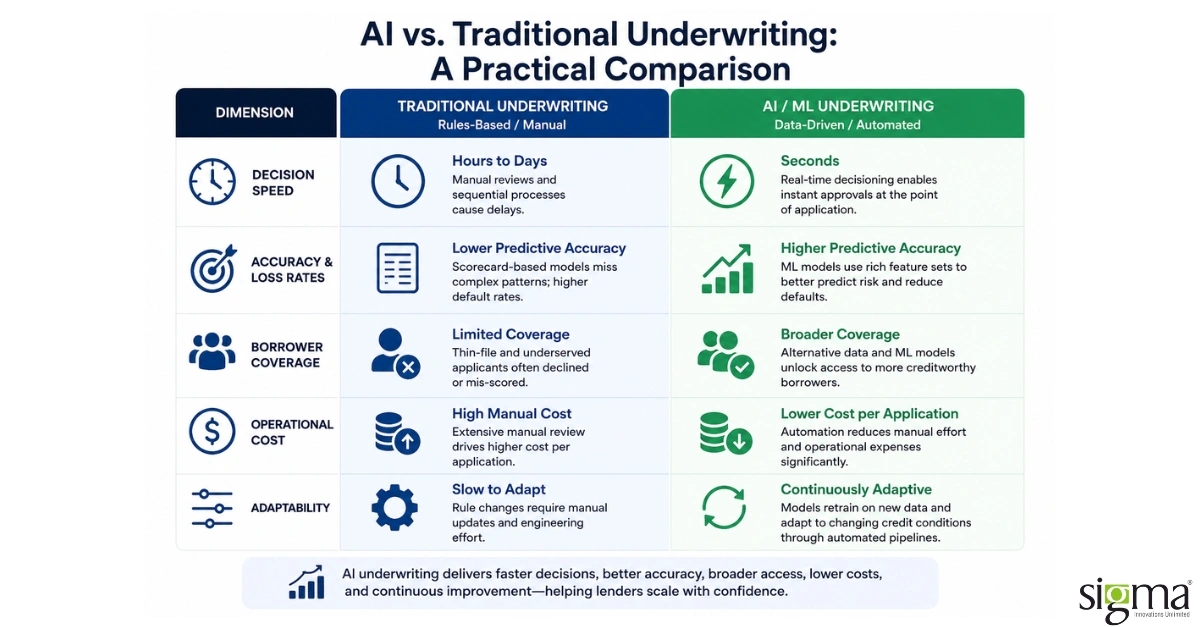
The business case for AI underwriting becomes clearest when compared directly against traditional approaches across the dimensions that matter to a scaling lending operation.
Decision speed: Rules-based systems operating with manual review steps take hours to days. ML decision engines return results in seconds, enabling real-time approvals at the point of application.
Accuracy and loss rates: Machine learning models trained on rich feature sets consistently outperform scorecard-based systems on predictive accuracy, which translates to lower default rates at equivalent approval volumes or higher approval rates at equivalent risk levels.
Borrower coverage: Traditional systems decline or miscode thin-file applicants at high rates. Alternative data-powered ML models extend credit access to underserved segments without increasing portfolio risk, a direct revenue and differentiation opportunity.
Operational cost: Automated underwriting replaces manual review for the majority of applications, reducing per-application operating costs significantly. For a growth-stage team, that freed capacity is redirected to product, partnerships, and complex edge cases that genuinely benefit from human judgment.
Adaptability: Rules engines require manual intervention to stay calibrated. ML models can be retrained on new data and redeployed through automated pipelines, allowing the underwriting system to adapt as credit conditions evolve without consuming engineering sprints every quarter.
Still relying on manual lending workflows?
What This Looks Like for a Growth-Stage Lender
If you’re a venture-backed digital lender or embedded finance platform with 10 to 200 people and an existing underwriting workflow, you’re likely in one of two situations:
Situation one: You have a rules-based system that worked at a lower volume but is now a bottleneck. You need to automate decision-making, improve accuracy, and reduce manual review without rebuilding your entire platform.
Situation two: You’re entering a new borrower segment or market, and your current model doesn’t have the data or feature coverage to serve those applicants accurately. You need alternative data integration and a new model, not just a tuned version of what you have.
In both cases, the practical constraint is the same: your core engineering team has a product roadmap. An AI underwriting build is specialized work model development, data pipeline architecture, MLOps infrastructure, explainability engineering that sits adjacent to your product’s core value creation. It’s the kind of work where a long-term engineering partner with fintech domain expertise delivers faster and at lower total cost than building in-house from scratch.
How Sigma Infosolutions Helps Build AI Underwriting Engines
Sigma Infosolutions is an AI-first product engineering partner with hands-on delivery experience in automated lending workflows. For digital lenders, alternative finance companies, and embedded finance platforms in the US, Canada, Australia, and New Zealand, Sigma builds production-grade ML underwriting systems as a long-term engagement partner, not a fixed-scope vendor.
Discovery and Data Assessment
Every engagement begins with a structured discovery phase that evaluates your existing data assets, underwriting workflow, and regulatory context across your operating markets. The team identifies which alternative data sources will deliver the highest predictive lift and maps the data pipeline architecture required to ingest them reliably.
Model Development and Feature Engineering
Sigma’s data science team builds and validates machine learning credit scoring models using your historical application and performance data. The team handles feature engineering, model selection, validation across borrower segments, and fairness testing to ensure the model performs accurately without introducing discriminatory patterns, a compliance requirement in every market Sigma serves.
Decision Engine Architecture
Sigma designs and builds the real-time decision engine that orchestrates data ingestion, model inference, policy rule application, and decisioning output. The engine is built for low latency, high availability, and auditability, with comprehensive logging of every decision input and output to support regulatory compliance and model monitoring.
Explainability and Compliance Integration
Every AI underwriting platform Sigma delivers includes SHAP-based explainability infrastructure that produces interpretable reason codes for every credit decision. This satisfies adverse action notice requirements under ECOA and FCRA in the US, and equivalent obligations in Canada and Australia, giving your compliance team a clear and auditable view of how the model operates across different borrower populations.
Deployment and Ongoing Model Operations
Sigma supports cloud deployment across AWS, Azure, and GCP, with MLOps infrastructure for model monitoring, drift detection, and retraining pipelines. Following launch, the team provides ongoing model operations support as a retained partner ensuring underwriting accuracy stays calibrated as your portfolio data accumulates and your borrower mix evolves.
This is not a handoff engagement. Sigma is structured to be a long-term product engineering partner that grows with your lending business.
Conclusion
AI underwriting is an active competitive requirement for any digital lending business that wants to match the speed, accuracy, and borrower reach that machine learning makes possible. For growth-stage lenders in the US, Canada, Australia, and New Zealand, the transition from rules-based systems to ML-powered credit decisioning is not a future initiative; it is happening now, and the lenders making that transition are pulling ahead.
The transition requires deliberate engineering: clean data pipelines, robust model development, real-time decision engine architecture, and explainability infrastructure that satisfies regulatory requirements across your operating markets. Done well, it produces a lending operation that is faster, cheaper, more accurate, and capable of serving creditworthy borrowers that traditional systems turn away.
If your current underwriting system is a bottleneck or if you’re expanding into borrower segments, your model wasn’t built for, Sigma Infosolutions has the AI engineering expertise and fintech domain knowledge to help you move faster than building in-house alone.
Sigma works best with lenders who have existing systems to modernize, a defined challenge, and an appetite for a long-term engineering partnership rather than a fixed-scope project. If that describes your situation, let’s talk.
Frequently Asked Questions
1. What is AI in loan underwriting?
AI in loan underwriting uses machine learning to automate and improve credit risk assessment for lenders.
2. How does AI speed up credit decision-making?
AI analyzes borrower data instantly to deliver faster and more accurate loan approvals.
3. Why is machine learning important in digital lending?
Machine learning helps digital lenders reduce risk, improve approvals, and scale underwriting operations efficiently.
4. Can AI underwriting improve loan approval rates?
AI underwriting improves approval rates by using alternative data to assess more borrowers accurately.
5. What are the benefits of AI-powered credit scoring?
AI-powered credit scoring increases accuracy, reduces manual work, and lowers loan default risks.
6. How does AI help lenders reduce fraud risk?
AI detects suspicious borrower patterns and unusual transaction behavior in real time to prevent fraud.
7. What industries use AI underwriting solutions?
Banks, fintech companies, NBFCs, and embedded finance platforms widely use AI underwriting solutions.
8. How does Sigma Infosolutions help digital lenders?
Sigma Infosolutions develops AI-driven lending platforms, automated underwriting systems, and real-time credit decision engines for fintech businesses.