Fraud Detection in Fintech Using Machine Learning: Approaches and Best Practices

Key Highlights
- Growth-stage fintech companies digital lenders, neobanks, and payments platforms face escalating fraud losses and mounting AML compliance pressure, but rarely have the in-house ML capability to build and operate effective fraud prevention systems on their own.
- Machine learning-based fraud detection systems that combine supervised learning, anomaly detection, and behavioral analytics deliver real-time fraud scoring with significantly lower false positive rates than rules-based approaches and can be stood up without a large internal data science team.
- Sigma Infosolutions partners with growth-stage fintech companies to design, build, and operationalize ML fraud detection systems covering transaction monitoring, identity verification, and anomaly detection so your team ships a production-grade system without hiring a full ML org.
Introduction
If you’re running a digital lending platform, a payments product, or a neobank, fraud isn’t a theoretical risk, it’s a line item eating into your margins right now.
Payment fraud, account takeover, synthetic identity fraud, and money laundering attacks have all intensified as digital financial services have scaled. And the rules-based detection systems that many fintech companies start with, whether built in-house or inherited from a vendor, are no longer capable of keeping pace with the sophistication and volume of modern fraud.
The good news: machine learning models can now identify fraudulent transactions in milliseconds, adapt to evolving attack patterns without manual rule updates, and dramatically reduce the false positive rates that frustrate legitimate customers and inflate your ops team’s review queue.
For growth-stage fintech companies with 6–200 employees, this creates a real strategic choice. You likely don’t have the resources to build and maintain a dedicated ML fraud team internally. But you can’t afford to operate with detection tooling that’s two steps behind the attackers either. The right answer for most companies at this stage is a specialized engineering partner who can build and operationalize ML fraud systems in your existing infrastructure quickly, without locking you into a black-box vendor.
This article covers the key ML approaches used in fintech fraud detection, the data signals that drive model accuracy, how to reduce false positives without increasing exposure, and the operational patterns required to keep fraud models effective in production.
Read the blog: Why Fintech Platforms Fail to Scale And How Modern Software Architecture Fixes It
Why Rules-Based Fraud Detection Falls Short
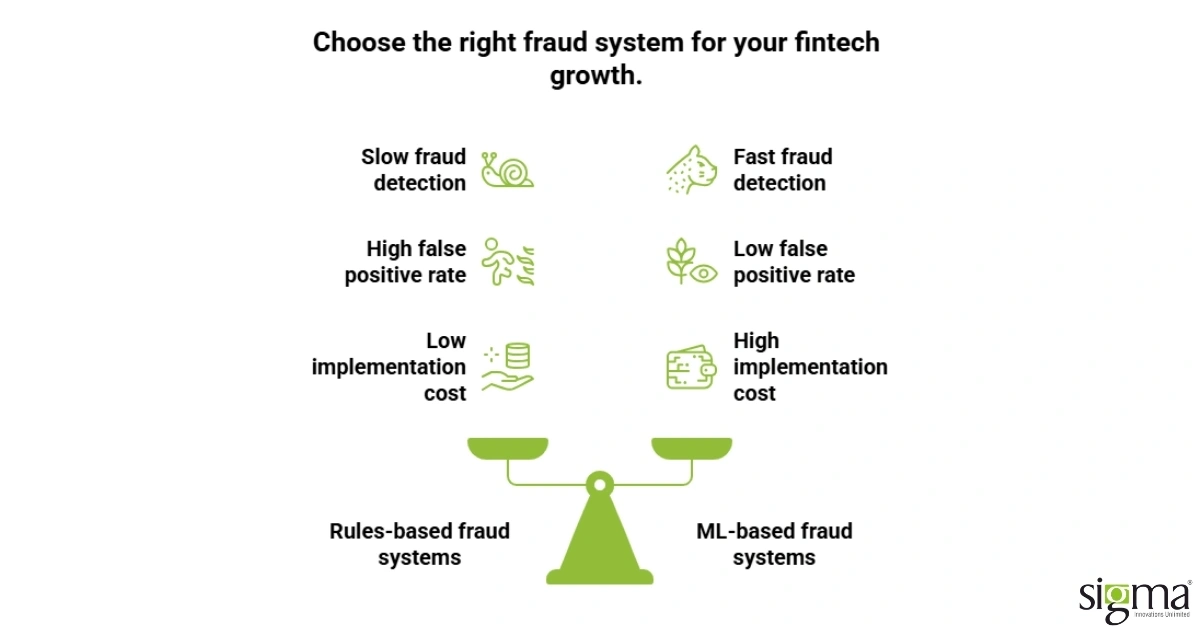
Rules-based fraud systems operate on manually coded thresholds and logic trees: flag a transaction if the amount exceeds a threshold, decline a login if the device is unrecognized, block a card if the geography changes unexpectedly.
For early-stage products with low transaction volume, rules engines are fast to implement and easy to audit. But they have fundamental limitations that become operationally painful as your platform scales.
Rules always lag the attacker. Every rule must be written and updated manually, which means your fraud team is always reacting to patterns they’ve already observed. Sophisticated fraud actors adapt quickly often within days of encountering a new rule. By the time your rules engine is updated, a new attack pattern is already in circulation. ML models trained on behavioral data detect anomalies that don’t yet have a named rule, catching novel fraud variants before they scale into losses.
False positives become a growth problem. Rigid thresholds generate high volumes of legitimate transaction flags, creating manual review queues that are expensive to operate and frustrating for customers. At 1,000 transactions a day, this is manageable. At 50,000, it becomes a serious operational liability. ML models score transactions probabilistically rather than binarily, enabling finer-grained risk thresholds that significantly reduce false positive volume without increasing fraud exposure.
For a growth-stage fintech team, these aren’t abstract engineering concerns, they’re direct costs: declined legitimate revenue, customer churn, and ops headcount that scales with fraud volume instead of staying flat.
Machine Learning Approaches for Fintech Fraud Detection
No single model architecture solves every fraud detection problem. Production fraud systems typically combine multiple ML approaches, each suited to a different detection task.
Supervised Learning for Known Fraud Patterns
Supervised learning models train on labeled historical data: transactions and events that have been confirmed as fraudulent or legitimate. Gradient boosting algorithms such as XGBoost and LightGBM are widely used in payment fraud detection because they handle tabular data effectively, train quickly on large datasets, and produce well-calibrated probability scores.
If your platform has observed synthetic identity fraud, card testing attacks, or first-party fraud in your portfolio, supervised models can learn the feature signatures associated with those cases and apply that pattern recognition to new events in real time.
The key requirement is labeled training data. If you’re earlier in your fraud data lifecycle, supervised models need to be paired with unsupervised approaches to fill coverage gaps.
Unsupervised Learning and Anomaly Detection
Unsupervised models learn what normal behavior looks like across your user population and flag deviations from that baseline. Techniques such as autoencoders, isolation forests, and clustering algorithms identify outliers without requiring labeled fraud examples.
This makes unsupervised approaches especially valuable for growth-stage companies that haven’t yet accumulated large labeled fraud datasets, as well as for detecting novel fraud patterns, money laundering schemes that don’t match known typologies, and low-frequency high-impact attacks.
Many fintech platforms deploy unsupervised models alongside supervised ones using the unsupervised layer to catch unusual activity that passes supervised scoring thresholds. The combination improves coverage across both known and unknown fraud vectors.
Behavioral Analytics and Sequence Modeling
Behavioral analytics models evaluate user activity over time rather than scoring individual transactions in isolation. Recurrent neural networks and transformer-based sequence models can identify when a pattern of account activity a series of small transactions followed by a large withdrawal, for example matches historical fraud sequences even when no individual transaction looks suspicious on its own.
Behavioral signals are particularly valuable for account takeover detection, where an attacker who has obtained valid credentials behaves differently from the legitimate account holder in ways that transaction-level scoring alone would miss. Session data, device fingerprints, typing cadence, and navigation patterns all contribute to a behavioral profile that can flag anomalous sessions before fraud is executed.
For digital lending platforms specifically, behavioral sequence modeling can also improve application fraud detection catching synthetic identities or stacking behavior early in the loan lifecycle.
Graph-Based Fraud Detection
Financial fraud rarely operates in isolation. Fraud rings involve networks of connected accounts, devices, addresses, and payment methods. Graph-based models represent these relationships explicitly, allowing the system to identify fraud clusters where individual accounts appear legitimate in isolation but reveal suspicious network patterns when analyzed collectively.
Graph analytics is particularly effective for AML transaction monitoring, synthetic identity ring detection, and merchant collusion schemes. As your platform scales and the sophistication of attacks increases, graph-based detection becomes an important addition to your fraud stack.
Turn Fraud Signals into Actionable Intelligence
Machine learning models generate enormous volumes of behavioral, transactional, and network data. Sigma’s Fintech AI & Data Analytics Solutions transform these signals into real-time insights, risk dashboards, and predictive intelligence that strengthen fraud prevention and portfolio performance.
Real-Time Fraud Scoring: Architecture and Latency Requirements
Fraud detection in payments must operate within the transaction processing window typically 100 to 300 milliseconds for card authorization decisions. Building a model that achieves high accuracy in development is only half the problem. Deploying it so it operates reliably at millisecond latency under production transaction volumes requires deliberate infrastructure design.
The key components of a real-time fraud scoring system include:
- A feature store that serves pre-computed behavioral features at low latency
- A model serving layer optimized for inference with minimal overhead
- An orchestration layer that combines scores from multiple models and applies configurable policy rules
- A feedback loop that routes confirmed fraud outcomes back into model retraining pipelines
Feature engineering is one of the most significant determinants of model performance in production. Raw transaction data alone is insufficient; the model needs aggregated features like rolling transaction velocities, account age, and historical chargeback rates. Computing these in real time for every transaction is expensive. A feature store architecture pre-computes and caches these signals so they’re available at inference time without adding latency.
For growth-stage teams, this infrastructure doesn’t need to be built from scratch at enterprise scale from day one. It should be designed to handle your current load reliably while being architected to scale as your transaction volume grows which is exactly the kind of pragmatic build that a specialist engineering partner is well-positioned to deliver.
Building Fraud Infrastructure Requires More Than Models
Production fraud detection depends on scalable architectures, resilient APIs, real-time data pipelines, and seamless integrations across your fintech ecosystem. Sigma’s Fintech Product Engineering Services deliver the engineering expertise required to design, build, and evolve these capabilities without expanding your internal team.
Reducing False Positives Without Increasing Fraud Exposure
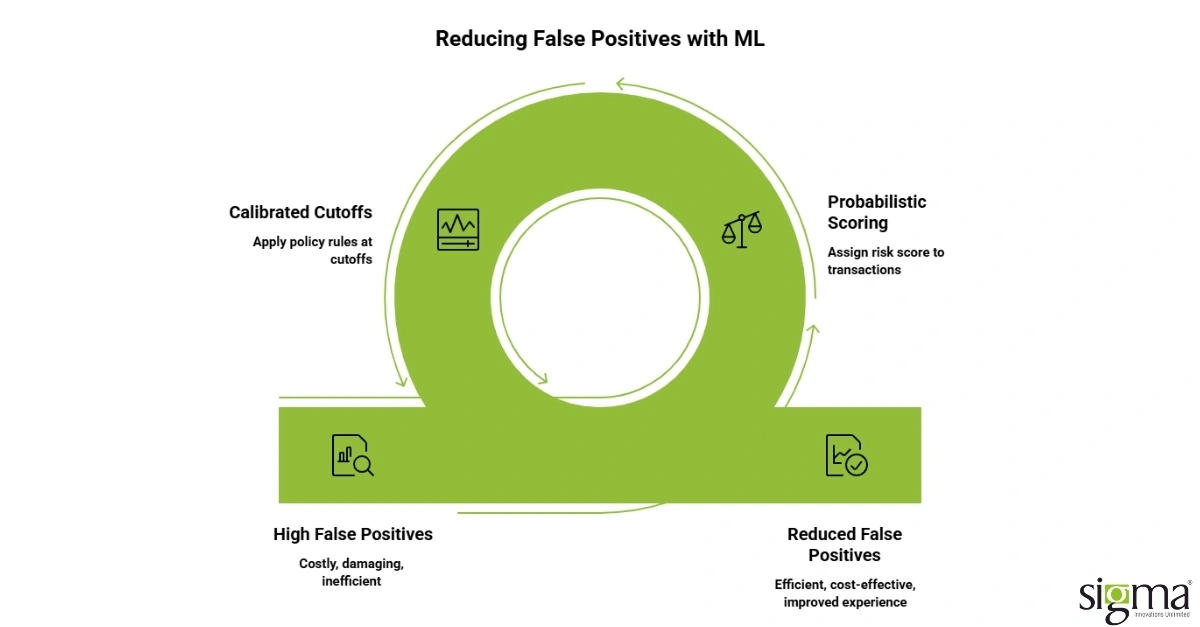
False positive reduction is one of the most commercially important problems in fraud detection. Every legitimate transaction flagged as fraudulent has a direct cost: the customer is declined or delayed, the merchant loses the sale, and your ops team absorbs a manual review task that adds no value. At scale, high false positive rates create measurable revenue drag and customer experience damage.
ML models reduce false positives by replacing binary thresholds with probabilistic scoring. Instead of blocking all transactions above a fixed dollar threshold, a trained model assigns a risk score to each transaction and applies policy rules at calibrated cutoffs. Adjusting the threshold shifts the trade-off between fraud capture rate and false positive volume, giving your risk team precise control over where the model operates on that curve.
Continuous model retraining is also critical. Fraud patterns evolve, and so does legitimate user behavior. A model trained on an older customer mix will drift in accuracy over time. Production fraud systems require monitoring for score drift, regular retraining on fresh data, and champion-challenger frameworks that validate new model versions against live traffic before full deployment.
For lean teams, this ongoing operational work is often the hardest part, not the initial model build, but keeping the system calibrated as your product, customer base, and the fraud landscape all change. Structuring this as an ongoing engineering partnership rather than a one-time project is typically the most cost-effective approach.
How Sigma Infosolutions Helps Growth-Stage Fintech Teams Build Production Fraud Detection
Sigma Infosolutions is an applied AI and fintech engineering partner with hands-on experience building and operationalizing fraud detection systems for growth-stage payments companies, digital lenders, and neobanks. We work as an extension of your team not a black-box vendor so your engineering and risk leaders stay in full control of the system.
Discovery and Risk Assessment
Every engagement starts with a structured assessment of your fraud exposure across product lines: reviewing historical loss data, mapping existing detection gaps, and identifying the fraud typologies that create the greatest risk for your specific business model. This determines which ML approaches deliver the highest impact and informs the data pipeline and feature engineering work required.
Model Development and Feature Engineering
Sigma’s data science team develops supervised, unsupervised, and behavioral fraud models using your transaction history and identity data. We handle feature engineering, model selection, validation across customer segments, and fairness review to ensure detection patterns don’t introduce discriminatory outcomes, a critical consideration for regulated lenders.
Real-Time Scoring Infrastructure
We design and build the real-time inference infrastructure that serves fraud scores within your transaction processing window. This includes feature store architecture, model serving layers optimized for low-latency production deployment, and orchestration logic that combines signals from multiple models and applies configurable policy thresholds your risk team can tune.
AML and Transaction Monitoring Integration
For platforms with AML obligations, Sigma integrates ML-based transaction monitoring that generates suspicious activity alerts aligned with regulatory typologies. We build case management workflows that route flagged transactions to compliance review queues with supporting evidence, reducing the manual workload required for regulatory reporting.
MLOps and Continuous Model Improvement
Sigma delivers MLOps infrastructure for model performance monitoring, drift detection, and automated retraining pipelines. Champion-challenger frameworks allow new model versions to be validated against live production traffic before promotion, ensuring accuracy improvements are verified before they affect customer-facing decisions.
This is structured as a long-term partnership, not a one-time delivery, so your fraud system stays calibrated as your platform evolves.
Conclusion
Fraud detection in fintech has moved well beyond rules engines and manual review queues. For growth-stage digital lenders, payments platforms, and neobanks, ML-powered fraud detection is no longer a nice-to-have; it’s the operational baseline that regulators expect and customers demand.
The challenge for most 6–200 person fintech teams isn’t understanding that ML fraud detection is necessary. It’s building and sustaining a system that actually works in production without hiring a full data science org to maintain it. That means robust feature engineering, real-time inference infrastructure, continuous retraining pipelines, and deep alignment between model outputs and operational risk workflows.
Sigma Infosolutions brings the applied AI expertise and fintech engineering experience to close that gap. From initial risk assessment through model development, real-time deployment, and ongoing model operations, we deliver fraud prevention systems that are fast, accurate, and built to keep pace with evolving threats as a dedicated engineering partner your team can rely on long-term.
Ready to strengthen your fraud defenses?
FAQs
What is machine learning fraud detection in fintech?
Machine learning fraud detection uses AI models to identify suspicious financial transactions in real time.
How does AI improve fraud detection in digital payments?
AI analyzes transaction patterns instantly to detect fraud faster and reduce financial losses.
Why are fintech companies using machine learning for fraud prevention?
Fintech companies use machine learning to improve fraud accuracy, reduce false positives, and automate risk monitoring.
Can AI detect payment fraud in real time?
AI-powered fraud detection systems can identify and block fraudulent transactions within milliseconds.
What types of fraud can machine learning detect in fintech?
Machine learning can detect payment fraud, account takeover, synthetic identity fraud, and AML risks.
How does behavioral analytics help prevent fintech fraud?
Behavioral analytics tracks user activity patterns to identify unusual behavior and potential fraud attempts.
Why is real-time fraud scoring important for fintech platforms?
Real-time fraud scoring helps fintech platforms prevent unauthorized transactions before financial damage occurs.
How does Sigma Infosolutions help fintech companies prevent fraud?
Sigma Infosolutions builds AI-powered fraud detection systems, real-time risk scoring engines, and secure fintech monitoring solutions.