Real-Time Loan Eligibility and Disbursement: What Engineering Leaders Risk When the System Cannot Deliver in Seconds

Key Highlights:
- A borrower who clears eligibility but then waits hours or days for a funding decision has time to reconsider, compare a competitor’s offer, or abandon the process entirely, which turns a won application into a lost loan.
- An eligibility engine and underwriting pipeline built on real-time bureau and identity data replaces sequential manual review with a decision loop that runs in a single pass instead of a queue.
- Compressing the time between application and funded loan protects conversion at exactly the stage where most digital lenders lose the applicants they worked hardest to acquire.
- Sigma Infosolutions engineers the eligibility, underwriting, and disbursement layers as one connected pipeline, so a faster decision actually reaches the borrower’s account faster too, rather than stalling after approval.
Introduction
A borrower does not abandon a loan application because the rate was wrong. Most walk away because the process took too long to give them an answer, or because the decision took too long to turn into funded money in their account. Real-time loan eligibility and disbursement are not separate features bolted onto a lending platform, they are the output of a specific engineering decision: whether every stage between application and funding runs as one connected, event-driven pipeline or as a series of manual handoffs with waiting built into each one. For lenders evaluating that broader architecture, digital lending solutions bring eligibility, underwriting, origination, servicing, integrations, and disbursement into a connected technology ecosystem.
For a VP of Engineering or Head of Product at an NBFC or alternative lender, this is the architecture question that determines whether the marketing spend that brought a borrower to the application actually converts into a funded loan.
Connect eligibility, underwriting, origination, and disbursement across the lending lifecycle.
Where Digital Lending Journeys Actually Break Down
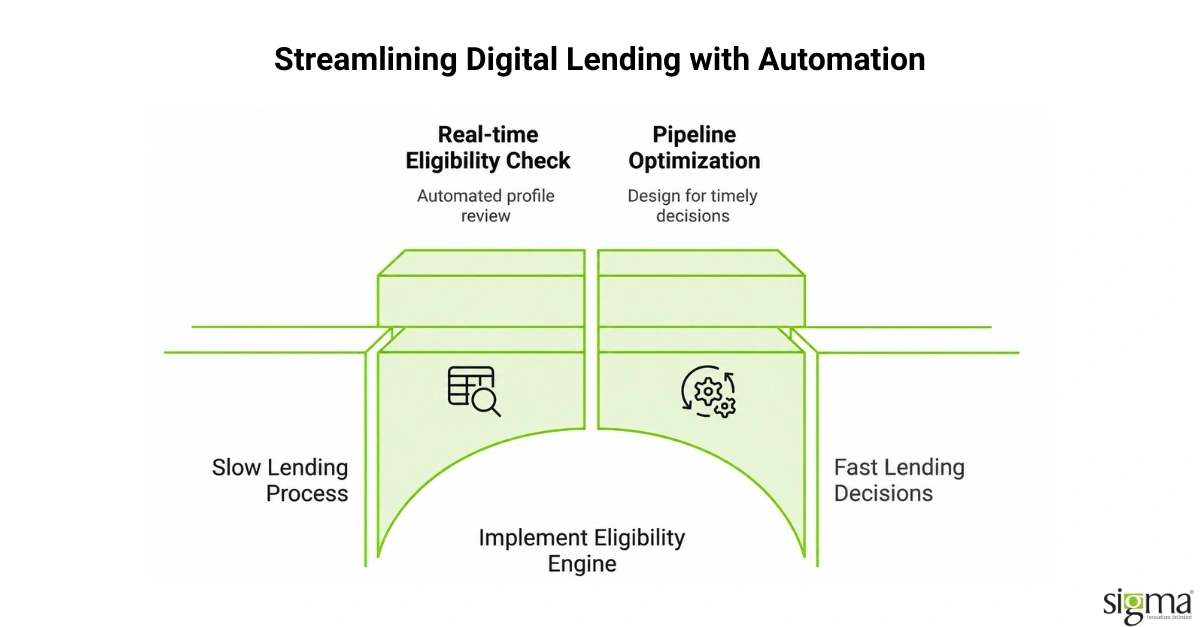
The failure point is rarely the application form itself. A borrower fills it out, submits it, and then waits for a callback that does not come on schedule, for a human to manually review uploaded documents, for a credit decision that depends on someone’s availability that day. Every one of those waits is a place where a motivated borrower has time to reconsider, apply somewhere else, or simply lose momentum and never come back. Research on the sector consistently identifies manual data collection and repeated back-and-forth with the borrower as one of the largest single obstacles lenders face in getting a loan application to a decision, and pipeline design, not the marketing funnel that generated the lead, is what determines whether that decision arrives in time to matter.
An eligibility engine is the front door of this pipeline: it is the automated layer that checks a borrower’s profile against lending criteria in real time, without a human reviewing the application first. Its speed sets the tone for everything downstream. A slow or manually gated eligibility check does not just delay one step; it delays every step that depends on it, which is why the engineering investment in this layer pays off disproportionately relative to its scope.
The Architecture Behind Real-Time Loan Eligibility and Underwriting
| Pillar | Function | Business Outcome | Technology Approach |
| Eligibility Engine | Validates borrower criteria against product rules instantly | Fast pre-qualification, no wasted applications on ineligible borrowers | Rules engine with configurable, product-specific parameters |
| Automated Underwriting | Scores creditworthiness using bureau and alternative data | Decisions in minutes rather than days, reduced manual review queue | Machine learning scoring layered with rule-based credit policy |
| Bureau and Identity API Integration | Pulls real-time credit, identity, and fraud signals | An accurate risk picture available at the moment of decision | Real-time API calls to credit bureaus and identity providers |
| Disbursement Module | Executes fund transfer immediately upon approval and signature | Borrower receives capital within minutes of approval, not days | Payment rail integration with automated agreement execution |
Each of these four pillars can be built well in isolation and still produce a slow borrower experience if they are not connected. An eligibility engine that is fast but feeds a manual underwriting queue has not actually solved the speed problem; it has just moved the bottleneck one stage downstream. The architecture that actually compresses time-to-funding runs these four functions in a single pass rather than a sequence, querying the bureau, scoring the applicant, and checking fraud signals concurrently instead of one after another, so the borrower experiences a decision loop measured in seconds rather than a workflow measured in days.
What Slow Disbursement Costs After the Decision Is Already Made
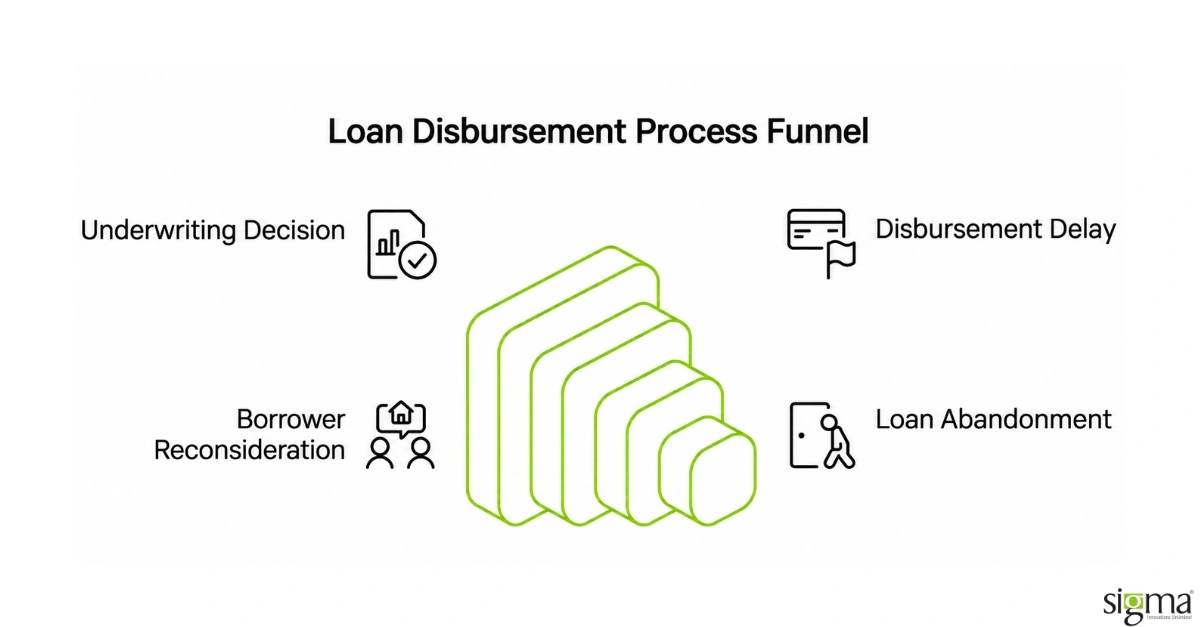
A fast, accurate underwriting decision that is followed by a slow disbursement process gives away most of the value that speed just created. The borrower who was told “approved” and then waits two days for funds has time to reconsider the loan, shop a competitor’s offer, or lose confidence that the process is actually as fast as it claimed to be. Lenders that still route capital delivery through manual treasury operations or end-of-day batch runs are conceding this ground to lenders who have connected disbursement directly to payment rail APIs, so the moment a signature is captured, the transfer initiates automatically without a separate manual trigger.
This is where the engineering question stops being about speed for its own sake and becomes about how tightly disbursement is integrated into the eligibility and underwriting layers that precede it. A lender evaluating this architecture should ask not “how fast is our underwriting” in isolation, but “how much total time elapses between the borrower’s click and the money landing in their account,” since that end-to-end number is the one that actually determines whether the borrower stays engaged through funding or abandons a loan they were already approved for.
Lenders building this pipeline internally still need to solve the underlying data problem: pulling accurate, real-time credit and identity signals into the decision at all.
Why This Compounds Into a Competitive Advantage, Not Just an Efficiency Gain
Lenders that compress the eligibility-to-disbursement window are not winning primarily on interest rate. Same-day funding is close to table stakes in most digital lending segments now, which means lenders who cannot deliver it are not being compared on price, they are being passed over before price even enters the conversation. The lenders capturing the most growth in NBFC and alternative lending segments are consistently the ones who have engineered the fastest, most reliable path from application to funded account, not necessarily the ones with the most competitive product terms on paper.
This also changes what a lender can afford to build. Once eligibility, underwriting, bureau integration, and disbursement operate as one connected pipeline instead of four separate systems, adding a new loan product or a new underwriting rule becomes a configuration change within that pipeline rather than a new integration project. That flexibility compounds over time in a way that is difficult to see in a single funding-speed metric but shows up clearly in how quickly a lender can respond to a new market opportunity or a new borrower segment.
Leverage Financial Software Development Services for Faster Lending
Modernize lending workflows, integrate financial systems, and engineer scalable software around evolving product and underwriting needs.
Sigma Infosolutions Engineers Eligibility Through Disbursement as One Pipeline
Most vendors sell strong individual components: a good eligibility engine, a capable underwriting model, a working disbursement integration, and leave the lender to connect them. Sigma’s approach engineers eligibility, automated underwriting, bureau and identity API integration, and disbursement as a single microservices-based pipeline from the start, so a lender is not left stitching together components that were never designed to hand off to each other in real time. Sigma completed a comparable engagement re-engineering a legacy loan origination system for a small business lender, replacing a manual underwriting queue with automated decisioning and role-based access controls, which helped the client set a new single-day funding record. Sigma also built a borrower-facing CRM and origination platform for a mortgage technology company focused on speed to lead and speed to decision, a project that produced a measurable increase in qualified borrower leads within months of launch.
That engagement solved the underwriting and funding-speed half of the pipeline; the borrower-acquisition half shows up just as clearly in a separate mortgage technology build.
Both results depend on the same real-time data access this post describes. The legacy LOS re-engineering compressed origination to same-day funding once underwriters could see live application data instead of a black box; the mortgage technology company’s CRM rebuild converted more leads without adding headcount once borrower data updated in real time across the pipeline. Disbursement speed and lead conversion are both, at bottom, a data-latency problem.
If your lending platform’s origination-to-disbursement flow has unacceptable latency or borrower drop-off at key handoff points, Sigma Infosolutions can assess the architecture and identify the integration or infrastructure changes required to meet real-time performance targets. Speak with Sigma’s fintech engineering team about your current system design.
Real-time eligibility and disbursement is not universally the right target: for lenders with simple, low-risk product lines, the infrastructure investment required for true real-time decisioning may exceed what the reduction in approval time is worth. The trade-off is speed against underwriting depth, compressing the decision window too aggressively risks approving loans that a slightly slower, more thorough review would have caught. Sigma works alongside lending teams as a long-term technology partner, helping determine where real-time processing creates genuine competitive advantage and where it does not, rather than treating it as a default requirement.
However, that speed comes with a constraint worth naming: the faster the decision window, the less room there is to catch an edge case manually, which is a risk underwriting teams should weigh deliberately rather than treat as a given.
Conclusion
The eligibility-to-disbursement window is where most digital lenders actually win or lose a borrower, not the marketing funnel that brought the application in the first place. Real-time loan eligibility and disbursement set the tone for everything downstream, and a slow or manually gated eligibility step delays every stage that depends on it. An architecture that runs eligibility, underwriting, bureau integration, and disbursement as one connected pipeline compresses a process that used to take days into one measured in minutes. A fast credit decision followed by slow disbursement still loses the borrower, since the total time from application to funded account is the number that actually determines whether they stay engaged. Lenders that still route capital through manual treasury operations or batch runs are conceding ground to competitors who have connected disbursement directly to payment rails. Same-day funding is close to table stakes now, which means lenders who cannot deliver it are being passed over before price ever enters the conversation. Connecting these four pillars into one pipeline also makes adding a new loan product a configuration change rather than a new integration project, which compounds in value well beyond the initial speed gain. Sigma Infosolutions engineers eligibility, underwriting, bureau integration, and disbursement as a single pipeline from the outset, rather than leaving a lender to connect components that were never designed to work together. For a VP of Engineering or Head of Product evaluating this architecture, the right question is not how fast any one stage runs in isolation. It is how much total time elapses between a borrower’s click and the funds landing in their account. That end-to-end number, more than any individual feature, is what determines whether a lending platform actually competes on speed.
Engineer a Faster Path From Application to Funding
Frequently Asked Questions
What does real-time loan eligibility actually mean in practice?
It means a borrower’s profile is checked against lending criteria automatically, using live bureau, identity, and product-rule data, without a human reviewing the application first. The result is a pre-qualification decision in seconds rather than a submission that sits in a manual review queue for days.
Why does disbursement speed matter if the credit decision is already fast?
A fast decision followed by a slow fund transfer still loses borrowers, since they have time to reconsider or compare offers while waiting for money to actually arrive. The engineering goal is compressing total time from application to funded account, not just the underwriting step alone.
How is an automated underwriting pipeline different from a fast manual review process?
Automated underwriting queries the bureau and alternative data and applies scoring rules in a single pass, producing a documented, auditable decision in minutes rather than days. A fast manual process still depends on a single reviewer’s workload and availability that day, which introduces both delay and inconsistency that an automated, event-driven pipeline avoids entirely.
What causes borrowers to abandon an application after they have already started it?
The primary causes are slow response times, repeated requests for documents already provided, unclear eligibility criteria, and the absence of real-time status updates during the wait. Each of these signals friction to the borrower and steadily erodes their confidence that the process will actually finish quickly and reliably.
What should a lender look for when evaluating a real-time eligibility and disbursement platform?
Key criteria include an API-first architecture connecting eligibility, underwriting, and disbursement as one pipeline, pre-built bureau and identity integrations, configurable underwriting rules, and a documented total time from application to funded account, not just a headline decision-speed claim made about one stage in isolation from the rest of the journey.