Digital Wallet Development: Building Seamless and Secure Payment Experiences
Key Highlights
- Fintech startups, payment providers, and banking innovators face mounting pressure to deliver modern digital wallet experiences that meet rising consumer expectations for speed, security, and convenience, yet many organizations lack the product engineering expertise to build compliant, scalable payment platforms from the ground up.
- Purpose-built digital wallet development that integrates secure payment processing, multi-factor authentication, contactless payment capabilities, and compliance-ready architecture gives organizations the technical foundation to launch and scale compelling e-wallet products in competitive payment markets.
- Sigma Infosolutions develops secure digital wallet platforms with robust payment integrations, advanced authentication systems, and compliance-ready architectures that enable fintech startups, payment providers, and banking innovators to deliver seamless payment experiences at scale.
Introduction
The way people pay for goods, services, and transfers has changed permanently. Cash and physical cards are no longer the default payment instruments for a growing segment of the global population. Digital wallets have become the preferred payment method for hundreds of millions of consumers across markets ranging from North America and Europe to Southeast Asia and Sub-Saharan Africa. In 2026, the digital wallet is not a novelty product. It is core financial infrastructure that organizations across the payment ecosystem must be equipped to build and support.
For fintech startups, payment providers, and banking innovators, the opportunity is significant. Digital wallet adoption continues to accelerate as contactless payment infrastructure expands, smartphone penetration deepens, and consumer comfort with mobile-first financial services grows. But the opportunity comes with substantial engineering and compliance complexity. Building a digital wallet that users trust requires getting security, user experience, regulatory compliance, and payment integration right simultaneously, from day one.
This blog examines the core technical components of modern digital wallet development, the security and compliance requirements that define the landscape, and how Sigma Infosolutions helps organizations build e-wallet platforms that are seamless for users and robust enough to operate at enterprise scale.
The Growing Strategic Importance of Digital Wallet Platforms
Digital wallets have evolved far beyond simple stored-value accounts. Modern e-wallet platforms serve as financial hubs that consolidate payment methods, manage loyalty programs, enable peer-to-peer transfers, facilitate buy-now-pay-later arrangements, and integrate with merchant ecosystems across physical and digital retail environments.
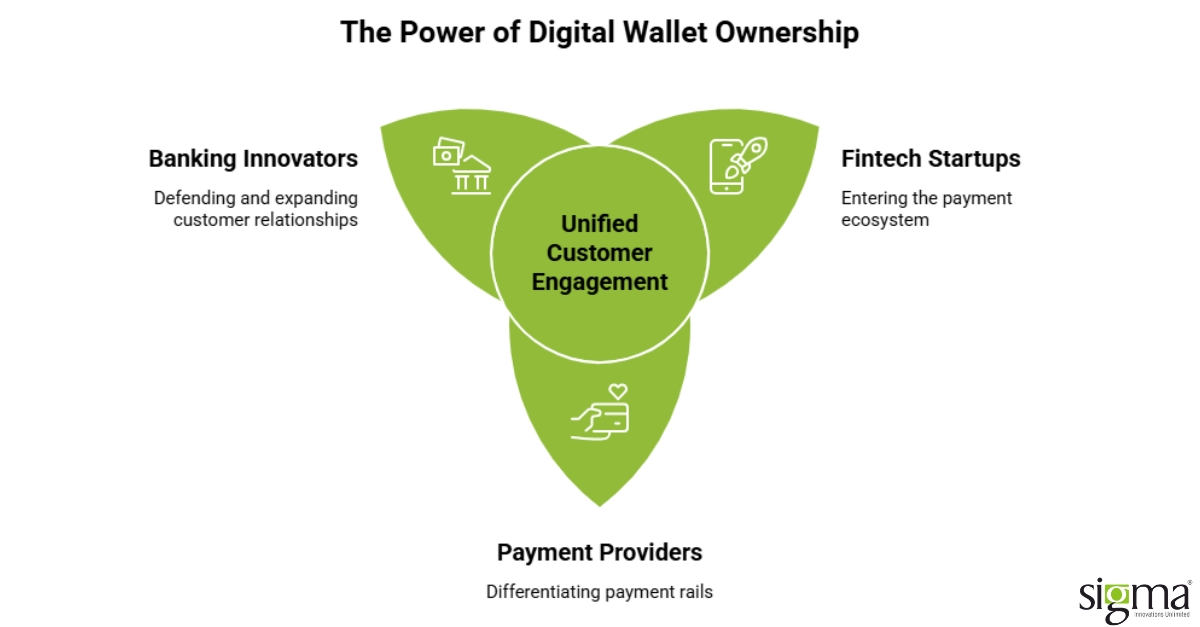
This expanded functionality reflects a broader shift in how consumers relate to financial services. The wallet is increasingly the primary interface through which users interact with their financial lives, making it a strategically valuable product for any organization that wants to build a lasting relationship with its customer base. Payment providers that own the wallet own the customer relationship, the transaction data, and the distribution channel for future financial products.
For banking innovators, the digital wallet represents an opportunity to defend and expand customer relationships that are under threat from fintech disruptors. For fintech startups, it represents an entry point into the payment ecosystem that can generate transaction revenue, data assets, and cross-sell opportunities. For payment providers, it is the product layer that differentiates a commodity payment rail from a branded, loyalty-generating consumer experience.
Core Technical Components of Digital Wallet Development
Building a digital wallet platform that performs reliably, scales efficiently, and earns user trust requires careful attention to each layer of the technical stack. The following components represent the foundational building blocks of a modern e-wallet architecture.
Payment Processing and Integration Layer
At the heart of every digital wallet is a payment processing engine that connects the wallet to the broader payment ecosystem. This layer manages the communication between the wallet application, card networks, bank accounts, payment gateways, and merchant acceptance systems that together enable value to move between parties.
A robust payment integration architecture supports multiple funding sources including debit cards, credit cards, bank account transfers via ACH or open banking rails, and cryptocurrency in markets where regulatory frameworks permit it. It also supports multiple payment output methods, enabling users to pay merchants via QR code, NFC-based contactless payment, in-app purchase flows, and peer-to-peer transfer.
The engineering challenge is not simply connecting to individual payment rails but building an abstraction layer that manages these connections consistently, handles failures gracefully, and presents a unified experience to the user regardless of which underlying payment method is being used for a given transaction.
Authentication and Identity Security
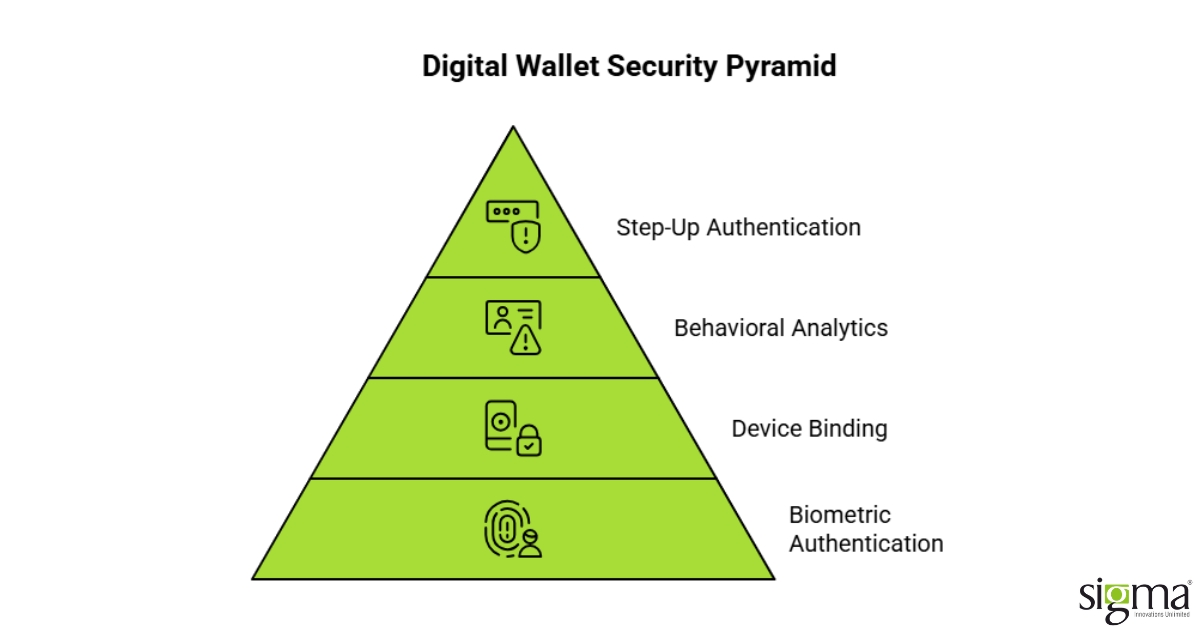
Secure payments depend on a robust authentication architecture that verifies user identity at login, at transaction initiation, and at any point where sensitive account actions are requested. In 2026, best-practice digital wallet authentication combines multiple verification factors to create a layered security model that is resistant to credential theft and account takeover attacks.
Biometric authentication using fingerprint recognition or facial recognition provides a user experience that is both highly secure and frictionless for the end user. Device binding ensures that wallet access is tied to a specific trusted device, reducing the risk that stolen credentials can be used to access the wallet from an unrecognized device. Behavioral analytics monitor transaction patterns and flag anomalies that may indicate account compromise even when authentication credentials are valid.
For transactions above defined value thresholds or involving new payees, step-up authentication requires the user to complete an additional verification challenge, adding a targeted layer of friction precisely where the risk of fraud is highest without degrading the experience for routine low-value transactions.
Contactless Payment and NFC Integration
Contactless payment capability is a defining feature of competitive digital wallet products in 2026. Near-field communication technology enables wallet users to make payments at point-of-sale terminals by tapping their smartphone against a payment reader, delivering the speed and convenience that has driven contactless adoption across retail, transit, and hospitality environments.
Implementing NFC-based contactless payment in a digital wallet requires integration with the Host Card Emulation framework on Android devices and compliance with the specific technical and certification requirements of the card networks whose payment credentials are being emulated. This is a technically demanding integration that requires deep expertise in payment security standards and mobile platform architecture.
Beyond NFC, QR code-based payment provides a contactless payment alternative that works across a broader range of merchant acceptance environments without requiring NFC-capable hardware. A well-engineered digital wallet supports both modalities, ensuring that users can make contactless payments regardless of the merchant’s terminal configuration.
Tokenization and Payment Security
Payment tokenization is the security mechanism that protects sensitive payment credentials by replacing them with a non-sensitive token that can be used for transaction processing without exposing the underlying card or account number. Tokenization is a foundational requirement for PCI DSS compliance and is the technology that makes it possible for digital wallets to store and use payment credentials without creating unacceptable security risk.
Modern tokenization architectures use network tokens issued by card networks, which provide additional security benefits including dynamic cryptogram generation for each transaction and the ability to update token credentials automatically when underlying card details change due to renewal or replacement. For digital wallet developers, implementing network tokenization correctly requires close coordination with payment network certification programs and a deep understanding of the token requestor registration process.
Compliance and Regulatory Architecture
Digital wallet platforms operate at the intersection of financial regulation, data privacy law, and consumer protection requirements that vary significantly across jurisdictions. A compliance-ready architecture anticipates these requirements and builds the technical controls, audit logging, and reporting capabilities needed to demonstrate compliance to regulators from the outset.
Key compliance considerations for digital wallet development include Anti-Money Laundering transaction monitoring that flags suspicious activity patterns for review, Know Your Customer identity verification requirements that apply at account opening and at defined transaction volume thresholds, Payment Card Industry Data Security Standard compliance for platforms that store or process card data, and data residency requirements that govern where user financial data can be stored and processed in markets with strict data sovereignty rules.
Organizations that treat compliance as a bolt-on concern rather than an architectural foundation consistently face costly remediation efforts when regulatory requirements crystallize. Building compliance controls into the wallet architecture from the beginning is both more effective and more economical than retrofitting them after launch.
Read the blog: Improving your website with Google Analytics
User Experience Design for Digital Wallet Adoption
Technical excellence is necessary but not sufficient for digital wallet success. The user experience layer is what determines whether users adopt the wallet, integrate it into their daily payment habits, and recommend it to others.
Onboarding and Account Activation
The wallet onboarding experience sets the tone for the entire user relationship. An onboarding flow that is too long, requires too much information upfront, or presents identity verification as an obstacle rather than a value-adding step will generate high abandonment rates before users ever experience the wallet’s core functionality.
Best-practice wallet onboarding applies progressive disclosure, collecting only the information required to activate a basic account at the outset and requesting additional verification as the user’s transaction activity increases. This approach balances compliance requirements with conversion optimization, allowing users to experience the wallet’s value before they are asked to complete the most demanding verification steps.
Transaction History and Financial Visibility
Users who engage regularly with their transaction history and spending summaries are more likely to consider the wallet their primary payment instrument and less likely to churn to competing products. A well-designed transaction interface provides clear, categorized transaction records, real-time push notifications for payment events, and summary views that give users meaningful insight into their spending patterns.
These features also serve a security function, enabling users to identify unauthorized transactions quickly and report them before losses accumulate. Combining financial visibility with easy dispute initiation creates a user experience that builds confidence and trust in the platform over time.
How Sigma Infosolutions Builds Secure Digital Wallet Platforms
Sigma Infosolutions brings specialized product engineering expertise to digital wallet development, helping fintech startups, payment providers, and banking innovators design, build, and launch e-wallet platforms that combine technical robustness with exceptional user experience. Sigma’s team covers the full development lifecycle from architecture design through compliance integration, security implementation, and post-launch optimization.
Discovery and Product Architecture
Sigma begins every digital wallet engagement by working with the client’s product and technology leadership to define the wallet’s target use cases, supported payment rails, compliance requirements, and scalability objectives. This discovery phase produces a detailed technical architecture that serves as the blueprint for all subsequent development work.
Payment Integration and Processing Engine
Sigma’s payment engineering team builds the integration layer that connects the wallet to card networks, bank transfer rails, payment gateways, and merchant acceptance systems. Integrations are designed for resilience, with redundant routing, automatic failover, and real-time monitoring that ensures transaction reliability even when individual payment rails experience service disruptions.
Authentication and Security Implementation
Sigma implements multi-factor authentication architectures, biometric verification integrations, and behavioral analytics systems that protect wallet users against account takeover and transaction fraud without creating unnecessary friction in the payment experience. Security implementations are validated against industry standards and penetration tested before deployment.
eKYC and Compliance Integration
Sigma integrates automated KYC verification, AML transaction monitoring, and regulatory reporting capabilities into the wallet platform, building the compliance infrastructure that allows clients to operate confidently in regulated payment markets. Compliance architectures are designed to accommodate regulatory requirements across multiple jurisdictions for clients with international growth ambitions.
Contactless Payment and NFC Engineering
Sigma’s mobile engineering team implements NFC-based contactless payment capabilities and QR code payment flows that meet card network certification requirements and deliver a reliable, low-latency payment experience across Android and iOS platforms.
Ongoing Support and Platform Evolution
After launch, Sigma provides continuous platform support, security monitoring, and feature development to help clients expand their wallet’s capabilities as user adoption grows and market requirements evolve.
Conclusion
Digital wallet development in 2026 demands a level of engineering precision, security expertise, and compliance readiness that goes far beyond standard mobile application development. The platforms that earn user trust and achieve sustained adoption are those that get the fundamentals right: secure payments, frictionless user experience, robust contactless payment capabilities, and a compliance architecture that scales with the business.
For fintech startups entering the payment market, payment providers modernizing their product offering, and banking innovators building next-generation customer experiences, the digital wallet is both an immediate product opportunity and a long-term strategic asset. The key to realizing that value is partnering with an engineering team that understands the full complexity of the payment ecosystem and has the expertise to navigate it effectively.
Sigma Infosolutions is the product engineering partner that payment innovators trust to build digital wallet platforms that are seamless for users, secure by design, and ready to scale. With deep expertise in payment integration, authentication architecture, eKYC compliance, and mobile engineering, Sigma delivers e-wallet solutions that meet the demands of modern financial technology markets. Contact Sigma Infosolutions today or explore our Digital Payment Solutions to begin building the secure payment experience your users and your business deserve.
FAQs
What is digital wallet development?
Digital wallet development involves designing and engineering secure mobile or web-based payment applications that allow users to store payment methods, transfer funds, make purchases, manage transactions, and access financial services digitally.
Why are digital wallets important for fintech companies?
Digital wallets have become a primary channel for digital payments, customer engagement, and financial service delivery. Fintech companies use e-wallet platforms to improve customer retention, enable seamless payments, generate transaction revenue, and expand digital financial ecosystems.
What features are essential in a modern digital wallet platform?
Modern digital wallet platforms typically include secure payment processing, biometric authentication, contactless NFC payments, QR code payments, peer-to-peer transfers, transaction history, multi-currency support, fraud detection, and compliance-ready KYC capabilities.
How does digital wallet security work?
Digital wallet security relies on layered protection mechanisms such as tokenization, encryption, biometric authentication, multi-factor authentication, device binding, behavioral analytics, and fraud monitoring to secure user accounts and payment transactions.
What is payment tokenization in digital wallets?
Payment tokenization replaces sensitive card or bank account details with secure digital tokens during transactions. This reduces the exposure of payment credentials and strengthens PCI DSS compliance and transaction security.
What is NFC technology in digital wallet applications?
Near-field communication (NFC) technology enables users to make contactless payments by tapping their smartphone or wearable device on compatible payment terminals. NFC powers fast and convenient in-store payment experiences.
How do digital wallets support contactless payments?
Digital wallets support contactless payments through NFC integrations, QR code payments, and mobile payment APIs that allow users to complete transactions securely without using physical cards or cash.
Why is eKYC important in digital wallet development?
Electronic Know Your Customer (eKYC) processes help digital wallet providers verify user identities, reduce fraud risk, meet regulatory compliance requirements, and support secure account creation and transaction monitoring.
What compliance requirements apply to digital wallet platforms?
Digital wallet platforms must often comply with regulations such as PCI DSS, AML (Anti-Money Laundering), KYC requirements, data privacy laws, transaction monitoring obligations, and regional financial regulations depending on operating markets.
What challenges do organizations face when building digital wallets?
Organizations commonly face challenges related to payment integration complexity, security implementation, regulatory compliance, scalability, fraud prevention, cross-platform mobile engineering, and maintaining seamless user experiences.
How do digital wallets improve customer experience?
Digital wallets improve customer experience by enabling faster payments, simplified checkout, real-time transaction tracking, easy fund transfers, mobile-first convenience, and frictionless authentication using biometrics or saved credentials.
What is the role of biometric authentication in digital wallets?
Biometric authentication uses fingerprint scanning or facial recognition to verify user identity securely and quickly. It strengthens account security while reducing friction during login and payment authorization.
Can digital wallet platforms scale globally?
Yes. Modern digital wallet platforms can support global expansion through multi-currency capabilities, regional payment integrations, localization support, compliance-ready architectures, and scalable cloud-native infrastructure.
How does Sigma Infosolutions support digital wallet development?
Sigma Infosolutions engineers secure digital wallet solutions with payment gateway integration, NFC payment capabilities, authentication systems, eKYC compliance workflows, fraud prevention architecture, and scalable fintech software development services for payment providers, fintech startups, and banking innovators.