BNPL Platform Development: What Fintech Companies Need to Know
Key Highlights
- Most fintech founders and CTOs building a buy now, pay later product seriously underestimate the engineering depth and compliance scope a production-ready BNPL platform demands before it can go live.
- A viable BNPL platform requires a modular architecture covering loan origination, real-time underwriting, repayment scheduling, payment gateway integration, KYC compliance, and embedded lending at the merchant level.
- Sigma Infosolutions delivers end-to-end BNPL platform development for fintech startups and digital lending companies, combining deep fintech engineering experience with proven compliance integration across US, Australian, and Canadian markets.
Introduction
Buy Now, Pay Later has moved well past trend status. For fintech startups, embedded finance companies, and digital lenders in the US, Canada, and ANZ markets, BNPL platform development is one of the most actively pursued product initiatives right now. Consumer appetite is real. Merchant demand is strong. And the installment payments market still has enough room that a well-built product can carve out serious ground.
The problem is that BNPL looks deceptively simple. A lot of founders and CTOs assume the hard part is a payment integration and a basic repayment schedule. It is not. A platform that can survive regulatory scrutiny, handle real transaction volume, and hold up under fraud pressure requires a loan origination pipeline, a real-time underwriting engine, multi-jurisdiction compliance logic, and an architecture that does not buckle when user counts climb.
Teams that skip those requirements pay for it later. Retrofitting compliance and architecture into a platform not designed for them is expensive, slow, and usually forces a near-complete rebuild at exactly the moment the business is trying to scale.
Building a BNPL platform requires expertise across lending, payments, compliance, and cloud-native architecture.
How BNPL Actually Works: The Product and Technical Reality
On the surface, the BNPL flow looks clean. A shopper selects installments at checkout, gets a credit decision in seconds, and repays on a schedule. Simple, fast, low friction.
Behind that experience, the platform has to evaluate credit risk in real time, coordinate with payment processors and credit bureaus, manage repayment schedules across thousands of concurrent accounts, handle failed payments without creating bad debt exposure, and do all of it without hurting checkout conversion.
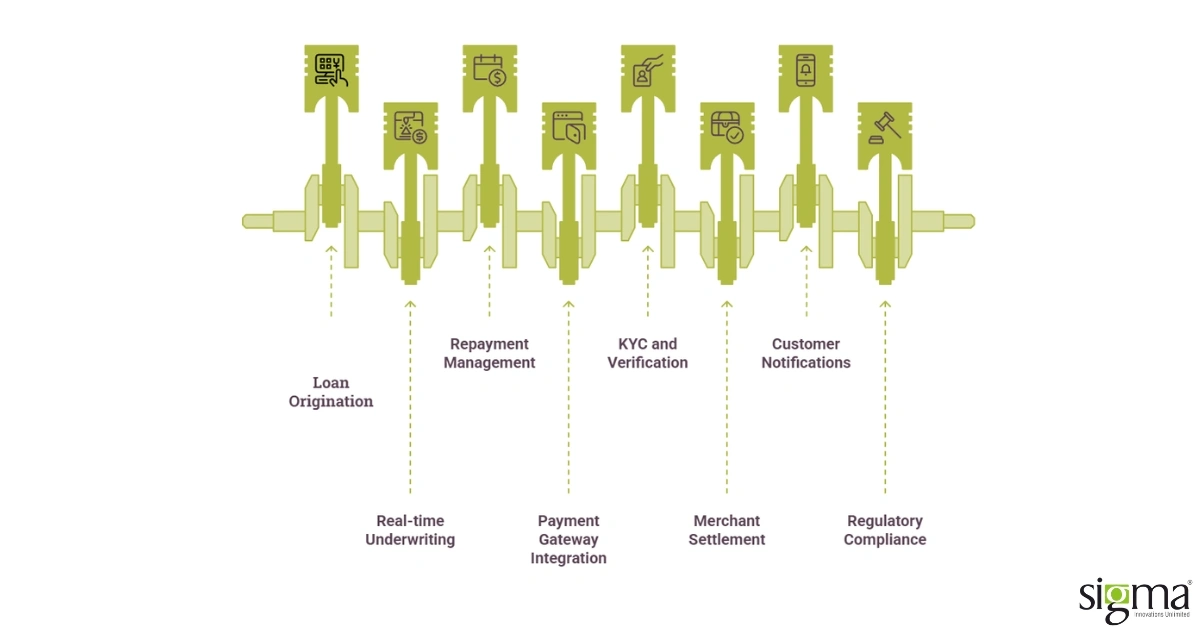
The core components that make this work include:
- Loan origination and application processing
- Real-time underwriting and credit risk scoring
- Repayment scheduling and installment management
- Payment gateway integration for collections
- KYC and identity verification workflows
- Merchant settlement and reconciliation
- Customer notifications and communications
- Regulatory compliance and audit logging
Each of these is a meaningful engineering effort on its own. Together, they define the full scope of what building a production-grade BNPL platform actually requires.
Looking to modernize origination, underwriting, servicing, and collections?
BNPL Platform Architecture: Decisions That Have a Long Tail
Architecture choices made early in a BNPL build shape what the platform can do years later. How services communicate, how the underwriting engine handles spikes, and how repayment data is stored are not decisions you want to revisit after launch.
Microservices and Event-Driven Design
Most production BNPL platforms run on a microservices model for a practical reason: different parts of the system carry very different load profiles. The underwriting service spikes at checkout. The repayment engine runs on a daily schedule. Keeping them separate, connected through an event-driven layer, means you scale what needs scaling without touching what does not.
The Underwriting Engine
The underwriting component carries the most technical difficulty. It has to return a credit decision fast enough that a shopper does not notice the wait, which means pulling bureau data, running fraud signals, and applying scoring logic in milliseconds. Most platforms integrate a third-party credit risk API at launch and build proprietary models once transaction history accumulates. Managing edge cases like thin-file applicants and high-velocity fraud patterns without degrading approval speed is a genuine engineering challenge.
Loan Origination System
The loan origination system manages every BNPL agreement from application through disbursement and into repayment. It connects to KYC providers, payment processors, and agreement generation workflows and must produce jurisdiction-compliant documentation based on the customer’s market.
Repayment Scheduling and Collections
The repayment layer handles installment due dates, runs automatic payment collection, manages retry logic for failed transactions, and routes delinquent accounts into a collections workflow when needed. It also has to handle early repayments, partial payments, and refunds tied to merchant returns. These sound like edge cases until you are reconciling them at scale.
Embedded Lending and Merchant Integration
The embedded lending experience at checkout is often where BNPL products win or lose merchant relationships. Integration options include a hosted checkout widget, a JavaScript SDK for custom checkout flows, and REST APIs for deep POS integration. Each path carries its own onboarding and compliance documentation requirements.
BNPL Compliance: Where Most Platforms Get Into Trouble
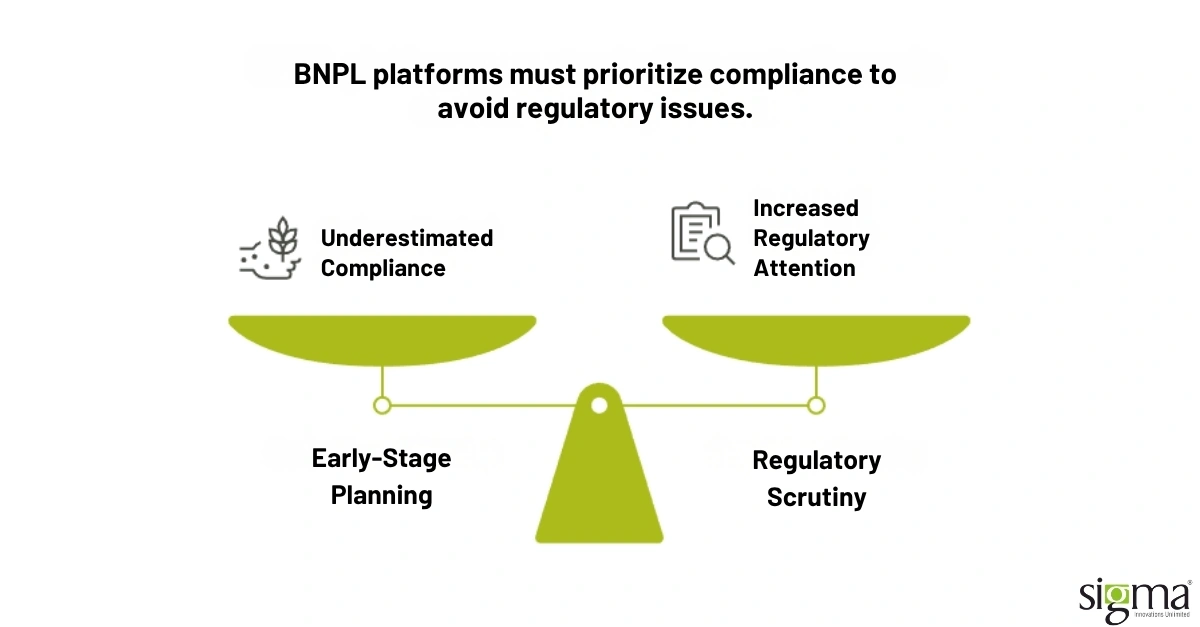
Compliance is the part of BNPL development that early-stage product planning consistently underestimates. Regulators in the US, UK, Australia, and the EU are paying increasing attention to buy now, pay later products, and the days of treating BNPL as outside the consumer credit regulatory perimeter are effectively over.
KYC and Identity Verification
KYC requirements apply at the point of application. The platform needs to verify identity using government-issued documentation, run sanctions screening, and apply fraud detection logic, all within a workflow fast enough that it does not destroy checkout conversion. That balance is harder to get right than most teams expect.
Consumer Lending Regulations
In the US, BNPL products may fall under the Truth in Lending Act depending on product structure, alongside state-level lending license requirements and evolving CFPB guidance. In Australia, ASIC has moved to bring BNPL under the National Consumer Credit Protection Act, introducing responsible lending obligations that need to be built into affordability assessment workflows. In other markets, similar shifts are underway. Compliance logic needs to live inside the platform architecture, not be patched in afterward.
Data Privacy and Security
BNPL platforms handle sensitive financial and personal data, triggering obligations under GDPR, CCPA, the Australian Privacy Act, and PCI DSS depending on the markets you operate in. Encryption standards, access controls, and data handling practices need to be in the architecture from the start, not bolted on once a regulator asks about them.
Audit Logging
Regulators expect platforms to fully reconstruct credit decisions, borrower communications, and repayment activity when asked. Audit logging infrastructure is not a nice-to-have. Platforms that come under review without it face remediation costs and timeline risk that dwarf the original build investment.
Reduce compliance overhead with automated KYC, AML monitoring, sanctions screening, and audit-ready regulatory workflows.
Build vs. Buy: How Growth-Stage Fintech Companies Approach It
The build versus buy question surfaces early in almost every BNPL product conversation. Off-the-shelf BNPL-as-a-service platforms offer faster time to market but limit product differentiation, lock in transaction fee structures that hurt margins at volume, and restrict how you can configure risk models or lending terms.
Building from scratch gives full product control but demands real fintech engineering depth and a realistic timeline, typically six to eighteen months for a production-grade platform, depending on scope and compliance requirements.
For growth-stage companies planning to operate at meaningful volume, the right answer is usually a hybrid. Build the core platform where differentiation lives and integrate proven third-party providers for commodity functions like bureau access, KYC verification, and payment processing. You get product control without rebuilding infrastructure that already exists.
Engaging a fintech engineering partner compresses this timeline significantly. Teams that have built BNPL platforms before have worked through the architecture trade-offs, hit the compliance integration edge cases, and know which early decisions are hard to reverse. For a founder or CTO at a 20 to 50 person company, that experience is genuinely high-leverage.
How Sigma Infosolutions Helps Build Compliant BNPL Platforms
Sigma Infosolutions works with fintech startups and digital lending companies across the US, Canada, and Australia to design, build, and launch BNPL platforms built for production scale and regulatory compliance. Sigma works well with venture-backed and growth-stage teams that need a long-term engineering partner, not a one-time vendor.
Discovery and Strategy
Every engagement starts with a structured discovery phase. Sigma maps product requirements to architecture decisions, identifies regulatory obligations by market, and establishes integration priorities before code is written. The output is a technical blueprint that surfaces risk factors before they become expensive mid-build problems.
Solution Architecture
Sigma’s architects design platforms for scalability and compliance from day one. Stack selection is driven by target market, transaction volume, and product roadmap, with a preference for microservices and event-driven patterns.
Agile Development
Development runs on short sprints with continuous integration and regular product reviews. Sigma builds the loan origination system, underwriting engine, repayment scheduler, and merchant integration layer on parallel tracks to compress timelines without sacrificing compliance coverage.
KYC and Compliance Integration
Sigma integrates KYC providers, credit bureaus, and sanctions screening services into the platform workflow. Compliance logic, disclosure generation, and audit logging are built in from the start, covering US, Australian, and Canadian regulatory requirements.
Payment Gateway Integration and Collections
Sigma connects platforms to leading payment gateways and ACH processors, covering the full repayment workflow, including retry logic, failed payment handling, and refund reconciliation. Merchant settlement systems are built for high transaction volumes.
Quality Assurance and Deployment
Every platform Sigma delivers is tested for functional correctness, load performance, and security before go-live. Sigma supports cloud deployment across AWS, Azure, and GCP using infrastructure-as-code and remains engaged post-launch as the product grows.
Conclusion
BNPL platform development is one of the more demanding product engineering challenges in fintech right now. The teams that do it well invest early in loan origination, real-time credit risk assessment, KYC compliance, and resilient payment infrastructure, and they bring in partners who have done it before. Those teams move faster, avoid expensive early decisions, and ship products that hold up under regulatory review.
The companies that struggled underestimated the compliance surface, made architecture choices that did not scale, or tried to build in-house without the fintech depth required.
Sigma Infosolutions brings the fintech engineering experience and compliance integration capability to help growth-stage companies build BNPL platforms that are production-ready from day one. Whether you are starting from scratch, extending a partial build, or modernizing an existing digital lending product, Sigma offers the technical depth and long-term partnership model to get your product to market on a timeline that makes business sense.
Building a BNPL platform is only one part of a larger financial technology strategy. Sigma’s Financial Software Development Services combine fintech domain expertise, scalable architecture, compliance-focused engineering, and modern cloud technologies to accelerate product delivery across lending, payments, banking, and embedded finance.
FAQs
1. What is BNPL platform development?
BNPL platform development involves creating software that enables customers to pay for purchases in installments. It includes lending workflows, underwriting, payments, compliance, and merchant integrations.
2. What are the key components of a BNPL platform?
Core components include loan origination, underwriting, repayment scheduling, payment gateway integration, KYC verification, and compliance management.
3. How long does it take to build a BNPL platform?
Developing a production-ready BNPL platform typically takes between 6 and 18 months, depending on features, integrations, and regulatory requirements.
4. Why is compliance important for BNPL platforms?
BNPL providers must comply with lending regulations, KYC requirements, data privacy laws, and security standards to reduce legal and operational risks.
5. Should fintech companies build or buy a BNPL solution?
Many companies adopt a hybrid approach—building core capabilities while using third-party providers for payments, KYC, and credit bureau integrations.
6. What architecture is best for BNPL platforms?
Microservices and event-driven architectures are commonly used because they provide scalability, flexibility, and support for high transaction volumes.
7. How does a BNPL underwriting engine work?
The underwriting engine analyzes credit data, fraud signals, and lending rules in real time to deliver fast approval decisions during checkout.
8. Why partner with a fintech engineering company for BNPL development?
Experienced fintech partners help accelerate development, address compliance requirements, and build scalable platforms that support long-term growth.