How KYB Automation Cuts Merchant Onboarding Delays for Fintech Platforms

Key Highlights
- Manual document review, disconnected registry checks, and back-and-forth email chains stretch merchant activation from days into weeks, stalling revenue for fintech and payment platforms.
- KYB automation consolidates business verification, UBO identification, and AML screening into a single digital workflow, reducing onboarding time while producing an audit trail regulators can follow.
- Platforms that stick with manual KYB processes lose merchants to faster competitors, accumulate compliance gaps that surface during audits, and burn operations headcount on work that should be handled by software.
- The US identity verification market, which includes business verification and KYB, is projected to grow from USD 4.34 billion to USD 8.16 billion by 2030, reflecting the aggressive investment by regulated industries in automated onboarding infrastructure.
Introduction
The rapid growth of digital financial services is reshaping how regulated businesses onboard merchants. The US identity verification market, which includes business verification and Know Your Business (KYB), is projected to grow from USD 4.34 billion to USD 8.16 billion by 2030, reflecting the increasing investment in automated onboarding infrastructure by fintechs, lenders, payment providers, and other regulated industries. This shift underscores the growing importance of robust financial software development services that can orchestrate verification workflows, integrate third-party compliance providers, and deliver secure, scalable merchant onboarding experiences.
If you run a fintech platform, a payment facilitator, or a digital lending operation that onboards business customers, you already know what the bottleneck looks like. A merchant submits an application. Your compliance team opens the documents. Somebody pulls up a Secretary of State website in one tab, a sanctions list in another, and a spreadsheet to track where things stand in a third.
Three days later, the merchant is still waiting for activation, your operations team is buried in follow-up emails requesting missing documents, and the merchant is quietly evaluating your competitor that promises same-day approval. This is the KYB automation problem, and it is costing growth-stage fintech platforms more than most founders realize.
The friction is not just operational. Every day a legitimate merchant waits for activation is a day of transaction volume your platform does not capture. For organizations processing payments, issuing credit, or enabling embedded finance, those delays quickly translate into lost revenue, higher operating costs, and increased compliance risk. Addressing these challenges requires more than standalone verification tools. It requires financial software development services that connect identity verification, registry validation, AML screening, and workflow automation into a unified, API-driven onboarding ecosystem.
This article explores where manual KYB processes break down, what automated merchant onboarding workflows look like in practice, and how modern financial software development enables secure, compliant third-party KYC integration without introducing new operational or regulatory risks.
What KYB Actually Requires (and Why Manual Processes Break)
Know Your Business verification is fundamentally more complex than consumer KYC. A consumer identity check verifies one person. A KYB check verifies a legal entity, its registration status, its ownership structure, the individuals who ultimately own or control it, and whether any of those parties appear on sanctions or politically exposed person lists.
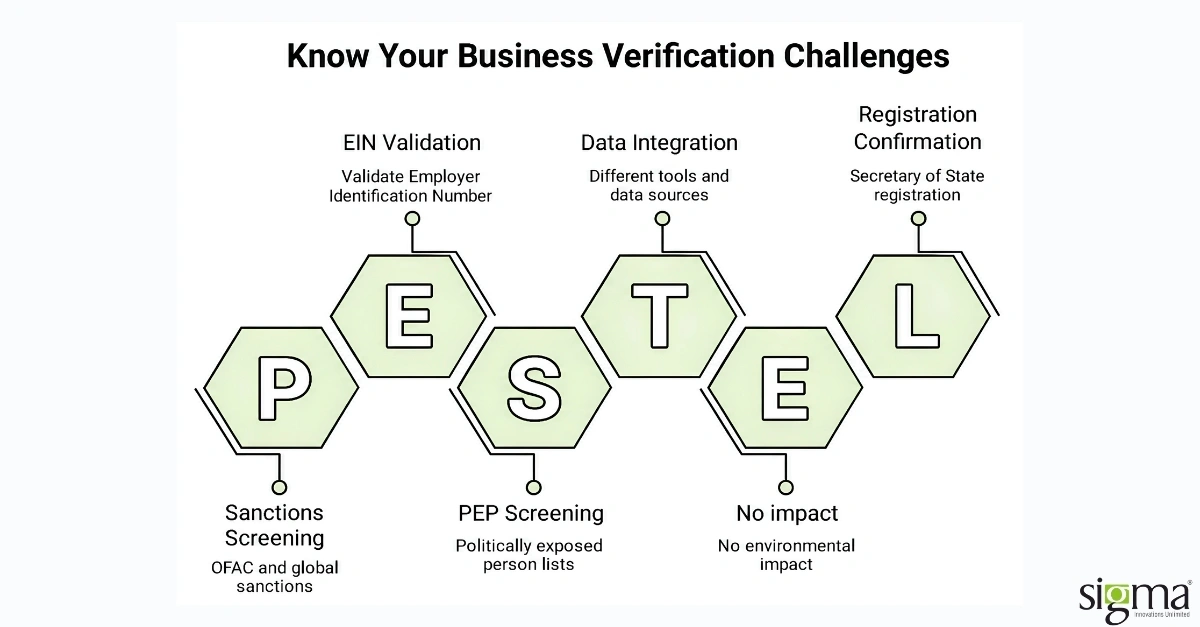
For a fintech platform onboarding merchants across multiple states or countries, that verification chain quickly turns into a manual research project. An analyst might need to confirm registration with the Secretary of State, validate the EIN, map the ownership structure to identify ultimate beneficial owners above the 25% threshold, verify each UBO’s identity, screen every entity and individual against OFAC and global sanctions databases, review the company’s website for risk signals, and document the reasoning behind the approval.
Done manually, each step involves a different tool, a different data source, and often a different team member. The result is predictable: inconsistent decisions, incomplete audit trails, and onboarding timelines that stretch from hours into weeks.
The Regulatory Pressure Is Getting Heavier, Not Lighter
The compliance burden on merchant onboarding has intensified in the last 18 months. In the US, FinCEN’s March 2025 interim final rule narrowed the Corporate Transparency Act’s beneficial ownership filing requirement to foreign reporting companies only. That sounds like a simplification, but the operational effect is the opposite: the centralized FinCEN database will not contain data on US-formed entities, so platforms still need to verify domestic UBO information through state registries and their own verification infrastructure.
Card networks are tightening requirements simultaneously. Visa’s Acquirer Monitoring Program (VAMP), launched in 2025, holds acquirers and payment facilitators directly accountable for the compliance performance of their merchant portfolios. Platforms with weak onboarding compliance face escalating fines and potential loss of processing privileges.
For growth-stage fintech platforms, these requirements create a clear resource problem. Merchant onboarding automation is the only way to grow the merchant base without growing the compliance team at the same rate.
Read the blog: Fraud Detection in Fintech Using Machine Learning: Approaches and Best Practices
What an Automated KYB Workflow Actually Looks Like
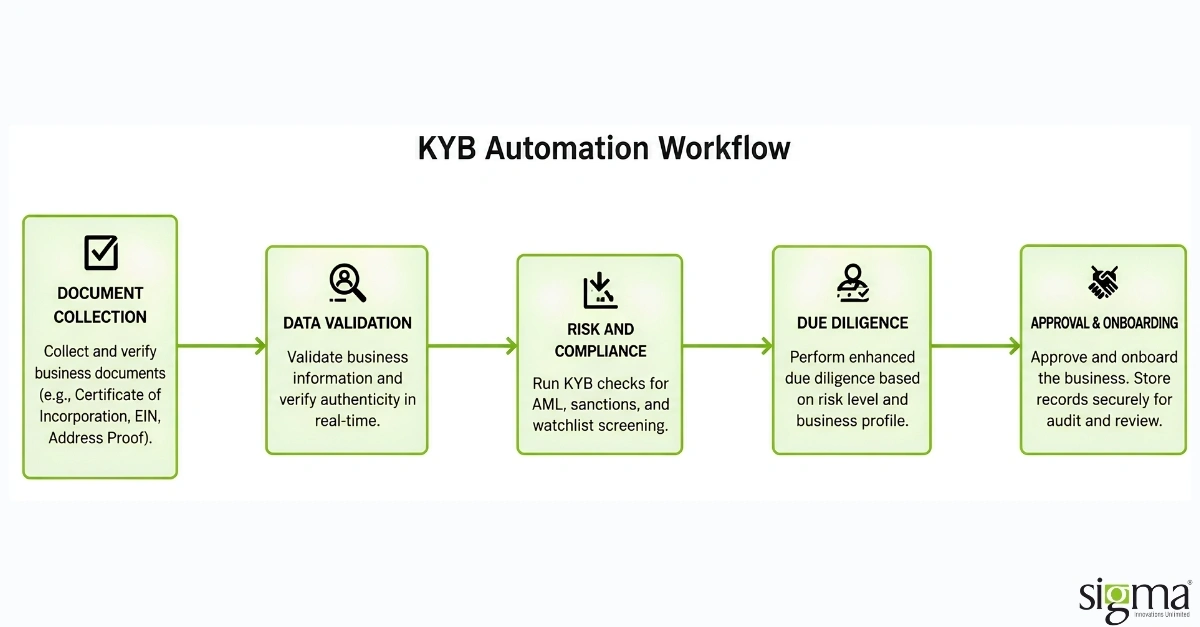
Effective KYB automation replaces disconnected manual steps with a single, sequential workflow that collects data, validates it, screens the relevant parties, and routes the application for decisioning. Here is what each layer handles:
Structured Data Collection: Instead of accepting unstructured email attachments, the application flow collects the company’s legal name, registration number, jurisdiction, business type, website, and contact details through adaptive forms that adjust required fields based on entity type and risk signals.
Registry Validation and Business Verification: The platform queries official registries (Secretary of State databases, IRS records, international company registries) to confirm that the entity exists, is in good standing, and matches the submitted details. This is the core of business KYC for commercial accounts.
UBO Identification and Ownership Mapping: Automated tools map the ownership structure, identify individuals above the 25% ownership threshold, and flag layered or complex structures (holding companies, trusts, nominee arrangements) that require deeper review.
Identity Verification of Key Individuals: Each UBO and authorized signatory goes through identity verification, typically combining document checks with biometric matching or database verification.
AML, Sanctions, and PEP Screening: Every entity and individual in the ownership chain is screened against OFAC, EU sanctions lists, PEP databases, and adverse media sources. Continuous monitoring re-screens at regular intervals after onboarding.
Risk-Based Decisioning: Applications are scored and routed based on risk. Low-risk merchants with clean registrations and straightforward ownership can be auto-approved. Medium-risk cases go to an analyst with all the verification data pre-assembled. High-risk cases are flagged for enhanced due diligence.
The following table compares manual versus automated KYB across the metrics that matter most to growth-stage fintech platforms:
| Metric | Manual KYB Process | Automated KYB Workflow |
| Average onboarding time | 3 to 10 business days | Under 24 hours for standard-risk merchants |
| Analyst time per application | 45 to 90 minutes | 5 to 15 minutes (review only, not research) |
| Audit trail completeness | Fragmented across email, spreadsheets, and notes | Centralized, timestamped, and reproducible |
| Decision consistency | Varies by analyst judgment | Standardized by rules and risk scoring |
| Scalability | Linear with headcount | Scales with transaction volume |
| Ongoing monitoring | Annual manual review (if remembered) | Continuous automated re-screening |
Where Third-Party KYC Integration Gets Complicated
Most fintech platforms do not build their own registry connections or sanctions databases. They integrate third-party providers for each capability. The challenge is making those integrations work as a single onboarding experience rather than a patchwork of disconnected API calls.
A typical third party KYC integration stack might include a registry data provider for business verification, a separate identity verification provider for UBO checks, an AML screening service, and a document verification tool. If each provider operates through its own dashboard and API conventions, the integration effort multiplies and the resulting workflow has gaps where data does not flow cleanly between steps.
The platforms that get this right treat integration as an architecture decision. They define a unified data model for the onboarding workflow, normalize outputs from each provider into that model, and build orchestration logic that determines which providers to call based on the merchant’s jurisdiction, entity type, and risk profile. That orchestration layer is where most of the engineering complexity sits, and it is the piece that distinguishes a fast onboarding experience from a duct-taped collection of vendor calls.
Unify third-party verification providers with API-driven integration architecture that streamlines onboarding, eliminates data silos, and scales with your fintech platform.
Avoiding the Two Most Common Implementation Mistakes
Mistake 1: Automating the happy path and ignoring exceptions. Most KYB automation projects start by solving the easy cases: single-owner LLCs with clean registrations. That is the right starting point, but teams that stop there end up with a system that auto-approves 60% of applications and routes the other 40% into a manual black hole. Plan exception handling from the beginning. Define what happens when an ownership structure has three layers or when a registry returns stale data.
Mistake 2: Treating compliance as a one-time gate. Onboarding verification is the starting point, not the finish line. Ownership changes, registration lapses, and new sanctions designations all need to be caught after initial approval. Platforms that build onboarding automation without continuous monitoring end up with a clean front door and an unmaintained portfolio, which is exactly the pattern that VAMP is designed to penalize.
Read our success story: Streamlining Lending Operations with Intelligent Cheque Data Processing
How Sigma Infosolutions Approaches KYB Workflow Engineering
Sigma does not sell a KYB product. Sigma builds the onboarding workflow layer that sits between your platform and the verification providers you need to connect.
That distinction matters because most growth-stage fintech platforms already know which registry data provider, AML screening service, and identity verification tool they want to use. What they lack is the engineering to make those providers work as a single orchestrated workflow. That is the work Sigma does.
For a payment facilitator onboarding sub-merchants across 12 US states, the work might focus on building a unified API layer that normalizes data from three different state registry formats, routes UBO verification through one provider and sanctions screening through another, and assembles a compliance packet that satisfies card network requirements. The merchant sees a single application flow. The compliance team sees a pre-assembled case with all verification results in one place.
For a digital lending platform expanding into merchant cash advances, KYB requirements overlap with credit underwriting data needs. Sigma architects the data flow so that a single onboarding interaction serves both the compliance decision and the credit decision without duplicating collection steps.
The team builds inside your stack, using your API infrastructure and compliance requirements as design constraints. The result is an onboarding workflow you own and control.
Automate regulatory workflows with AI-driven RegTech solutions that streamline compliance, reduce manual reviews, and strengthen audit readiness across your financial platform.
Conclusion
Manual KYB is not just slow. It is a growth ceiling. Every week your platform spends chasing documents, re-keying data between tools, and manually screening beneficial owners is a week where legitimate merchants are waiting for activation and transaction volume is sitting on the table. KYB automation eliminates that ceiling by turning disconnected compliance steps into a single, auditable workflow that scales with your merchant volume instead of scaling with your headcount. The regulatory direction is unmistakable: verification requirements are getting stricter, card network accountability is increasing, and the platforms that invest in merchant onboarding automation now will have a structural advantage over those that wait. Sigma Infosolutions helps growth-stage fintech platforms build that advantage, not by selling a product, but by engineering the onboarding workflow layer that connects your platform, your compliance requirements, and your verification providers into one system that works.
Modernize digital lending with scalable solutions that automate onboarding, streamline decisioning, and connect every stage of the lending lifecycle.
Frequently Asked Questions
What is KYB automation and how does it differ from KYC?
KYB automation streamlines the verification of business entities, including registry checks, ownership mapping, UBO identification, and AML screening. KYC focuses on verifying individual consumers. KYB is inherently more complex because it requires validating a legal entity, its ownership structure, and the identities of the individuals who control it, all within a single workflow.
Why is merchant onboarding automation critical for fintech platforms?
Merchant onboarding automation removes the manual bottlenecks that stretch activation timelines from days into weeks. For fintech platforms processing payments or issuing credit, every day a merchant waits is lost transaction volume. Automation also ensures consistent compliance decisions and produces audit trails that hold up under regulatory review.
How does third party KYC integration work in an automated KYB workflow?
Third party KYC integration connects specialized verification providers (registry data, identity verification, AML screening, document extraction) into a single orchestrated workflow via APIs. The platform defines which providers to call, in which order, and how their outputs feed into the risk-based decisioning engine that approves or escalates each application.
What are the biggest compliance risks in manual merchant onboarding?
Manual processes create fragmented audit trails, inconsistent decision-making across analysts, and gaps in ongoing monitoring. These weaknesses become visible during regulatory audits or card network reviews. Platforms operating under VAMP or similar monitoring programs face escalating penalties when onboarding compliance gaps result in fraud or dispute rate violations.
How does Sigma Infosolutions help fintech platforms automate KYB?
Sigma engineers the onboarding workflow layer that connects a platform’s existing stack with its chosen verification providers. This includes building unified API orchestration for business KYC checks, normalizing data from multiple registry and screening sources, and designing risk-based routing that auto-approves clean applications while escalating complex cases with pre-assembled evidence for analyst review.