6 Key FinTech Trends in 2026 That Are Reshaping Financial Services
Key Highlights
- Sigma Infosolutions helps financial institutions adopt automated, data-driven lending workflows aligned with modern fintech trends, eliminating the need to build and maintain costly proprietary systems.
- Institutions that modernize their digital infrastructure reduce operational costs significantly and improve customer acquisition through faster, more accurate credit decisioning.
- Financial services firms that delay adopting modern technology frameworks risk losing market share to agile alternative lenders and neobanks operating at lower cost structures.
- The global corporate lending platform market is projected to reach approximately $11 billion by 2030, growing at a CAGR of 24.5% from 2024.
Why Financial Institutions Must Track FinTech Trends in 2026
The financial services industry is experiencing a period of structural change driven by regulatory pressure, shifting customer expectations, and the accelerating pace of financial technology adoption. Institutions that rely on legacy infrastructure are increasingly exposed to efficiency gaps that affect both profitability and compliance. Understanding the dominant fintech trends of 2026 is no longer a strategic exercise; it is an operational necessity.
Digital banking has moved beyond mobile-first interfaces into fully automated service models. Peer-to-peer lending platforms, robo-advisors, and embedded finance products are now standard offerings from both established banks and challenger institutions. The organizations that will lead over the next decade are those building infrastructure today that supports these capabilities at scale.
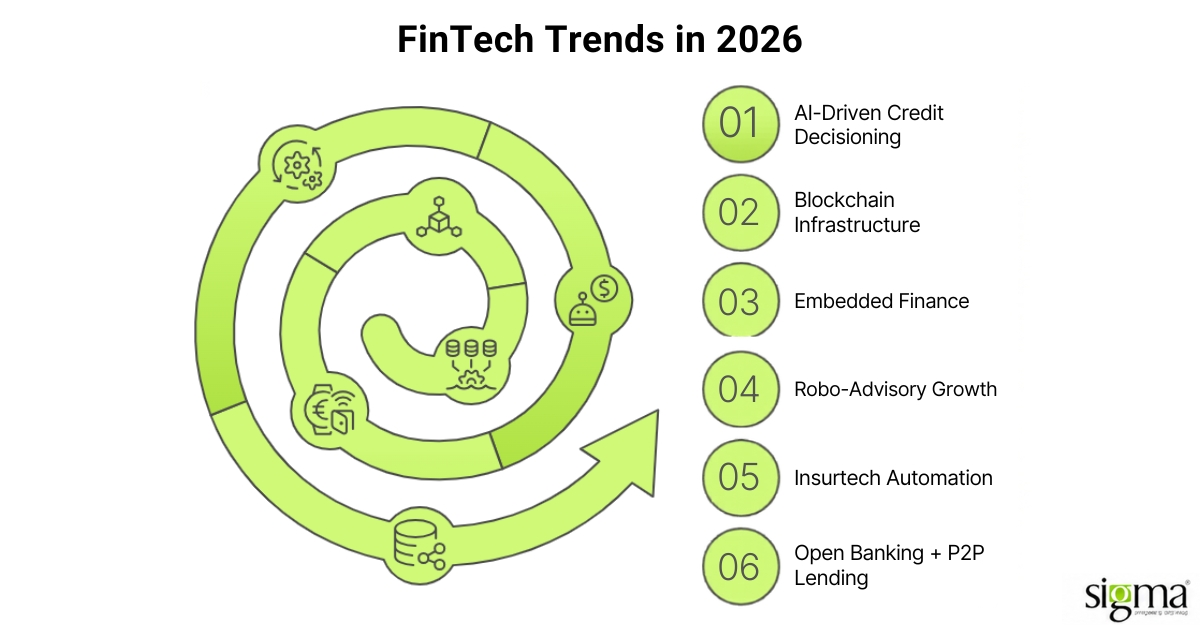
Trend 1: AI-Driven Credit Decisioning Is Replacing Manual Underwriting
Automated underwriting powered by machine learning has become a standard expectation in digital lending. Lenders using AI-based systems are reporting faster approval cycles and measurable reductions in default rates due to more granular risk modeling. Manual underwriting workflows, by contrast, introduce delays and inconsistencies that affect both portfolio quality and borrower experience.
Financial services firms are increasingly integrating AI models that analyze non-traditional data points, including cash flow patterns, behavioral signals, and transaction history. This approach is particularly relevant for small business lending, where thin credit files have historically limited access to capital. The result is a broader, more accurate assessment of creditworthiness that benefits both lenders and borrowers.
Trend 2: Blockchain Is Maturing Into a Core Infrastructure Layer
Blockchain adoption in financial services has shifted from experimental pilots to production-grade deployments in trade finance, cross-border payments, and digital asset custody. The technology provides an immutable audit trail that satisfies regulatory requirements while reducing reconciliation costs across institutional counterparties. Several central banks have accelerated their central bank digital currency programs in 2025 and 2026, adding further momentum to blockchain infrastructure investment.
Smart contract automation is now being used to execute loan agreements, insurance claims settlements, and securities transfers without manual intervention. This removes a class of operational risk that has historically added cost and latency to financial transactions. For institutions operating across multiple jurisdictions, blockchain-based settlement offers a path to standardization that legacy systems cannot match.
Trend 3: Embedded Finance Is Reshaping Payment Solutions
Payment solutions are no longer confined to dedicated financial platforms. Embedded finance allows non-financial companies to offer banking, lending, and insurance products directly within their own applications. Retailers, logistics firms, and SaaS providers are now functioning as distribution channels for financial services, fundamentally altering customer acquisition economics.
The buy-now-pay-later segment, along with embedded business credit products, has grown substantially as merchants seek to reduce cart abandonment and increase average order values. This trend is forcing traditional banks to reconsider their distribution strategies. Institutions that cannot offer API-ready financial products risk being bypassed entirely by embedded finance intermediaries.
FinTech Trends at a Glance: 2026 Landscape Overview
FinTech Trend | Core Technology | Primary Beneficiary | Adoption Stage |
| AI-Driven Underwriting | Machine Learning, NLP | Alternative Lenders, NBFCs | Mainstream |
| Blockchain Settlement | Distributed Ledger, Smart Contracts | Banks, Trade Finance Firms | Early Majority |
| Embedded Finance | Open APIs, BaaS Platforms | Retailers, SaaS Providers | Growth Phase |
| Robo-Advisory Services | Algorithmic Models, AI | Wealth Management Firms | Mainstream |
| Insurtech Automation | AI, IoT Data Integration | Insurance Carriers, Brokers | Early Majority |
| Peer-to-Peer Lending Platforms | Cloud Infrastructure, Credit Models | SME Borrowers, Retail Investors | Mature |
Trend 4: Robo-Advisors Are Entering Institutional Wealth Management
Robo-advisors have matured beyond retail investing tools into solutions used by institutional wealth management desks to automate portfolio rebalancing and tax-loss harvesting. The cost economics are compelling: automated advisory at scale reduces the cost-per-client to a fraction of traditional managed account models. This is accelerating adoption among mid-market asset managers who cannot justify the headcount required for manual portfolio oversight.
Regulatory frameworks have now established clearer guidelines for algorithmic advice, removing a significant barrier to institutional adoption. Firms that integrate robo-advisory infrastructure are also better positioned to serve younger, digitally native clients who expect real-time portfolio visibility. Wealth management as a service is becoming a viable product category for banks that previously offered only brokerage accounts.
Trend 5: Insurtech Is Automating Claims and Underwriting Simultaneously
Insurtech platforms are applying the same data-driven underwriting logic that has reshaped lending to the insurance sector. Real-time data from connected devices, telematics, and health monitoring systems is enabling carriers to price risk dynamically rather than relying on static actuarial tables. This shift is compressing the time between policy issuance and claims settlement from weeks to hours in some product categories.
For brokers, insurtech platforms provide a layer of automation that reduces administrative overhead without reducing service quality. The integration of AI-based fraud detection into claims workflows is also materially reducing loss ratios for carriers that have deployed these systems. As the technology matures, the distinction between insurtech startups and traditional carriers will continue to narrow.
Trend 6: Open Banking Is Accelerating Peer-to-Peer Lending Growth
Open banking mandates in major markets are providing peer-to-peer lending platforms with richer, more reliable data for credit assessment. Borrowers can now consent to share verified bank transaction data directly with lenders, eliminating the document collection friction that has historically slowed origination. This has improved both approval rates and the accuracy of repayment predictions on P2P platforms.
Institutional investors are also increasing their allocations to P2P lending as asset yields have remained attractive relative to fixed-income alternatives. The result is a more liquid marketplace that benefits all participants. For financial services firms, the challenge is building the data infrastructure required to consume and act on open banking feeds at scale.
Also Read: Top 10 Investment Technology Trends To Watch in 2026
How Sigma Infosolutions Supports Financial Institutions Adapting to FinTech Trends
Sigma Infosolutions addresses operational challenges driven by evolving fintech trends through a robust, SaaS-based digital lending ecosystem that manages the entire loan lifecycle from origination to servicing. Built on a microservices architecture, it integrates with over 50 pre-configured third-party providers, including credit bureaus, fraud detection systems, and identity verification services, ensuring scalability, security, and seamless cloud-native performance for modern institutions.
For financial institutions aiming to modernize without rebuilding from scratch, Sigma Infosolutions offers a configurable environment that significantly reduces time-to-market. Its engineering teams have transformed legacy loan origination systems for established lenders, achieving results like processing 16 funded units in a single day, totaling $1.52 million. This was enabled by replacing complex legacy logic with automated calculation engines and role-based approval workflows.
Conclusion
The fintech trends shaping 2026 are redefining how financial institutions operate, compete, and deliver value. From AI-driven underwriting and embedded finance to blockchain infrastructure and open banking, the industry is moving toward faster, more intelligent, and highly connected financial ecosystems. Institutions that modernize now will be better positioned to improve operational efficiency, reduce risk, and meet rising customer expectations in an increasingly digital market. For lenders, banks, and financial services firms looking to accelerate this transition, Sigma Infosolutions provides the scalable engineering expertise and configurable lending infrastructure needed to adapt quickly, innovate confidently, and compete effectively in the next era of financial services.
Frequently Asked Questions
Q: What are the most significant fintech trends affecting financial services in 2026?
The most significant trends include AI-driven credit decisioning, blockchain-based settlement, embedded finance, robo-advisory platforms, insurtech automation, and open banking expansion. Each of these is reshaping how financial products are built, distributed, and serviced.
Q: How is digital banking different from traditional online banking?
Digital banking encompasses fully automated, API-driven financial services that operate without physical branch infrastructure. Traditional online banking typically replicates branch services through a web interface without redesigning the underlying processes.
Q: What role does blockchain play in modern financial services?
Blockchain provides a distributed, tamper-resistant ledger that reduces reconciliation costs and supports real-time settlement across counterparties. It is now being used in trade finance, cross-border payments, and digital asset custody at an institutional scale.
Q: How do robo-advisors benefit wealth management firms?
Robo-advisors automate portfolio rebalancing, tax optimization, and client reporting at a cost per account that manual processes cannot match. This allows wealth management firms to serve a broader client base without proportional headcount increases.
Q: What is peer-to-peer lending, and how does it fit within current fintech trends?
Peer-to-peer lending connects borrowers directly with investors through technology platforms, bypassing traditional bank intermediaries. Open banking data integration has made P2P credit assessment more accurate and the origination process significantly faster.
Q: How does insurtech differ from traditional insurance operations?
Insurtech uses real-time data, AI underwriting, and automated claims processing to reduce costs and improve accuracy compared to traditional actuarial models. The result is faster policy issuance and claims resolution for both carriers and policyholders.
Q: What payment solutions are financial institutions adopting in 2026?
Institutions are prioritizing embedded finance APIs, real-time payment rails, and digital wallet integrations that allow financial products to be delivered within third-party platforms. This approach reduces customer acquisition costs and improves retention.
Q: How can a mid-sized lender implement these fintech trends without building from scratch?
Sigma Infosolutions offers configurable, cloud-native lending infrastructure that integrates with existing data sources and third-party services, reducing implementation time and capital expenditure compared to custom development.