AI-Driven Event-Driven Architecture for Real-Time Decisioning in Fintech and SaaS
Key Highlights:
- Fintech platforms and SaaS organizations are increasingly unable to meet the demands of real-time personalization, fraud detection, and operational scalability using traditional batch-processing architectures that were never designed to handle the velocity and complexity of modern data streams.
- AI architecture built on event-driven systems enables fintech and SaaS platforms to process data streams in real time, trigger automated decisions at the moment of maximum relevance, and scale operations dynamically without the latency constraints that cripple batch-oriented infrastructure.
- Sigma Infosolutions engineers event-driven architectures that integrate AI decisioning engines, real-time analytics pipelines, and scalable fintech infrastructure to help organizations automate complex decisions, detect fraud instantly, and deliver personalized experiences at the speed modern users expect.
Introduction
Modern fintech and SaaS platforms operate in an environment where milliseconds matter. A fraud signal that takes thirty seconds to process is a fraud signal that arrives too late. A personalization decision that depends on yesterday’s batch data is a personalization decision based on yesterday’s customer. The gap between when something happens and when a system responds to it is no longer a technical inconvenience. It is a direct determinant of business outcomes, risk exposure, and competitive position.
AI architecture built around event-driven systems closes this gap by treating every meaningful business event as an immediate trigger for data processing, model inference, and automated action. When a user submits a loan application, initiates a transfer, or interacts with a product feature, an event-driven system captures that signal instantly, routes it through the appropriate AI decisioning logic, and produces a response in real time, without waiting for a scheduled batch job to run or a human analyst to intervene.
For CTOs, SaaS architects, fintech product teams, and engineering leaders, the shift to event-driven AI architecture is not simply a technology upgrade. It is a foundational change in how platforms are designed to operate, compete, and scale. Organizations that make this transition gain capabilities that batch-oriented competitors cannot replicate, and they build the infrastructure foundation that AI in fintech demands to deliver its full potential value.
Why Batch-Processing Architecture Is a Competitive Liability in 2026
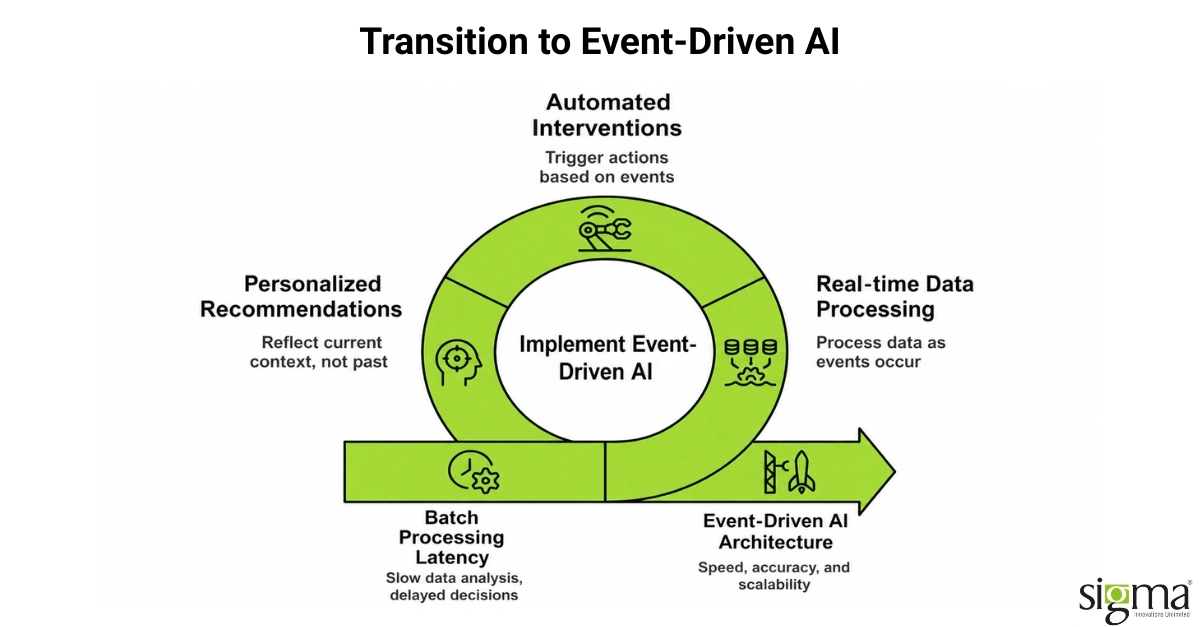
For most of the history of enterprise software, batch processing was the dominant paradigm for data analysis and decision automation. Data accumulated throughout the day, jobs ran overnight, and reports were ready in the morning. This model was adequate when business cycles moved slowly and customer expectations were calibrated to the rhythms of traditional financial services.
Neither of those conditions applies in 2026. Fintech customers expect instant credit decisions, real-time transaction alerts, and personalized product recommendations that reflect their current context rather than their behavior from last week. SaaS platforms operating at scale need to detect anomalous usage patterns, trigger automated interventions, and adjust pricing or access controls in response to events as they occur, not hours later when a batch job surfaces the relevant data.
Batch architecture creates latency that has become structurally incompatible with these requirements. It also creates brittleness, because batch jobs that fail silently or produce stale outputs can propagate incorrect decisions across downstream systems before anyone notices the problem. For fintech platforms where incorrect decisions translate directly into credit losses, fraud exposure, or regulatory violations, this brittleness is not an acceptable engineering trade-off.
The organizations that recognize batch processing as a competitive liability and invest in event-driven AI architecture are positioning themselves to operate at a fundamentally different level of speed, accuracy, and scalability than those that do not.
Also, read the blog : Digital Lending Platforms Market Size in 2026: Growth Trends, Key Drivers, and Future Outlook
The Technical Foundations of Event-Driven AI Architecture
Building an event-driven architecture that supports real-time AI decisioning requires a specific set of technical components working together as a cohesive system. Understanding these components and how they interact is essential for engineering leaders evaluating this architectural approach.
Event Streaming Infrastructure
The backbone of any event-driven system is a high-throughput, fault-tolerant event streaming platform that captures business events as they occur and makes them available to downstream consumers in real time. Apache Kafka is the most widely adopted platform for this purpose in enterprise environments, offering the combination of throughput capacity, durability, and ecosystem maturity that fintech-grade workloads demand.
Kafka’s log-based architecture ensures that every event is durably recorded and can be replayed by consumers that need to reprocess historical data, rebuild state after a failure, or onboard new downstream systems without losing historical context. For fintech platforms where auditability is a regulatory requirement, this durable event log is also a compliance asset that provides a complete, immutable record of every business event that has occurred within the system.
AWS Kinesis and Google Pub/Sub provide managed alternatives to self-hosted Kafka deployments, reducing operational overhead for organizations that prefer to minimize infrastructure management responsibilities. The choice between these platforms depends on existing cloud commitments, throughput requirements, and the organization’s appetite for operational complexity.
Real-Time AI Decisioning Engines
Event-driven infrastructure delivers its full value when it is connected to AI decisioning engines that can consume event streams, apply machine learning model inference, and produce actionable outputs within the latency constraints of real-time operation. This requires a specific approach to model design and serving infrastructure that differs significantly from the batch inference patterns common in traditional analytics environments.
Real-time model serving platforms such as MLflow, Seldon, and AWS SageMaker Real-Time Inference provide the infrastructure to host trained machine learning models as low-latency API endpoints that can process individual prediction requests in milliseconds. These platforms handle the scaling, versioning, and monitoring requirements of production model serving, allowing data science teams to focus on model quality rather than infrastructure management.
Feature stores play a critical supporting role in real-time AI decisioning by providing pre-computed, up-to-date feature values that models need to generate accurate predictions without incurring the latency of computing those features on demand at inference time. A well-designed feature store maintains a real-time layer that reflects the current state of key business entities and a historical layer that supports model training and backtesting.
Event-Driven Microservices and Workflow Orchestration
AI architecture built on event-driven principles naturally decomposes complex fintech workflows into discrete, independently scalable microservices that each respond to specific event types and produce outputs that trigger downstream services. This decomposition creates systems that are easier to develop, test, scale, and modify than monolithic alternatives.
A loan origination workflow built on event-driven microservices might include separate services for identity verification, credit bureau integration, fraud scoring, underwriting decision, and customer notification, each consuming events from and publishing events to shared Kafka topics. When application volume spikes, individual services can scale independently based on their specific queue depths rather than requiring the entire application to scale as a unit.
Workflow orchestration tools such as Apache Airflow, Temporal, and AWS Step Functions manage the coordination of these microservices for complex, multi-step processes that require conditional logic, error handling, and state management across multiple event processing steps.
High-Impact Use Cases for Event-Driven AI in Fintech and SaaS
The combination of event-driven infrastructure and real-time AI decisioning unlocks a set of capabilities that are transformative for fintech and SaaS platforms operating at scale.
Real-Time Fraud Detection and Prevention
Fraud detection is perhaps the most compelling use case for event-driven AI architecture in fintech. Every payment transaction, account login, and profile modification generates an event that carries signals relevant to fraud risk. An event-driven fraud detection system processes these signals in real time, applies machine learning models trained on historical fraud patterns, and produces a risk score that determines whether the transaction proceeds, requires step-up authentication, or is blocked entirely.
The latency advantage of event-driven fraud detection over batch-based alternatives is decisive. A fraud ring executing a coordinated attack across multiple accounts can cause significant losses in the minutes it takes a batch system to surface the anomaly. An event-driven system that processes each transaction event within milliseconds and correlates signals across accounts in real time can identify and block coordinated fraud patterns before losses accumulate.
Many leading payment platforms have reported dramatic reductions in fraud losses after transitioning from rule-based batch fraud detection to event-driven AI systems that incorporate behavioral signals, network analysis, and machine learning inference into a unified real-time decisioning pipeline.
Instant Credit Decisioning and Dynamic Underwriting
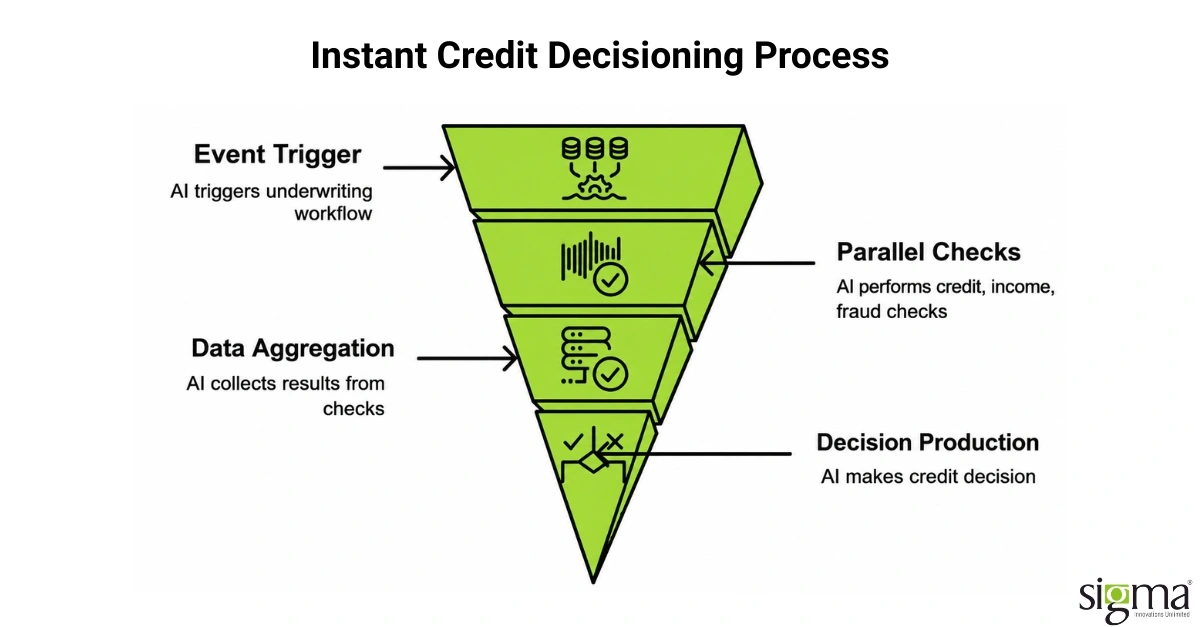
Borrower expectations for credit decisioning speed have been permanently reset by digital-native lenders that return loan decisions within seconds of application submission. Traditional lenders that rely on overnight batch underwriting processes are increasingly unable to compete for borrowers who expect an instant answer and will move to a competitor if they do not receive one.
Event-driven AI architecture enables instant credit decisioning by triggering the full underwriting workflow at the moment of application submission and orchestrating parallel calls to credit bureaus, income verification services, fraud detection systems, and the underwriting model itself. Results are aggregated as they arrive, and a decision is produced as soon as all required inputs are available, typically within seconds.
Dynamic underwriting extends this capability by enabling the underwriting model to incorporate real-time signals that were not available at application time, such as updated bureau data, bank account transaction analysis, or behavioral signals generated during the application session itself. This richer input set improves decision accuracy and enables more nuanced risk pricing that benefits both the lender and creditworthy borrowers who might be declined by less sophisticated models.
Real-Time Personalization in SaaS Platforms
For SaaS platforms, event-driven AI architecture enables a level of real-time personalization that significantly improves user engagement, feature adoption, and retention outcomes. Every user interaction within the platform generates events that reveal intent, capability level, and engagement patterns. An event-driven personalization system processes these signals continuously and adjusts the product experience in real time to reflect each user’s current context.
A project management SaaS platform might use event-driven personalization to identify users who are struggling with a specific feature based on their interaction patterns and proactively surface contextual help content or trigger an outreach from the customer success team before the user’s frustration leads to disengagement. The same architecture can power dynamic feature recommendations, personalized onboarding paths, and usage-based nudges that guide users toward the behaviors associated with long-term retention.
Operational Scalability and System Resilience
Beyond specific AI use cases, event-driven architecture provides systemic benefits for operational scalability and resilience that are particularly valuable for fintech platforms operating under regulatory scrutiny and service level commitments. Because event-driven systems decouple producers from consumers through the event stream, individual components can scale, fail, and recover independently without cascading failures that take down the entire platform.
This decoupling also enables graceful degradation under extreme load. When transaction volumes spike during peak periods, event streams absorb the load and allow downstream services to process events at their maximum sustainable rate rather than being overwhelmed by synchronous request floods. The result is a system that maintains acceptable performance under stress rather than collapsing precisely when reliability matters most.
How Sigma Infosolutions Engineers Event-Driven AI Architecture for Fintech and SaaS
Sigma Infosolutions brings deep expertise in AI architecture, event-driven systems, and fintech platform engineering to help organizations design and build the real-time decisioning infrastructure that modern financial technology and SaaS products demand. Sigma’s engineering team works closely with CTOs, architects, and product leaders to deliver architectures that are technically sophisticated, operationally reliable, and aligned with the specific business outcomes the organization needs to achieve.
Architecture Assessment and Design
Sigma begins every engagement with a comprehensive assessment of the client’s existing platform architecture, data infrastructure, and decisioning workflows. This assessment identifies the specific latency, scalability, and AI integration gaps that are limiting the platform’s performance and produces a detailed event-driven architecture design that addresses those gaps within the constraints of the client’s existing technology investments.
Event Streaming Platform Implementation
Sigma’s infrastructure engineering team implements and configures event streaming platforms including Apache Kafka and managed cloud alternatives, building the topic structure, consumer group configuration, and operational monitoring capabilities that support reliable, high-throughput event processing at fintech scale. Streaming infrastructure is designed with data durability, replay capability, and multi-region resilience from the outset.
AI Decisioning Engine Integration
Sigma’s data science and machine learning engineering teams build and integrate real-time AI decisioning engines that connect to the event streaming layer and produce low-latency predictions for fraud detection, credit underwriting, personalization, and operational automation use cases. Feature stores, model serving infrastructure, and monitoring systems are implemented as integral components of the decisioning architecture rather than afterthoughts.
Microservices Development and Workflow Orchestration
Sigma engineers the event-driven microservices that implement specific business capabilities within the broader architecture and builds the workflow orchestration layer that coordinates complex, multi-step processes across those services. Each microservice is designed for independent deployability, horizontal scalability, and observability, ensuring that the engineering team can monitor, debug, and evolve individual components without disrupting the broader system.
Compliance and Security Integration
Sigma integrates the compliance controls, audit logging, and security monitoring capabilities that fintech platforms require into the event-driven architecture from the beginning. Every event processed by the system is logged to an immutable audit trail, access controls are enforced at the event stream level, and sensitive data is encrypted in transit and at rest throughout the processing pipeline.
Conclusion
AI architecture built on event-driven systems is the technical foundation that separates fintech and SaaS platforms capable of operating at the speed and scale of modern digital commerce from those that remain constrained by the latency and brittleness of batch-oriented infrastructure. Real-time decisioning in fraud detection, credit underwriting, personalization, and operational automation is not a future capability. It is a present-day competitive requirement for any platform serious about winning in the markets it serves.
The transition to event-driven AI architecture requires engineering expertise that spans distributed systems, machine learning infrastructure, fintech domain knowledge, and cloud-native platform design. Organizations that attempt this transition without the right technical partner frequently find that the complexity exceeds their internal capacity and that the resulting systems fall short of the real-time performance and reliability they were designed to deliver.
Sigma Infosolutions is the advanced fintech architecture and engineering partner that CTOs, SaaS architects, and product leaders trust to design and build event-driven AI systems that perform at scale. With proven expertise in AI in fintech, event-driven systems, and real-time decisioning infrastructure, Sigma delivers the architectural foundation that ambitious fintech and SaaS platforms need to compete and win.
FAQs
What is event-driven AI architecture in fintech?
Event-driven AI architecture is a system design approach where business events such as transactions, loan applications, account activity, or customer interactions trigger real-time data processing and AI-driven decisions instantly. This architecture enables fintech platforms to automate fraud detection, underwriting, personalization, and operational workflows without relying on delayed batch processing.
Why are fintech companies moving away from batch-processing systems?
Batch-processing systems introduce delays that limit real-time responsiveness. Modern fintech platforms require instant fraud detection, real-time credit decisioning, and dynamic customer experiences that batch workflows cannot support efficiently. Event-driven AI architecture reduces latency, improves scalability, and supports continuous decision-making.
How does AI improve real-time decisioning in fintech?
AI models analyze streaming data in real time to generate predictive insights and automated decisions within milliseconds. This allows fintech platforms to instantly assess fraud risk, approve or reject loans, personalize offers, monitor transactions, and automate operational workflows based on live customer behavior and financial signals.
What role does Apache Kafka play in event-driven architecture?
Apache Kafka acts as the event streaming backbone that captures, stores, and distributes real-time business events across fintech systems. It enables high-throughput, fault-tolerant processing and supports scalable AI decisioning pipelines by allowing multiple services to consume and react to events simultaneously.
What are the benefits of real-time AI fraud detection?
Real-time AI fraud detection enables fintech platforms to identify suspicious activity immediately rather than after losses occur. AI models analyze transaction patterns, behavioral anomalies, device signals, and account activity continuously to block fraudulent actions, reduce false positives, and improve risk management.
How does event-driven architecture support instant credit underwriting?
Event-driven systems trigger underwriting workflows immediately after a borrower submits an application. AI decisioning engines process credit bureau data, income verification, fraud signals, and behavioral insights in parallel, allowing lenders to generate credit decisions within seconds instead of hours or days.
What is a feature store in AI architecture?
A feature store is a centralized system that manages and serves machine learning features used during model training and real-time inference. In fintech AI systems, feature stores provide low-latency access to updated customer, transaction, and behavioral data that improves prediction accuracy for fraud detection and underwriting models.
How do microservices improve scalability in fintech platforms?
Event-driven microservices allow fintech platforms to break complex workflows into independently scalable components. Services such as identity verification, fraud scoring, payment processing, and underwriting can scale separately based on workload demand, improving system resilience and operational efficiency.
Which cloud platforms support real-time AI decisioning infrastructure?
Cloud platforms such as Amazon Web Services, Google Cloud, and Microsoft Azure provide managed services for event streaming, AI model serving, workflow orchestration, and scalable infrastructure that support real-time fintech applications.
What are common use cases for event-driven AI in SaaS platforms?
SaaS organizations use event-driven AI architecture for real-time personalization, churn prediction, usage anomaly detection, dynamic pricing, customer engagement automation, workflow orchestration, and operational monitoring. These capabilities improve customer retention and platform performance.
How does event-driven architecture improve fintech platform resilience?
Event-driven systems decouple applications and services through asynchronous communication. This architecture minimizes cascading failures, supports graceful load handling during traffic spikes, and improves recovery capabilities by allowing services to process queued events independently.
Is event-driven AI architecture secure and compliant for fintech?
Yes. Modern event-driven fintech architectures include encrypted event streams, immutable audit logs, role-based access controls, compliance monitoring, and secure data handling practices. These capabilities support regulatory requirements related to auditability, data protection, and operational transparency.
How does Sigma Infosolutions support AI-driven fintech modernization?
Sigma Infosolutions designs and engineers scalable event-driven architectures for fintech and SaaS platforms. Sigma integrates AI decisioning engines, real-time analytics pipelines, microservices infrastructure, workflow orchestration, and cloud-native scalability to accelerate fraud detection, lending automation, and intelligent operational workflows.