Embedded Finance Explained: How Non-Banks Are Adding Financial Services

Key Highlights:
- SaaS companies, marketplaces, and platform businesses recognize embedded finance as a significant growth opportunity but lack clarity on where to start, which partners to work with, and what engineering is actually involved.
- Embedded finance enables non-financial businesses to offer payments, lending, insurance, and banking products directly within their own platforms by connecting to Banking as a Service providers and fintech APIs, without building financial infrastructure from scratch.
- Sigma builds embedded finance infrastructure for platforms and SaaS companies, leveraging BaaS APIs, open banking integrations, and payment orchestration layers to bring financial products to market faster and with less regulatory complexity.
Introduction
Financial services used to be something consumers and businesses went to a bank to access. Embedded finance is changing that model fundamentally. Today, a logistics platform can offer its drivers a corporate card. A marketplace can provide its sellers with instant revenue-based financing. A SaaS tool can let its customers pay invoices, manage payroll, or access a business account without leaving the product.
Embedded finance is the integration of financial products, including payments, lending, insurance, and deposit accounts, directly into non-financial software platforms and applications. It is one of the fastest-growing segments in financial technology, and the companies moving earliest are building revenue streams, reducing churn, and increasing customer lifetime value in ways that their traditional product roadmaps could not deliver.
The challenge for founders and CTOs at SaaS companies, marketplaces, and platforms is that embedded finance looks deceptively simple from the outside. Behind a seamless lending widget or payment flow sits a technology stack involving BaaS provider relationships, regulatory obligations, API orchestration, and compliance workflows that require deliberate engineering.
This article explains what embedded finance is, how it works, which models are most relevant for different platform types, and what teams need to understand before starting implementation.
What Is Embedded Finance?
Embedded finance refers to the integration of financial products and services directly into non-financial platforms, delivered through APIs and provided by licensed financial infrastructure partners. The business offering the financial product does not need to be a bank or a licensed lender. It partners with a Banking as a Service provider or a specialized fintech API provider that holds the relevant licenses and operates the regulated infrastructure, while the platform business controls the user experience and the customer relationship.
The range of products that can be embedded is broad. Embedded payments allow platforms to process transactions within their own interface rather than redirecting users to an external processor. Embedded lending enables platforms to offer working capital, invoice financing, or installment credit at the point of need. Embedded banking products such as business accounts, debit cards, and savings features let platforms become the primary financial interface for their customers. Embedded insurance allows platforms to offer relevant coverage at the moment of a transaction.
What these products share is that they are delivered within the context of the platform’s own experience, powered by third-party financial infrastructure accessed via APIs.
Build Embedded Financial Products with Expert FinTech Engineering.
Embedded Finance vs Banking as a Service: Understanding the Distinction
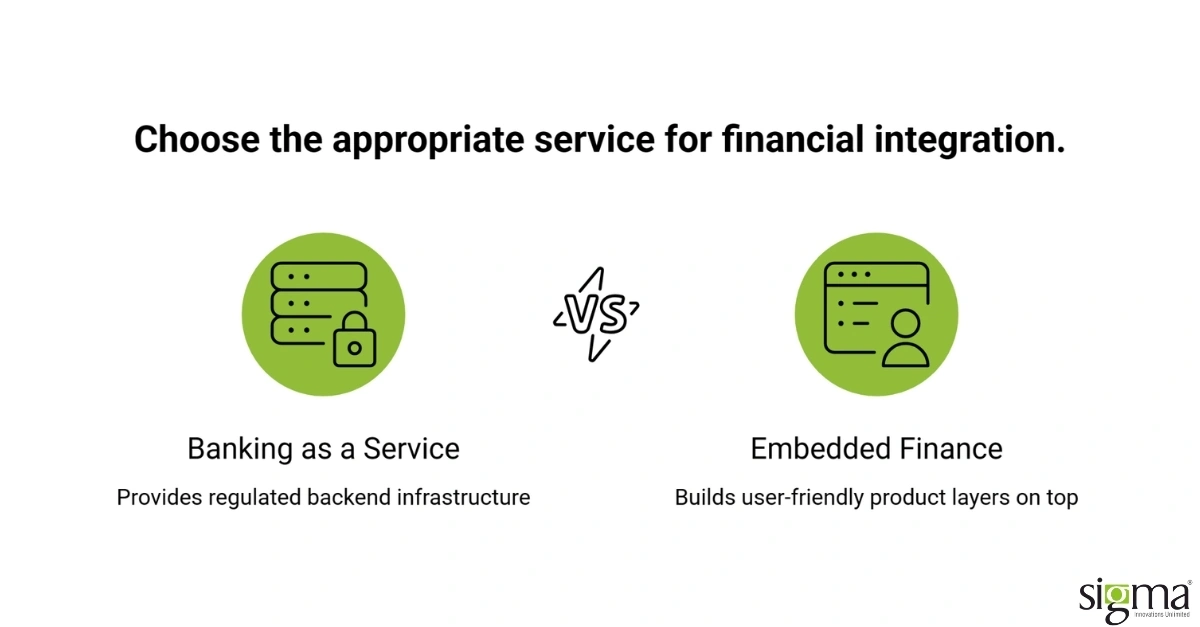
Embedded finance and Banking as a Service are closely related concepts that are frequently conflated. Banking as a Service is the infrastructure model that makes embedded finance possible. A BaaS provider is a licensed financial institution or regulated technology provider that exposes banking capabilities, including accounts, payment rails, card issuance, and lending, through APIs. Embedded finance is what a platform business builds on top of that infrastructure.
A software company that integrates a BaaS provider’s API to offer its customers a business checking account is practicing embedded finance. The BaaS provider holds the banking license and operates the regulatory compliance infrastructure. The software company designs the user experience, owns the customer relationship, and builds the product layer that makes the financial service accessible within its platform.
This distinction matters because it clarifies where the engineering work actually happens. The BaaS provider supplies the regulated backend. The platform team builds the integration, the user experience, the onboarding flow, the compliance workflows on their side of the relationship, and the product logic that makes the financial service relevant in context.
Embedded Finance Use Cases by Platform Type
SaaS Platforms
SaaS businesses serving small and medium enterprises are among the most active adopters of embedded finance. An accounting software platform that offers a business account directly within its product eliminates the need for customers to reconcile across tools, increasing retention and creating a new revenue stream from interchange and account fees. A payroll SaaS that offers earned wage access or small business lending has a structural advantage in lending decisions because it already has visibility into the employer’s payroll data.
Marketplaces
Marketplace businesses sit at the intersection of buyers and sellers and have natural use cases for embedded payments, seller financing, and buyer credit. A B2B marketplace that offers its suppliers instant payment on invoice approval, rather than waiting for buyer payment terms, solves a genuine working capital problem and creates a sticky financial relationship with suppliers. Buyer financing at checkout increases average order value and conversion rate simultaneously.
Vertical Software and Industry Platforms
Vertical software companies serving specific industries such as healthcare, construction, or logistics have deep data visibility into their customers’ business operations. This data advantage makes embedded lending particularly powerful. A construction management platform that understands a contractor’s project pipeline and revenue schedule is better positioned to underwrite a working capital line than a generalist lender with access only to bank statements.
Also, read the blog: BNPL Platform Development: What Fintech Companies Need to Know
How Embedded Finance Works: The Technology Stack
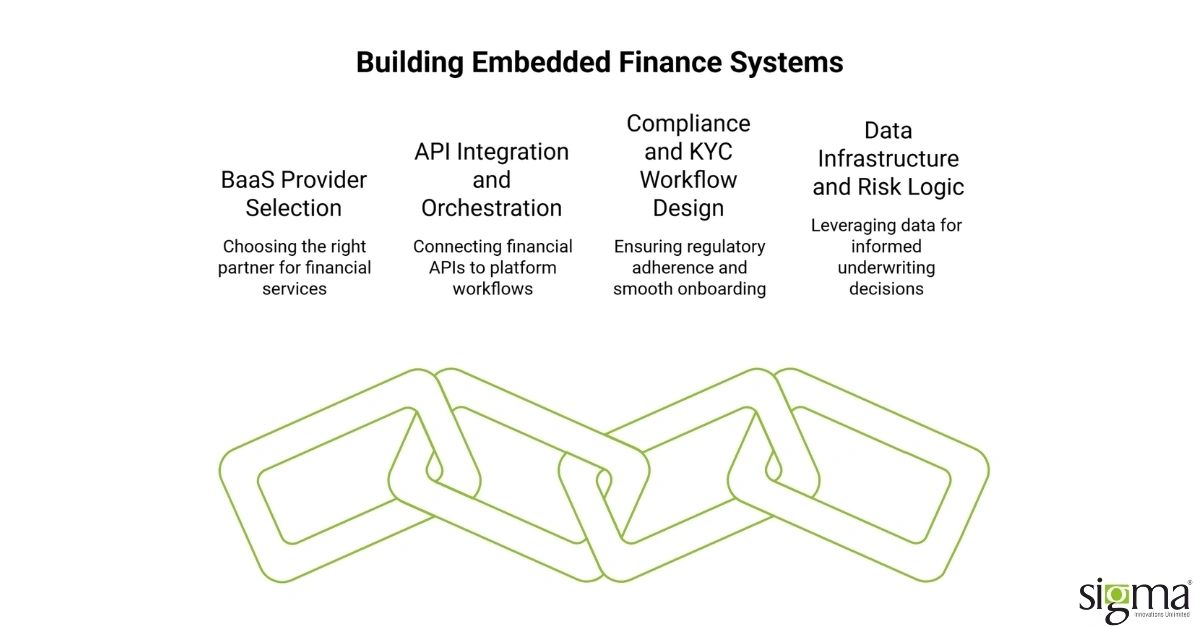
Implementing embedded finance requires connecting several layers of technology and establishing the right partner relationships before a single line of product code is written.
BaaS Provider Selection
The BaaS provider is the foundational partner for any embedded finance implementation. The right provider depends on the financial products being offered, the geographic markets being served, and the regulatory environment. BaaS providers vary in API quality, product breadth, pricing model, and compliance support. Selecting the wrong provider creates dependency risk and integration complexity that is expensive to unwind.
API Integration and Orchestration
Once a BaaS provider is selected, the platform team builds the integration layer connecting BaaS APIs to the platform’s own data and product workflows. This typically involves account provisioning, KYC orchestration, transaction initiation, and webhook handling for real-time event processing. For platforms using multiple financial infrastructure partners, an orchestration layer that manages routing, error handling, and reconciliation becomes necessary.
Compliance and KYC Workflow Design
Embedded finance products trigger regulatory obligations that vary by product type and jurisdiction. Embedded payments require PCI DSS compliance. Embedded lending may require state-by-state lending licenses or a partnership with a licensed lender. Embedded deposit products require the platform to manage KYC and AML obligations, either directly or by relying on the BaaS provider’s compliance infrastructure.
A poorly designed KYC workflow that requires customers to re-verify identity they have already provided to the platform creates friction that undermines the embedded experience. Compliance workflow design determines how smoothly the financial product integrates into the platform’s existing onboarding and identity management.
Data Infrastructure and Risk Logic
For embedded lending products, the platform’s data advantage is only valuable if the data can be used effectively in underwriting decisions. This requires building data pipelines that extract and serve relevant platform signals to the underwriting engine, whether that engine belongs to the BaaS partner or is built by the platform team. Platforms that invest in this data infrastructure unlock credit products that generalist lenders cannot match on accuracy.
Read our success story: US based B2C Mobile App and Admin Portal for Digital Payments
How Sigma Infosolutions Helps Build Embedded Finance Products
Sigma Infosolutions is an embedded finance engineering partner that bridges BaaS provider capabilities, regulatory requirements, and product delivery for SaaS companies, marketplaces, and platform businesses. Working with founders, CTOs, heads of product, and VP of engineering at growth-stage and mid-market platforms across the US, Canada, Australia, and Europe, Sigma combines fintech domain expertise with full-stack engineering to bring embedded financial products to market efficiently and compliantly. Engagements run as dedicated teams or long-term product engineering partnerships.
Discovery and Partner Strategy
Sigma begins every embedded finance engagement with a structured discovery phase covering the platform’s user base, the financial products that create the most value, and the BaaS and API provider landscape. The team produces a partner selection recommendation and a product architecture blueprint before implementation begins.
BaaS API Integration and Orchestration
Sigma’s engineers build the API integration layers that connect BaaS providers, payment processors, and open banking data sources to the platform’s product workflows. The team implements account provisioning, transaction management, webhook handling, and reconciliation logic, with orchestration architecture designed to support multiple financial infrastructure partners as the product scales.
KYC and Compliance Workflow Engineering
Sigma designs and builds the compliance workflows on the platform’s side of the BaaS relationship, including KYC onboarding flows, AML transaction monitoring integrations, and audit trail infrastructure. The team balances compliance rigor with onboarding conversion, ensuring regulatory requirements do not create unnecessary friction.
Embedded Lending and Payment Product Development
For platforms building embedded lending or payment products, Sigma develops the full product layer including the user-facing application, the underwriting data pipeline, and the repayment management system. The team integrates platform-native data signals into lending decisions to unlock the risk accuracy advantage that makes embedded lending economically compelling.
Quality Assurance and Ongoing Support
Backed by ISO 9001, ISO 27001, SOC 2, and GDPR-aligned practices, Sigma tests every integration rigorously and supports the product as a long-term partner, so the embedded finance layer evolves safely as you add products and markets.
Why Sigma Infosolutions Is the Right Partner for Embedded Finance
Embedded finance represents a genuine product and revenue opportunity for SaaS companies, marketplaces, and platform businesses with an engaged customer base and relevant transaction data. By integrating payments, lending, or banking products directly into their platforms through BaaS and fintech APIs, non-financial businesses can deepen customer relationships, add meaningful revenue streams, and deliver financial services at the moment of highest relevance.
The implementation path requires deliberate technology and partner decisions. BaaS provider selection, API orchestration, compliance workflow design, and data infrastructure investment each determine how quickly and successfully the product reaches production. Teams that approach these decisions without fintech domain expertise risk integration delays, compliance gaps, and product experiences that fall short of what embedded finance promises.
Sigma Infosolutions brings the embedded finance engineering expertise and regulatory knowledge to help your team build financial products that work within your platform from day one. Whether you are exploring your first embedded payment integration or building a full embedded lending product, Sigma provides the architecture guidance, engineering execution, and compliance support to deliver successfully.
Launch Secure, Scalable Payment Experiences Within Your Platform.
Frequently Asked Questions
What is embedded finance?
Embedded finance is the integration of financial products like payments, lending, and banking directly into non-financial platforms through APIs. The platform controls the user experience while a licensed BaaS provider handles the regulated infrastructure.
How is embedded finance different from Banking as a Service?
Banking as a Service is the infrastructure layer that provides licensed financial capabilities through APIs. Embedded finance is what a platform builds on top of that infrastructure to deliver financial products within its own experience.
What types of financial products can be embedded?
Payments, lending, deposit accounts, cards, and insurance can all be embedded. The right product depends on the platform’s user base, the data it holds, and where financial friction exists in the customer journey.
Which platforms benefit most from embedded finance?
SaaS companies serving SMEs, marketplaces connecting buyers and sellers, and vertical software with deep operational data all have strong embedded finance use cases. The common thread is an engaged user base and relevant transaction or business data.
What does it take to build an embedded finance product?
It requires BaaS provider selection, API integration and orchestration, KYC and compliance workflow design, and data infrastructure for risk decisions. Each layer demands fintech domain expertise alongside strong engineering.
What compliance is required for embedded finance?
Requirements vary by product and jurisdiction and can include PCI DSS for payments, lending licenses or lender partnerships for credit, KYC and AML checks, and data protection obligations. Compliance should be designed into the architecture from the start.
How do I choose a BaaS provider?
Evaluate API quality, product breadth, geographic licensing, pricing, and the compliance support offered to platform partners. The wrong choice creates dependency and integration costs that are expensive to unwind.
How does Sigma Infosolutions help with embedded finance?
Sigma handles discovery, BaaS integration, compliance workflows, and full product development for embedded finance. It combines fintech domain expertise with engineering delivery to bring financial products to market compliantly and efficiently.