Capital Markets Software: Build vs. Buy Decisions That Still Hold Up in Year Two

Key Highlights
- Off-the-shelf platforms constrain workflows and data, while full custom builds overrun budget and stall launches.
- Buy the commodity core, build the client-facing and analytics layers, and integrate the rest through well-defined interfaces.
- Leadership can fund ownership only where it produces differentiation and can sequence the rest against a launch date.
- Sigma Infosolutions acts as a long-term engineering partner that scopes, builds, and evolves the owned layers on a dedicated team or time and material basis.
Capital markets software is the set of platforms that route orders, hold positions, calculate performance, reconcile with custodians, and produce client and regulatory reporting for an investment business. In practice it divides into a commodity core that every firm needs and a differentiating layer that clients actually see. Packaged products force compromises on workflows and data models, while custom builds routinely overrun budget, so leadership teams struggle to tell which layers deserve ownership. Integration with custodians, market data vendors, and order and portfolio management systems then decides how fast any product can launch, whichever route is chosen. This article gives CEOs, CTOs, and heads of product at Series A to C wealthtech, trading, and investment app companies a verdict, a decision matrix, and a scorecard to carry into Q4 and FY2027 planning.
Capital Markets Software Splits Into a Commodity Core and a Differentiating Layer
The short verdict is a hybrid: buy the commodity core and build the layer that clients see and that your data uniquely enables. A useful rule of thumb is to buy what regulators and custodians standardize, and build what differentiates the client experience.
The commodity core covers order routing, custody and clearing connectivity, market data ingestion, and books and records. Every competitor needs these functions, and no client chooses a platform because of them. The differentiating layer covers onboarding, portfolio views, personalization, analytics, and reporting. This is where retention, advisor productivity, and pricing power are decided.
Treating all investment software systems as one purchase is the most common source of regret. A single vendor decision then locks the commodity and differentiating layers together, and every future product change becomes a negotiation with the vendor’s release plans.
Streamline investment workflows with custom investment software development, seamless system integrations, and scalable solutions tailored to your business needs.
Where Packaged Capital Markets Software Stops Fitting the Business
Packaged platforms fit well when the business model matches the vendor’s assumptions, and they stop fitting when workflows, fee structures, or data needs diverge. The symptoms are consistent across growth-stage firms: workarounds in spreadsheets, manual reconciliation between modules, and reporting that cannot be reshaped without a vendor change request.
Three signals indicate that a packaged product has been outgrown. First, the product team maintains a backlog of client-facing features that the vendor cannot support. Second, operations staff reconcile positions or fees by hand each month. Third, onboarding a new custodian or data source requires a vendor project rather than a configuration change.
None of these signals argue for replacing the entire platform. They argue for isolating the layer that is constrained and rebuilding only that layer while keeping the licensed core in place.
What Does a Custom Build Really Cost Beyond the Initial Quote?
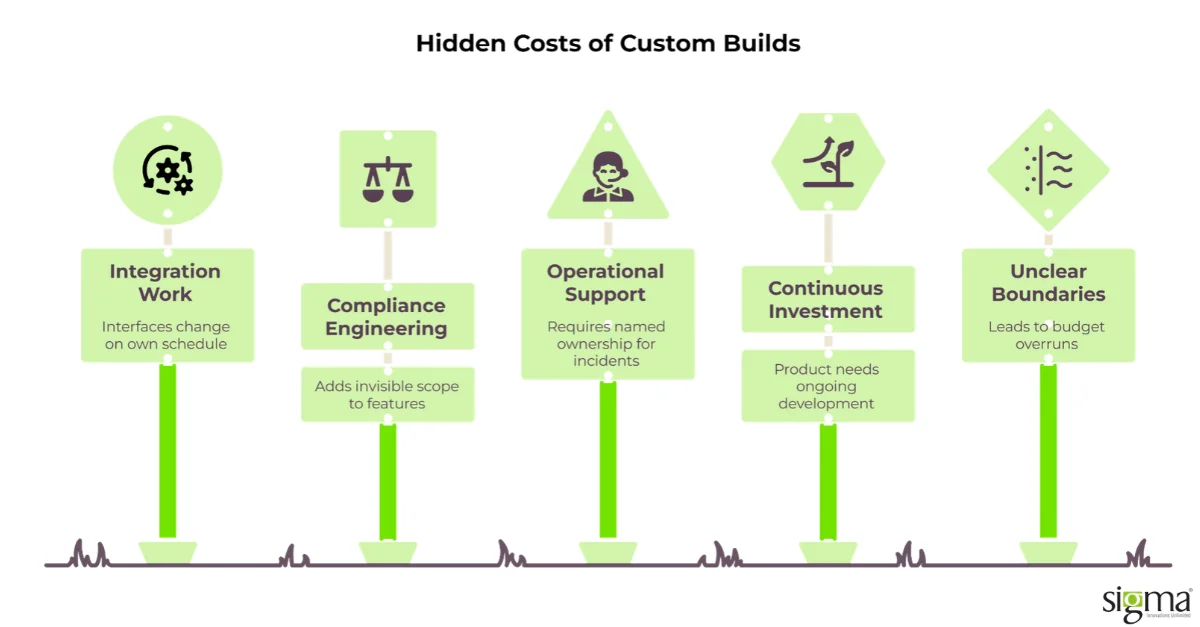
A custom build costs the initial engineering estimate plus integration, compliance, and ongoing evolution, and the later categories are the ones most often omitted. Total cost of ownership over three years is the comparison that matters, not the first invoice.
Four cost categories deserve explicit line items. Integration work with custodians, clearing firms, and market data providers is rarely a one-time effort, because each counterparty changes its interfaces on its own schedule. Compliance engineering, including books and records, audit trails, and reporting, adds scope that is invisible in feature lists. Operational support and incident response require named ownership. Finally, the product itself needs continuous investment, which is why a dedicated team model usually fits better than a fixed scope.
Budget overruns on custom builds typically come from unclear boundaries, not from engineering difficulty. A build limited to a defined layer, with the commodity core licensed, keeps the boundary visible and the estimate defensible.
Compare build, buy, and hybrid options for your platform in a short architecture review of capital markets software priorities.
A Hybrid Model Assigns Each Layer to Buy, Build, or Integrate
Layer-by-Layer Calls
A hybrid model works because it assigns ownership by layer instead of by product. The table below summarizes the call most growth-stage firms reach once they separate the stack into its functional layers.
| Layer | Buy when | Build when | Typical call |
|---|---|---|---|
| Order routing and execution connectivity | Standard asset classes and venues | Proprietary routing logic is the product | Buy |
| Custody and clearing integration | Mainstream custodians with standard APIs | Multiple custodians need a unified abstraction | Integrate, then build the abstraction |
| Market data ingestion | Common vendors and delayed or standard feeds | Alternative data defines the offering | Buy |
| Portfolio accounting and books and records | Conventional accounting treatment | Unusual instruments or fee models | Buy, extend selectively |
| Client apps and onboarding | Never the sole choice | Client experience is the differentiator | Build |
| Analytics and reporting | Basic statements suffice | Personalization and insight drive retention | Build |
The pattern is consistent: the further a layer sits from the client, the stronger the case for buying, and the closer it sits to the client’s decisions, the stronger the case for building. Teams that follow this logic spend engineering capacity where it compounds.
A Build/Buy Scorecard Leadership Can Use in a Board Meeting
A scorecard turns the debate into a repeatable decision that a board or leadership team can review. Score each layer from one to five against the criteria below, then total toward build or toward buy.
| Criterion | Score toward build when | Score toward buy when |
|---|---|---|
| Client differentiation | Clients choose you for this capability | Clients never notice this capability |
| Data advantage | Your proprietary data improves the output | The function uses generic inputs only |
| Regulatory exposure | You can operate and evidence controls | The vendor carries strong audit evidence |
| Integration burden | Counterparties need a unified abstraction | Standard interfaces already exist |
| Time to market | The build fits inside the launch window | A licensed product ships this quarter |
| Three-year cost | Owned cost beats license growth | License cost stays flat as volume grows |
A five-step framework keeps the process short. Map the stack into layers, score each layer, assign buy, build, or integrate, sequence the work against the launch calendar, and set a review date to re-score as the business scales. Layers that score high on differentiation and data advantage go first, and the commodity core can wait.
Regulatory Scope Shapes the Decision Before Features Do
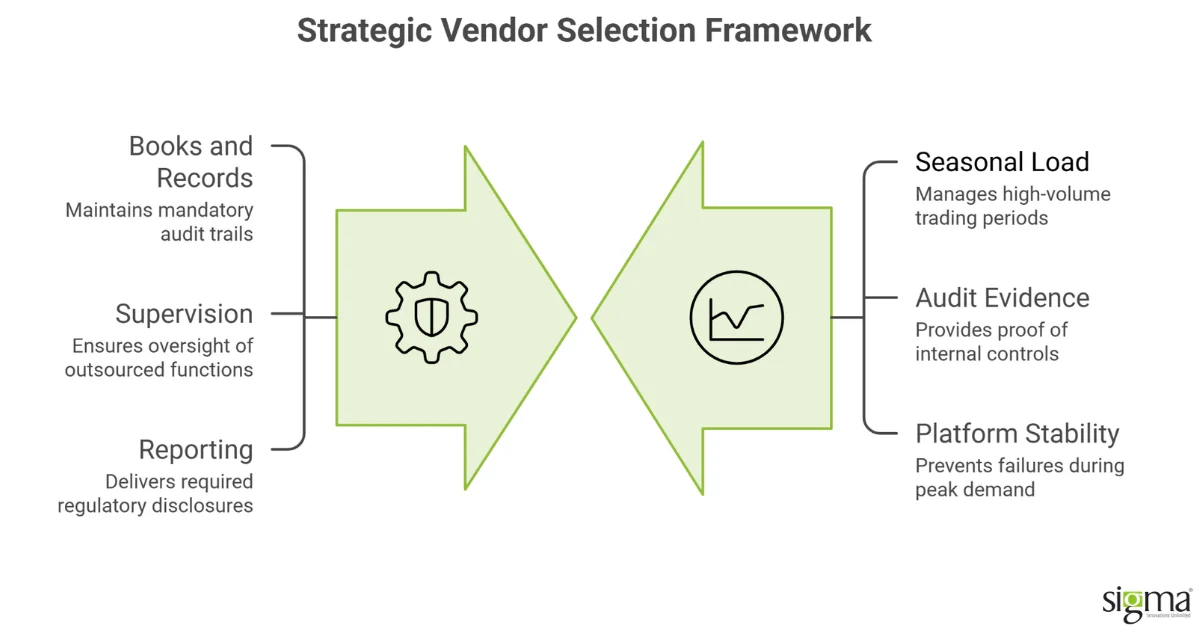
Regulation determines who carries accountability for each layer, and that allocation should be settled before any vendor demonstration. In the United States, the SEC and FINRA set expectations for books and records, supervision, and reporting. In Canada, CIRO oversees investment dealers, in Australia ASIC supervises market participants, and in the United Kingdom the FCA performs the equivalent role.
The consistent principle across these regimes is that outsourcing a function does not outsource accountability. A licensed firm remains responsible for the records, controls, and client outcomes produced by a vendor platform. That reality favors buying components with strong audit evidence and building only where the firm can operate and evidence the controls itself.
Seasonal load also belongs in the decision. Year-end portfolio rebalancing and tax-loss harvesting concentrate trading, reporting, and support demand into a few weeks. Platforms that cannot absorb that peak create client-visible failures at the worst moment.
Rebuilding the Analytics Layer While Custodian Feeds Stay Untouched
The decision Sigma Infosolutions most often helps clients make is which layer to rebuild first, and the trade-off is speed against disruption. Replacing the full platform promises a clean architecture, but it exposes custodian connectivity and books and records to risk. Rebuilding only the analytics and client layer delivers visible value sooner and leaves regulated plumbing intact.
Sigma built a custom web platform for a boutique capital formation firm to streamline investment operations, replacing fragmented tooling with a single operating surface. That engagement started from the operating workflow, not from a technology preference, which kept scope tied to outcomes the firm could measure.
See how a custom platform streamlined investment operations for a boutique capital formation firm.
The second path matters when data, not workflow, is the constraint. In a lending context, Sigma delivered a Snowflake-native intelligence platform for real-time portfolio analytics and AI-ready insights, which demonstrates the same analytics-layer pattern that investment platforms need for performance, exposure, and client reporting.
Explore how a real-time portfolio analytics platform built on Snowflake was delivered.
Both engagements ran as ongoing partnerships rather than one-time projects, which is the engagement model that suits layers the business intends to evolve. A discovery sprint that maps the stack, assigns each layer to buy, build, or integrate, and produces a cost sequence is the usual first step.
Conclusion
Capital markets software decisions fail when they treat the platform as a single purchase. The stack divides into a commodity core and a differentiating layer, and each deserves a different decision. Buying the core protects the budget and the launch date. Building the client-facing and analytics layers protects differentiation and pricing power. Total cost of ownership over three years is the right comparison, because integration, compliance, and evolution costs dominate the first quote. Regulation allocates accountability to the licensed firm, so ownership should follow the layers a firm can operate and evidence.
Seasonal peaks such as year-end rebalancing test any platform and should inform vendor selection. A scorecard converts these judgments into a decision that a board can review and a team can repeat. Dedicated team and time and material engagements suit the owned layers because scope changes with the product. A discovery sprint that costs and sequences each layer is the lowest-risk way to begin. Leaders who apply this discipline to capital markets software spend engineering capacity where it compounds and license budget where it does not.
Tailored Financial Software Solutions for Investment Businesses
FAQs
Should a fintech build or buy a portfolio management system?
Most growth-stage fintechs should buy the accounting and books-and-records core and build the client-facing and analytics layers. Building the core consumes engineering capacity on functions that no client values, while buying the visible layers limits differentiation. The scorecard in this article helps score each layer against differentiation, data advantage, regulatory exposure, and three-year cost.
What does capital markets software include?
Capital markets software typically includes order and execution connectivity, custody and clearing integration, market data ingestion, portfolio accounting, performance and risk calculation, client reporting, and compliance record keeping. Growth-stage firms often add client-facing applications and analytics on top. The scope varies by business model, so each layer should be assessed separately before choosing a vendor or a build.
How long does a custom trading platform take?
Timelines depend on scope, asset classes, and counterparties, so any single figure is unreliable. A platform limited to a defined client and analytics layer, with the commodity core licensed, usually reaches production sooner than a full build. A discovery sprint that maps layers and integrations produces a defensible estimate before budget is committed.
What is the real cost difference between building and buying?
The initial quote understates both options. Licensed products add per-user, per-account, or volume-based fees that grow with the business, while custom builds add integration, compliance, support, and continuous product investment. Compare the three-year total cost of ownership by layer, and include the cost of vendor change requests for features the product team needs.
Which regulators matter when choosing a platform?
The United States relies on the SEC and FINRA, Canada on CIRO, Australia on ASIC, and the United Kingdom on the FCA. Across these regimes a licensed firm remains accountable for records, controls, and client outcomes even when a vendor operates the function. Choose vendors with strong audit evidence and build only where your firm can evidence controls.