Data Quality Management: Why Executives Stop Trusting BI Dashboards

Key Highlights:
- Executives lose trust in dashboards when the same metric shows different numbers depending on which report they open, turning analytics investments into expensive screensavers.
- Upstream data quality management through validation, cleansing, and governance ensures every dashboard number traces to one auditable source of truth.
- Companies that skip data quality work see BI adoption collapse, analytics teams buried in reconciliation tickets, and AI initiatives stalled because models cannot learn from unreliable inputs.
- Organizations that embed data quality checks at ingestion rather than fixing errors after dashboards break spend significantly less time on reconciliation and see higher BI adoption across non-technical teams.
Introduction
You have been in this meeting. The VP of Sales opens a dashboard showing $2.3M in pipeline. The CFO pulls a different report showing $1.9M. The next 30 minutes disappear into a debate about which number is right. No decision gets made. Someone is asked to “just pull the real numbers” into a spreadsheet by the end of the day.
That spreadsheet becomes the actual source of truth, and the BI platform becomes background noise. This is what broken data quality management looks like at the business level. It does not crash. It does not throw errors. It quietly erodes trust until nobody opens the dashboard anymore. Sigma’s BI & Analytics Development Services help growth-stage companies fix this by building quality into the pipeline before data ever reaches a visualization layer.
The problem is becoming more widespread. The 2025 Data Integrity Report by Precisely and Drexel University found that 67% of organizations do not completely trust the data they use for decision-making, up from 55% the previous year. The issue is rarely the dashboard itself. It begins much earlier, with inconsistent data, weak validation, duplicate records, and disconnected systems that undermine confidence before insights ever reach business users.
For growth-stage SaaS, FinTech, and eCommerce companies investing in analytics, restoring trust requires fixing the data pipeline upstream. When validation, governance, and master data management become part of the foundation, dashboards become decision-making tools instead of numbers that teams constantly question.
The Real Cost of Broken Dashboard Trust
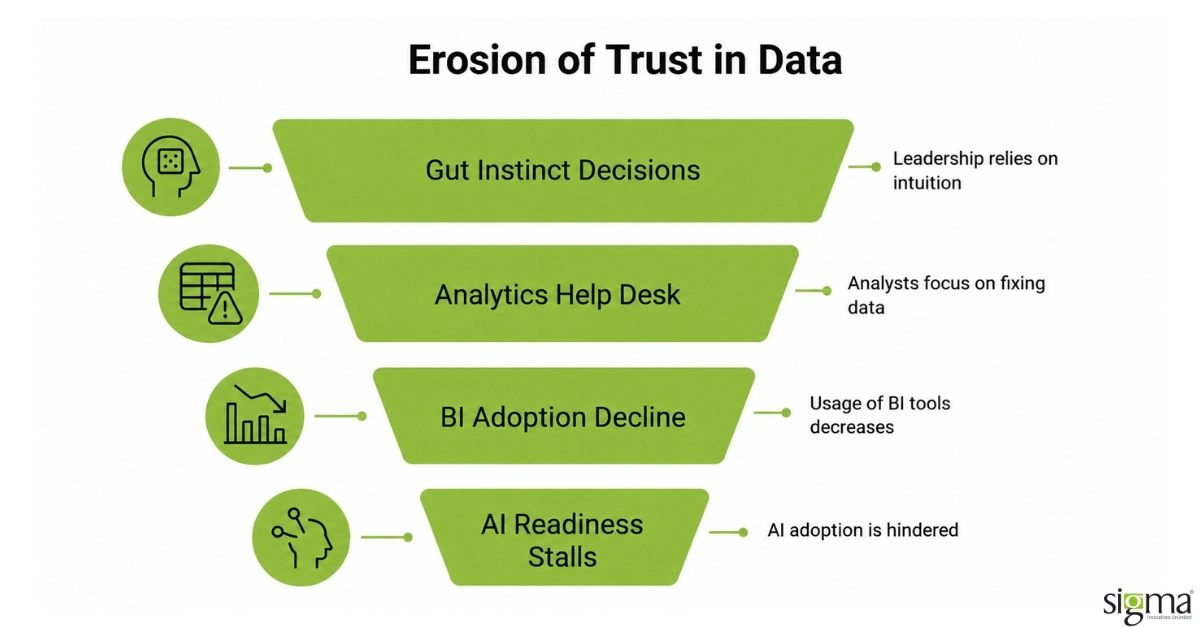
Conflicting numbers in one meeting are annoying. The downstream damage is structural.
Decisions revert to gut instinct. When dashboards cannot be trusted, leadership falls back on experience and intuition. That works at 10 employees. At 50 or 100, it produces inconsistent priorities because each leader operates from a different version of reality.
The analytics team becomes a help desk. Instead of identifying trends or surfacing opportunities, data analysts spend the majority of their time answering “why does this number look wrong” tickets. They become data janitors, manually reconciling reports that should have been consistent from the start.
BI adoption quietly dies. The dashboards exist. The licenses are paid. But usage drops month over month. Marketing builds their own tracking spreadsheet. Sales trusts CRM filters over the BI report. Finance runs everything through Excel. You are paying for a platform nobody uses because the data feeding it was never trustworthy.
AI readiness stalls. Every growth-stage company is being pushed toward predictive analytics and AI. But models trained on inconsistent data produce unreliable outputs dressed in fancier packaging. If descriptive analytics cannot be trusted, predictive analytics will not be trusted either.
Read the blog: The full picture of how data quality erodes confidence, and where DQM fits across cloud, BI, and compliance: turning data chaos into business confidence with data quality management.
How Data Quality Breaks Down Upstream
Nobody builds an untrustworthy pipeline on purpose. The problems accumulate quietly, and by the time they surface in a dashboard, the root causes are two or three layers upstream.
Conflicting Metric Definitions Across Systems
“Active customer” means “logged in within 30 days” in the product database, “has a current subscription” in billing, and “placed an order in 90 days” in the CRM. All three are valid in their own context. When a dashboard pulls from all three, the number is technically computed and practically meaningless.
Duplicate Records Nobody Catches
A customer exists in Salesforce, HubSpot, and Stripe as three separate records. Revenue gets triple-attributed. Segment counts inflate. Every downstream metric that depends on a clean customer count inherits the error silently.
No Validation at Ingestion
Data flows from source systems into the warehouse without automated checks. Null fields, wrong formats, and impossible values pass through and accumulate until a report breaks or two reports contradict each other.
Stale Batch Pipelines
Overnight ETL means the dashboard shows yesterday’s picture. For operational decisions in FinTech or eCommerce, a 12-hour lag makes the dashboard useless for anything time-sensitive.
No Data Ownership
Nobody is accountable for the quality of what flows from each source system. Problems persist across quarters because fixing them is everyone’s concern and nobody’s responsibility.
The following table maps each root cause to what it looks like in the pipeline and on the dashboard:
| Root Cause | Pipeline Symptom | Dashboard Impact |
| Conflicting metric definitions | Same entity counted differently across sources | CFO and VP of Sales show different revenue totals |
| Duplicate records | Same customer in 3 systems, no deduplication | Inflated counts, broken segment breakdowns |
| No ingestion validation | Nulls and format errors pass through silently | Incomplete breakdowns, unexplained data gaps |
| Stale batch data | 12-hour refresh cycle | Numbers lag behind real business activity |
| No data ownership | Nobody accountable for source quality | Same problems recur quarter after quarter |
How to Fix Data Quality Before It Reaches the Dashboard
The instinct is to fix the dashboard: adjust the query, add a filter, change the visualization. That treats the symptom. The fix belongs upstream, at the point where data enters the pipeline.
Build Data Validation Pipelines
Data validation pipelines enforce rules at ingestion. Customer ID cannot be null. Order date cannot be in the future. Revenue must be positive. Records that fail validation are quarantined for review instead of silently corrupting the warehouse. This single layer prevents the majority of “why does this number look wrong” investigations because bad data never reaches the BI dashboard in the first place.
Implement Master Data Management
Master data management creates a golden record for core entities: customers, products, vendors. Instead of three systems each maintaining their own version of a customer, MDM reconciles duplicates, standardizes formats, and establishes one authoritative record. For a company pulling from Salesforce, Stripe, and HubSpot, master data management is the difference between three conflicting customer counts and one reliable number.
Run Data Cleansing as a Continuous Pipeline
Data cleansing is not a one-time sprint before a board meeting. Automated rules standardize phone numbers, normalize company names, and merge duplicates continuously at the transformation layer. Once validation and MDM are in place, the volume of cleansing work drops because fewer bad records enter the system.
Establish BI Data Governance
BI data governance is what prevents the fix from degrading over time. It assigns ownership for each data domain, documents metric definitions so “active customer” means one thing everywhere, requires cross-system impact reviews when source fields change, and monitors quality through automated scorecards. Without governance, every quality improvement is temporary. The same drift that caused the original problems recreates them within months.
An 18% Discrepancy That Was Not a Math Error
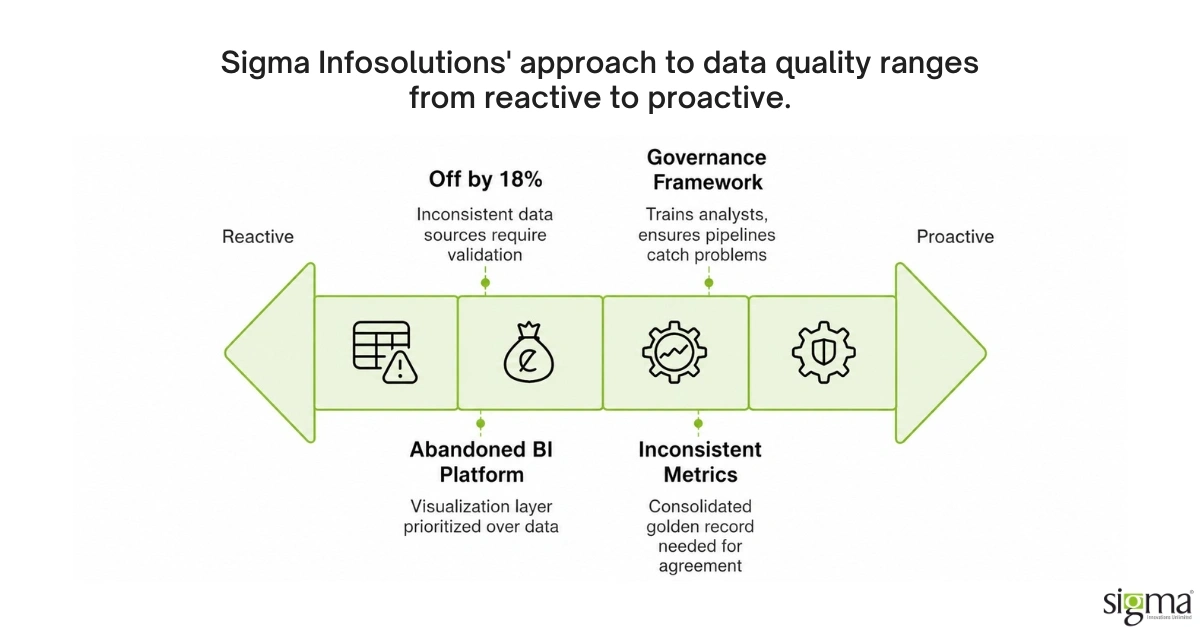
A FinTech client’s category-level revenue dashboards were off by 18% against the ERP. The BI team had spent three weeks auditing the queries and found nothing wrong, because there was nothing wrong with them.
The problem was three API-based data sources loading transaction records with inconsistent currency formatting and missing merchant category codes. Every calculation downstream of that was arithmetically correct and factually wrong. Sigma built validation rules at each ingestion point, implemented cleansing logic for the format inconsistencies, and set up automated alerts that catch quality regressions before they reach the reporting layer. Dashboard numbers matched the ERP within a week.
Read our success story: Natural-language access to governed data without waiting on analyst queues: A LangGraph-powered conversational BI agent.
The pattern generalizes. A B2B SaaS company with 40,000 customer records across Salesforce, HubSpot, and a billing platform had a board-level metric nobody could agree on, because “active customer” meant three different things depending on which system answered. Sigma consolidated the golden record, defined the canonical metric once, and built reconciliation logic so every downstream report draws from one source.
What Sigma does not do is clean the data and leave. The governance framework gets built, the client’s analysts get trained on monitoring quality scores, and the validation pipelines keep catching problems after the engagement ends, which is the entire point of building them through Sigma’s BI and Analytics Development Services rather than as a one-time cleanup.
Read our success story: Power BI integration with governed data models and row-level security for 50,000+ users: Empowering due diligence reporting.
Conclusion
The problem was never the dashboard. It was the duplicate records, missing fields, undefined metrics, and stale pipelines that corrupted the data before it reached the screen. Once executives lost trust in the numbers, they stopped using the platform entirely, and the BI investment stopped delivering value. Data quality management fixes this by pushing data validation pipelines, master data management, data cleansing, and BI data governance upstream into the pipeline where problems are caught before they become wrong numbers in a board meeting. Sigma Infosolutions helps growth-stage companies build that upstream quality layer so their analytics investment produces decisions, not debates.
Frequently Asked Questions
What is data quality management and why does it matter for BI?
Data quality management is the ongoing practice of validating, cleansing, and governing data to ensure accuracy and consistency across systems. For BI, it determines whether dashboards produce numbers executives trust and act on, or conflicting reports that drive teams back to manual spreadsheets and erode confidence in the entire analytics investment.
How do data validation pipelines prevent dashboard errors?
Data validation pipelines apply automated checks at data ingestion, catching null values, format errors, and rule violations before records enter the warehouse. By quarantining failed records instead of loading them silently, these pipelines ensure only verified data feeds into dashboards, eliminating the most common source of reconciliation investigations.
When does a company need master data management?
Master data management becomes necessary when a company operates three or more source systems with overlapping entity definitions, producing duplicate records and conflicting counts. The typical trigger is a leadership meeting where the same metric shows different numbers depending on which system generated the report.
What is BI data governance and why does it prevent quality from degrading?
BI data governance assigns ownership for data domains, documents metric definitions, requires impact reviews when source fields change, and monitors quality through automated scorecards. Without it, data quality improvements are temporary because the same definition drift and ownership gaps that caused the original problems will recreate them within months.
How does Sigma help fix data quality for BI dashboards?
Sigma builds upstream quality infrastructure: validation rules at ingestion, data cleansing automation, MDM for entity reconciliation, and governance frameworks with quality monitoring. The team works inside the client’s existing stack and trains internal analysts to maintain quality independently, so the fix is permanent rather than a recurring cleanup project.