Headless vs Monolithic Commerce: MACH Architecture Explained

Key Highlights
- Older monolithic platforms make every change slow and risky, and that drag quietly shows up as lost sales and a worse customer experience.
- Going headless with a MACH architecture splits the storefront from the commerce engine, so teams can ship faster and plug in the tools they actually want.
- Sigma reviews what you run today, maps a migration that will not take the store offline, and builds headless commerce that scales.
Introduction
Sooner or later, most commerce teams hit the same wall. The catalog grows, a second sales channel shows up, marketing wants a new landing page live by Friday, and the platform says no. Or it says yes, but only after six weeks and a tense release. That wall is usually the architecture underneath the store, and the choice of headless vs monolithic commerce decides how high it sits.
Ignore it, and the costs pile up quietly. Releases slow down. A small integration turns into a quarter-long project. The site gets heavier, pages load slower, and shoppers leave before they buy. None of it looks like a crisis on any single day, which is exactly why it goes unaddressed for years.
Headless commerce and MACH architecture take a different route. Split the customer experience from the commerce logic, and your team can move on the front end without touching the plumbing behind it. That is the whole pitch. The rest of this guide unpacks what it means in practice, and when it is actually worth the effort.
Read the blog: Why Coders Should Go Headless with Magento? – Benefits & Challenges
What Is Monolithic Commerce Architecture?
A monolithic platform keeps everything in one place. Storefront, catalog, checkout, promotions, content, back-office logic- all of it lives in a single codebase, usually talking to a single database. Classic Magento builds, and the older enterprise suites work this way.
For a long time that was fine, and for plenty of smaller stores it still is-one system, one vendor, one place to look when something breaks. A single team can learn the platform and run the whole thing end to end.
The trouble starts as you grow. Everything is wired together so that a checkout change can ripple into the catalog, and a front-end redesign drags you into core commerce code. Testing balloons, releases get nerve-wracking, and progress slows to a crawl. That friction is what sends teams looking for another way.
What Is Headless Commerce?
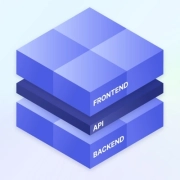
Headless commerce pulls the front end, the “head,” away from the back-end commerce engine. The two talk over APIs. So the storefront can be built in whatever modern framework your team likes, while the commerce logic keeps running underneath, untouched.
The freedom is the point. Redesign the site, launch an app, add a kiosk in a store- none of it forces you back into the commerce core. One back end can feed a website, a mobile app, a marketplace listing, and a connected device all at once.
Is headless commerce worth it? That depends on how complex your business really is. If you sell across a handful of channels, test constantly, or expect fast growth, a headless commerce platform earns its keep. If you run one channel and a small catalog, you may not need it yet, and that is a perfectly good answer.
What Is MACH Architecture, and What Does MACH Stand For?
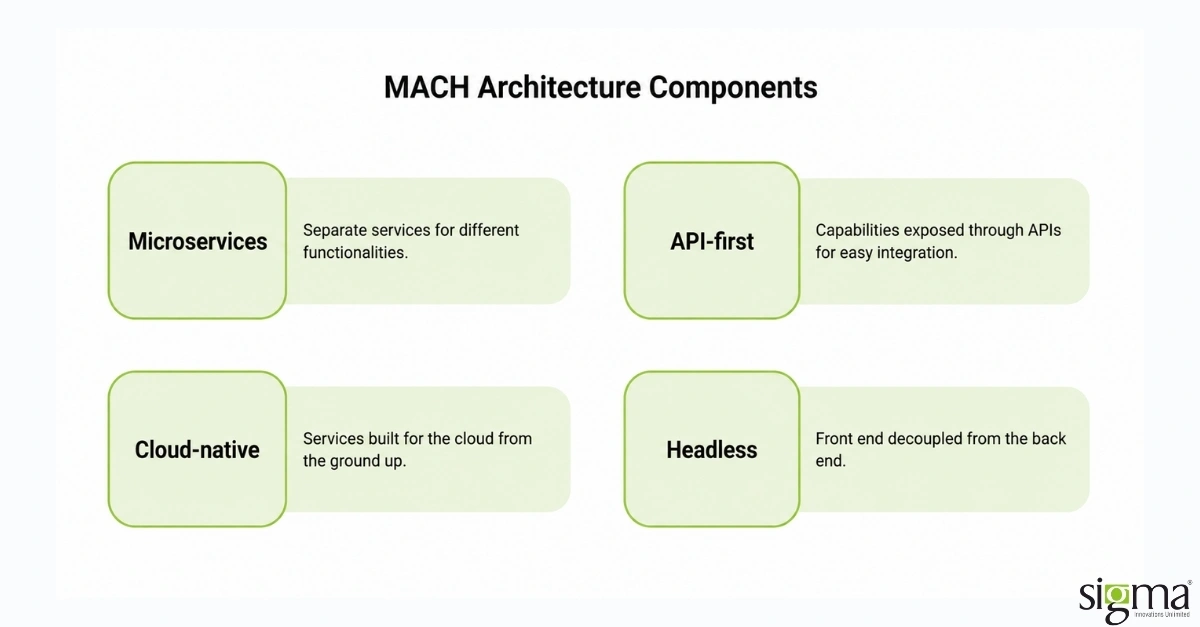
MACH is the blueprint that makes headless work at scale. It stands for Microservices, API-first, Cloud-native, and Headless. The idea is simple: build the system out of separate, swappable parts instead of one big block.
- Microservices architecture: Search, checkout, promotions, and the rest each run as their own service, so you can update one without disturbing the others.
- API-first commerce: Every capability is exposed through an API, which makes connecting things predictable instead of painful.
- Cloud-native commerce: The services are built for the cloud from the start, not shoved onto it later.
- Headless: The front end stays decoupled from the back end, so the experience layer is yours to shape.
There is even an industry group, the MACH Alliance, pushing open and composable technology so these pieces play nicely together. For most enterprises modernizing a legacy stack, MACH is now the default starting point for the conversation.
Headless vs Composable Commerce: Clearing the Confusion
People throw around “headless” and “composable” as if they mean the same thing. They do not, and the difference between headless and composable commerce is worth getting straight before you plan a build.
Headless is one specific move: split the front end from the back end. Composable commerce is the bigger idea. It means building your whole stack from best-of-breed, packaged business capabilities: one vendor for search, another for payments, another for content, all wired together through APIs.
Most real projects land somewhere in between. You go headless first to free up the front end, then swap out monolithic modules for specialized services over time, as the case for each one becomes clear. Nobody has to boil the ocean on day one.
Headless vs Monolithic: The Core Differences
Put headless vs monolithic ecommerce architecture side by side and the trade-offs get obvious fast.
| Factor | Monolithic | Headless / MACH |
| Release speed | Slower, tightly coupled | Fast, independent deployments |
| Scalability | Scales as one unit | Scales services individually |
| Integrations | Custom and rigid | API-first and flexible |
| Multichannel reach | Limited | Native across channels |
| Front-end freedom | Constrained by platform | Any modern framework |
| Upfront complexity | Lower | Higher |
| Long-term agility | Declines with scale | Grows with the business |
The short version: monolithic is easier and cheaper to start; headless and MACH pull ahead once scale and complexity kick in. Pick based on where the business is going, not just where it sits this quarter. For most companies with real growth plans, that arrow points toward a decoupled architecture.
Headless Commerce Pros and Cons
Nothing here is free, so it helps to be honest about the headless commerce pros and cons before you spend the budget.
On the plus side: faster releases, freedom to use modern front-end frameworks, cleaner integrations, better page speed and Core Web Vitals, and genuine reach across channels. These benefits of MACH architecture for ecommerce tend to grow as you add channels and traffic.
The catch is that headless asks more of you up front. You need real architectural planning, an engineering team or partner who has done it before, and the discipline to manage a lot of moving APIs. For a tiny single-channel store, a monolithic platform can still be the smarter, cheaper call.
When to Migrate from Monolithic to Headless Commerce
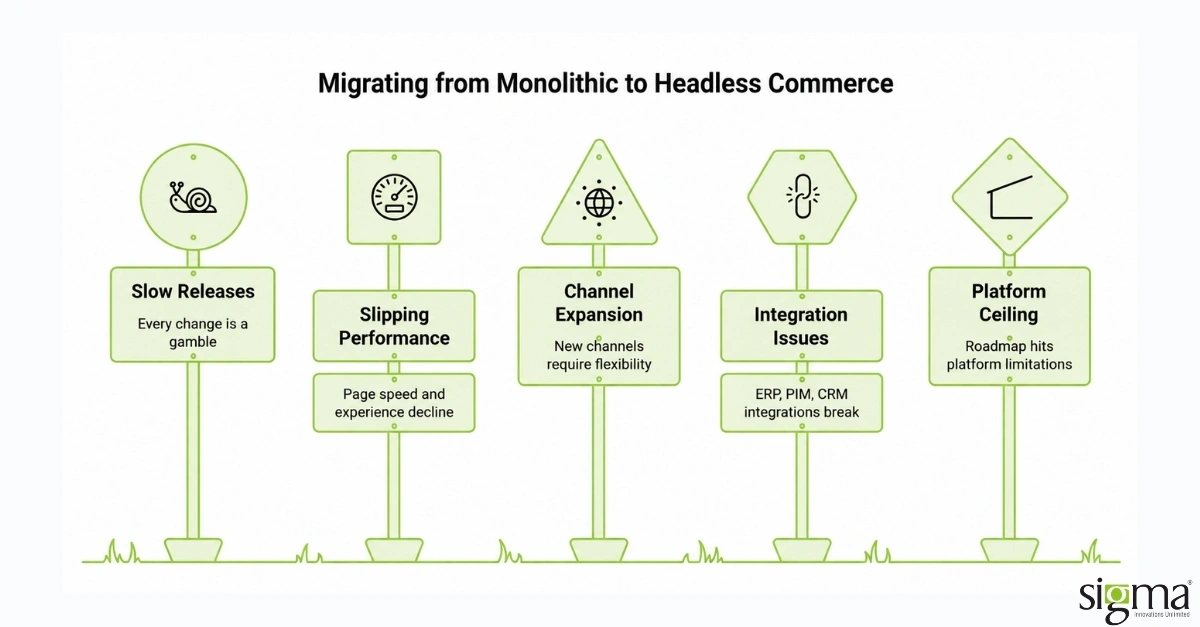
Timing is half the decision. Move too early, and you carry complexity you do not need. Move too late, and you bleed sales while you wait. A few signals tell you when to migrate from monolithic to headless commerce:
- Releases drag, and every change feels like a gamble.
- Page speed and the shopping experience are clearly slipping.
- You are pushing into new channels, new regions, or a B2B model.
- ERP, PIM, and CRM integrations keep breaking or slowing everyone down.
- Your roadmap keeps hitting the same platform ceiling.
When two or three of these show up together, replatforming toward headless usually pays for itself. Teams that go composable often find releases get shorter and experiments get easier, which frees people to work on the customer instead of babysitting the platform.
MACH Architecture for B2B Ecommerce
B2B is no longer the simpler sibling of B2C, and MACH architecture for B2B ecommerce is a big reason more of these projects are getting greenlit. Buyers want the slick, consumer-grade experience, but the back end still has to handle contract pricing, approval chains, and multi-level account structures.
A headless, composable setup handles both. You get a buyer experience you can tailor, plus deep hooks into ERP, CRM (such as Salesforce), and procurement networks. And because one back end can serve B2B and B2C at the same time, businesses running both models finally get a single source of truth instead of two systems that disagree with each other.
How Sigma Infosolutions Helps Build Scalable Headless Commerce
Sigma Infosolutions works with enterprises on exactly this kind of shift: moving off legacy platforms and onto modern, API-first commerce without putting revenue at risk along the way. Here is how that plays out.
Architecture Evaluation
First, Sigma looks at what you actually run today, finds the bottlenecks, and lays out a path to headless or composable commerce that fits your goals rather than a stock template.
Solution Architecture
From there, Sigma designs MACH-aligned solutions on microservices, API-first patterns, and cloud-native foundations, so each part can scale and change on its own without breaking the rest.
Migration and Replatforming
The move happens in phases. Critical pieces go first, the rest follow in a controlled order, and the store stays live the whole way through. No big-bang cutover, no crossed fingers.
Agile Development
With hands-on headless and composable experience across the major platforms, Sigma builds decoupled storefronts and integrations for both B2B and B2C, shipping in short cycles so you see value early.
Cloud Engineering and Ongoing Support
As an AWS Partner Network (APN) member maintaining ISO 9001:2015 (Quality Management) and ISO/IEC 27001:2022 (Information Security) certified processes, Sigma runs secure, cloud-native infrastructure and sticks around after launch instead of disappearing once the site goes live.
Read our success story: Upgrading the Magento Platform and Implementing Headless Architecture for an Oceania-based client
Conclusion
In the end, headless vs monolithic commerce comes down to one question: how much room to move does your business need? Monolithic is simple to start but tends to box you in as channels and complexity grow. Headless and MACH take that ceiling away.
Split the front end, lean on API-first microservices, and pull in the best-of-breed tools you actually want, and you end up with a commerce stack that bends instead of breaking. Faster releases, better experiences, and a platform that keeps up with the business rather than holding it back.
Sigma Infosolutions helps you make that move, from the first architecture review through migration and the long haul after go-live.
FAQs
What is the difference between headless and monolithic commerce?
Monolithic commerce combines frontend and backend in one system, while headless commerce separates them through APIs.
What does MACH stand for in commerce architecture?
MACH stands for Microservices, API-first, Cloud-native, and Headless architecture.
Is headless commerce worth it for growing businesses?
Yes, headless commerce improves flexibility, scalability, and speed for businesses managing multiple channels and rapid growth.
When should a company migrate from monolithic to headless commerce?
Businesses should consider migration when releases slow down, integrations become difficult, and omnichannel requirements increase.
What are the main benefits of MACH architecture for eCommerce?
MACH enables faster deployments, independent scaling, seamless integrations, and greater front-end flexibility.
What is the difference between headless and composable commerce?
Headless separates the presentation layer from the backend, while composable commerce combines multiple best-of-breed services through APIs.
Can MACH architecture support B2B eCommerce requirements?
Yes, MACH supports complex B2B needs such as contract pricing, approval workflows, account hierarchies, and ERP integrations.
How does headless commerce improve customer experience?
Headless commerce enables faster page loads, personalized experiences, and consistent shopping journeys across digital channels.