How to Prepare Your e-Commerce Store for the July 4th Sales Rush

Key Highlights
- e-Commerce platforms without proactive performance optimization lose significant e-Commerce sales revenue when traffic surges overwhelm unscaled infrastructure during the July 4th events.
- Sigma Infosolutions audits and optimizes CDN configuration, caching layers, and auto-scaling policies to ensure platforms remain stable at peak-traffic volumes.
- Stores that fail to prepare for seasonal traffic spikes face site crashes, cart abandonment, and lasting damage to customer trust that extends well beyond the holiday window.
- Brands that invest in pre-event engineering readiness consistently report higher conversion rates and lower bounce rates during e-Commerce holiday marketing campaigns.
Introduction
e-Commerce sales during the July 4th weekend represent one of the most concentrated revenue opportunities of the US retail calendar. Consumer spending surges across categories, including apparel, home goods, electronics, and outdoor products, driving traffic volumes that can exceed daily baselines by several multiples. For founders, CTOs, and VP Engineering leaders at growth-stage and mid-market retail brands, this period demands more than compelling 4th of July sale ideas and aggressive promotions. It demands a platform that is technically capable of absorbing sudden, high-volume demand without degrading the customer experience. Brands that prepare their infrastructure in advance capitalize on the surge; those that do not face outages, abandoned carts, and preventable revenue loss.
Why Peak-Season Scalability Is a Business-Critical Priority
The Revenue Window Is Narrow and Unforgiving
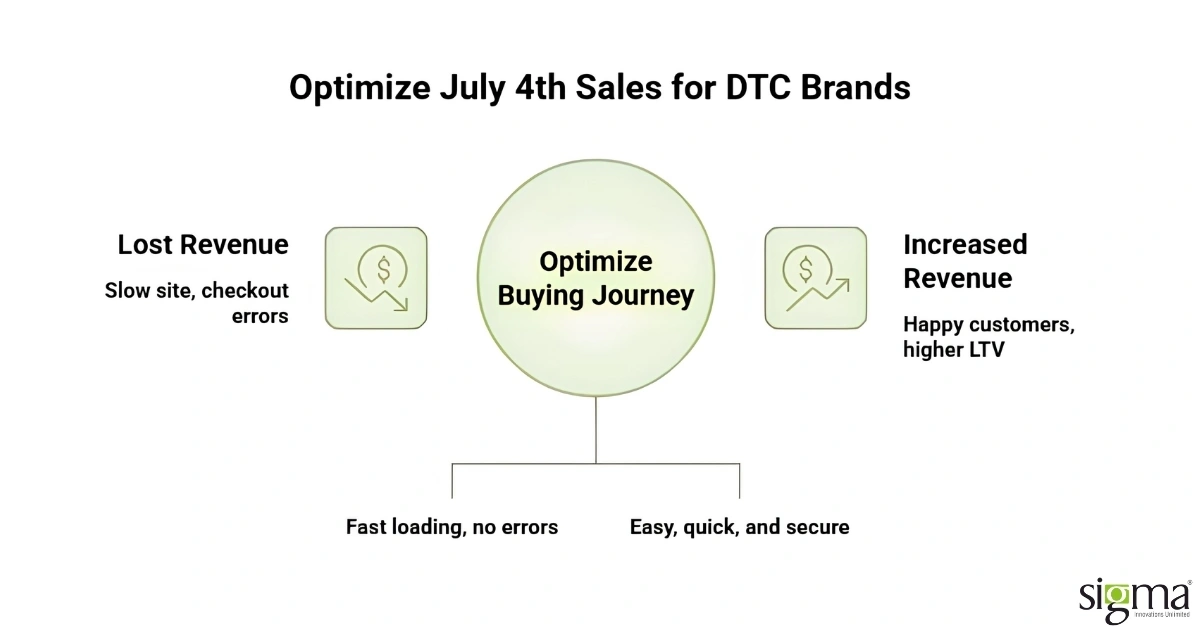
The July 4th sales period is time-compressed by nature. Consumers make purchase decisions within short windows driven by promotional urgency, and any friction in the buying journey accelerates abandonment. A site that loads slowly or returns checkout errors during this window does not receive a second chance. The customer moves to a competitor, and the revenue is permanently lost.
For DTC brands and growth-stage retailers operating with lean engineering teams, the downstream effect of a single outage during peak hours extends beyond the immediate transaction loss. It affects paid media return on ad spend, email campaign performance, and customer lifetime value projections for newly acquired buyers.
Read The Blog: Holiday Ecommerce Sales Trends That Every Business Must Know
Traffic Spikes Expose Infrastructure Gaps That Normal Operations Conceal
e-Commerce platforms functioning acceptably under standard traffic conditions frequently expose critical bottlenecks when demand escalates rapidly. Database connection pools that handle routine query volumes become exhausted under concurrent load. Application servers that serve pages efficiently at low concurrency begin queuing requests and timing out.
These failure modes do not present themselves during normal operations, which is precisely why pre-event load testing and infrastructure review are non-negotiable preparation steps.
Core Technical Areas to Address Before July 4th
Server Capacity and Auto-Scaling Configuration
The foundation of peak-season readiness is a cloud infrastructure configured to scale horizontally in response to traffic demand. Auto-scaling policies on platforms such as AWS, Google Cloud, and Azure must be defined, tested, and validated before the event begins. Scaling triggers based on CPU utilization, request count, and memory thresholds must be calibrated to activate with sufficient lead time to provision new instances before existing ones become saturated.
Load testing using tools such as k6 or Apache JMeter should simulate traffic volumes exceeding the projected peak by at least 25 percent. This safety margin ensures that the infrastructure remains stable even if actual demand surpasses forecasts, which is a realistic scenario during a high-visibility e-Commerce summer sale.
Read the blog: Is Site Speed the Grinch Stealing Your Sales? The Case for Website Performance Optimization
CDN Configuration and Cache Warming
A correctly configured content delivery network is the most effective single mechanism for absorbing traffic volume during a high-demand event. Static assets, promotional banners, category pages, and product images must be pre-warmed in the CDN cache before campaign traffic begins arriving. Cache-control headers must be reviewed to ensure promotional content is served from edge nodes rather than forcing repeated origin server requests.
For platforms including Magento, Shopify Plus, and BigCommerce, application-layer cache settings must align with CDN policies to prevent conflicting invalidation rules that eliminate caching benefits entirely. An improperly configured CDN during a July 4th promotion can accelerate origin server failure rather than prevent it.
Front-End Performance and Core Web Vitals
Front-end performance has a direct, measurable relationship with e-Commerce sales conversion rates. Google Core Web Vitals metrics, specifically Largest Contentful Paint, Cumulative Layout Shift, and Interaction to Next Paint, must fall within acceptable thresholds before peak traffic arrives. Poor scores on these metrics correlate with higher bounce rates and lower transaction completion rates.
Standard front-end optimizations include image compression, lazy loading for below-the-fold assets, JavaScript bundle splitting, and elimination of render-blocking resources. These improvements benefit both organic search visibility and on-site conversion performance, making them high-return investments ahead of any e-Commerce holiday marketing campaign.
Improve Website Speed Before Peak Holiday Traffic
Boost Core Web Vitals, reduce page load times, optimize checkout performance, and improve conversion rates with Sigma’s Website Performance Optimization Services designed for high-growth eCommerce businesses.
Checkout and Payment Gateway Reliability
The checkout flow carries the highest revenue density of any page segment and must function without error under peak concurrent load. Payment gateway rate limits, tokenization configurations, and fallback routing policies must all be verified. Third-party integrations within the checkout path, including loyalty widgets, address validation services, and upsell modules, must be audited for latency and failure handling.
Real-time monitoring tools such as Datadog or New Relic should be configured with alerting thresholds specific to checkout error rates, ensuring that engineering teams receive immediate notification of any degradation during the sale window.
Optimize Payment Performance During Peak Sales Events
Reduce checkout failures, improve transaction success rates, and strengthen payment infrastructure with Sigma’s Digital Payment Solutions for secure, scalable, and seamless payment experiences.
Aligning 4th of July Promotion Ideas With Engineering Requirements
Strong 4th of July promotion ideas and 4th of July sale ideas each carry specific technical dependencies that must be addressed in advance. The following table maps common promotional tactics to their corresponding engineering requirements:
Promotion Type | Engineering Dependency | Preparation Required |
| Flash Sale with Countdown Timer | Real-time inventory sync, cache invalidation | Verify cache TTL settings and test inventory API under load |
| Tiered Discount Structures | Pricing engine rule configuration | End-to-end UAT in staging environment |
| Bundle and Kit Offers | Product relationship logic, cart calculations | Regression testing across device types |
| Referral and Influencer Campaigns | UTM tracking, analytics pipeline capacity | Validate event tracking under high concurrency |
| Free Shipping Thresholds | Cart rule triggers, shipping API integration | Load test cart rule evaluation at peak concurrency |
| Email-Triggered Promo Codes | Coupon validation logic, usage limits | Stress test redemption flow with concurrent users |
Every marketing initiative a team plans for the July 4th weekend introduces a corresponding engineering task. Misalignment between promotional timelines and engineering readiness is one of the most common and preventable causes of campaign failure.
Monitoring and Incident Readiness During the Event
Preparation does not end at launch. Active monitoring throughout the July 4th sales window is essential for detecting and responding to anomalies before they escalate into outages. Dashboards covering server response times, error rates, CDN cache hit ratios, and checkout completion rates must be reviewed continuously by designated engineering personnel during peak hours.
Incident response runbooks must be prepared in advance, documenting escalation paths, rollback procedures, and communication protocols. A team that knows exactly what to do when an alert fires resolves issues in minutes rather than hours, a difference that is directly measurable in recovered revenue during a time-limited e-Commerce summer sale.
How Sigma Infosolutions Helps Maximize e-Commerce Sales During July 4th
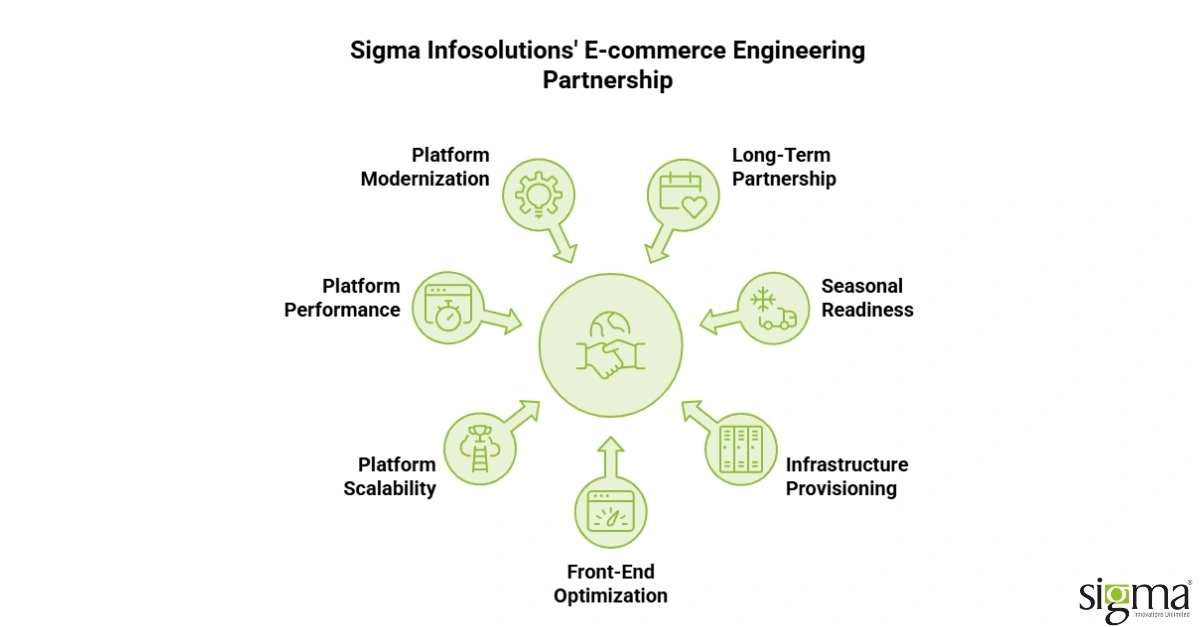
Sigma Infosolutions serves as the long-term e-Commerce engineering partner for founders, CTOs, and VP engineering leaders at growth-stage and mid-market retail brands that cannot afford infrastructure failures during critical revenue windows. Sigma’s structured approach to seasonal readiness covers every layer of the technology stack, from infrastructure provisioning to front-end performance optimization. Beyond seasonal readiness, Sigma partners with e-Commerce brands on an ongoing basis to ensure platform scalability, performance, and modernization across every phase of growth.
Platform Audit and Diagnostics: Sigma conducts a comprehensive review of the existing e-Commerce platform, identifying performance bottlenecks in server configuration, database query patterns, caching policies, and asset delivery pipelines. The output is a prioritized remediation roadmap aligned to the July 4th preparation timeline.
CDN and Caching Optimization: Sigma’s engineers configure and validate CDN rules across providers, including Cloudflare, Fastly, and AWS CloudFront. Cache warming strategies are executed in advance of campaign launches to ensure promotional content is delivered at edge speed from the first moment traffic arrives.
Auto-Scaling and Load Testing Sigma provisions and validates auto-scaling configurations on AWS and other cloud environments, then conducts load testing to confirm that the platform sustains stability at projected peak volumes. This process surfaces any remaining infrastructure gaps while there is still time to address them.
Front-End Performance Engineering Sigma resolves Core Web Vitals deficiencies, implements lazy loading, optimizes image delivery, and eliminates render-blocking scripts. For Magento merchants, Sigma’s expertise with the Hyvä theme framework delivers substantial performance gains that directly improve conversion rates during high-traffic e-Commerce holiday marketing campaigns.
AI-Driven Platform Modernization Beyond event readiness, Sigma brings AI and digital transformation capabilities that help growth-stage e-Commerce brands future-proof their platforms. From intelligent personalization to automated analytics, Sigma’s engineering expertise enables brands to scale intelligently well beyond any single sales event.
Real-Time Monitoring and Event Support Sigma deploys monitoring dashboards and alert configurations ahead of the event and maintains engineering availability throughout the peak sales window. This ensures that any anomaly is detected and resolved with minimal impact on the customer experience and revenue outcome.
Build a Peak-Traffic Ready Commerce Platform
Prepare for holiday traffic surges with Sigma’s Platform Engineering Services, delivering cloud scalability, Kubernetes implementation, DevOps automation, load testing, performance optimization, and resilient infrastructure for high-growth eCommerce businesses.
Conclusion
e-Commerce sales during the July 4th weekend reward brands that treat infrastructure readiness as a strategic priority rather than an afterthought. The combination of proactive performance auditing, CDN optimization, auto-scaling validation, and real-time monitoring determines whether a platform capitalizes on peak demand or collapses under it. Aligning 4th of July promotion ideas with their corresponding engineering requirements is equally critical to ensuring that marketing investments translate into completed transactions.
Sigma Infosolutions provides the technical expertise and long-term partnership that founders, CTOs, and VP Engineering leaders at growth-stage and mid-market retail brands need to enter the July 4th sales rush with full confidence in their platform. Preparation initiated early and executed thoroughly is the clearest path to maximizing revenue during one of the most competitive retail events of the summer.
Scale Digital Commerce for Peak Sales and Long-Term Growth
Prepare your store for high-traffic events with Sigma’s eCommerce Development Services, including Magento, Shopify, BigCommerce, checkout optimization, and scalable digital commerce solutions.
FAQs
1. How can I increase e-Commerce sales during the July 4th weekend?
Increasing e-Commerce sales during July 4th requires a combination of compelling promotions and a technically reliable platform. Offer time-sensitive discounts, bundle deals, and free shipping thresholds to drive urgency. Simultaneously, ensure your infrastructure is load-tested, your CDN is properly configured, and your checkout flow is verified to handle peak concurrent traffic without errors or slowdowns.
2. What are the best 4th of July sale ideas for e-Commerce brands?
Effective 4th of July sale ideas include flash sales with countdown timers, tiered discounts based on cart value, patriotic-themed product bundles, and exclusive email subscriber offers. Each promotion type requires specific technical preparation, including pricing engine configuration, cache invalidation planning, and inventory sync validation, to ensure the customer experience remains smooth when traffic volumes peak.
3. How does e-Commerce holiday marketing differ from standard campaigns?
e-Commerce holiday marketing operates under compressed timeframes and significantly higher traffic volumes than standard campaigns. The stakes are higher because consumer intent is strong and promotional windows are short. This requires advanced engineering work, including load testing, CDN cache warming, and checkout stress testing that standard campaigns do not typically demand, making pre-event technical preparation a core component of campaign success.
4. What causes e-Commerce sites to slow down during a summer sale?
e-Commerce sites slow down during a summer sale primarily due to unscaled server infrastructure, cache misses on high-traffic pages, unoptimized database queries, and render-blocking front-end assets. Third-party scripts in the checkout flow and poorly configured auto-scaling policies are also frequent contributors. Addressing these issues through a structured performance audit before the event significantly reduces the risk of degradation.
5. How does Sigma Infosolutions help prepare e-Commerce platforms for peak traffic?
Sigma Infosolutions conducts end-to-end platform audits, configures CDN and auto-scaling policies, resolves Core Web Vitals issues, and deploys real-time monitoring ahead of peak events. Their engineering expertise across Magento, Shopify Plus, and BigCommerce ensures that growth-stage and mid-market retail brands handle July 4th traffic volumes without performance failures, protecting both revenue outcomes and long-term customer trust.