Salesforce CPQ Readiness: What Sales Leaders Need to Evaluate Before the Investment Gets Approved

Key Highlights:
- Sales teams juggling manual quoting lose deals to slow turnaround and pricing mistakes that nobody catches until the discount has already eaten the margin.
- Salesforce CPQ automates product configuration, pricing rules, and approval routing directly inside the CRM, so a rep produces an accurate quote in minutes instead of days.
- Standardizing pricing logic this way removes the guesswork from every quote, which shortens the sales cycle and gives leadership a single, reliable view of every deal in the pipeline.
- Sigma configures Salesforce CPQ around your actual catalog, pricing rules, and approval chain rather than a generic template, so the system matches how your team already sells.
Introduction
A sales team that spends more hours building quotes than talking to prospects has a process problem, not a headcount problem. For a B2B company with a real product catalog, tiered pricing, or a multi-step approval chain, generating one accurate quote can take a full day or longer once every custom configuration and sign-off is accounted for. Salesforce CPQ, short for Configure, Price, Quote, is built to close that gap. It automates product selection, pricing, and quote generation directly inside Salesforce, which turns a task that used to involve spreadsheets, email chains, and manual math into a guided flow a rep completes in minutes. The harder question for most revenue leaders is not what the tool does. It is whether their team’s actual complexity, catalog size, pricing structure, and approval requirements justify adding it.
Plan Your Salesforce CPQ Investment With Confidence
What Salesforce CPQ Actually Does
Salesforce CPQ is a native Salesforce application that sits on the opportunity record and handles three connected jobs. Configure lets a rep build a valid quote by selecting products and options the system already knows work together, which prevents the kind of incompatible bundle that causes rework after a deal closes. Price applies discount schedules, approval thresholds, and customer-specific terms automatically, so the number on the quote reflects the company’s actual pricing policy rather than whatever the rep remembers or negotiates on the fly. Quote generates a branded, ready-to-sign document, often with e-signature built in, without the rep leaving the CRM to assemble it manually. The distinction that matters for a revenue leader evaluating this is that every quote pulls from live CRM data, the real product catalog, and the real opportunity record, rather than a static spreadsheet someone forgot to update. That is what turns Salesforce CPQ from a documentation tool into a control layer over pricing and margin.
The Cost of Running Without It
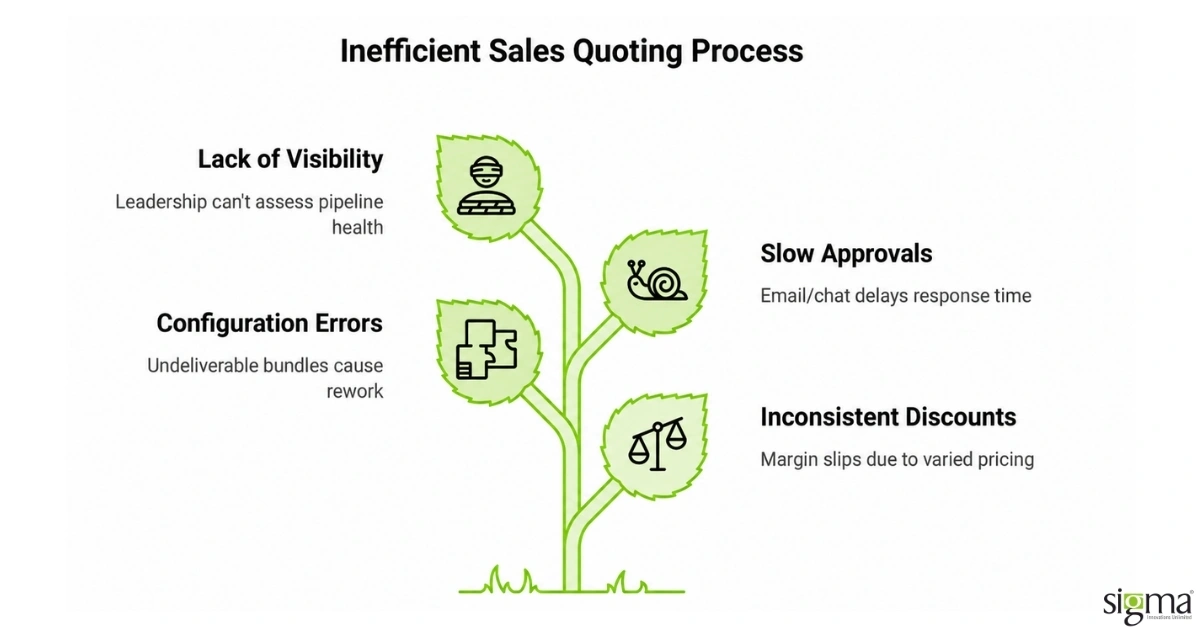
Manual quoting rarely shows up as a line item on a P&L, which is exactly why it survives so long inside a growing sales organization. Different reps quietly apply different discounts on comparable deals, and nobody notices the pattern until aggregate margin has already slipped. Configuration mistakes slip through in the absence of enforced rules, which means a deal gets signed on a bundle that cannot actually be delivered as quoted, triggering rework, a client conversation nobody wants to have, and a delayed start date. Approval requests routed through email or chat add days to a cycle that a prospect is timing against your competitor’s response time. Perhaps the most costly effect is the one leadership never sees directly: without a system of record for quote terms, discount history, and approval decisions, a VP of Sales or CRO cannot answer a basic question about pipeline health without asking around. None of these costs require a new competitor or a market shift to hurt the business. They compound quietly as headcount and deal volume grow, which is why the case for fixing them tends to become obvious only after the damage is already measurable in cycle time and margin.
When Complexity Actually Justifies the Investment
Not every sales team needs Salesforce CPQ, and forcing it onto a simple pricing model adds overhead without a matching return. A company selling one product at one price with no approval chain will get little from a configuration and pricing engine built for complexity it does not have. The test is not whether quoting feels slow. It is whether the underlying complexity that makes it slow is structural and growing, in which case the problem will not resolve itself as the team scales.
| Signal | Justifies CPQ Now | Not Yet a Priority |
| Catalog Complexity | Multiple configurations, bundles, or add-ons that combine in non-obvious ways | One product, one price, no meaningful configuration |
| Pricing Structure | Varies by volume, customer tier, contract length, or geography | Flat pricing with no tiering or negotiation |
| Approval Requirements | Discounts above a threshold require manager or deal-desk sign-off | No formal approval chain needed |
| Revenue Model | Subscription or recurring revenue where terms must stay aligned with billing | One-time sale with no ongoing contract terms |
| Quote Volume | Reps lose meaningful time to repetitive, error-prone quote-building | Quoting is infrequent and already fast |
B2B SaaS companies, vertical software platforms, and technology services firms hit this threshold earliest, because their pricing and packaging complexity tends to grow faster than their headcount.
Scoping the Investment Honestly
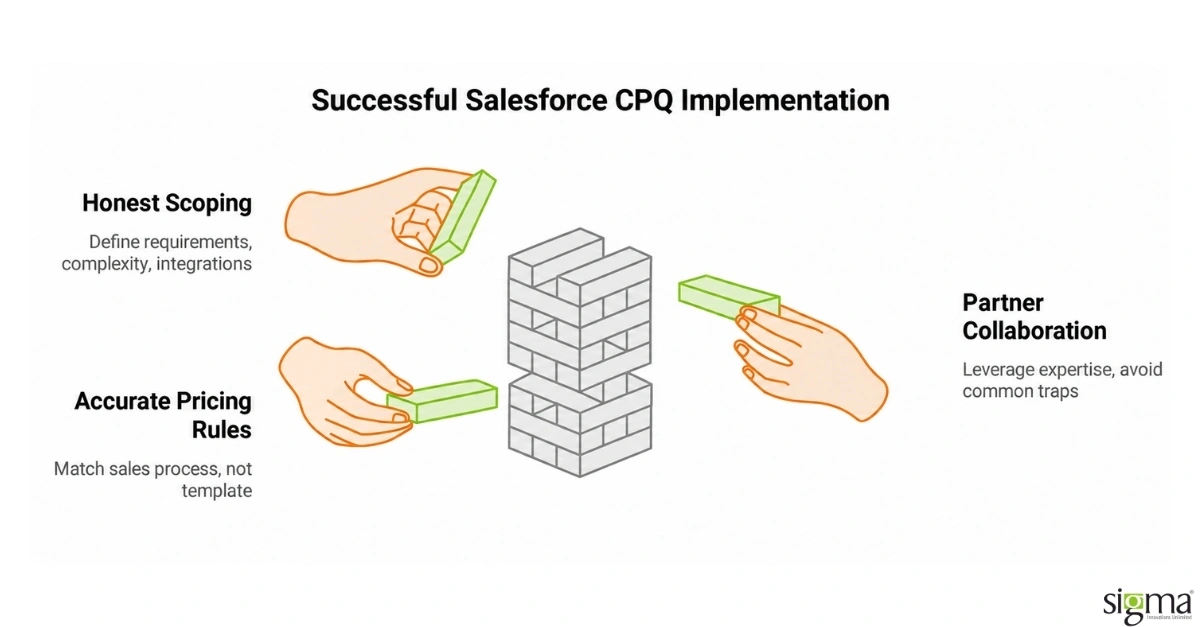
Salesforce CPQ is licensed separately from Sales Cloud on a per-user, per-month basis, and the real cost of a project extends well past that license fee once implementation and customization are counted. How complex that implementation gets depends on catalog size, the number of distinct pricing rules, and how tightly the system needs to connect to billing, ERP, or existing workflows. For a mid-market company with moderate complexity, a properly scoped implementation typically reaches go-live in eight to twelve weeks, a timeline that stretches with catalog complexity and integration depth. Working with an experienced Salesforce partner reduces risk on both dimensions: a partner who has seen the common configuration traps before builds pricing rules and approval logic that match how the team actually sells, rather than forcing the sales process to bend around a generic template. This upfront scoping conversation is where most of the risk in a Salesforce CPQ project actually lives, and skipping it is the most common reason implementations run long or require costly rework after go-live.
Mapping the Real Quoting Workflow Before Touching Configuration
Deciding whether Salesforce CPQ is worth the investment is a scoping problem before it is a technical one, and most vendors skip straight to configuration without doing that work properly. Sigma starts every engagement by mapping the actual quoting workflow, product catalog structure, and approval logic already in use, since a configuration built against an assumed process rather than the real one is the most common reason CPQ projects underdeliver. From there, Sigma’s architects design the data model, pricing rule sets, and product hierarchy to fit both current volume and where the business is headed, then configure the system in iterative sprints so sales and operations can test against real deal scenarios at each stage rather than discovering gaps after go-live. Sigma completed a Salesforce-to-Salesforce integration for a specialty finance company operating across home improvement, HVAC, roofing, and solar dealer networks, unifying data between separate Sales, Marketing, and Operations orgs. That engagement cut manual data transfer effort by 85 percent and API consumption by 80 percent while holding sub-one-second synchronization latency, evidence of the same underlying discipline, mapping the real workflow before touching configuration, that a CPQ evaluation and rollout depends on. Sigma applied the same workflow-first discipline, customizing a Salesforce CRM implementation for a US-based client, building the data model around how the sales team actually worked rather than a default configuration.
Read our success story: Multi-org Salesforce operations unified and manual data duplication eliminated for a specialty finance company.
Sigma Infosolutions Maps Your CPQ Workflow Before Touching Configuration
A successful Salesforce CPQ implementation starts with understanding how your sales process actually works. Sigma begins by mapping the product catalog, quoting steps, pricing rules, approval requirements, and handoffs already in place. This reveals where CPQ can remove manual work, where existing Salesforce configuration needs to change, and where process decisions need to be made before configuration begins.
The next step is to translate that workflow into a practical Salesforce design. Product hierarchies, pricing logic, approval rules, data structures, and integrations are configured around real sales scenarios rather than a generic template. Iterative testing with sales and operations teams then validates the configuration against the way quotes are actually created, reviewed, approved, and closed.
This workflow-first approach also applies when Salesforce environments need to be connected or customized. Sigma’s experience includes multi-org Salesforce integration and CRM customization engagements where the starting point was the client’s existing workflow and data structure rather than an out-of-the-box configuration. The same discipline matters when evaluating Salesforce CPQ: understand the process first, then determine what should be automated and how the system should be configured.
The result is a CPQ implementation scoped around the actual complexity of the sales operation, with clearer requirements, fewer configuration assumptions, and a more practical path to adoption.
Read our success story: A Salesforce CRM customized to the actual sales workflow of a US-based client without the overhead of a standard out-of-box configuration.
How Sigma Infosolutions Implements Salesforce CPQ
Sigma Infosolutions approaches Salesforce CPQ implementation as a sales process redesign engagement first and a configuration project second. The Salesforce team begins by mapping the existing quoting and approval workflow, identifying where CPQ can simplify manual steps and where process changes may be required. Product catalogs, pricing rules, approval thresholds, and Salesforce data structures are then designed around how the sales team actually sells rather than around a generic platform configuration.
Implementation progresses through iterative configuration and testing, using real deal scenarios to validate product rules, pricing logic, approvals, and quote generation before rollout. This allows sales and operations teams to identify gaps early and ensures the final configuration supports the workflows it was designed to improve.
Salesforce CPQ is not the right fit for every sales motion. The relevant trade-off is between the complexity of the sales process and the cost of introducing a dedicated configuration and pricing layer. A simple catalog with limited pricing rules and few approval requirements may not justify the added configuration overhead. More complex environments, where pricing varies by customer, volume, contract terms, or product combinations, require a closer assessment of where manual processes are creating measurable delays and errors.
The starting point is therefore not the CPQ configuration itself. It is the quoting process. Understanding where deals stall, where pricing or configuration errors occur, how approvals are routed, and how much manual effort goes into producing each quote provides the evidence needed to determine whether CPQ addresses a genuine operational problem.
Conclusion
Salesforce CPQ solves a problem that hides in plain sight inside a growing sales organization. Manual quoting rarely appears as its own line item, yet it quietly erodes margin through inconsistent discounting, slows cycles through email-based approvals, and leaves leadership without a reliable view of the pipeline. The tool itself is straightforward: it configures valid product combinations, applies pricing rules automatically, and generates a ready-to-sign quote without a rep leaving the CRM. The harder and more useful question is whether a given sales team’s complexity actually justifies the investment. Catalog size, pricing variability, approval requirements, and quote volume are the honest inputs to that decision, not a general sense that quoting feels slow. Teams selling one product at one fixed price rarely need it. Teams managing bundles, tiered pricing, or multi-level approvals usually reach the point where the manual process is costing more than the tool would. Scoping the investment properly, catalog complexity, integration depth, and implementation timeline- protects against the most common failure mode, a configuration built around an assumed process rather than the real one. Once a team decides the complexity is real, the next question shifts from whether to invest to how the rollout should be scoped and sequenced. That question, along with the ROI case for the project, is where the companion piece on this cluster picks up. Getting the initial evaluation right is what determines whether the eventual implementation delivers the revenue recovery it promises.
Transform Your Salesforce Sales Process.
Frequently Asked Questions
What is Salesforce CPQ in plain terms?
It is a native Salesforce tool, short for Configure, Price, Quote, that automates product selection, pricing rules, and quote generation on top of your existing CRM data. Instead of building quotes in spreadsheets, reps work through a guided flow that produces an accurate, branded quote in minutes.
How do we know if our sales team actually needs it?
The signal is structural complexity, not just slow quoting. If your catalog includes multiple configurations or bundles, pricing varies by tier or volume, discounts require approval routing, or quote volume is growing faster than your team can handle manually, the case for CPQ is usually already there.
Is Salesforce CPQ worth it for a smaller sales team?
It depends on complexity, not headcount. A small team selling one product at a fixed price gets little value from it, since there is no pricing logic to automate. A small team managing tiered pricing, bundles, or multi-step approvals often benefits more per rep than a larger team running simpler pricing, since errors scale with complexity.
How long does evaluating and implementing Salesforce CPQ take?
The evaluation and scoping conversation typically runs a few weeks, covering catalog review, pricing rule mapping, and approval logic. Once scoped, a mid-market implementation with moderate complexity usually reaches go-live in eight to twelve weeks, with timelines extending further for larger catalogs, more pricing tiers, or deeper billing and ERP integration requirements that need their own testing cycle.
What happens if we implement CPQ without a proper process assessment first?
The configuration ends up modeling an assumed process rather than how the team actually sells, which is the most common cause of rework, rep resistance, and slow adoption after go-live. Reps quietly revert to spreadsheets when the system does not match reality. Mapping the real workflow, catalog, and approval chain before configuration begins is what prevents this outcome entirely.