Salesforce Automation Strategies to Optimize Customer Experience and Operations in 2026
Key Highlights
- Many enterprises operating within the Salesforce ecosystem are leaving significant value on the table by relying on manual workflows, disconnected customer journeys, and underutilized automation capabilities that slow down sales cycles and degrade customer experience.
- Salesforce marketing automation combined with intelligent workflow design and customer journey orchestration enables organizations to deliver consistent, personalized experiences at scale while reducing operational overhead across sales, service, and marketing functions.
- Sigma Infosolutions customizes Salesforce workflows, automates operational processes, and improves customer engagement across service and sales ecosystems to help enterprises maximize the return on their Salesforce investment.
Introduction
Customer expectations have fundamentally changed. In 2026, buyers expect personalized, timely, and consistent interactions at every stage of their journey, regardless of which channel or team they engage with. For enterprises managing complex sales cycles, large customer bases, and multi-channel service operations, meeting these expectations manually is not sustainable. The cost in time, resources, and lost opportunities is simply too high.
Salesforce marketing automation addresses this challenge directly by enabling organizations to orchestrate customer journeys, automate routine workflows, and deliver the right message to the right person at the right moment, all within a unified CRM ecosystem. When implemented strategically, Salesforce automation transforms how sales, service, and marketing teams operate, reducing friction, improving response times, and creating the kind of seamless customer experience that drives loyalty and revenue growth.
For CRM leaders, customer experience teams, and sales operations managers, the opportunity in 2026 is not simply to automate more tasks. It is to redesign customer-facing and operational processes around intelligent automation that makes every interaction smarter, faster, and more valuable for both the customer and the business.
Why Most Salesforce Implementations Underperform
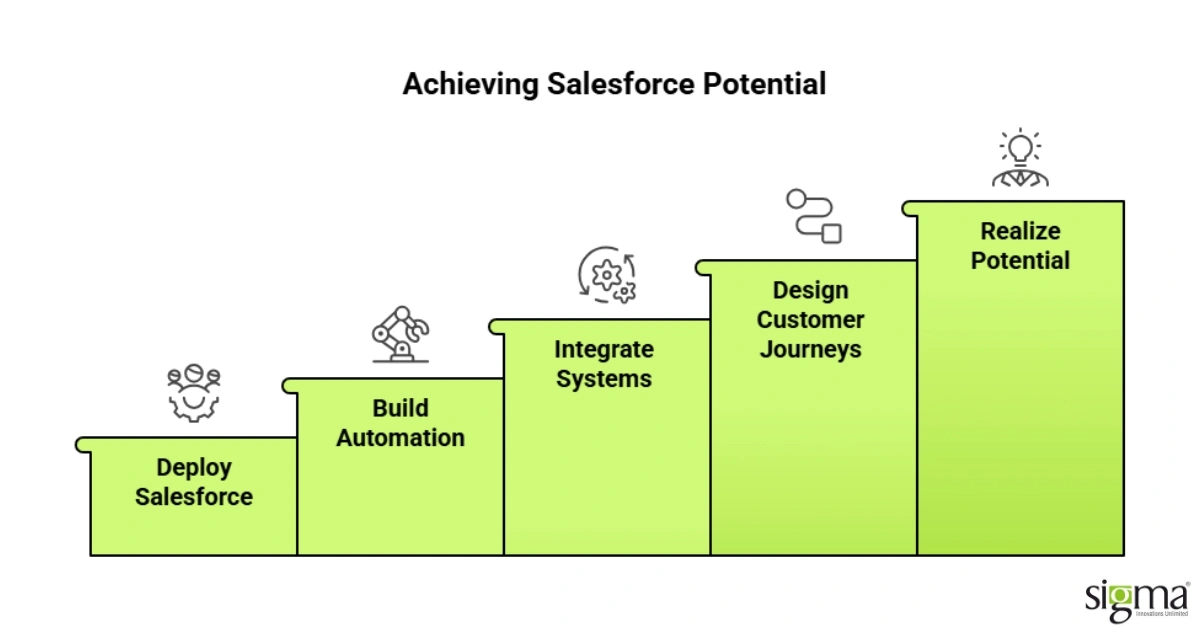
Salesforce is the world’s leading CRM platform, but a significant number of enterprise implementations fail to deliver their full potential. The reasons are rarely technical. Most organizations deploy Salesforce as a system of record rather than a system of action, using it to store customer data without building the automation and workflow layers that transform that data into business outcomes.
Teams end up working around the platform rather than through it. Sales representatives manually log activities that could be captured automatically. Marketing teams send batch campaigns instead of triggered, behavior-based communications. Service agents handle routine inquiries that intelligent automation could resolve without human intervention. The result is a Salesforce environment that is expensive to maintain, slow to deliver insights, and disconnected from the real-time demands of modern customer relationships.
The gap between what Salesforce can do and what most organizations actually use it for represents one of the largest untapped efficiency opportunities in enterprise technology today. Closing that gap requires a deliberate strategy built around automation, integration, and customer journey design.
Core Salesforce Marketing Automation Strategies for 2026
The following strategies represent the highest-impact approaches to Salesforce automation available to enterprise organizations in 2026. Each one addresses a specific operational challenge and contributes directly to improved customer experience and business performance.
Customer Journey Orchestration with Salesforce Marketing Cloud
Salesforce Marketing Cloud provides the tools to design, automate, and optimize end-to-end customer journeys across email, SMS, social, and digital advertising channels. Journey Builder allows marketing teams to create dynamic, behavior-triggered communication sequences that respond to real customer actions rather than following a fixed calendar schedule.
A customer who downloads a product guide, for example, can automatically enter a nurture journey that delivers relevant content, schedules a sales follow-up at the optimal moment, and adjusts messaging based on subsequent engagement. This level of customer experience automation replaces manual coordination between teams with an intelligent, always-on system that operates consistently at scale.
Effective journey orchestration requires clean customer data, well-defined audience segments, and clear definitions of the triggers and outcomes that govern each journey stage. Organizations that invest in this foundation consistently see improvements in lead conversion rates, customer engagement scores, and pipeline velocity.
Workflow Automation with Salesforce Flow
Salesforce Flow is one of the most powerful and underutilized tools in the Salesforce ecosystem. It allows organizations to automate complex, multi-step business processes without custom code, reducing the cost and complexity of maintaining automation logic over time.
Common workflow automation applications using Salesforce Flow include automatic case escalation based on service level agreement thresholds, triggered approval workflows for discount requests and contract modifications, automated data enrichment when new leads or accounts are created, and real-time alerts to sales managers when high-value opportunities reach critical pipeline stages.
The Salesforce Spring 2026 release introduced significant enhancements to Flow, including improved multi-page flow support, native Kanban components, and expanded styling options that reduce reliance on custom Lightning Web Components. Organizations that build automation on native Flow rather than custom code benefit from lower maintenance costs and smoother platform upgrades over time.
Sales Process Automation and CRM Optimization
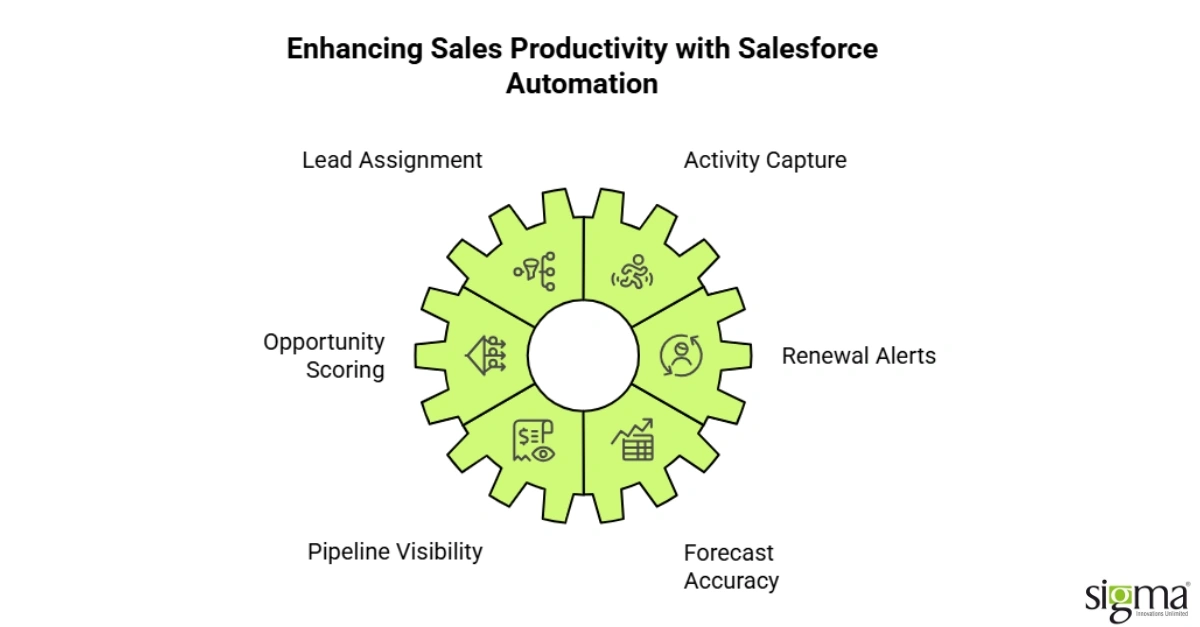
Sales operations teams that have standardized their sales process within Salesforce and automated the administrative tasks surrounding it consistently report higher sales productivity and shorter sales cycles. Salesforce CRM strategies built around automation reduce the time representatives spend on non-selling activities and give managers real-time visibility into pipeline health and forecast accuracy.
Key automation opportunities in the sales process include automatic lead assignment based on territory, industry, or account size rules, activity capture that logs emails, calls, and meetings without manual input from representatives, opportunity scoring models that prioritize the deals most likely to close, and automated renewal alerts that prompt customer success teams to engage accounts before contract expiration.
These automations work together to create a sales environment where representatives focus on building relationships and closing deals while Salesforce handles the coordination, data management, and administrative work that would otherwise consume a significant portion of their day.
Service Cloud Automation and Intelligent Case Management
Customer service operations represent one of the highest-value areas for Salesforce automation. Service Cloud provides a comprehensive set of tools for automating case routing, resolution workflows, and customer communications that reduce handle times and improve first-contact resolution rates.
Einstein Classification, part of Salesforce’s AI layer, automatically categorizes incoming cases based on the content of customer messages and routes them to the most appropriate agent or queue. This eliminates the manual triage step that slows down response times and ensures that complex cases reach specialists without delay.
Many enterprise service teams are also deploying Salesforce-integrated chatbots and self-service portals that resolve common inquiries without agent involvement. A leading telecommunications provider reduced its inbound service call volume significantly after implementing a self-service automation layer within its Salesforce Service Cloud environment, freeing agents to focus on complex, high-value customer interactions that genuinely require human judgment.
Personalization at Scale with Salesforce Einstein
Salesforce Einstein brings AI-powered personalization capabilities directly into the CRM ecosystem, enabling organizations to deliver individualized experiences across sales, service, and marketing without requiring separate AI infrastructure. Einstein Recommendation Builder analyzes customer behavior and preferences to suggest the next best action for sales representatives, the most relevant content for marketing journeys, and the most effective resolution path for service agents.
Effective customer experience automation powered by Einstein moves organizations beyond segment-based personalization toward true one-to-one engagement, where every interaction is informed by the full context of that customer’s history, preferences, and current needs. For enterprises managing thousands or millions of customer relationships, this capability is a transformational shift in how customer experience is delivered.
Read the blog: Salesforce Implementation Cost in 2026: What to Expect and How to Plan Your Investment
Building a Connected Salesforce Ecosystem
Individual automation tools deliver the greatest value when they operate within a connected, integrated Salesforce ecosystem where data flows freely between Sales Cloud, Service Cloud, Marketing Cloud, and third-party business systems.
Integration with ERP platforms ensures that sales teams have accurate product availability and pricing information when they need it. Integration with customer success platforms ensures that service history and health scores are visible to sales representatives during renewal conversations. Integration with marketing automation ensures that sales teams can see which content a prospect has engaged with before a discovery call.
This level of connectivity transforms Salesforce from a standalone CRM into the central nervous system of the enterprise customer relationship, giving every team the complete customer context they need to deliver a consistently excellent experience at every touchpoint.
How Sigma Infosolutions Helps Optimize Salesforce Automation and Customer Experience
Sigma Infosolutions is a certified Salesforce consulting partner with deep expertise in workflow automation, customer journey design, and Salesforce ecosystem integration. Sigma’s team works with CRM leaders, customer experience teams, and sales operations managers to design and implement automation strategies that deliver measurable improvements in efficiency and customer satisfaction.
Discovery and Process Mapping
Sigma begins every Salesforce engagement by mapping the client’s existing sales, service, and marketing processes to identify automation opportunities, integration gaps, and areas of workflow friction. This discovery phase produces a prioritized automation roadmap aligned with the organization’s business objectives and Salesforce licensing capabilities.
Salesforce Flow and Workflow Automation
Sigma’s certified Salesforce developers build scalable, maintainable automation using Salesforce Flow and native platform tools that reduce the reliance on custom code and lower the long-term cost of platform ownership. Every automation is designed with business user manageability in mind, ensuring that process owners can make adjustments without requiring developer intervention.
Customer Journey Design and Marketing Cloud Implementation
Sigma’s marketing automation specialists design and implement customer journey frameworks within Salesforce Marketing Cloud that deliver personalized, behavior-triggered communications across every channel. Journeys are built with defined success metrics and A/B testing frameworks that enable continuous optimization over time.
CRM Integration and Data Unification
Sigma connects Salesforce with the enterprise systems that surround it, including ERP platforms, customer success tools, and proprietary internal applications, to create a unified customer data environment that supports intelligent automation across every business function.
Ongoing Support and Platform Optimization
Sigma provides continuous support to monitor automation performance, incorporate new Salesforce release capabilities, and expand the automation program as the organization’s needs evolve. Explore Sigma’s Salesforce Services to learn how the team helps enterprises maximize the value of their Salesforce investment.
Conclusion
Salesforce marketing automation in 2026 is about more than sending triggered emails or routing support tickets automatically. It is about redesigning the entire customer relationship around intelligent, connected workflows that deliver consistent, personalized experiences at every touchpoint while reducing the operational burden on sales, service, and marketing teams.
Organizations that build their Salesforce CRM strategies around journey orchestration, native workflow automation, AI-powered personalization, and deep system integration are positioning themselves to outperform competitors in both customer experience quality and operational efficiency. The technology to achieve this exists within the Salesforce ecosystem today. The critical success factor is the strategy and expertise to implement it effectively.
Sigma Infosolutions brings the certified Salesforce expertise and proven delivery methodology that enterprise teams need to transform their Salesforce environment into a true engine of customer experience automation and operational excellence.
Frequently Asked Questions
What is Salesforce marketing automation?
Salesforce marketing automation uses tools within the Salesforce ecosystem, including Marketing Cloud, Salesforce Flow, and Einstein AI, to automate customer journeys, campaign execution, lead nurturing, customer communications, and operational workflows across sales, service, and marketing teams.
Why do many Salesforce implementations underperform?
Many organizations use Salesforce primarily as a system of record rather than a system of action. Without workflow automation, customer journey orchestration, CRM integrations, and AI-driven personalization, teams continue relying on manual processes that reduce efficiency and limit customer experience improvements.
How does Salesforce Marketing Cloud improve customer experience?
Salesforce Marketing Cloud enables enterprises to create personalized, behavior-triggered customer journeys across email, SMS, social media, and digital channels. This allows organizations to deliver timely, relevant communications that improve engagement, conversion rates, and customer retention.
What is Salesforce Flow used for?
Salesforce Flow is a native workflow automation tool that allows businesses to automate multi-step operational processes without extensive custom code. Common use cases include lead assignment, approval workflows, case escalations, notifications, data updates, and sales process automation.
How does Salesforce automation improve sales operations?
Salesforce automation reduces manual administrative tasks by automating activity tracking, lead routing, opportunity scoring, follow-ups, renewal alerts, and reporting workflows. This allows sales teams to focus more on relationship building and revenue generation while improving pipeline visibility and forecasting accuracy.
What role does Salesforce Einstein play in automation?
Salesforce Einstein brings AI-powered capabilities into the CRM ecosystem, including predictive analytics, next-best-action recommendations, intelligent case routing, and personalized customer engagement. It enables organizations to deliver more relevant and data-driven customer experiences at scale.
Why is CRM integration important for Salesforce automation?
Salesforce automation delivers the greatest value when connected with ERP systems, customer support platforms, marketing tools, and internal business applications. Integrated systems create a unified customer data environment that improves visibility, reduces data silos, and supports intelligent workflow automation across departments.
How can Sigma Infosolutions optimize Salesforce automation?
Sigma Infosolutions customizes Salesforce workflows, implements Salesforce Flow automation, designs customer journeys within Marketing Cloud, integrates Salesforce with enterprise systems, and develops scalable CRM strategies that improve operational efficiency and customer experience outcomes.
What industries benefit most from Salesforce marketing automation?
Industries with complex customer journeys, large customer bases, and multi-channel engagement requirements benefit significantly from Salesforce automation. This includes financial services, healthcare, retail, manufacturing, SaaS, telecommunications, and enterprise B2B organizations.
How should enterprises approach Salesforce automation in 2026?
Enterprises should focus on customer journey orchestration, AI-powered personalization, workflow automation, and connected CRM ecosystems rather than isolated automation initiatives. The goal is to create scalable, intelligent customer experiences that improve operational efficiency and long-term customer engagement.