WooCommerce vs Shopify: Which Platform Fits a Growing Brand Before the Wrong Choice Becomes Expensive

Key Highlights:
- Choosing an eCommerce platform based on familiarity rather than business requirements can leave growing brands with unnecessary costs and technical overhead.
- Limited content flexibility or customization can become a growth constraint as catalog complexity and operational requirements increase.
- Evaluating hosting responsibility, content needs, engineering capacity, and total cost of ownership helps brands select a platform that fits their current operations and growth plans.
- Sigma Infosolutions builds and migrates WooCommerce and Shopify storefronts, aligning platform selection with each brand’s technical resources, content strategy, and scalability needs.
Introduction
WooCommerce vs Shopify is one of the most searched eCommerce platform comparisons, and most existing comparisons treat it as a feature checklist exercise rather than what it actually is for a growing brand: a decision about how much technical ownership, hosting responsibility, and content control the business wants to hold directly versus hand off to a managed platform. WooCommerce, a WordPress plugin, gives a brand full ownership of hosting, code, and content architecture, at the cost of taking on the real responsibility that ownership genuinely carries. Shopify, a fully hosted platform, removes that hosting and infrastructure responsibility entirely, trading some flexibility and content control for a considerably lower technical overhead burden on the team actually running the store day to day without dedicated engineering support permanently on staff to maintain, monitor, and troubleshoot it. For a Head of eCommerce or CTO at a growth-stage brand, this decision shapes how much of the team’s capacity goes toward infrastructure management versus catalog growth and merchandising. Getting the fit right from the outset avoids both an unnecessary maintenance burden and a platform ceiling that arrives sooner than expected.
Need expert eCommerce development services for WooCommerce or Shopify?
What Full Ownership Actually Means With WooCommerce
WooCommerce’s core appeal is that it runs on WordPress, giving a brand complete control over hosting provider, theme and plugin selection, and content architecture, which particularly benefits brands whose marketing strategy depends heavily on content, since WordPress’s content management capabilities are considerably more mature and flexible than what a hosted commerce platform typically provides natively. This ownership comes with real responsibility: the brand or its technical partner is responsible for hosting performance, security patching, and plugin compatibility management, which is meaningfully more operational overhead than a fully hosted platform requires from a lean team without dedicated technical staff on hand.
What Shopify’s Hosted Model Actually Trades Away
Shopify’s fully hosted model removes hosting, security patching, and infrastructure management from the brand’s responsibility entirely, which is precisely why it appeals to lean teams that want to focus resources on merchandising and marketing rather than technical infrastructure management. This convenience comes with a real trade-off in flexibility: content management capabilities are less mature than WordPress’s, customization beyond what Shopify’s app ecosystem and theme system natively supports requires working within the platform’s architectural constraints, and a brand outgrows some aspects of this flexibility ceiling sooner than it would on a fully self-hosted WooCommerce build over time.
Comparing WooCommerce vs Shopify on the Factors That Matter Most for Growing Brands
| Factor | WooCommerce | Shopify |
|---|---|---|
| Hosting Responsibility | Brand or partner owns it directly | Fully managed by Shopify |
| Content Management Maturity | Strong, native to WordPress | Moderate, less flexible natively |
| Technical Overhead | Higher, ongoing maintenance required | Lower, platform-managed |
| Customization Ceiling | High, but requires more technical effort | Moderate, within platform constraints |
Also, read the blog: Shopify Dawn Theme Conversion Advantage: What Works and Where It Breaks Down for Complex Stores
Reading Which Team Structure Fits Each Platform
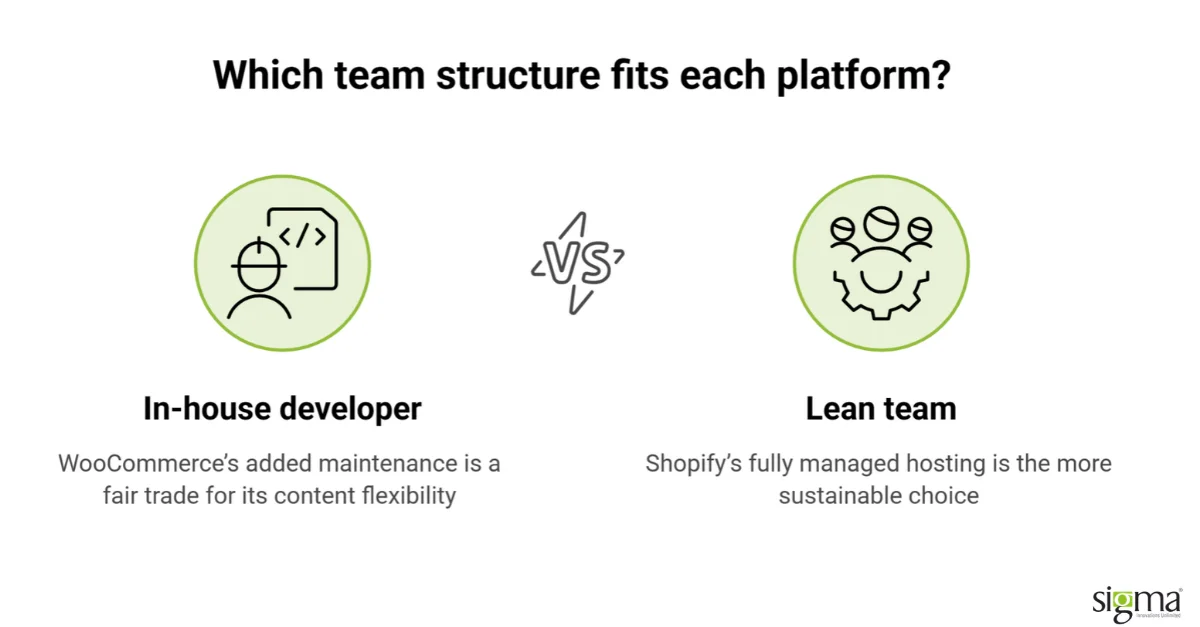
A brand with an in-house developer or an ongoing technical partner relationship can absorb WooCommerce’s added maintenance responsibility without it becoming a meaningful drag on the team’s broader priorities, which makes WooCommerce’s added content flexibility and lower platform fees a genuinely favorable trade for that specific team structure and its priorities. A lean brand without dedicated technical resources, where the founder or a small marketing team needs to manage the store directly without ongoing developer involvement, generally finds Shopify’s fully managed hosting model considerably more sustainable, even accounting for its higher platform fees and narrower content flexibility.
That same operational reality, weighing genuine technical ownership against a team’s actual capacity to manage it, is exactly what should drive the WooCommerce vs Shopify decision for a specific growing brand.
Weighing Total Cost of Ownership Beyond Platform Fees
WooCommerce’s lower direct platform cost, no monthly subscription fee beyond hosting, can be misleading if evaluated without accounting for the ongoing development and maintenance time a brand needs to budget for hosting management, security updates, and plugin compatibility work throughout the year. A brand that skips this accounting often finds its actual WooCommerce costs converging with what a Shopify subscription would have cost, once staff or contractor time is properly factored into the comparison rather than treated as a hidden, unbudgeted expense. Shopify’s monthly subscription and transaction fees are more visible and predictable but should be weighed against what those fees replace: the hosting, security, and infrastructure management overhead a WooCommerce brand would otherwise need to fund separately through internal staff time or an ongoing development partner relationship.
The Platform Decision Framework Sigma Delivers for Growing Brand Migrations
Sigma Infosolutions builds and migrates both WooCommerce and Shopify storefronts for growing brands, evaluating each engagement against the brand’s actual content needs, technical team capacity, and near-term growth trajectory rather than defaulting to either platform as a universal recommendation. That work has included WooCommerce builds for content-heavy brands with dedicated technical resources, and Shopify implementations for lean teams prioritizing operational simplicity over maximum content flexibility.
Brands that evaluate this decision against their real operational capacity, rather than a general platform reputation, consistently avoid both unnecessary technical overhead and a platform ceiling reached sooner than the business expected to hit it.
Recognizing When a Brand Has Outgrown Either Platform
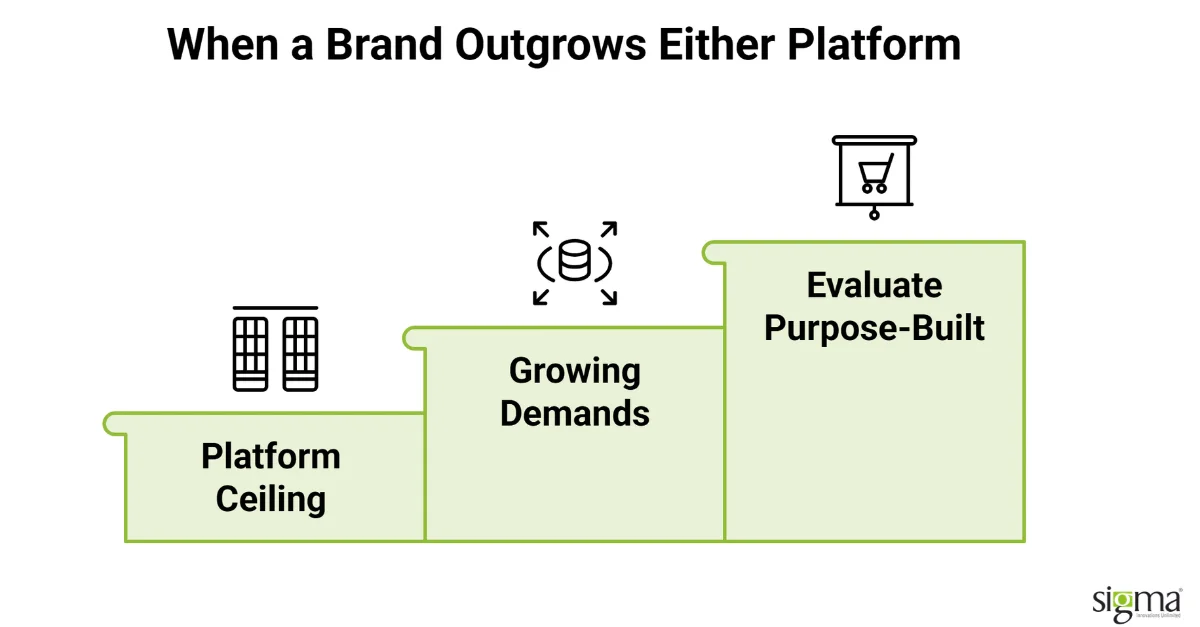
Both WooCommerce and Shopify have a genuine ceiling for a brand whose catalog complexity, B2B requirements, or transaction volume grows well beyond what either platform was designed to handle natively, at which point a more purpose-built commerce platform becomes worth evaluating regardless of which lighter platform the brand started on. Recognizing this transition point, rather than stretching either platform well past its comfortable capacity through extensive custom workarounds, is part of the same platform evaluation discipline that should inform the original WooCommerce versus Shopify decision in the first place.
For brands whose catalog and growth trajectory point toward a more purpose-built commerce platform entirely, rather than a choice between two lighter-weight options, a broader structured evaluation framework is worth reviewing before committing to either path.
Neither WooCommerce nor Shopify is optimal for every growth-stage brand. WooCommerce provides more flexibility but requires more engineering ownership. Shopify offers a more managed infrastructure but limits customization at the platform level. The decision should be based on the brand’s catalog complexity, the team’s engineering capacity, and the specific operational requirements that the platform needs to support, not on cost alone or platform brand recognition.
The cost trade-off between WooCommerce and Shopify shifts as a brand grows: WooCommerce’s lower licensing cost is offset by higher maintenance and hosting overhead at scale, while Shopify’s subscription cost is offset by lower operational risk. A brand scaling past a certain revenue threshold that does not revisit this trade-off risks growth being throttled by infrastructure it has outgrown rather than accelerated by it.
Conclusion
The WooCommerce vs Shopify decision for a growing brand comes down to how much technical ownership, hosting responsibility, and content control the team wants to hold directly, not a simple feature checklist comparison between the two platforms. WooCommerce’s full ownership model gives a brand considerably more content flexibility and lower direct platform fees, at the cost of ongoing hosting, security, and maintenance responsibility that requires either dedicated technical staff or an ongoing development partner relationship. Shopify’s fully hosted model removes that infrastructure responsibility entirely, trading some content flexibility and customization ceiling for meaningfully lower technical overhead that suits lean teams without dedicated technical resources particularly well. A brand with an in-house developer or an ongoing technical partner can absorb WooCommerce’s added responsibility without meaningful drag, while a lean team generally finds Shopify’s managed model considerably more sustainable day to day. Total cost of ownership should weigh platform fees against what they replace, not compare sticker prices in isolation without accounting for hosting and maintenance overhead on either side. Both platforms carry a genuine ceiling for a brand whose catalog complexity or transaction volume outgrows what either was designed to handle, at which point a more purpose-built commerce platform becomes worth genuine evaluation. Brands that evaluate this decision against their actual operational capacity, rather than a general platform reputation or a founder’s past experience, consistently avoid both unnecessary technical overhead and reaching a platform ceiling sooner than expected. The right platform is the one that matches the team’s genuine capacity to manage it, not the one that ranks highest in a general comparison written without a specific brand’s actual situation in mind. This decision is also not permanent, since team capacity, content strategy, and catalog complexity can all shift meaningfully as a brand grows past its original assumptions. Revisiting the fit question periodically, rather than treating the initial platform choice as fixed, keeps a growing brand from either over-investing in unneeded flexibility or stretching a platform well past the point where it comfortably serves the business. Brands that build this habit into their planning cadence consistently make better platform decisions over the long run than those that choose once and never look back.
Frequently Asked Questions
1. Is Shopify always the easier platform for a small team to manage?
Generally yes for teams without dedicated technical resources, since Shopify removes hosting and infrastructure management entirely. A small team with an ongoing developer relationship may find WooCommerce’s added content flexibility worth the modest additional technical overhead it introduces to their day-to-day operations and product roadmap.
2. Does WooCommerce really offer better content management than Shopify?
Yes, meaningfully, since WooCommerce runs on WordPress, which has considerably more mature native content management capabilities than Shopify’s built-in system, particularly benefiting brands whose marketing strategy depends heavily on content-driven customer acquisition and organic search visibility built up steadily over a long period of time.
3. How should platform fees be weighed against total cost of ownership?
Shopify’s visible subscription fees should be weighed against what they replace, the hosting and infrastructure management overhead WooCommerce requires funding separately, rather than simply comparing sticker prices alone without accounting for what each platform’s underlying pricing model actually includes and quietly excludes from view entirely.
4. Can a brand migrate from WooCommerce to Shopify or the reverse without major disruption?
Yes, with proper planning, including careful URL redirect mapping and content migration executed before cutover. Both directions of migration are common as a brand’s technical capacity or content needs shift meaningfully over time as the business continues to grow, scale, and steadily mature much further into its lifecycle.
5. At what point does a growing brand outgrow both WooCommerce and Shopify?
When catalog complexity, B2B requirements, or transaction volume grow well beyond what either platform was designed to handle natively, at which point a more purpose-built commerce platform becomes genuinely worth evaluating regardless of which lighter platform the brand originally started building its own store upon initially.