How Fintechs Use API Integration for Real-Time Credit Scoring: A Complete Guide for 2026

Key Highlights
- The global digital lending platform market is projected to grow from $3.0 billion to nearly $11.0 billion by 2030, reflecting how quickly lenders are shifting toward automated, real-time credit infrastructure.
- Lenders still relying on batch-based credit scoring face growing operational risks, including delayed approvals, rising manual review workloads, stale borrower data, and increasing borrower attrition to faster competitors.
- Sigma Infosolutions helps fintechs modernize lending operations through API-driven credit decisioning workflows, integrating real-time bureau, open banking, fraud detection, and income verification data into scalable automated lending platforms.
Credit scoring infrastructure has changed more in the last five years than it did in the previous two decades. Borrowers now expect lending decisions in minutes, not days, while lenders are under increasing pressure to reduce fraud exposure, improve underwriting accuracy, and scale operations without expanding manual review teams.
That shift has made API integration a foundational part of modern lending architecture. Real-time connections to credit bureaus, open banking platforms, payroll systems, fraud detection tools, and identity verification providers allow lenders to make decisions using current borrower data instead of delayed batch-based snapshots.
For fintechs and digital lenders, the difference is no longer just operational speed. Real-time credit scoring directly affects approval quality, portfolio performance, customer acquisition, and long-term competitiveness in a market that is rapidly moving toward automated decisioning infrastructure.
Why Batch-Based Credit Assessment Has Become a Liability
For a long time, batch processing was the only realistic option. Lenders pulled bureau data on a weekly or nightly schedule, ran applicants through scoring models, and moved decisions along to underwriters. The process was slow by today’s standards, but it was consistent, and borrowers did not yet expect anything faster.
Then fintech platforms started approving loans in minutes. Not hours. Minutes. And the contrast exposed something that lenders running batch systems had not fully reckoned with: the data problem. A borrower who applied on a Tuesday might be scored on data that was last refreshed the previous Thursday. Anything that happened between those two dates, like a new credit card, a missed payment, or a cash advance, was invisible to the lender’s model. The decision went out anyway.
The consequences do not always show up immediately, but they compound. Underwriters end up spending significant time trying to reconcile bureau files that contradict what a borrower’s income documents are showing. Collections teams inherit loans that defaulted ahead of schedule because the risk signals were already there at origination, just buried in a data lag. And for lenders competing against platforms that moved to real-time infrastructure years ago, the performance gap only widens. At a certain point, it stops being an operational inconvenience and starts being a ceiling on how far the business can grow without accepting outsized credit risk.
Also, read the blog: Digital Lending Platforms Market Size in 2026: Growth Trends, Key Drivers, and Future Outlook
What API Integration Actually Does for a Lending Decision
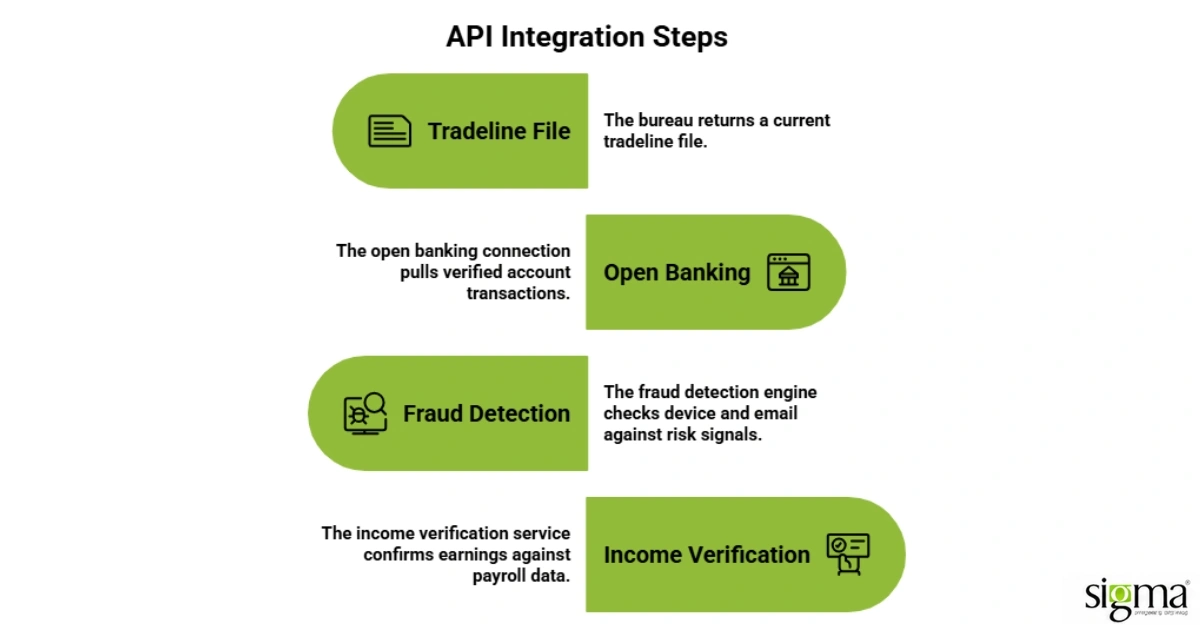
Strip away the technical language, and the concept is not complicated. When a borrower submits an application, the system sends simultaneous requests to every relevant data source. The bureau returns a current tradeline file. The open banking connection pulls verified account transactions from the past several months. The fraud detection engine checks the device, email address, and IP against a network of known risk signals. The income verification service confirms what the borrower said they earn against what their payroll system actually shows. All of it lands in the decisioning engine within seconds.
That is what replaces a nightly batch cycle. Not a marginal improvement in speed, but a fundamentally different relationship with data. The lender is no longer making a decision on what was true last week. They are basing it on what is true right now.
In lending categories where timing is everything, that distinction has direct financial consequences. A small business lender whose funding windows open and close within a single business day cannot wait for a scheduled data refresh. A consumer installment platform competing for borrowers who have three other tabs open, comparing offers, cannot afford a 48-hour approval cycle. The lenders who have closed that gap with API integration are not just faster. They are more accurate because the data they are scoring on has not had time to go stale.
Also, read the blog: The Vital Role of APIs in the Digital Lending Ecosystem
Batch-Based vs. API-Integrated Credit Scoring: A Comparative Overview
Component | Batch-Based Approach | API-Integrated Approach |
| Data Freshness | Hours to days old at point of decision | Current at the moment of application |
| Decision Speed | Minutes to days, depending on queue depth | Seconds to minutes for standard cases |
| Bureau Data Access | Scheduled pull on a fixed cycle | Live query per individual application |
| Fraud Signal Latency | Detected after batch processing completes | Caught inline before any credit is extended |
| Income Verification | Manual document review by underwriting staff | Direct API fetch from payroll or banking platforms |
| Operational Overhead | Heavy manual intervention at multiple stages | Automated routing with exception-based human review |
The API Categories Behind a Real-Time Scoring System
Credit Bureau APIs
Experian, TransUnion, and Equifax each offer APIs that return a full tradeline file in response to an individual query. The response arrives in milliseconds and reflects the borrower’s account standing at that exact moment, not at the time of the last scheduled pull. Lenders configure which bureau to query based on geographic coverage, the depth of data they need, and cost per call.
Where bureau data falls short is with thin-file applicants, borrowers who simply have not built up enough credit history for a bureau score to be meaningful. Supplementary APIs from alternative data providers can fill those gaps using utility payment histories, rental records, and other non-traditional signals. For lenders actively trying to serve underbanked segments, those connections are not optional extras. They are what make responsible decisioning possible on applicants who would otherwise be declined based on an absent bureau file rather than actual credit risk.
Open Banking and Income Verification APIs
A credit score is a useful summary, but it does not tell you whether a borrower’s salary actually lands on time every month, whether their discretionary spending is consistent with their stated obligations, or whether they are already servicing debts that do not yet appear on their bureau file. Open banking APIs answer those questions directly. With the borrower’s consent, they pull actual transaction history from the account, and what comes back is the kind of behavioral and cash-flow data that an experienced underwriter would want to see before approving a significant loan.
For borrowers who fall outside the traditional scoring population, this is often the deciding factor. Approval rates improve because lenders are no longer turning down creditworthy applicants simply because the bureau file is thin. And predictive accuracy improves because the model is working from observed financial behavior rather than inferred risk.
Income verification APIs handle a related but distinct task. Rather than asking a borrower to upload pay stubs and waiting for them to do it, these services, from providers including Plaid and Finicity, pull income confirmation directly from payroll systems. The verification runs in the background while the borrower completes the rest of the application. A step that used to add days to the approval cycle disappears entirely.
Fraud Detection and Identity Verification APIs
No underwriting team can manually screen for fraud signals at the volume that a digital lending platform processes applications. Fraud detection APIs do it automatically. They check device fingerprints, email addresses, IP addresses, and identity details against a network of known fraud patterns accumulated across thousands of lending events. When a match surfaces, the application is flagged before any credit exposure is created, not after a manual reviewer eventually gets to it in a queue.
Identity verification APIs sit alongside fraud detection and serve a different function. Document scanning and biometric matching confirm that the person completing the application is actually the person they are claiming to be. For platforms that never interact with borrowers face-to-face, this step is what makes Know Your Customer compliance workable at scale. In most standard application flows, it runs automatically, without routing anything to a human reviewer or adding noticeable delay for the borrower.
Read our success story: Automating Dealer Verification with Integrated CRM and Lending Workflows
How Sigma Infosolutions Helps Lenders Build This Infrastructure
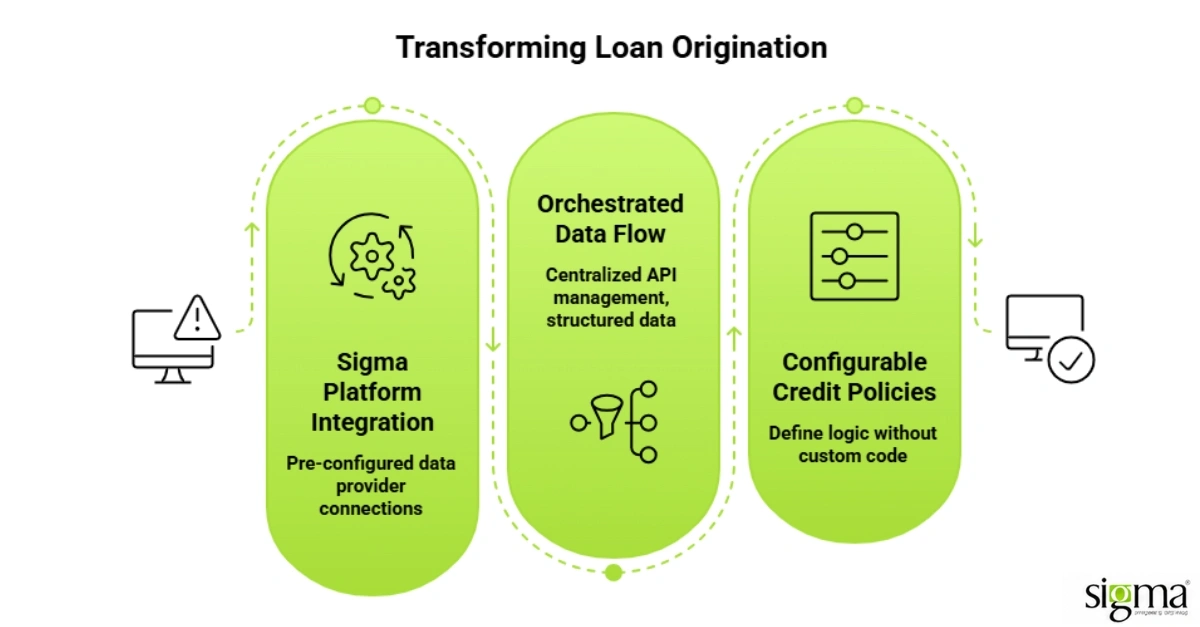
Modern lending platforms depend on far more than a single credit bureau connection. Real-time decisioning requires multiple APIs working together simultaneously across credit scoring, open banking, fraud detection, income verification, identity validation, and compliance workflows. Managing those integrations internally can quickly become difficult as providers update APIs, authentication methods, and data structures over time.
Sigma Infosolutions helps lenders simplify this complexity through scalable Open Banking & API Integration Solutions designed specifically for digital lending operations. Its lending infrastructure combines pre-built integrations, configurable decisioning workflows, and cloud-native architecture to help lenders accelerate approvals, reduce manual processing, and support long-term platform scalability.
Pre-Built Integrations Across Lending Data Providers
Sigma’s lending platform comes integrated with more than 50 third-party providers covering:
- Credit bureaus
- Open banking platforms
- Fraud detection services
- Income verification tools
- Identity validation systems
This reduces the time and engineering effort required to build and maintain individual integrations internally.
Centralized API Orchestration for Faster Decisioning
During the loan application process, Sigma’s orchestration layer manages multiple API calls simultaneously and consolidates incoming data into a structured decisioning workflow.
This allows lenders to:
- Process applications faster
- Reduce underwriting delays
- Automate approval routing
- Configure risk thresholds without custom development
The architecture supports both high-volume consumer lending and more complex commercial lending operations.
Lower Long-Term Integration Maintenance
API integrations are not static. Providers regularly update:
- Authentication standards
- Data schemas
- Endpoint structures
- Security requirements
Instead of managing those changes internally, lenders using Sigma’s infrastructure benefit from centrally maintained integrations that reduce ongoing engineering overhead and operational disruption.
Secure and Scalable Lending Infrastructure
Sigma’s lending ecosystem is built on AWS cloud infrastructure and backed by:
- AWS Select Technology Partner status
- ISO/IEC 27001:2022 certification for information security
This helps lenders support secure borrower data handling, scalable application processing, and compliance-focused lending operations.
Proven Results in Lending Workflow Modernization
Sigma has helped lenders modernize legacy lending environments by introducing automated workflows, configurable approval engines, and API-driven decisioning systems. In one engagement, Sigma rebuilt a legacy loan origination system for a long-established small business lender. After implementing automated calculations and role-based approval workflows, the client achieved its highest-ever single-day funding volume: 16 funded units totaling $1.52 million.
Conclusion
The lenders who built real-time credit scoring infrastructure early are now running a compounding advantage over everyone who waited. Each approval cycle they complete on live data is a cycle that their batch-dependent competitors complete on information that is already aging. Over months and years, that gap shows up in portfolio performance, operational costs, and the ability to compete for borrowers who have options. Connecting decisioning engines to live bureau data, open banking feeds, income verification, and fraud detection is no longer a future-state project for forward-thinking lenders. It is the current standard for anyone who intends to compete seriously in digital lending through 2030 and beyond. The market is growing fast, and the infrastructure that supports it is already proven. The remaining question for most lenders is not whether to make the shift, but how quickly they can get there.
Looking to modernize lending infrastructure?
Frequently Asked Questions
Q1. What is real-time credit scoring, and how does it differ from traditional scoring?
Traditional credit scoring pulls bureau data on a fixed schedule, which means the information driving a lending decision can be several days old by the time an underwriter sees it. Real-time credit scoring retrieves a live data picture at the exact moment a borrower applies. The practical difference is that lenders are working from what is actually happening in a borrower’s financial life today, not what was happening last week when the last batch ran.
Q2. Why is API integration essential for real-time credit decisioning in fintech?
Batch requests and scheduled data pulls cannot support decisions that need to be made in seconds. API integration replaces that model with on-demand queries that fire the moment an application is submitted, returning live bureau data, fraud signals, and income verification simultaneously. Without those direct connections, a lender has no path to real-time decisioning, regardless of how sophisticated their scoring model is.
Q3. Which types of APIs are typically used in a credit scoring system?
A fully connected scoring system draws on credit bureau APIs for tradeline history and scores, open banking APIs for verified account transactions and income signals, fraud detection APIs for device and identity risk screening, and Know Your Customer APIs for document and biometric verification. The exact mix depends on the lender’s product category, borrower profile, and the regulatory requirements that apply in their operating markets.
Q4. How does open banking data improve credit scoring accuracy for lenders serving thin-file borrowers?
Bureau data reflects credit history. Open banking data reflects actual financial behavior, income deposits, spending patterns, recurring obligations, and cash flow consistency. For borrowers who have not built up a substantial credit record, that behavioral data is often what makes a responsible lending decision possible at all. Approval rates improve because lenders are no longer declining creditworthy applicants on the basis of a thin bureau file rather than genuine risk.
Q5. What security standards should a fintech lending platform maintain when using third-party data APIs?
ISO/IEC 27001 certification is the recognized baseline for information security management in environments that process sensitive financial data. Beyond that, all data moving through the bureau and open banking connections should be encrypted in transit and at rest. Access to consumer financial records needs to be governed by role-based permissions that are aligned with data protection regulations in every market where the lender operates, not treated as a one-size-fits-all compliance checkbox.