Open Loop vs Closed Loop Payment Systems: Key Differences for Fintech Builders
Key Highlights
- Fintech founders and payments product teams at growth-stage companies lack clear guidance on how open-loop and closed-loop payment architectures differ, leading to costly infrastructure decisions made on incomplete information.
- Understanding the technical structure, business model implications, and regulatory requirements of each architecture allows teams to select the right foundation for their card or wallet product before engineering begins.
- Sigma Infosolutions advises fintech startups and digital banking companies on payment architecture selection and builds custom payment integrations, card program infrastructure, and API layers tailored to each product’s market and compliance requirements.
Introduction
Every payment product starts with a foundational infrastructure decision that most early-stage teams underestimate: open loop or closed loop. Whether you are building a prepaid card program, a corporate expense card, a digital wallet, or a marketplace payment product, this single architectural choice shapes every technical, commercial, and regulatory outcome that follows.
For fintech founders and CTOs at growth-stage companies, the urgency is real. Getting this decision wrong creates hard limits on where customers can transact, which revenue model is available, and which regulatory frameworks apply. Rebuilding payment infrastructure mid-product is expensive and often forces a product reset that costs months of runway.
This article gives fintech builders the technical and commercial clarity needed to make this decision confidently before locking in a technology stack.
Choosing the right payment architecture early can prevent costly rework, accelerate time to market, and create a stronger foundation for future growth. Explore how Sigma Infosolutions designs and delivers digital payment solutions tailored to fintech products, from card programs and digital wallets to payment integrations and compliance-ready infrastructure.
What Is an Open Loop Payment System?
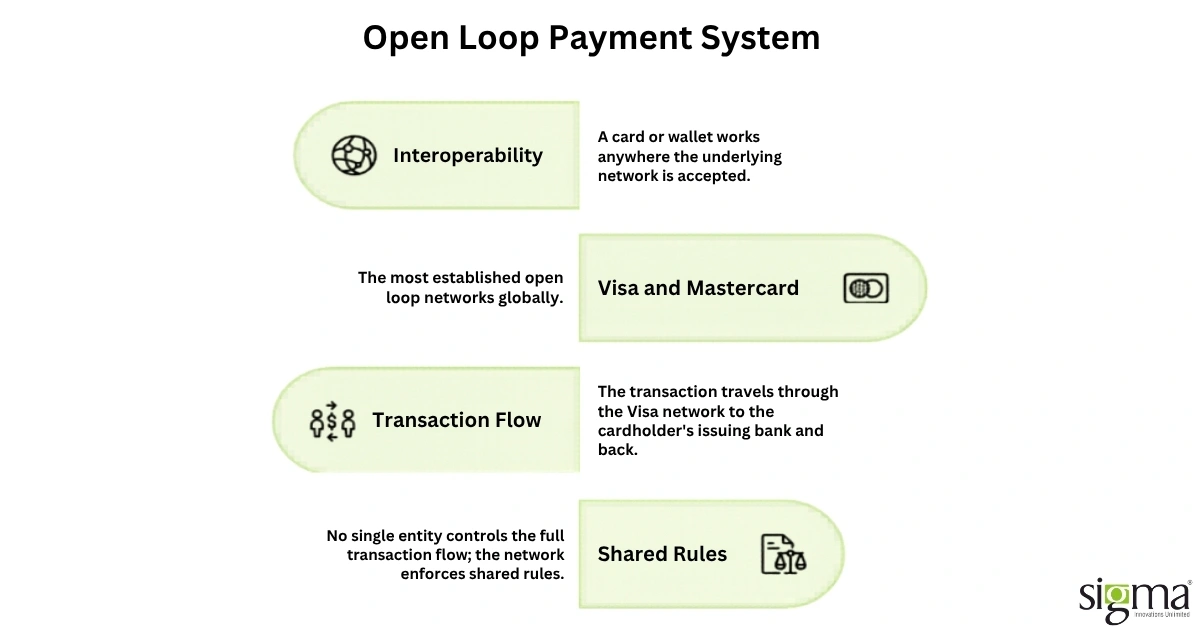
An open-loop payment system is a network where transactions flow across multiple participating merchants, banks, and financial institutions through shared card networks and payment rails. The defining characteristic is interoperability: a card or wallet issued within an open-loop system works anywhere the underlying network is accepted.
Visa and Mastercard are the most established open loop networks globally. When a consumer uses a Visa debit card at a retailer, the transaction travels from the merchant’s acquirer through the Visa network to the cardholder’s issuing bank and back. No single entity controls the full transaction flow; the network enforces shared rules that every participant must follow.
How Open-Loop Transactions Flow
The transaction lifecycle in an open-loop system involves four key parties: the cardholder, the issuing bank or fintech that issued the card, the acquiring bank processing payments on behalf of the merchant, and the card network routing and settling the transaction. Each party plays a defined role governed by network operating rules and bilateral agreements.
Interchange fees are central to open-loop economics. The acquiring bank pays an interchange fee to the issuing bank on each transaction, and the card network takes a separate assessment fee. For fintech companies building card programs, interchange revenue is typically the primary economic driver from day one.
Key Characteristics of Open-Loop Systems
- Accepted wherever the underlying card network operates, including internationally
- Governed by card network operating rules such as Visa or Mastercard regulations
- Interchange revenue flows to the issuing bank or program manager
- Requires a bank sponsor, issuing license, or BaaS partnership to participate
- Subject to card network compliance requirements and certification processes
- Enables broad merchant acceptance without separate commercial agreements
Read the blog: How Fintechs Use API Integration for Real-Time Credit Scoring: A Complete Guide for 2026
What Is a Closed-Loop Payment System?
How Sigma Infosolutions Helps Fintech Companies Build the Right Payment Infrastructure
Sigma Infosolutions works with fintech startups, digital banking companies, and growth-stage payment platforms at the architecture stage, before technology decisions lock in outcomes that are expensive to reverse. The team combines deep payments domain expertise with full-stack engineering capability to help clients move from product concept to production-grade infrastructure on the right foundation.
Architecture Advisory and Product Alignment
Sigma begins every payment engagement with a structured advisory phase that maps product requirements to architecture options. The team evaluates open-loop and closed-loop trade-offs against each client’s target market, merchant strategy, and revenue model, producing a clear recommendation grounded in real-world delivery experience.
Card Program Infrastructure
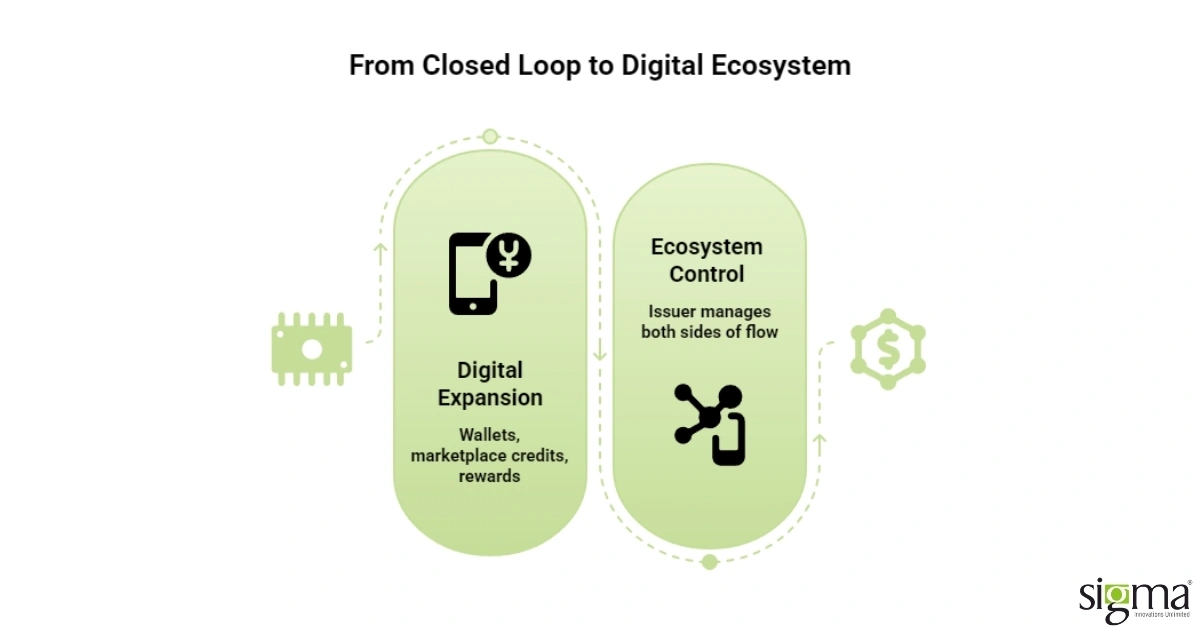
For open-loop card programs, Sigma designs and builds the integration layers connecting program managers to issuer processors, card networks, and bank sponsors. This includes API architecture supporting card issuance, transaction authorization, balance management, and reporting. For closed-loop programs, Sigma builds the ledger systems, wallet infrastructure, and merchant integration layers that power the payment ecosystem from day one.
Payment Gateway and API Integration
Sigma’s engineering team integrates payment gateways, processor APIs, and card network connections across both open and closed loop environments. Under dedicated team or T&M engagement models, Sigma embeds directly into the product engineering workflow, building integration layers that handle authorization, settlement, and reconciliation at the scale the business is building toward.
As fintech ecosystems become increasingly interconnected, scalable payment gateway integration and open banking API integration capabilities are essential for delivering seamless customer experiences. Discover how Sigma Infosolutions designs secure API frameworks, integrates payment processors, and enables real-time financial connectivity for next-generation payment platforms.
Compliance and KYC Integration
Payment products in both architectures require a compliance infrastructure. Sigma integrates KYC verification, AML screening, and transaction monitoring into payment platforms, ensuring products meet regulatory requirements across the United States, Australia, Canada, and the United Kingdom, without compromising the onboarding conversion rates that early-stage companies depend on.
Ongoing Engineering Partnership
Sigma supports payment infrastructure through ongoing engineering retainers and dedicated team models that provide continuity across regulatory updates and product expansion. For fintech companies that have identified a technology gap and need a long-term engineering partner, Sigma’s engagement model is built for that relationship from day one.
Conclusion
The choice between open loop and closed loop payment systems is one of the most consequential architecture decisions a fintech product team will make. Open loop systems deliver broad acceptance and interchange economics at the cost of greater regulatory and technical complexity. Closed loop systems offer faster time to market, cost efficiency, and data control within a bounded ecosystem.
Neither architecture is universally superior. The right choice depends on your product’s purpose, your merchant strategy, and the revenue model you are building toward. For growth-stage fintech companies where this decision determines the trajectory of the next two to three years of engineering investment, making it with full technical and commercial clarity is not optional.
Sigma Infosolutions brings the payments domain expertise and engineering capability to help your team make the right infrastructure decision before the first line of production code is written. Whether you are building an open loop card program, a closed loop wallet, or a hybrid product, Sigma delivers the architecture advisory, integration work, and long-term engineering partnership to bring your product to market with confidence.
Ready to get your payment architecture right?
Frequently Asked Questions
1. What is an open loop payment system?
An open loop payment system allows payments across multiple merchants using networks like Visa and Mastercard.
2. What is a closed loop payment system?
A closed loop payment system only works within a specific merchant, app, or business ecosystem.
3. What is the biggest advantage of open loop payment systems?
Open loop payment systems provide wider acceptance and better scalability for fintech products.
4. Why do businesses use closed loop payment systems?
Businesses use closed loop systems to reduce transaction costs and improve customer loyalty programs.
5. Are open loop payment systems more complex to build?
Open loop systems require bank partnerships, compliance checks, and network integrations, making them more complex.
6. Which payment system is better for digital wallets?
Digital wallets can use either model, but closed loop systems work best for controlled ecosystems.
7. Can fintech companies combine open and closed loop systems?
Many fintech platforms use hybrid payment models to balance customer reach and operational control.
8. How does Sigma Infosolutions support fintech payment platforms?
Sigma Infosolutions helps fintech companies build secure payment infrastructure, API integrations, and scalable digital payment solutions.