Why Cloud BI Migrations Create New Cost, Governance, and Data Challenges

Key Highlights:
- Moving business intelligence to the cloud changes more than infrastructure. It affects how companies manage BI costs, control data access, connect new data sources, and operate analytics over time.
- Cloud pricing can make BI spending more flexible, but savings depend on how closely usage, licenses, storage, and workloads are managed.
- Broader access to analytics creates new governance requirements around permissions, sensitive data, and auditability.
- Faster data integration can accelerate reporting, but without clear ownership and standards, it can also create data sprawl and inconsistent reporting.
- A successful cloud BI migration should be treated as an operating-model decision, not simply a platform replacement.Sigma Infosolutions aligns cloud BI migration with data, governance, and business priorities, not just platform replacement.
Introduction
Cloud business intelligence is often presented as a fairly straightforward technology upgrade. Move BI to the cloud, reduce infrastructure overhead, make reporting easier to access, and scale analytics as the business grows. The reality is more nuanced.
When an organization moves from on-premise BI to a cloud environment, the change affects much more than where the technology runs. The way the company pays for analytics changes. The number of people who can access data changes. Adding new data sources becomes easier, which changes how quickly the analytics environment can grow. Each of those benefits also introduces a new management responsibility.
That is why the cloud BI decision is better viewed as an operating-model decision than a hosting decision. For a Head of Data, VP of Analytics, CIO, or technology leader, the important question is not simply which platform to choose. It is what will change once the platform is in place, and whether the organization is prepared to manage those changes.
What the Cost Model Actually Changes
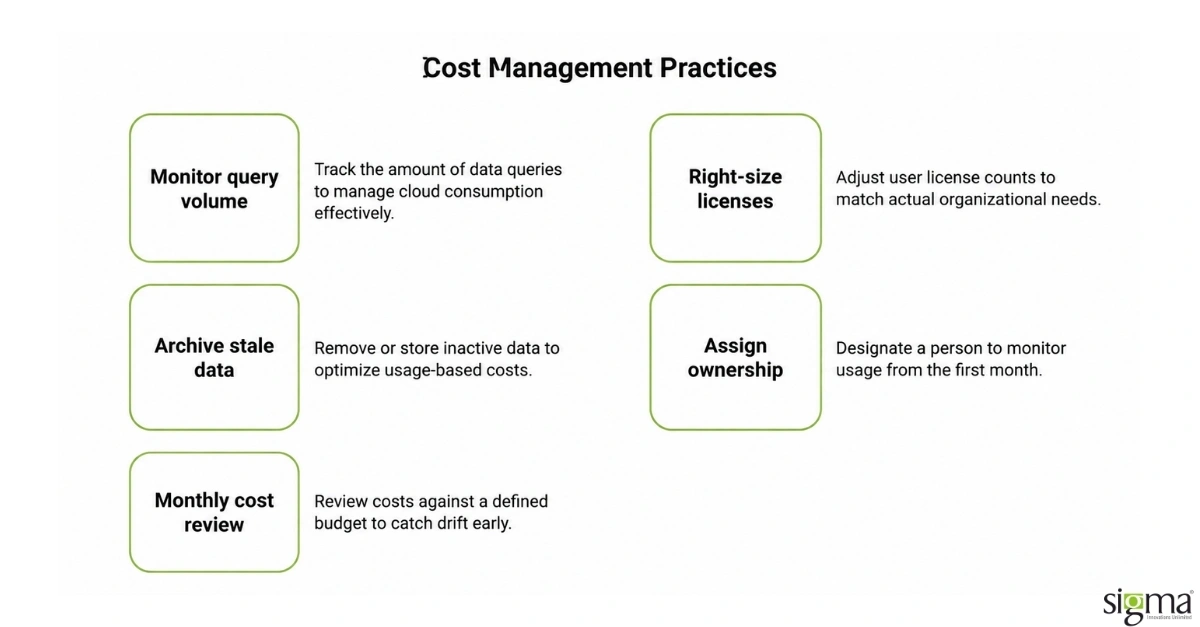
One of the clearest differences between cloud and on-premise business intelligence is the way the cost is structured.
An on-premise BI environment generally requires the organization to make a larger upfront investment in infrastructure, software licensing, storage, and capacity. Cloud BI moves more of that spending into an ongoing model based on factors such as users, storage, compute, data processing, or platform consumption.
That can be valuable for a growing business because capacity does not have to be determined entirely years in advance. A company can expand its analytics environment as demand increases rather than continually purchasing infrastructure ahead of actual requirements.
But that flexibility does not automatically translate into lower costs.
In fact, one of the operational adjustments companies sometimes underestimate is that cloud consumption needs ongoing attention. Inefficient workloads, unnecessary data retention, unused licenses, or rapidly growing query activity can gradually increase the cost of the environment. The organization may have moved away from a large infrastructure purchase, but it has not moved away from the need for financial discipline.
The companies that manage this transition well tend to treat BI consumption as an ongoing operating consideration. They establish ownership early, monitor usage against expectations, and review whether the resources being consumed are actually supporting important business requirements. That does not mean trying to minimize every cloud expense. It means making sure the organization understands where its BI spending is going and why.
Comparing Cloud and On-Premise Business Intelligence
The comparison is not about declaring one model universally better than the other. An organization with substantial existing infrastructure investment, specific regulatory constraints, or architectural requirements may have valid reasons to retain some on-premise capabilities. Cloud BI becomes more compelling when the business values greater scalability, broader access, faster data integration, or a more flexible cost structure and is prepared to manage the responsibilities that come with those advantages.
That distinction is important because moving to the cloud simply because cloud is considered the modern option does not solve an underlying BI problem. If the existing environment suffers from poor data quality, unclear ownership, duplicated reporting, or inconsistent business definitions, those problems can follow the organization into the new environment.
| Factor | On-Premise BI | Cloud Business Intelligence |
| Cost Structure | Upfront capital expenditure, fixed licensing | Usage-based subscription, scales with demand |
| Deployment Timeline | Weeks to months for infrastructure provisioning | Days to weeks for initial environment setup |
| Data Access | Limited to on-network or VPN users | Available to any authenticated user, requires governance |
| Scaling New Data Sources | Requires infrastructure planning per source | Elastic, but requires integration and access controls per source |
Why Broader Access Creates a Governance Requirement, Not Just a Convenience
One of the biggest advantages of cloud BI is that analytics can become much easier to access.
Executives can review dashboards without being tied to a corporate network. Business teams can work with reporting from different locations. Regional teams can access information relevant to their operations. Analytics can move beyond a small reporting group and become part of everyday decision-making.
But once more people can access business data, the organization has to become more deliberate about who can see what.
That requirement can be easy to underestimate because on-premise environments often had practical limitations built into them. A smaller user base, internal networks, and infrastructure boundaries naturally restricted access. Cloud removes many of those barriers, which is useful from an accessibility standpoint but means the organization can no longer rely on those boundaries alone.
For companies handling sensitive financial, customer, healthcare, or operational information, this becomes particularly important. Role-based access, data classification, audit logging, and appropriate controls around sensitive fields need to be considered as part of the migration rather than added after users have already started building dashboards.
The same issue applies outside highly regulated industries. An eCommerce business with several brands may want finance, operations, and regional teams to work from the same underlying information while restricting each team’s visibility to the data relevant to them. A SaaS company may have similar requirements across geographies, business units, or customer segments.
Cloud BI makes this type of access possible, but the technology does not decide the governance model for the business. That needs to be designed around how the organization actually operates.
What Changes About Connecting New Data Sources
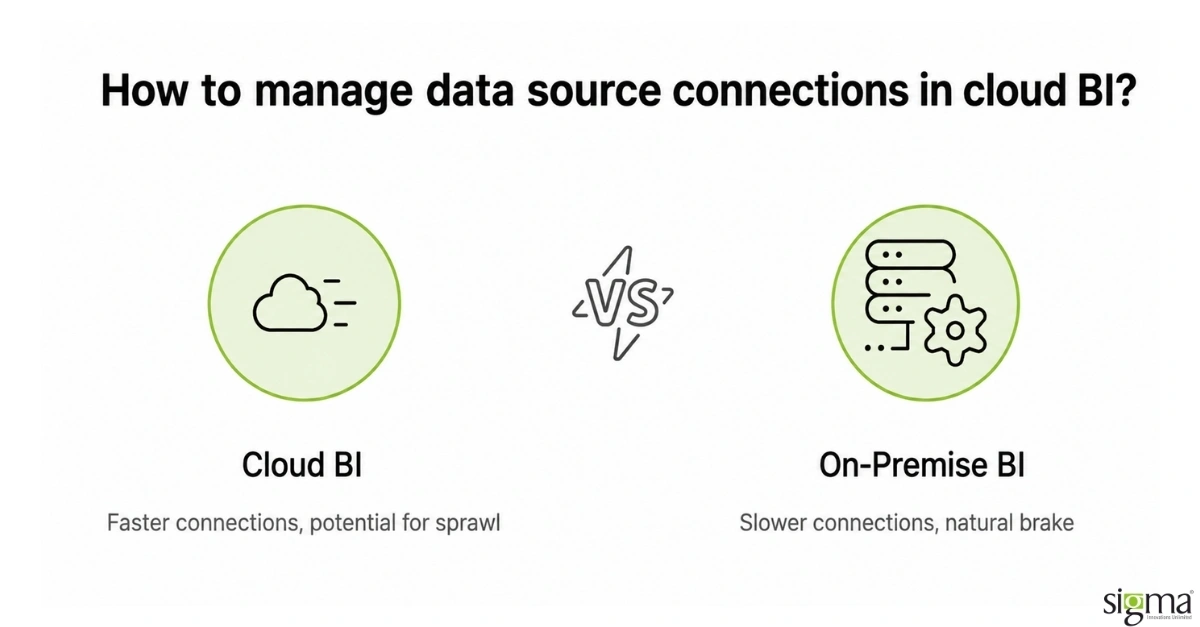
Cloud BI also changes the economics and effort involved in bringing new data into the analytics environment.
A marketing platform, payment processor, product analytics system, ERP, or operational database can often be connected without the same infrastructure planning that an on-premise environment may have required. That can shorten the distance between a new business requirement and the reporting needed to support it.
The risk is that the organization can start adding data faster than it can govern it.
When connecting another source becomes relatively easy, there is less natural friction to make people stop and ask whether the source is actually necessary, who owns it, whether another dataset already contains the same information, or what downstream reporting will depend on it.
Over time, that can lead to multiple versions of the same metric, duplicated datasets, unclear ownership, inconsistent refresh schedules, and dashboards that produce different answers to what should be the same business question.
That is not necessarily a cloud BI problem. It is an operating-model problem that the cloud can make more visible because the technology makes expansion easier.
A lightweight intake and ownership process can provide enough structure without turning every integration into a lengthy approval exercise. Before another source enters the BI environment, the organization should have a reasonable understanding of what business requirement it supports, who owns the data, what access restrictions apply, and whether the information already exists elsewhere.
That balance is important. The goal is not to make the analytics environment difficult to change. It is to make sure that speed does not come at the expense of consistency.
Evaluate your data architecture before adding more sources to your cloud BI environment.
The Migration Should Be Sequenced Around Business Value
The way a company approaches the migration can be just as important as the platform it selects.
A full cutover may seem attractive because it creates a clear endpoint, but moving every report, data source, user, and integration at the same time also means that problems in one area can affect everything else. It becomes harder to determine whether a problem is caused by the platform, the data, the integration architecture, or an underlying reporting process.
A phased migration gives the organization more room to validate those assumptions.
The first stage can focus on establishing the cloud environment and moving a limited number of high-value data sources and reporting workloads. Rather than attempting to recreate the entire existing BI environment, the organization can use a meaningful business use case to determine whether the architecture is delivering the expected value.
Once that foundation is working, the migration can expand to additional sources and users while governance becomes more formal. Access controls, data ownership, classification, and reporting standards can be tested against a broader operating environment instead of being designed entirely around theoretical requirements.
Cost and workload optimization can then become more informed because the organization has actual usage patterns to evaluate. It can see which workloads are important, where consumption is increasing, and which reports or data sources may no longer justify their cost or complexity.
The exact sequence will vary by organization. A highly regulated business with complex source systems may need a different approach from a mid-market company with a relatively contained reporting environment. The underlying principle is the same: validate the operating model before scaling it across the organization.
The Platform Is Only Part of the Investment
This is where many cloud BI discussions become too focused on technology.
Selecting a platform and successfully moving dashboards does not necessarily mean the business has solved its BI problem. If the organization still has inconsistent KPI definitions, unclear data ownership, uncontrolled access requests, duplicated sources, and no visibility into consumption, the same operational problems can simply appear in a different environment.
A more useful way to think about the investment is as four connected areas: platform, data, governance, and operating model.
The platform provides the foundation, but the surrounding architecture determines whether the organization can use it effectively. Data needs to be reliable and appropriately structured. Governance needs to reflect who should have access and why. The operating model needs to establish who owns the environment and how it will be managed as requirements change.
This is also why the business case for cloud BI should extend beyond migration costs. The organization needs to consider the work required to integrate data, establish governance, rationalize reporting, manage consumption, and maintain the environment after implementation.
Cloud BI is not a project that becomes finished when the first dashboards go live.
What to Evaluate Before Committing to a Cloud BI Migration
Before committing a budget, leadership should first establish whether the current BI environment is actually being limited by infrastructure.
If the primary problems are slow reporting, fragmented data, inconsistent metrics, or manual processes, moving the existing environment to the cloud without addressing those issues may produce a newer version of the same problem.
It is also worth understanding how much broader access the business genuinely needs. A company where analytics is primarily used by a small finance or leadership team will have different requirements from one that wants reporting available across operations, sales, product, finance, and regional teams.
The organization should also be realistic about governance. Expanding access to business information without deciding who owns that access, how sensitive information is classified, and how permissions will be reviewed can create problems later that are much harder to resolve once dozens of reports depend on the existing structure.
Data sources deserve the same scrutiny. Not every existing report or integration necessarily needs to move to the new environment. A migration is an opportunity to identify what the business actually relies on, what has become redundant, and where inconsistent definitions are creating reporting friction.
Finally, the organization needs to think beyond go-live. Data sources will change. Users will change roles. Reporting requirements will evolve. Cloud consumption will fluctuate. A BI environment that works well today can become difficult to manage over time without ongoing engineering and governance ownership.
How Sigma Approaches Cloud Business Intelligence
Sigma Infosolutions approaches cloud BI as a broader data and analytics engineering initiative rather than simply a platform migration.
That starts with understanding the existing environment and the business requirements behind it. The appropriate architecture depends on the organization’s data landscape, reporting priorities, governance requirements, existing investments, and expected growth. The goal is to determine what should be modernized, what should be retained, and where engineering effort will produce the greatest business value.
Sigma’s work with a cloud-based analytics provider serving Fortune 500 clients, illustrates this approach. Sigma built more than 250 ETL jobs across two primary data sources on Amazon Redshift and automated weekly, monthly, and year-end reporting processes. The engagement eliminated more than 500 hours of manual reporting work by addressing the data and reporting processes supporting the analytics environment.
Governance can be equally important when expanding access to analytics. In a Snowflake-native lending intelligence platform, Sigma incorporated row-level security and dynamic data masking alongside self-service analytics. The significance is not simply the individual security capabilities. It is that access controls were considered part of the analytics architecture rather than treated as a separate cleanup exercise after the environment had already expanded.
See how Sigma incorporated governance into a Snowflake-native analytics platform.
These engagements reflect the broader role Sigma brings to cloud BI initiatives: understanding the business problem, evaluating the architecture, addressing the underlying data and governance requirements, and taking ownership of the engineering work required to keep the environment useful as the business evolves.
Conclusion
Cloud business intelligence can give organizations a more flexible foundation for analytics, but the real change is not where the BI platform runs. It is how the organization operates around it.
Costs become more closely tied to consumption. Data becomes easier to access, which makes governance more important. New sources can be connected more quickly, which makes ownership and data standards more important. Analytics can reach more parts of the organization, which increases the need for a clear operating model.
None of these changes make cloud BI inherently right or wrong for a particular company. The value depends on the organization’s existing architecture, business priorities, data environment, and ability to manage the operating changes that come with the move.
For that reason, the strongest cloud BI business cases look beyond platform features. They consider what the organization is trying to improve, where the current environment is creating friction, which data and reporting capabilities actually matter, and what needs to be in place to operate the new environment over the long term.
That is where Sigma Infosolutions brings value. Rather than treating cloud BI as a straightforward migration exercise, Sigma evaluates the technology, data, governance, and engineering requirements together and takes ownership of the work required to turn that strategy into a sustainable analytics environment.
Frequently Asked Questions
Does cloud business intelligence actually cost less than on-premise BI?
It can, but savings depend on active cost management rather than the platform choice alone. Usage-based pricing scales with data volume and user activity, which produces genuine savings for variable or growing usage, but requires monitoring query volume and license allocation to avoid costs creeping upward unmanaged over time.
What governance does cloud BI require that on-premise BI did not?
Role-based access controls, data classification for sensitive fields, and audit logging for data access all become necessary once BI is reachable by any authenticated user rather than limited to an on-network user base, which is a governance requirement most on-premise deployments never had to build.
How long does a typical cloud BI migration take?
Initial platform setup with a small number of high-value data sources typically takes a few weeks to reach a working proof of concept. Full migration, including governance framework implementation and broader data source coverage, commonly spans two to four months depending on data complexity and the number of source systems involved.
Can an existing on-premise BI team manage a cloud migration internally?
Often for platform configuration, yes, but governance framework design and ongoing cost optimization typically benefit from outside experience, since these are organizational and process problems that most internal BI teams have not previously had to solve at this scale or with this level of access.
What is the most common reason a cloud BI migration underdelivers?
Skipping the phased sequencing that pairs platform rollout with governance and cost management, and instead attempting a full cutover at once across the whole organization, which reliably produces data source sprawl and unmanaged usage costs before any framework exists to control either one properly and consistently.